
PMax AI voice-over is on by default. Test it on your spend
Google auto-enabled AI voice-over on Performance Max videos on March 20, 2026, with an opt-out but no voiced-vs-silent reporting split. This record labels the circulating lift numbers as unaudited claims, dates Google's only cited figure to a 2024 video-presence study, and walks through a before/after test that works without a platform split.
- Platform
- Google Ads
- Creative type
- AI video ads
- Last reviewed
- 0-08-26
Google’s Performance Max AI voice-over rollout moved from notice to default-on in less than two weeks: the change was announced around March 9–10, 2026, and was automatically activated on March 20 for accounts with video enhancement control enabled.[1][2][3] The practical result is simple enough to audit and awkward enough to matter: an AI voice synthesizer for ad creative can now add narration to eligible PMax video assets by default, advertisers can opt out, and Google does not yet give buyers a voiced-versus-silent reporting split.
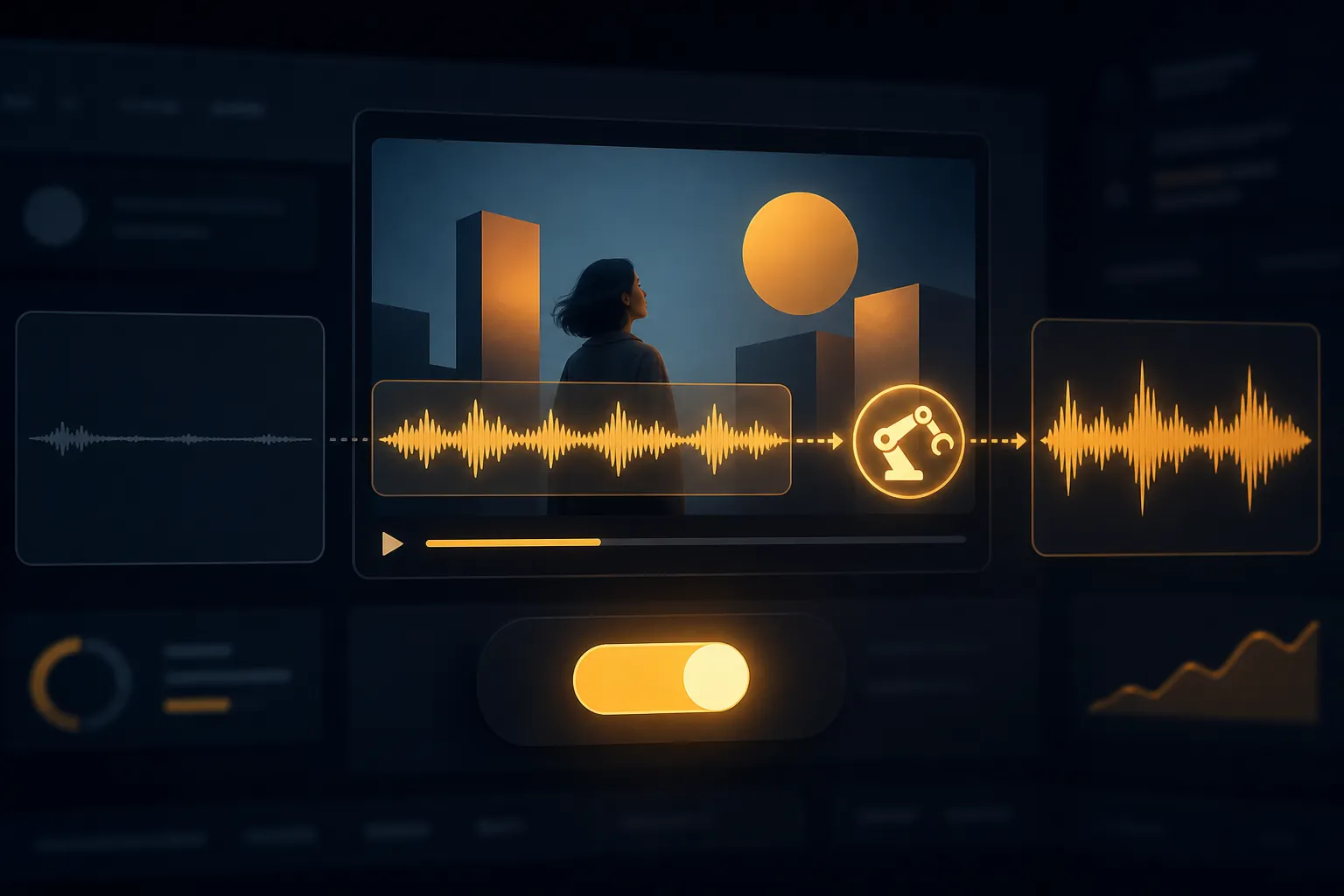
That makes this a platform-change record before it is a creative-trend story. The setting changed. The lift claims circulating around the change are not audited performance evidence. Google’s cited 12% figure is older, from February 2024, and refers to campaigns with at least one video asset, not to AI narration improving results.[3][4]
For anyone responsible for spend, approvals, and the post-launch explanation, the question is not whether synthetic voice can be useful. It can be. Silent PMax assets often exist because no one budgeted for voice-over in the first place. The question is whether this particular default should stay on in a given account before the account owner can separate narrated impressions from silent ones.
What changed on March 20
The rollout applied to Performance Max campaigns where video enhancement control was already enabled. Google’s system can generate a voice-over for eligible video ads, using the advertiser’s own text assets, and attach that narration as a new video asset rather than destructively replacing the original file.[1][3]
| Operational item | What the record supports |
|---|---|
| Announcement window | Around March 9–10, 2026, via Arpan Banerjee’s LinkedIn post and advertiser email coverage.[1][2][3] |
| Default-on date | March 20, 2026, for accounts with video enhancement control enabled.[1][3] |
| Assets affected | Videos without an existing voice track; the system does not rewrite ad copy for narration.[1][3] |
| Text source | Advertiser-supplied headlines and descriptions.[1][3] |
| Asset handling | A new, non-destructive narrated video asset is saved beside the untouched original.[1][3] |
| Advertiser control | Opt out through campaign-level video enhancement control; bulk handling is available through Google Ads Editor 2.7 and the API field Campaign.auto_generated_video_voice_over.[1][3] |
| Propagation | Changes may take 24–48 hours to propagate.[3] |
| Reporting | No dedicated AI-voice versus silent performance column at launch; a dedicated column is described as coming later in 2026.[4] |
The default matters because “video enhancement” no longer just describes visual assembly or format help. In these accounts, it can also mean that the platform adds a spoken layer to a brand asset unless the campaign-level control is turned off.
The asset pipeline is narrower than the sales pitch
The system is not supposed to invent a new script. It uses existing advertiser-supplied headlines and descriptions, generates narration from that text, and applies it only where the source video does not already contain a voice track.[1][3]
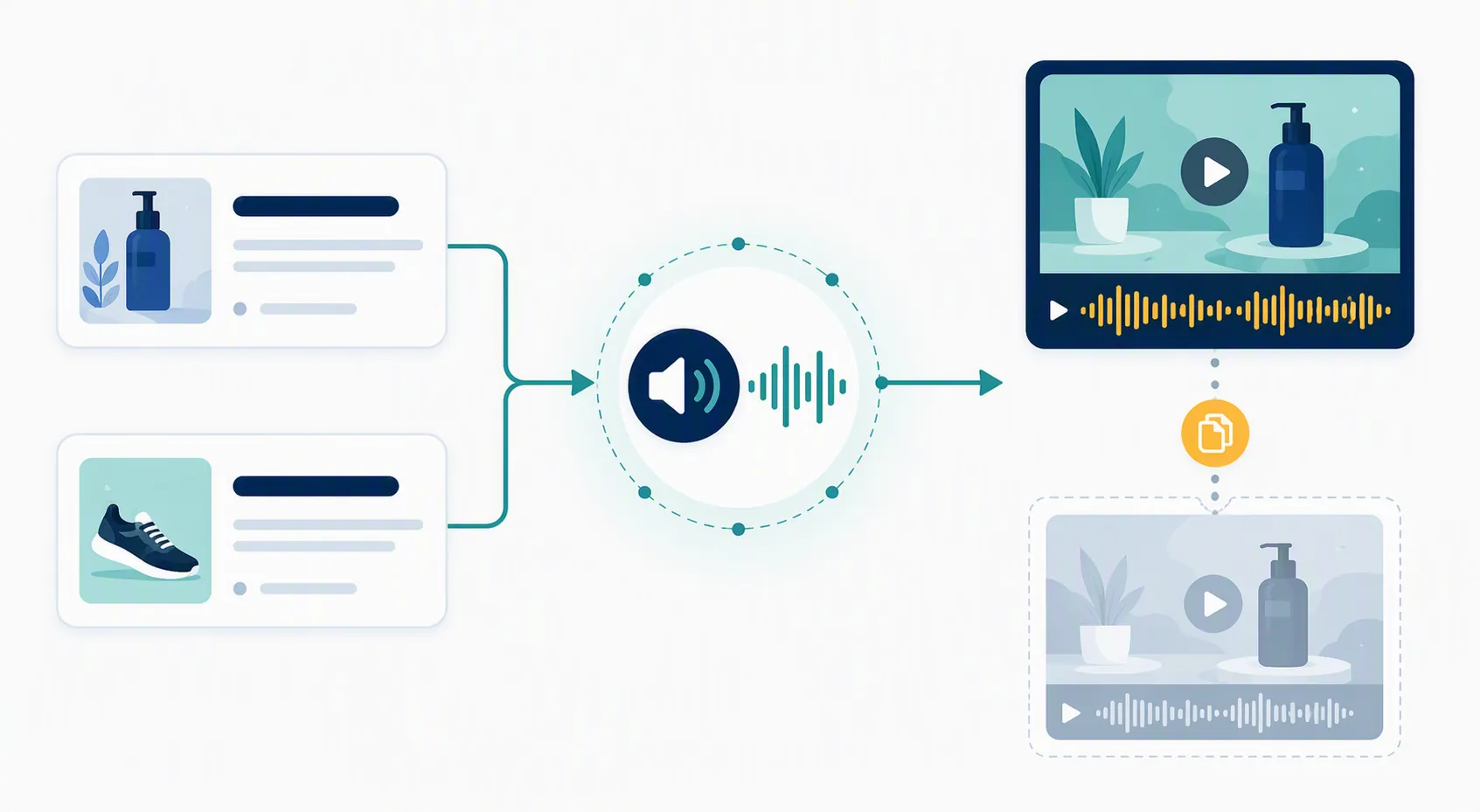
That distinction should change the review process. A buyer is not only checking whether an AI voice sounds natural. They are checking whether display-written copy still works when spoken. A phrase that scans well in a headline can sound clipped, overclaimed, or legally incomplete when delivered as audio over a video.
The non-destructive asset handling is helpful. It means the original silent file remains available, and the narrated version can be reviewed as a separate generated asset. It does not solve the harder measurement issue: if both versions run inside PMax and the reporting does not isolate voiced from silent delivery, the buyer still has to infer the effect from account-level movement.
The performance numbers need labels before they influence budget
Several numbers have circulated around the rollout: 10–20% view-through lift, 3–7% CTR improvement, a claim that 40% of PMax videos lack audio, and references to 200-plus voice variants. In the available material, those are agency-published or practitioner-circulated claims without a published methodology that would let a buyer inspect sample size, vertical mix, control design, spend weighting, or attribution handling.[3][4]
They may be directionally interesting. They are not enough to approve incremental spend or defend a brand change. A claimed view-through lift can come from many things: audience mix, inventory mix, creative freshness, different source videos, campaign learning, seasonality, or the fact that video with any audio may be treated differently by users. Without the method, the number cannot be cleanly assigned to AI narration.
The 12% figure deserves extra caution because it sounds more official and is easy to repeat badly. The cited Google number dates to February 2024 and describes an average conversion uplift for campaigns that had at least one video asset. It is a video-presence finding, not a test of AI voice-over, and not evidence that narration added in March 2026 raises conversions.[3][4]
This is the same evidence problem that shows up across AI creative rollouts: adoption data, preference data, creative novelty, and performance lift often get compressed into one optimistic sentence. The useful habit is to keep the labels visible. Our AI creative backlash record treats consumer and executive reactions as test inputs, not as proof that a specific ad unit will perform. The same discipline applies here.
The reporting gap is the real product limitation
At launch, the account owner cannot pull a clean Google Ads report that says narrated generated videos produced one result and silent versions produced another. Digital Applied describes a dedicated reporting column as expected later in 2026, but that does not help the buyer who needs to decide now whether the default should remain on.[4]
That absence changes the standard of proof. If Google later exposes asset-level or narration-specific reporting, the test can become cleaner. Until then, platform-level performance after March 20 is not automatically voice-over performance. It is performance after a bundle of possible changes: new assets, different creative eligibility, learning effects, auction variation, budget shifts, and whatever else happened in the account during the same window.
This is why the most useful response is not a blanket opt-out or a blanket acceptance. It is an account-level measurement design that is honest about what it cannot see.
A before-and-after test that works without a voice column
The cleanest available test is a controlled before-and-after read around the AI voice-over activation. It is not as good as a randomized split. It is better than accepting an agency benchmark or a platform-adjacent lift claim as if it were your own campaign result.

| Test component | How to handle it |
|---|---|
| Boundary | Use the actual account change date, not the announcement date. For auto-enabled accounts, March 20, 2026 is the default boundary; if you manually opted out or back in later, use the effective date after propagation. |
| Pre-window | Select a stable period before the change where budgets, conversion actions, feed status, major promotions, and landing pages were not materially altered. |
| Post-window | Use a comparable period after the 24–48 hour propagation window, avoiding days where campaign edits or external promotions would swamp the creative change. |
| Campaign set | Limit the read to PMax campaigns where video enhancement control was enabled and eligible silent videos existed. Do not average in campaigns that could not have received narrated assets. |
| Primary metrics | Use the account’s normal decision metrics: conversion volume, conversion value, CPA, ROAS, spend, impression volume, video engagement, and CTR where relevant. |
| Guardrails | Track complaints, approval issues, disapprovals, lead quality notes, brand review failures, and any unusual customer-service comments about ad audio. |
| Decision | Keep the feature on only if the post-change movement is acceptable against the account’s own baseline and the generated assets pass review. Opt out where the read is negative, ambiguous under high risk, or impossible to isolate. |
The campaign set is where most bad reads start. If only a subset of campaigns had video enhancement enabled, and only some of those had silent videos eligible for narration, then an all-account before-and-after average will dilute the effect. It may also hide a problem in the one campaign where generated narration actually took delivery.
The second common failure is editing too much during the test. If budget, audience signals, product feed health, conversion goals, and creative assets all change in the same week, the result becomes a diary of account activity rather than a read on narration. In a live account, perfect isolation is rare. The standard should be whether the change is isolated enough to make a spend decision without pretending the data is cleaner than it is.
What to pull before touching the setting
- Campaigns with video enhancement control enabled.
- Silent video assets that could be eligible for generated narration.
- Current generated video assets and their approval status.
- The exact date and time the opt-out or opt-in was changed, if changed manually.
- Budget, bid strategy, conversion action, feed, and landing-page changes in the same window.
- Asset-level review notes from brand, legal, or compliance reviewers.
For agencies managing many accounts, the first pass can be triage rather than analysis. Regulated accounts, premium brand accounts, multilingual accounts, and campaigns using short display-style headlines as their main text assets deserve review before the feature is left running. Lower-risk lead-gen or ecommerce accounts with historically silent assets may be better candidates for a measured test.
Where to opt out, and what that does not prove
Advertisers can opt out at the campaign level through the video enhancement control. Bulk management is available in Google Ads Editor 2.7, and API users can work with the Campaign.auto_generated_video_voice_over field. PPC Land’s coverage notes that changes may take 24–48 hours to propagate.[1][3]
Opting out is a control action, not a conclusion. If an account opts out immediately because the brand cannot approve synthetic narration, that is a valid operating decision. It does not show that AI voice-over would have hurt performance. If an account leaves the feature on and performance rises, that is also not proof that narration caused the rise unless the surrounding conditions were controlled well enough to support that read.
The useful record is the decision log: when the setting changed, which campaigns were affected, which assets were eligible, what reviewers saw, and what performance looked like before and after. The point is to avoid a month-later meeting where everyone is trying to reconstruct whether a strange-sounding video was a deliberate creative choice or a platform default.
Creative risks to review before the test gets expensive
The launch risks are practical, not theatrical. The available practitioner coverage flags several watchpoints: no advertiser control over voice selection, the possibility of similar-sounding voices across competing advertisers, display copy sounding awkward when spoken, regulated-industry disclaimer delivery, and uneven multi-language quality.[3]
Voice selection matters because audio creates identity faster than text. If two competitors in a category receive a similar synthetic narrator, neither brand has done anything wrong, but the ads can start to feel interchangeable. That is a creative differentiation issue before it is a philosophical AI issue.
The copy issue is more immediate. PMax headlines and descriptions are often written to survive combinations, truncation, and visual placement. Spoken aloud, the same lines may lose context. A price claim, a product qualifier, or a soft disclaimer that felt acceptable on-screen can become too abrupt or too vague in narration.
Premium accounts should be slower here. The question is not whether an AI voice can sound polished in a demo; it is whether the generated asset fits the brand’s normal approval threshold. The tension between AI production efficiency and premium brand tone is already visible in creative work such as the La Roche-Posay and Pond’s Naravit campaign record, where the relevant question is not whether AI was used, but whether the finished asset can carry the brand.
Quality reaction is also measurable. If users complain, comment, skip, or mock the voice, that belongs in the test record. The Tyga AI backlash record is a useful reminder that “AI backlash” is not just a vibe; it can become a distribution, approval, and reputation variable.
Google is not alone in moving synthetic media closer to the buying interface. TikTok’s Symphony AI avatar ad setup shows the same broader platform direction: creative generation is becoming native to media tools, which means buyers need review and measurement habits that fit platform-native AI, not one-off production experiments.
The defensible answer is account-specific
For some accounts, default AI narration may be useful. Silent video assets that were never going to receive a studio voice-over may become more complete ads, and the non-destructive asset flow gives reviewers something concrete to inspect. That upside is real enough to test.
The evidence does not support treating the circulating lift numbers as proof. The strongest platform-adjacent number being repeated is about video presence in 2024, not AI narration in 2026. The newer lift ranges lack published methodology. The reporting split that would make the feature easier to judge is not available at launch.
So the operating rule is restrained: test AI voice-over on the advertiser’s own spend where the brand and compliance risk is acceptable, keep a clean change log, and opt out where the creative or regulatory downside is too high to wait for a later reporting column.
References
- Google Ads adds AI voice-over to Performance Max video ads, Search Engine Land
- Google AI Voice Models Coming To Google Ads PMax Videos, Search Engine Roundtable
- Google's AI voice-over is coming to your Performance Max videos - opt out by March 20, PPC Land
- Google Ads AI Voice-Over: Performance Max Video Guide, Digital Applied
This is a record of what happened and what was tested, not legal advice. Compliance determinations require qualified counsel.