
Will NVIDIA chip export restrictions raise ad platform costs?
A dated log of NVIDIA's AI chip export restrictions (April 2025–August 2026), read through the question media buyers actually ask: when does this change what I pay for ads on Meta, Google, and TikTok? The transmission chain is indirect — DRAM prices, AI server price hikes, hyperscaler capex — and the dated math puts any material effect on 2027 auctions, not 2026, with the chain still unconfirmed by any platform.
- Platform
- Meta, Google0 TikTok
- Change category
- policy
- Effective date
- 0-01-01
- Change type
- policy shift
- Impact level
- Low
Short answer for 2026 planning: NVIDIA AI chip sales restrictions do not directly change what you pay in Meta, Google, or TikTok auctions. Through August 2026, there is no platform-attributed pass-through from export controls to advertiser pricing. The chain that could matter runs through memory, AI server pricing, and hyperscaler capex, and the dated evidence points more toward a 2027 watch item than a reason to rewrite Q4 2026 budgets.
That distinction matters because “ad costs are up” can mean several different things. Meta can report a higher average price per ad. An agency can publish higher CPM benchmarks. A finance team can ask for a Q4 reserve. None of those, by itself, proves that export controls on NVIDIA chips have moved auction clearing prices.
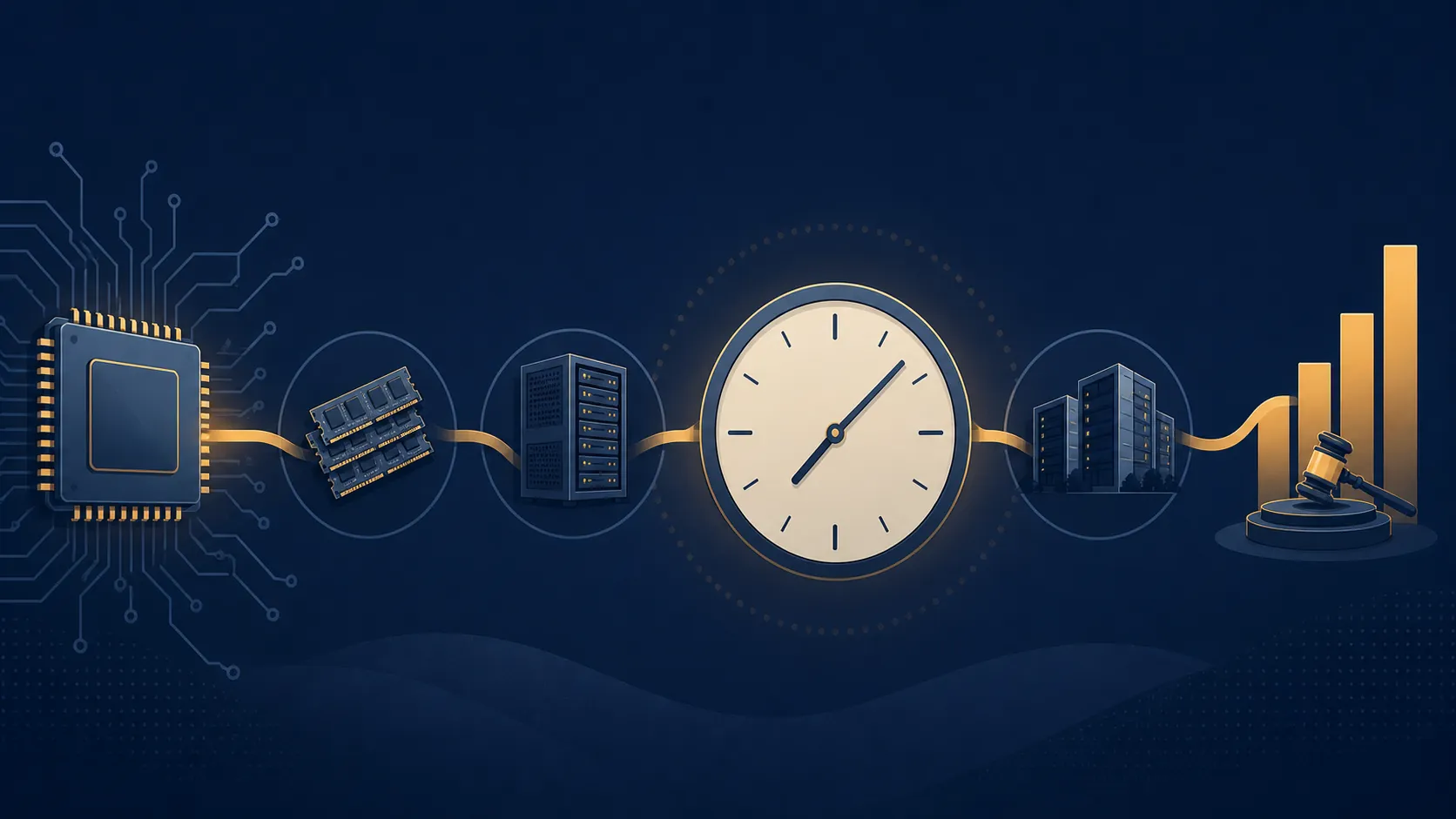
The dated tracker: what changed, and whether it changes ad buying yet
| Date | Export-control event | Infrastructure link it could touch | Ad-buying read |
|---|---|---|---|
| April 2025 | The U.S. required licenses for NVIDIA H20 exports to China. NVIDIA said it would take a $5.5 billion charge tied to H20 inventory and commitments; AMD flagged about $800 million of exposure. [1] | Immediate chip-vendor revenue and inventory disruption, not an ad-platform cost line. | No direct bid or budget change. This is the first policy shock in the chain, not evidence of auction repricing. |
| December 2025 | CNBC reported approval for H200 sales to China with a 25% U.S. cut attached to the arrangement. [2] | Potentially changes vendor economics and allocation incentives for high-end AI accelerators. | Still not an ad-price signal. It matters only if it later changes server availability or hyperscaler costs. |
| January 2026 | The Bureau of Industry and Security revised license-review policy for advanced semiconductors exported to China, including case-by-case review for H200 and AMD MI325X exports. [3] | Regulatory uncertainty around which systems can ship, where, and under what license. | Watch for procurement delays and price adjustments upstream. Do not treat it as a live CPM input. |
| February 2026 | NVIDIA reported zero China data-center chip revenue for the quarter, and CFO Colette Kress said, “We do not know whether any imports will be allowed into China.” [2] | Confirms the export channel was commercially material to NVIDIA, but not that ad platforms were paying more for compute. | Useful for risk logs; not enough to alter paid-media bids. |
| May–June 2026 | BIS said the AI chip shipment ban also applied to Chinese firms operating outside China, closing a foreign-entity route. [4] | Could tighten effective demand pressure outside the original China boundary. | Raises the need to watch AI server and memory pricing, not to pre-raise Q4 auction assumptions. |
| August 2026 | Reports described NVIDIA warning major customers of more than 15% price hikes on AI servers shipping early next year, including Vera Rubin and Grace Blackwell systems. [5][6] | This is the clearest reported bridge from chip and component pressure into server pricing. | Now relevant to 2027 cost assumptions. Still not a measured ad-platform pass-through. |
The tracker does not say “nothing matters.” It says the timing and the layer matter. April 2025 is a chip-vendor charge. January 2026 is a licensing rule. February 2026 is China revenue and access uncertainty. August 2026 is where the ad-cost question becomes more practical, because reported server price hikes would land on systems shipping early in 2027 rather than on ads being bought in Q4 2026.
The transmission chain is indirect, and each link has to be kept separate
A clean pass-through claim would need a platform saying something like: export restrictions raised our infrastructure cost, so advertiser prices increased. No major ad platform has said that. The usable chain is narrower: export restrictions and AI demand can contribute to constrained component and server supply; those costs can show up in hyperscaler capex; platforms may then absorb, offset, or eventually price around higher infrastructure costs. That last step remains inference.
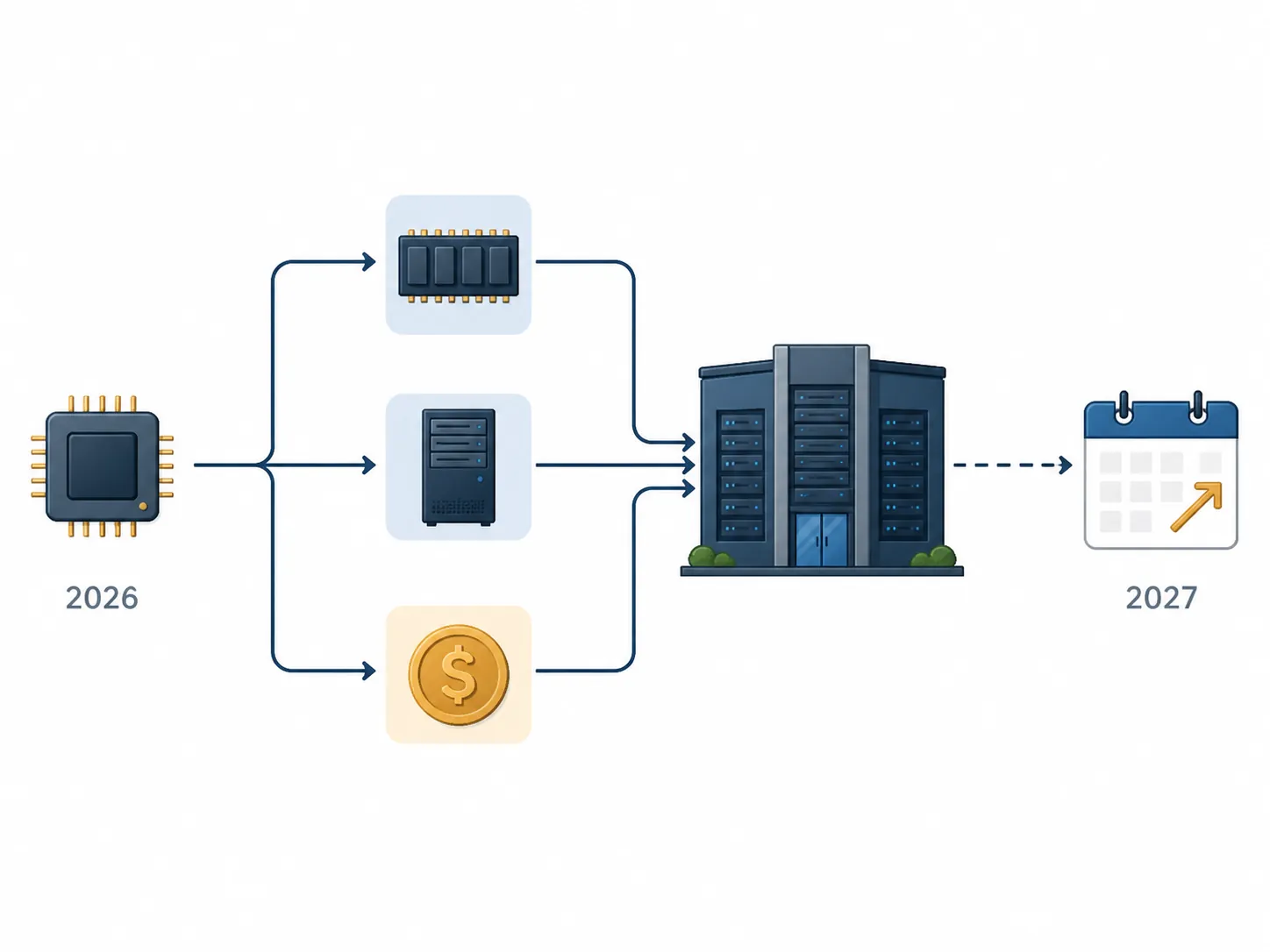
Memory: a measurable upstream pressure, not an auction price
The memory link is the first place where the numbers look less theoretical. Tom’s Hardware, citing Bloomberg, reported DRAM contract prices rising 90% to 95% quarter over quarter in Q1 2026, with another 58% to 63% quarter-over-quarter increase projected for Q2 2026. The same report tied the pressure to AI server demand and NVIDIA warning large customers about AI server price increases. [5]
That is a real cost signal, but it is not an ad-market signal. DRAM contract inflation tells a buyer that AI infrastructure is getting more expensive to build. It does not tell the buyer whether Meta’s delivery system, Google’s auction, or TikTok’s pricing has repriced because of that cost.
Servers: the early-2027 shipping window is the practical date
The server-pricing link is more directly relevant to ad platforms because hyperscalers buy systems, not isolated policy headlines. Fortune reported that NVIDIA customers were being warned of more than 15% AI-related price hikes on systems shipping early the next year, including Vera Rubin and Grace Blackwell chips. [6]
For a media plan, “shipping early next year” is the key phrase. If a platform is placing orders in 2026 and receiving more expensive systems in early 2027, that does not give a clean mechanical reason to raise bids in Q4 2026. It gives a reason to ask whether 2027 infrastructure cost pressure could become harder for platforms to absorb.
Capex: hyperscalers can absorb costs before advertisers ever see them
The capex layer is where upstream pressure can become visible without yet touching ad pricing. Meta’s Q2 2026 numbers show the scale of the absorption problem: capital expenditures were $31.1 billion, nearly 98% of $31.86 billion in operating cash flow, while free cash flow was $784 million, down 91% year over year. [7]
That does not mean Meta raised ad prices because of NVIDIA export controls. It means Meta is spending heavily enough on infrastructure that component and server inflation deserves a place in the 2027 monitoring file. Alphabet’s 2026 capex raise belongs in the same category: relevant to cost absorption, not proof of auction pass-through.
This is the same discipline used in adjacent ad-cost audits: an upstream compute shock can be real and still be only “indirect, lagged, and partially offset” for advertisers. Readers who want the broader mechanism map can compare this tracker with the prior AI infrastructure cost audit and the earlier NVIDIA earnings-to-ad-cost tracker.
What the ad-market layer actually shows in 2026
The observable ad-market signals are mixed with many causes: demand, inventory, targeting quality, automation, measurement, creative saturation, seasonality, and macro budgets. They are worth watching precisely because they are close to buyers. They are not clean evidence that chip export policy has reached auctions.
Meta’s Q2 2026 results show strong ad-market pricing and volume at the same time. Ad revenue was $59.4 billion, up 27% year over year. Ad impressions rose 14%, and average price per ad rose 12%. [7]
Those are platform-reported figures. They show that Meta’s ad system was able to generate materially more revenue per ad while serving more impressions. They do not attribute the 12% average price-per-ad increase to AI server costs, DRAM inflation, or export restrictions.
Third-party CPM benchmarks are also up. Threadpoint published a 2026 Meta CPM discussion citing its portfolio up 13% year over year and a Ryze benchmark up 20%. [8]
Those numbers are useful as market-color checks, not as causal attribution. They are agency-published third-party figures, not platform explanations and not this site’s own benchmark set. A buyer can use them to sanity-check whether an account’s CPM inflation is unusual, but they should not be filed as “NVIDIA export controls raised Meta CPMs.”
| Signal | What it measures | What it does not prove |
|---|---|---|
| Meta average price per ad +12% YoY in Q2 2026 [7] | Platform-reported average price per ad across Meta’s ad business. | It does not identify chip policy, memory prices, or server costs as the cause. |
| Meta ad impressions +14% YoY in Q2 2026 [7] | More served ad impressions, alongside higher reported price per ad. | It does not show infrastructure scarcity limiting ad supply. |
| Threadpoint portfolio CPM +13% YoY and Ryze benchmark +20% [8] | Agency-published CPM context for Meta advertisers. | It does not isolate export controls from demand, targeting, creative, placement mix, or seasonality. |
| Meta capex $31.1B and free cash flow $784M in Q2 2026 [7] | The scale of infrastructure spending and cash absorption. | It does not show advertisers were charged more because of that spending. |
If an account’s CPMs are up in 2026, the first diagnostic should still be auction competition, audience overlap, creative fatigue, campaign structure, bid strategy, placement mix, and measurement quality. Chip restrictions sit too far upstream to outrank those account-level checks.
Why the timing points to 2027, not Q4 2026
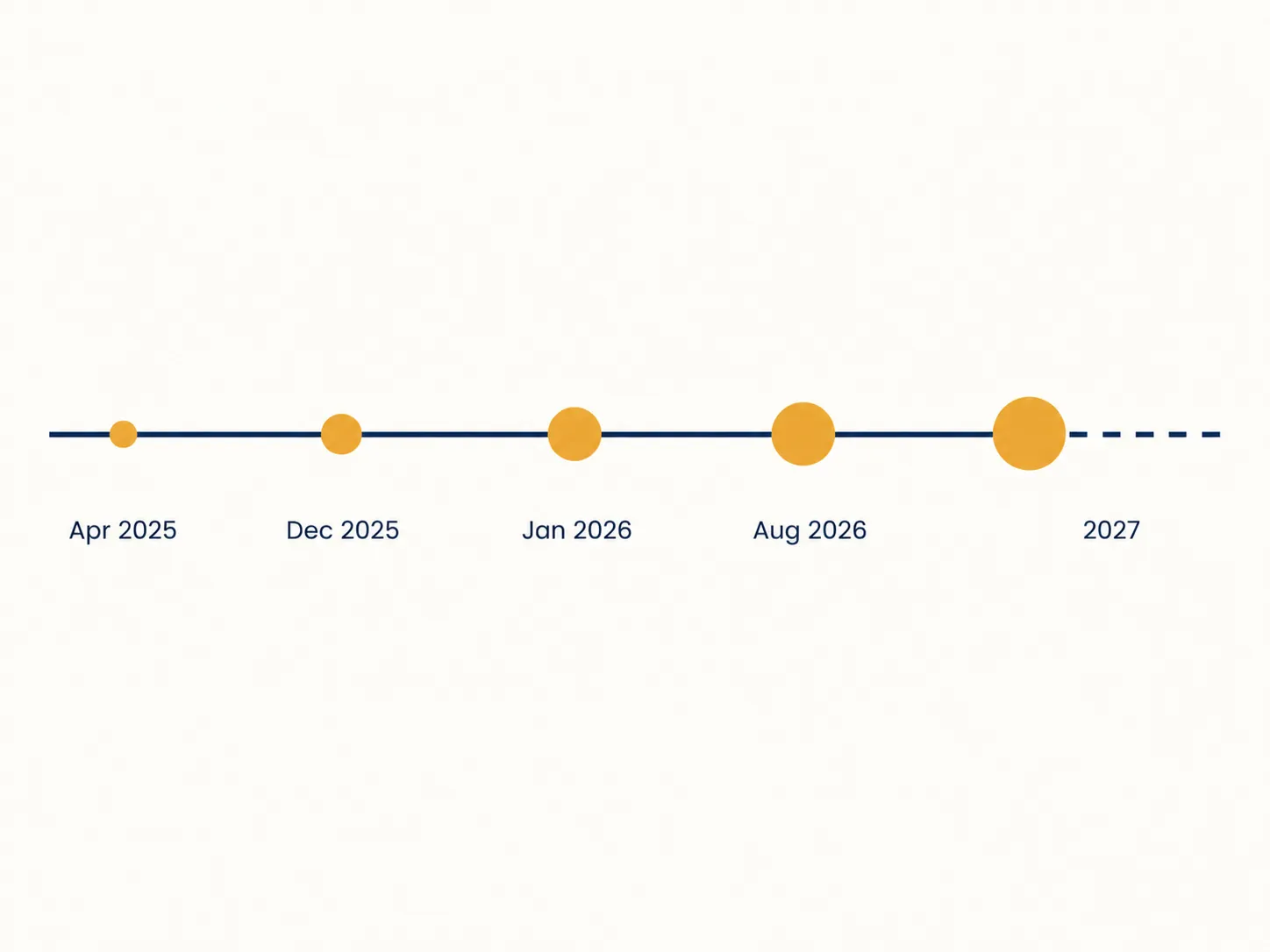
The timing problem is straightforward. The regulatory shocks began in 2025 and tightened through 2026. Memory prices were already moving sharply in early 2026. The clearest reported AI server price hikes are tied to systems shipping early the next year. That sequence is more consistent with 2027 cost pressure than with a Q4 2026 auction repricing event.
The memory shortage backdrop also argues against treating this as a one-quarter ad-buying event. IEEE Spectrum reported a forward-looking memory-shortage timeline that included Intel’s view that there would be “no relief until 2028” and discussed fab timing constraints. [9]
For planning, that creates two different decisions. Q4 2026 budgets should not be automatically marked up because of NVIDIA export-control headlines. 2027 models should carry an infrastructure-cost watch item, especially for platforms whose AI ranking, creative, measurement, and automation systems require growing data-center investment.
How to use this in a budget conversation
The most defensible answer to a CFO is not “ignore chips.” It is: the restriction story is upstream, delayed, and not yet tied by any platform to advertiser pricing. The costs to watch are DRAM, AI server systems, and hyperscaler capex. The ad-market checks are Meta’s reported average price per ad, agency CPM benchmarks, and any platform guidance that explicitly links infrastructure costs to pricing. That explicit link is still missing.
- Do not raise bids solely because an NVIDIA export-control headline crosses the desk.
- Do separate platform-reported ad-price movement from agency CPM benchmarks and from account-level CPM changes.
- Do keep 2027 assumptions flexible if server and memory inflation keeps flowing into hyperscaler capex.
- Do ask for platform attribution before treating infrastructure cost pressure as advertiser pass-through.
There are useful parallels in other upstream-risk trackers, including the CoreWeave debt watchlist and the data-center regulation tracker. In both cases, the useful standard is the same: identify the upstream pressure, date it, then stop short of claiming a platform pass-through unless the platform says so or the data isolates it.
The working verdict through August 2026
For 2026 paid-media planning, export restrictions are not a standalone reason to lift bids or rewrite Q4 budgets. For 2027, they belong on the cost-pressure watchlist because reported server and memory costs are moving into the infrastructure layer that supports ad delivery, optimization, and measurement. No Meta, Google, or TikTok statement has tied advertiser pricing to NVIDIA export policy, so the record remains a dated synthesis of a plausible chain, not a confirmed pass-through claim.
References
- US tightens controls on AI chip exports by Nvidia, AMD, AP News
- Nvidia says China chip sales fell to zero in latest quarter due to export controls, CNBC, February 26, 2026
- Department of Commerce Revises License Review Policy for Semiconductors Exported to China, Bureau of Industry and Security
- US says ban on AI chip shipments applies to Chinese firms outside China, Al Jazeera, June 1, 2026
- Nvidia reportedly warns biggest customers of 15 percent price hikes on AI servers, Tom’s Hardware
- Nvidia customers face AI-related price hikes of more than 15% for Vera Rubin and Grace Blackwell chips, Fortune, August 22, 2026
- Meta Q2 2026 Earnings: Ad Strength, Capex Selloff, Digital Applied
- Why Are My Meta CPMs So High in 2026 and What to Actually Do About It, Threadpoint
- The DRAM Shortage Is Coming for AI, IEEE Spectrum
Primary source: https://www.bis.gov/press-release/department-commerce-revises-license-review-policy-for-semiconductors-exported-to-china