
Is AI Really Driving Up Digital Ad Costs?
Media buyers are told AI is inflating digital ad costs, but 'AI-driven inflation' is really four separate mechanisms that push prices in different directions. This audit scores each mechanism against dated, sourced data — including the macro inflation context — so you can tell which driver actually explains rising CPCs, CPMs, and CPAs in your own accounts.
- Platform
- Google Ads
- Bid strategy
- AI Max, Maximize Conversions0 Smart Bidding
- Difficulty
- Intermediate
- Last reviewed
- 0-08-26
Grounded in benchmark case file: Alphabet Q2 earnings AI Max and cost increases
When CPCs, CPMs, or CPAs move against you, “AI is driving inflation” is too blunt to be useful. It does not tell you whether to raise the budget, tighten the target, split a campaign, exclude expanded queries, challenge an AI Max recommendation, or leave the machine alone because demand simply got more expensive this week.
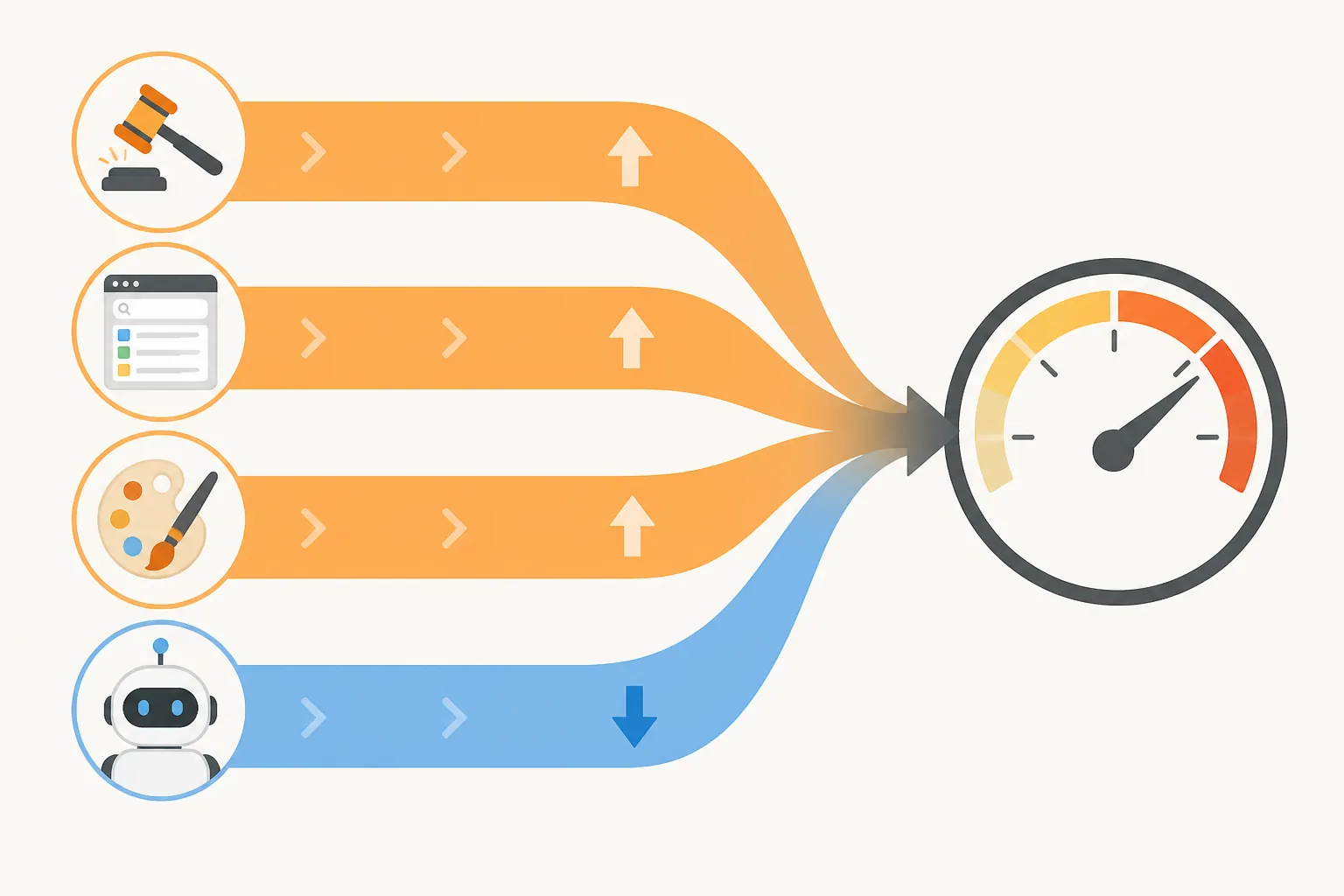
The cleaner answer is less dramatic: AI is part of the digital ad cost story, but not as one force. In paid media accounts, the phrase usually mixes four different mechanisms. AI bidding can intensify auction competition. AI Overviews can compress click supply on some Google queries. AI creative can lower the cost of entering auctions, though the evidence is thinner. Agentic buying can move the other way by reducing auction participation and price discovery. Those mechanisms do not all push CPCs and CPMs in the same direction.

That distinction matters because the buyer’s next move depends on the mechanism. A 15% CPC increase after AI Max expansion is a different operating problem from a flat CPC paired with a paid CTR collapse on AI Overview queries. A higher CPA caused by broader query matching is not the same as a higher CPM caused by more bidders entering a display auction. If the diagnosis stops at “AI,” the account gets managed with a headline instead of evidence.
The first problem: there is no single believable CPC number
Before blaming AI, the measurement problem has to be faced directly. Search Engine Land’s May 2026 review of Google Ads CPC inflation is useful precisely because it does not pretend the market has one clean benchmark. Alphabet 10-K data for 2019 through 2024 implied only 2.33% average annual CPC growth, while paid-click volume grew about 14.5% per year. WordStream/LocaliQ benchmarks implied roughly 4% CAGR, with 12 of 23 industries above the 4.24% average U.S. CPI rate. One agency’s owned search-term data, however, showed 11.75% average CAGR across seven long-running accounts [1].
That is not a rounding error. It is a roughly fivefold spread among sources that can each be defended for a different purpose. Alphabet’s blended disclosure is broad and platform-level. Industry benchmark datasets are closer to advertisers but still normalize across verticals, account maturity, and mix shifts. Owned long-run search-term data is closer to the auction experience a buyer feels, but narrower. The disagreement is the signal: a published CPC benchmark can set context, but it cannot diagnose an account.
Even the same benchmark ecosystem can produce awkward comparisons. The same Search Engine Land write-up cites 2025 Google Ads CPC figures that do not resolve neatly into one number, including $5.42 and $5.26 depending on the benchmark cut [1]. If a budget owner wants to know why their own nonbrand search CPC rose, the right answer is not to pick whichever outside number makes the story sound cleanest. The right answer is to check what changed in that account, on dated campaigns, against auction and query evidence.
Macro inflation is the backdrop, not the mechanism
The broad media market is not giving buyers a simple inflation story either. ECI Media Management’s 2026 inflation outlook forecasts global media inflation easing to 3.1% in 2026 from 3.8% in 2025 [2]. In the U.S., IAB’s 2026 Outlook forecasts total ad spend growth of 9.5%, with digital growing at double-digit rates [3]. eMarketer’s 2026 U.S. AI advertising forecast belongs in that same context layer: AI is increasingly embedded in advertising workflows and inventory, but that does not by itself identify the cause of a higher CPC in a search account [4].
So the macro read is mixed: ad spend can grow while media inflation decelerates; digital budgets can expand while one advertiser’s marginal clicks get more expensive. For the CPI-to-budget channel, the better question is timing — which costs hit media plans immediately, which show up through consumer demand, and which move through finance pressure later. That broader channel is separate from AI-era auction mechanics, and it is covered more directly in how CPI reports affect ad budgets.
The same discipline applies to the AI infrastructure story. Data-center power demand and chip-market narratives may eventually affect platform cost bases, pricing incentives, or corporate margin pressure, but they are indirect and lagged compared with the auction-level signals a buyer can inspect this week. Those rival explanations belong in trackers such as AI data-center power and ad costs and Nvidia earnings and AI ad costs, not as the first explanation for a campaign-level CPC move.
| Mechanism | Likely price direction | What the evidence can support | What to verify in-account |
|---|---|---|---|
| AI bidding competition | Upward pressure on CPC/CPA when more advertisers enter or bids broaden | Strongest near-term evidence in this source set, especially from buyer-reported 2026 search cost increases and auction participation estimates | AI Max or PMax changes, Smart Bidding strategy changes, auction insights, query expansion, match-type drift, target changes |
| AI Overview inventory compression | Upward pressure on effective click costs or CPA when CTR falls, even if CPC itself is flat | Strong evidence of paid CTR decline on AIO-affected informational and educational queries; weaker evidence for direct CPC causation | AIO-exposed queries, paid CTR, impressions, click volume, CPC, CVR, CPA by query type |
| AI creative lowering entry barriers | Potential upward pressure through more participants and more ads | Weakest mechanism in this source set; supported mainly by participation evidence and agency commentary, not a dedicated dated dataset | New entrant pressure, creative volume, auction overlap, CPM movement by placement and audience |
| Agentic buying | Possible downward pressure on CPMs when agents enter fewer auctions or withhold bids | Early and secondhand evidence; useful for price-discovery discussion, not an efficiency verdict | Programmatic auction participation, bid density, clearing CPM, win rate, conversion quality by supply path |
Mechanism 1: AI bidding competition is the most account-verifiable inflation path
If a paid-search buyer says AI made costs worse, this is usually the mechanism they are feeling: automated bidding and expanded matching put more advertisers into more auctions, with systems willing to pay up when they predict conversion value. The cost increase is not caused by the word “AI” in the interface. It shows up when the machine expands eligible traffic, lifts bids in auctions that used to clear lower, or prioritizes conversion volume over marginal efficiency.
The 2026 buyer-reported evidence is not subtle, though it still needs to be read as reported ranges rather than a universal market number. Digiday reported on May 6, 2026, that one year after Google’s AI Max launch, search costs were up as much as 15% year over year for some clients. Mediaplus reported CPCs up 10% to 15%; Collective Measures described 10% as typical and increases up to 25%; Adthena estimated advertiser participation in search auctions was up 35% year over year [5].
Those numbers describe a plausible auction pathway: more participants, broader eligibility, and bidding systems trained to find conversions beyond the old keyword map. They do not prove every AI Max rollout worsens CPA. They do tell buyers where to look when CPCs rise after campaign automation changes. If auction participation rises and your own account expands into more marginal queries, the platform can report more conversion volume while your average cost per acquisition deteriorates.
MRS Digital’s April 2026 critique points at the same operating risk from another angle: Maximize Conversions can prioritize winning conversions over preserving cost efficiency, and the agency described client CPC increases as high as 36% to 40% [6]. That is not a reason to reject automated bidding. It is a reason to stop accepting “needs more room” as a complete explanation after the learning period is over.
The audit here starts with dates. Pull the week before and after any AI Max activation, Performance Max expansion, Smart Bidding target change, broad-match push, or budget uncapping. Then separate the movement into CPC, CTR, CVR, CPA, impression share, and query mix. A higher CPC with stable conversion rate is a different problem from a flat CPC with worse CVR caused by query expansion. A higher CPA with more total conversions may be acceptable if the marginal conversions meet value targets. A higher CPA with irrelevant search terms is just expensive reach.
This is also where account-level lift testing matters more than another benchmark screenshot. The sibling analysis on Alphabet Q2 earnings, AI Max, and reported cost increases goes deeper on the AI Max timeline and an in-account test protocol. The short version for this audit: do not judge AI bidding by platform-reported conversions alone. Judge it by incremental conversion value, query quality, and whether the system’s extra auction reach clears your CPA or ROAS threshold.
What would make the AI-bidding explanation credible?
- A dated automation change: AI Max, Performance Max, broad match, Maximize Conversions, target CPA/ROAS changes, or budget expansion.
- Auction evidence: higher overlap, lower outranking share, lost impression share from rank, or higher top-of-page cost pressure.
- Query evidence: more spend from new or broader search terms, especially if conversion rate or lead quality falls.
- Unit economics: CPA or ROAS deterioration after controlling for seasonality, landing-page changes, offer changes, and tracking disruptions.
If those items line up, “AI raised costs” becomes a specific claim: AI bidding expanded participation or bid intensity in auctions where the account did not earn enough incremental value. That is actionable. The buyer can narrow query eligibility, reset targets, isolate campaign types, change budget allocation, or require an incrementality read before accepting the next recommendation.
Mechanism 2: AI Overviews can damage click economics without proving CPC inflation
AI Overviews create a different cost problem. The first-order effect is not necessarily a higher auction price. It is fewer clicks from the same search demand, especially on queries where the answer is increasingly satisfied on the results page. That can make paid search less efficient even if CPC does not rise.
Seer Interactive’s September 2025 update is the key study here, and it needs to be handled carefully. In a paid sample of 1.1 million impressions, Seer found that paid CTR on AI Overview-affected queries fell from 19.70% to 6.34%, a 68% decline. For queries without AI Overviews, paid CTR fell from 19.1% to 13.04%, a 32% decline [7].
That is a large CTR gap. It is not, by itself, proof that CPC rose. Seer’s authors explicitly note that CPC “may not have changed” [7]. The study is also retrospective, focused on informational and educational queries, and vulnerable to correlation risk: queries that trigger AI Overviews may already be the kinds of queries where users are less likely to click ads. The measured finding is click-through and efficiency pressure, not direct CPC causation.
Still, a CTR collapse can raise the practical cost of demand capture. If impressions hold, clicks fall, and conversions fall with them, the account may need more impressions, different queries, higher bids, or more budget to produce the same conversion volume. In that case the buyer experiences “higher costs” even if the auction’s average CPC line is flat. The paid search problem has moved from price per click to clicks per eligible search.
This is why AIO exposure should not be mixed into a generic CPC chart. Segment affected query themes, especially upper-funnel informational terms, educational modifiers, and question-style queries. Compare paid CTR, CPC, CVR, CPA, and impression volume before and after AIO visibility. Then keep branded, commercial, and transactional queries separate. AIO compression on “how to” traffic does not automatically explain rising CPC on “near me,” competitor, or high-intent product terms.
The search-interface mechanism is also moving fast enough that dated trackers matter. For related coverage of voice-style and AI-answer search behavior, see voice AI replacing typing in paid ads. For campaign controls that may affect exposure, check internal tracker entries on AI Max launch and beta exit, the ECPC sunset, and the DSA sunset when mapping old query coverage to new automation.
Mechanism 3: AI creative may lower entry barriers, but this is the weakest-evidenced inflation claim here
The creative argument is plausible: generative tools reduce the time and cost required to produce ad variants, landing-page drafts, product imagery, hooks, and test concepts. If more advertisers can launch more ads faster, auction participation can rise. More participation can pressure CPMs and CPCs upward, especially in social, display, retail media, and crowded search categories.
But plausibility is not the same as a dated cost finding. In this source set, there is no dedicated dataset showing that AI creative adoption caused a measured increase in CPC or CPM. The closest support is the broader search participation signal — Adthena’s estimate, reported by Digiday, that advertiser participation in search auctions rose 35% year over year — plus agency commentary that AI-era tools are expanding who can compete and how broadly they can test [5]. That supports a participation hypothesis, not a proven creative-driven inflation mechanism.
A buyer can still check for it. In paid social or programmatic, look for rising CPMs paired with a visible increase in competitor creative volume, faster fatigue, lower thumb-stop or engagement rates, and more frequent creative refreshes across the category. In search, creative alone is harder to isolate because bidding, matching, and landing-page relevance are intertwined. If the only evidence is “everyone is using AI now,” the mechanism is not strong enough to carry a budget argument.
Mechanism 4: agentic buying can push prices down, which breaks the simple inflation story
The counter-story matters because it prevents the easy mistake: assuming every AI layer makes ad inventory more expensive. Agentic buying can reduce auction participation if agents decide many auctions are not worth entering. Fewer bids can mean less price discovery, lower clearing prices, or stranger supply-path dynamics. That is not automatically good for advertisers, but it is clearly not the same as AI bidding inflation.
Relevant Audience, reporting DataBeat figures via PPC Land, said agentic buyers entered 86% fewer auctions and cleared at $6.13 CPM versus $6.95 CPM, a 13.4% lower clearing price [8]. The same report noted that IAB Tech Lab shipped AAMP 2.3 in July 2026 with a pricing-provenance field, a control designed for a world where automated agents may need more explicit transparency around how prices are formed [8].
That evidence comes with a visible source chain — DataBeat to PPC Land to Relevant Audience — and it does not include conversion or outcome data by buyer class. So it cannot support a claim that agentic buying improves efficiency. It can support a narrower point: some AI-mediated buying may thin auctions rather than crowd them, lowering observed clearing CPMs while raising new questions about transparency, supply quality, and whether agents are skipping valuable opportunities.
The academic literature is also not one-directional. A Bocconi IGIER working paper on artificial intelligence, algorithmic bidding, and collusion in online advertising finds Q-learning and neural-network bidders can sustain low bids in simulated settings [9]. Zhao and Berman’s Wharton paper on two-dimensional algorithmic coordination also belongs on the deflationary or coordination-complication side of the discussion rather than as simple evidence of higher ad prices [10]. These are simulations and models, not live account proof. They are useful because they widen the hypothesis space: algorithmic buyers can coordinate in ways that change prices, and the direction is not guaranteed to be up.
Programmatic buyers should therefore audit agentic changes differently from search automation. Look at bid density, win rate, floor-price behavior, supply-path shifts, clearing CPM, viewability, conversion rate, and post-click quality. A lower CPM can still be a worse buy if the agent avoids competitive but valuable inventory. A higher CPM can be acceptable if the agent concentrates spend where outcomes improve. The price line alone is not the verdict.
The account audit to run this week
Do not start with a market benchmark. Start with a dated change log and a metric split. The goal is to identify which mechanism, if any, is active in the account. One account can have more than one: AI Max may be expanding query eligibility while AI Overviews reduce CTR on informational terms, and a separate programmatic test may be clearing at lower CPMs through agentic bidding.
- Chart CPC, CPM, CTR, CVR, CPA, ROAS, spend, impressions, clicks, and conversion volume by week. Mark every platform or bidding change on the timeline.
- Separate macro pressure from platform mechanics. Keep CPI, category demand, seasonality, promotion changes, and media-inflation context in one layer; keep auction participation, query mix, and automation changes in another.
- For search, isolate AI Max, Performance Max, Smart Bidding, broad match, and Maximize Conversions changes. Compare pre/post query mix, match-type distribution, auction insights, impression share lost to rank, and top-of-page cost movement.
- For AI Overview exposure, segment informational and educational queries from commercial and branded terms. Read CTR, CPC, click volume, CVR, and CPA together so a click-supply problem is not mislabeled as a CPC problem.
- For creative-entry pressure, look for more competitor participation, faster fatigue, rising CPMs, and declining engagement quality. Treat this as a hypothesis unless the account data shows a participation change.
- For agentic or programmatic buying, compare auction participation, bid density, clearing CPM, win rate, supply path, viewability, and conversion quality before judging lower or higher prices as good or bad.
- Check platform roadmap effects against dated tracker entries, including AAMP 2.3 controls, ECPC changes, AI Max migration windows, and DSA coverage changes, so a structural product shift is not mistaken for ordinary volatility.
If the account shows higher CPCs after AI bidding expansion, more auction overlap, broader query reach, and weaker marginal CPA, AI bidding is a credible cost driver. If CPC is flat but paid CTR drops sharply on AIO-exposed informational queries, the problem is inventory compression and click yield. If CPMs rise alongside a surge in new creative competitors, creative-driven entry may be part of the story, but the evidence standard should stay higher. If agentic buying enters fewer auctions and clears lower CPMs, the AI effect may be deflationary on price while still uncertain on outcomes.
That is the practical answer for buyers weighing AI’s impact on digital ad costs. AI can raise costs, but only through identifiable mechanisms that show up in the account data. Without that mechanism-level evidence, “AI-driven inflation” is just a headline pasted over four different market behaviors.
References
- CPC inflation: How fast are Google Ads costs rising? — Search Engine Land
- Inflation Report 2026 — ECI Media Management
- Outlook Study Forecasts 9.5% Growth in U.S. Ad Spend — IAB
- US AI Advertising Forecast 2026 — eMarketer
- CPC pain is real: One year on, Google's AI Max has pushed up search budgets – and costs — Digiday, May 6 2026
- Cost Per Click Inflation and AI — MRS Digital, Apr 23 2026
- AIO Impact on Google CTR September 2025 Update — Seer Interactive, September 2025
- AI ad buying agents enter 86% fewer auctions but get lower CPMs — Relevant Audience, Aug 17 2026
- Artificial Intelligence, Algorithmic Bidding, and Collusion in Online Advertising — Bocconi IGIER
- Two-Dimensional Algorithmic Coordination — arXiv