
Trump's AI data center regulations are raising ad costs
This article traces the link between Trump-era AI data center regulatory actions and rising ad costs, showing how executive orders, the Ratepayer Protection Pledge, and FERC interconnection rules are flowing through to platform infrastructure expenses and ultimately to CPC, CPM, and CPA increases that media buyers are seeing in their accounts.
- Platform
- Policy
- Change category
- policy
- Effective date
- 0-06-18
- Change type
- policy or regulatory shift
- Impact level
- Medium
The first useful clue is not in Washington. It is in the account: higher CPCs, higher CPMs, and more budget needed to buy the same volume of qualified traffic. In Q3 2026, the practical question is whether Trump-era AI data center regulation is becoming one more input in the prices Google and Meta charge advertisers.
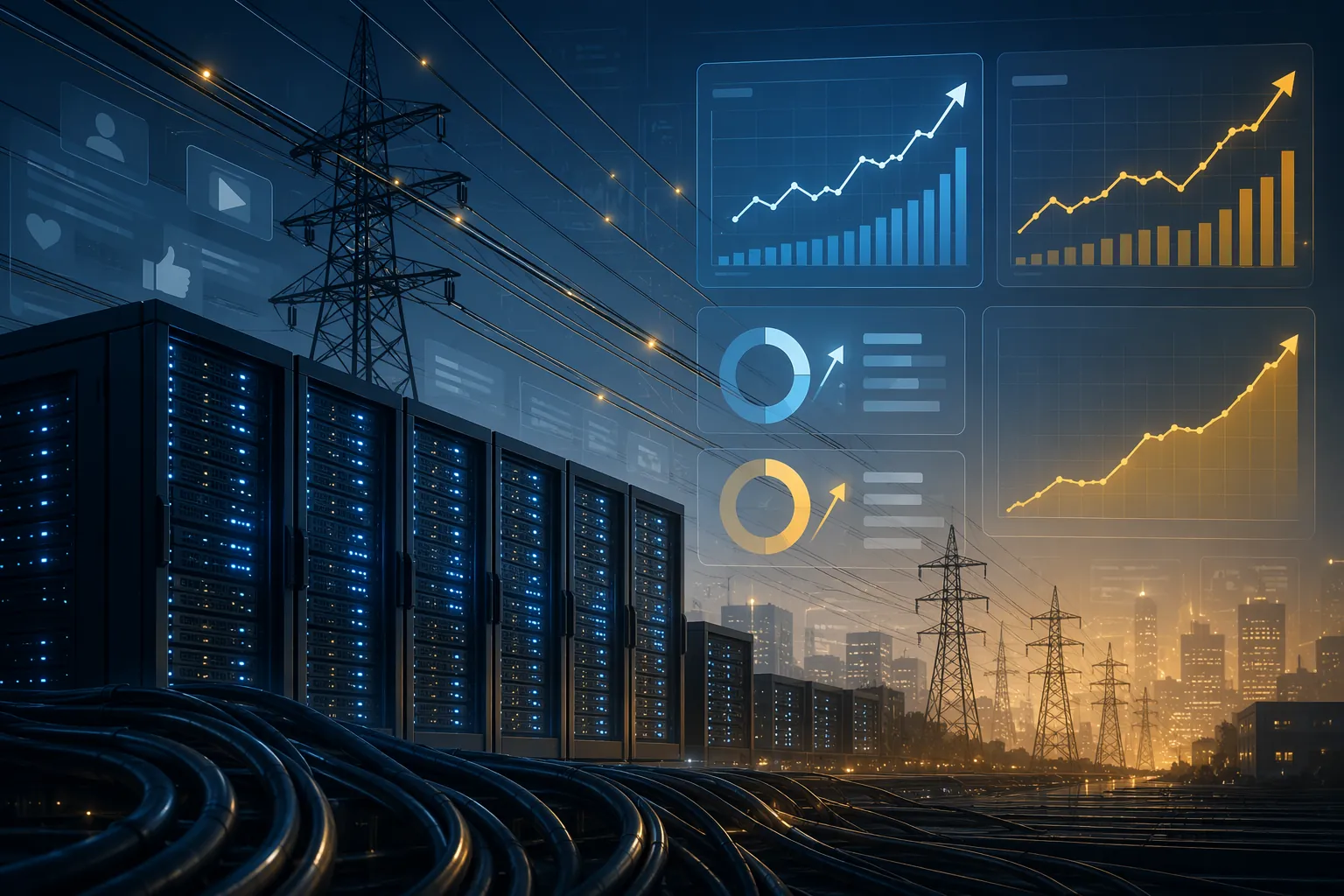
The cleanest answer is also the least satisfying one: no platform has said it raised ad prices because of energy regulation. But the dated signals now line up closely enough that media buyers should track the chain rather than wave it away as generic “auction dynamics.” Meta’s reported ad cost rose 14% year over year in 2025 while impressions grew only 6% [1]. Google’s average CPC reached $5.26 in 2025, with 87% of industries seeing CPC increases [2]. Those are not isolated complaints from a few noisy accounts; they are benchmark-level symptoms.
Start with the bill inside the ad account
A 14% Meta ad-cost increase against 6% impression growth matters because it suggests price pressure beyond simple inventory expansion. More available impressions did not prevent the average cost of ads from moving up [1]. That does not identify the cause, but it changes the burden of explanation for anyone managing Advantage+ budgets and trying to explain why the same creative, offer, and funnel need more cash to hold target CPA.
Google’s benchmark picture is similar, though the interpretation needs one extra step. The $5.26 average CPC in 2025 was the highest recorded in the cited benchmark set, and CPCs increased in 87% of industries [2]. At the same time, 65% of industries also saw improved conversion rates [2]. That means higher CPC did not automatically become higher CPA everywhere. In accounts where conversion quality improved, the landing page or automation layer may have absorbed part of the click-cost increase. In accounts where conversion rate stayed flat, the CPC move landed directly in CPA.
That distinction matters for planning. The buyer does not need a single-cause theory to act. She needs to know whether one more cost input is entering the auction environment while she is already modeling budget, efficiency, and volume tradeoffs for PMax, AI Max, and Advantage+.
The platform cost side is no longer background noise
The strongest platform-side signal is Meta’s capex. Data Center Dynamics reported that Meta was planning $115 billion to $135 billion in 2026 capital expenditures, described by the company as “notably larger” and nearly double prior guidance, with AI data center buildout as the driver [3]. That is not an ad-pricing disclosure. It is still a cost signal sitting next to a reported ad-price increase.
Google is harder to pin down from the materials available here. The 250%-plus electricity-consumption increase since 2019 that has circulated in secondary references is a relevant watch item, but it should be checked against Google’s original 2026 environmental reporting before it gets treated as a hard model input. The direction of the issue is still important: AI search, model serving, ad automation, and data center growth all require power, cooling, chips, racks, transmission access, and interconnection work. Those costs do not need to appear as a line item called “CPC surcharge” to matter.
Tariffs add another non-auction cost layer. Forbes estimated that AI data centers paid $6 billion to $7.2 billion in tariffs in 2025 on server and rack imports, including about $120,000 per top-of-the-line AI rack, based on estimated deployment of 50,000 to 60,000 racks industry-wide [4]. That estimate is sensitive to deployment assumptions and exemption changes, including supply chains affected by the April 2025 Taiwan exemption, so it should not be converted into a clean per-click formula. It is still part of the cost stack around AI infrastructure.
This is why infrastructure signals outside ad platforms have become useful for marketers. The same logic behind Why GE Vernova’s AI Infrastructure Stock Is a Marketer’s Signal applies here: if the physical buildout behind AI advertising systems is measurable in energy equipment, grid demand, data center capex, and import costs, it is no longer safe to treat platform automation as pure software margin.
The regulation chain is pro-buildout and cost-shifting at the same time
The policy sequence matters because the Trump-era actions did not simply “help data centers” or “hurt data centers.” They accelerated parts of the buildout while exposing operators to more explicit grid-cost responsibility.
The July 2025 Executive Order 14318 accelerated federal permitting for data center projects above 100 megawatts or $500 million in capex, but it did not preempt state land-use or utility regulation [5]. That gap is where state pressure entered. By April 2026, 27 states had introduced data-center energy-cost bills, according to MultiState [5]. For advertisers, the important detail is not the local politics. It is that faster federal permitting did not eliminate the question of who pays for the grid upgrades.
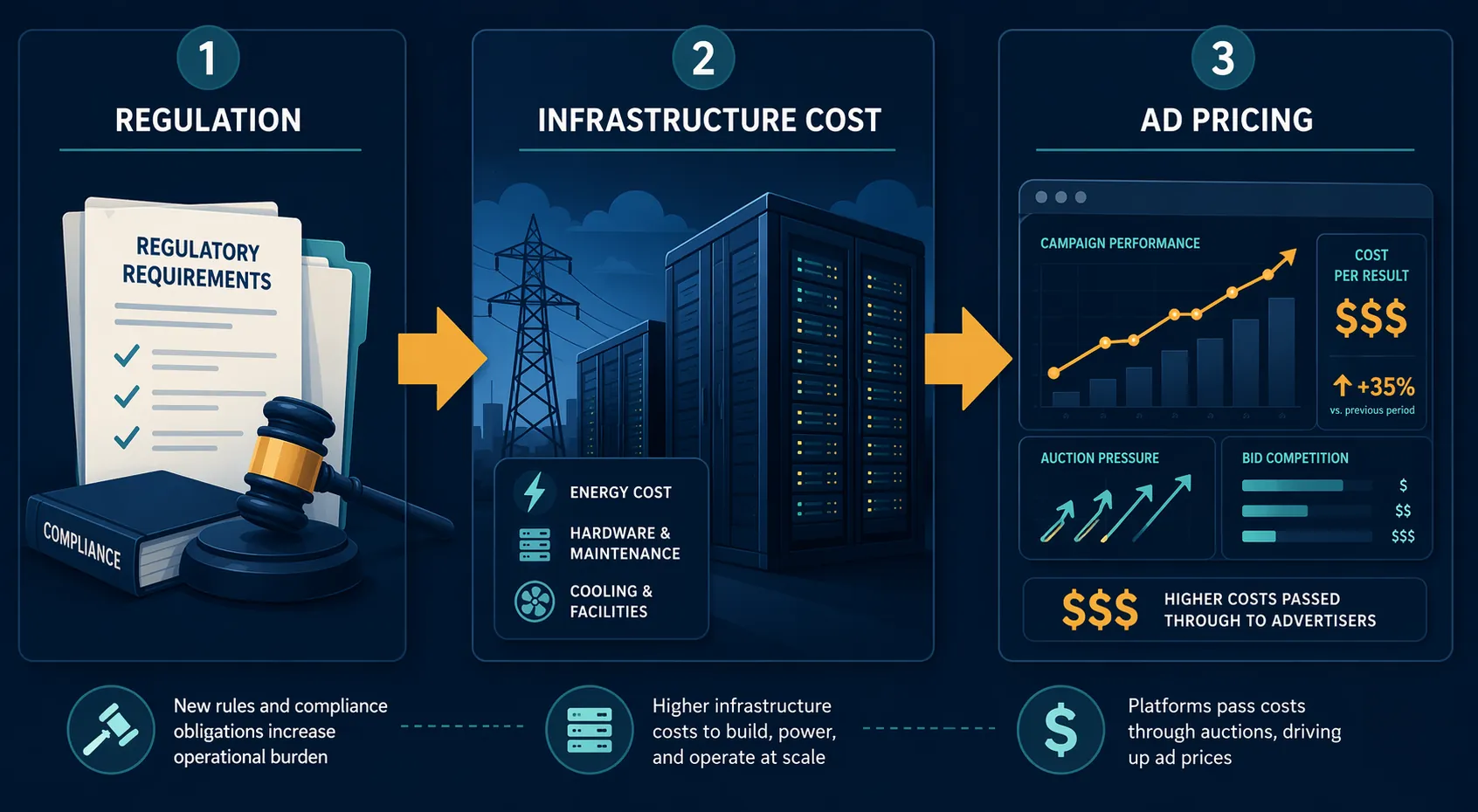
Then came the March 4, 2026 Ratepayer Protection Pledge. On paper, it pushed the idea that ordinary electricity customers should not bear the cost of large-load infrastructure required by AI data centers. The problem is enforceability: the pledge was voluntary and non-binding [6]. As a signal, it showed where the administration wanted cost allocation to move. As a cost rule, it was weaker than anything a finance team could reliably model.
The June 18, 2026 FERC order is more concrete. Federal regulators approved an interconnection approach that lets data centers connect to the grid faster while requiring them to pay the full cost of grid upgrades tied to that interconnection [7]. That is the kind of rule that changes a buildout spreadsheet. Faster connection helps deployment; full upgrade responsibility raises the cost of deployment.
That is the center of the pass-through risk. AI ad products require larger compute footprints. Larger compute footprints require larger data center and power commitments. If interconnection, transmission, and upgrade costs shift more directly onto the data center operator, those costs become part of the platform’s infrastructure economics. The platform still sets ad prices through auctions, relevance systems, budget competition, and delivery optimization. But the business running those auctions is also absorbing a larger physical cost base.
State and consumer energy pressure make the allocation fight harder to ignore
The consumer-side data does not prove ad-price pass-through, but it explains why ratepayer protection moved from slogan to legislative target. Consumer Reports found electricity prices rose 267% over five years in areas with high data-center concentration, including Northern Virginia, and reported that 78% of U.S. adults were concerned data centers would raise their energy bills in a survey of 2,146 adults [8]. That is not a Meta CPM benchmark. It is evidence that grid costs in data-center-heavy regions are visible enough to create political pressure.
The June 2026 House Energy subcommittee markup pushed the issue further. The Ratepayer Protection Act would codify the pledge into law for FERC-regulated areas if it survives the legislative path, including territories such as PJM, which spans 13 eastern states [9]. That was still a subcommittee vote, not enacted law, and the November 2026 midterms could affect its path. But if voluntary allocation becomes statutory in FERC-regulated territories, more of the grid-upgrade bill would be directed toward large-load customers rather than spread across ordinary ratepayers.
Where the evidence stops
This is the point where the argument needs discipline. Google and Meta do not disclose ad pricing methodology at a level that would let an outside buyer isolate energy regulation as a line-item driver of CPC, CPM, or CPA. Auction competition, privacy-driven signal loss, seasonal demand, creative fatigue, AI Overviews changing click behavior, and conversion-rate gains all affect paid-media economics at the same time.
| Status | What the current evidence supports |
|---|---|
| Known | Meta ad costs rose 14% year over year in 2025 while impressions rose 6%; Google average CPC reached $5.26, with CPC increases in 87% of industries [1][2]. |
| Known | Meta planned $115 billion to $135 billion in 2026 capex tied to AI data center buildout [3]. |
| Known | Trump-era federal actions accelerated data center permitting, promoted ratepayer protection, and, through FERC, required data centers covered by the interconnection order to pay full grid-upgrade costs [5][6][7]. |
| Likely | Higher AI infrastructure, power, tariff, and grid-upgrade costs increase pressure on the economics of platforms that sell AI-assisted ad delivery. |
| Not proven | No source here shows Google or Meta explicitly saying that energy regulation caused a specific CPC, CPM, or CPA increase. |
That last row is not a legal footnote. It is the difference between a useful tracker and a bad client slide. “Energy regulation is the reason CPCs rose” is too strong. “Energy regulation is now part of the dated infrastructure-cost chain behind 2026 ad-price pressure” is supportable.
How this should change 2026 paid-media planning
For planning purposes, treat AI data center regulation as an external cost input, not as an optimization lever. You cannot bid around FERC. You can, however, stop treating every CPC increase as a campaign-management failure when multiple platform-level cost signals are moving at the same time.
The practical change is in the account narrative. When CPCs rise, separate what the team can control from what belongs in the market-change log. Creative testing, feed quality, audience exclusions, landing-page speed, conversion tracking, and budget pacing still belong on the operating side. Infrastructure capex, electricity demand, tariffs, grid interconnection costs, and statutory cost allocation belong on the external-pressure side.
That separation matters when a CFO asks why CPA is up. If conversion rate improved enough to offset CPC, the answer may be that the account is absorbing market inflation well. If conversion rate did not improve, the buyer needs a clearer explanation of why more budget is required to buy the same action volume. In 2026, that explanation should include platform infrastructure pressure alongside the usual auction and tracking factors.
What to watch next
- Whether the Ratepayer Protection Act advances beyond subcommittee markup and becomes enforceable law in FERC-regulated areas.
- Whether PJM and other FERC-regulated territories shift more grid-upgrade costs directly onto data center operators.
- Whether Google’s original 2026 environmental reporting confirms the cited electricity-consumption increase that has been circulating in secondary references.
- Whether Meta continues reporting ad-price growth alongside elevated AI data center capex.
- Whether Google CPC benchmarks keep rising across industries even where conversion rates improve.
Do not cite Trump-era AI data center regulation as the only cause of higher CPCs. Do add it to the dated change log behind 2026 benchmark movement.
References
- Why Meta Ads Are More Expensive in 2026 — Coinis, Feb 2026.
- Google Ads Statistics 2026: 52 Data Points on Market Size, Performance Benchmarks and AI Automation — Hooked Marketing.
- Meta plans 'notably larger' capex spend on AI data centers in 2026, compute expectations already higher than last quarter prediction — Data Center Dynamics.
- AI Data Centers Have Paid $6B In Tariffs In 2025 — A Cost To US AI Competitiveness — Forbes, Dec 10, 2025.
- Federal AI Data Center Policy Meets Resistance from State Lawmakers — MultiState, Apr 14, 2026.
- Fact Sheet: President Donald J. Trump Advances Energy Affordability with the Ratepayer Protection Pledge — The White House, Mar 4, 2026.
- Federal regulators approve Trump plan to fast-track AI data centers — CNBC, Jun 18, 2026.
- AI Data Centers’ Impact on Electric Bills, Water, and More — Consumer Reports, Mar 2026.
- AI data centers tech companies Congress energy costs — CNBC, Jun 24, 2026.
Primary source: https://www.cnbc.com/2026/06/18/federal-regulators-approve-trump-plan-to-fast-track-ai-data-centers.html