
Does CoreWeave's debt actually move AI ad costs?
CoreWeave's debt is a dated, verifiable event, but it is not yet a direct ad-cost event: no platform has announced an AI-compute pass-through. This tracker entry logs July 2026's credit events, maps the indirect mechanisms that could eventually move AI ad infrastructure costs, and names the signals that would confirm or falsify the link.
- Platform
- Google Ads, Meta0 TikTok
- Change category
- bidding
- Effective date
- 0-07-31
- Change type
- policy or regulatory shift
- Impact level
- low
As of July 31, 2026, the answer to “does CoreWeave debt impact AI ad infrastructure costs?” is still: watch it, do not reforecast CPMs from it. CoreWeave’s debt stack and July credit events are real enough to track. They are not yet an advertiser-facing cost event because Google, Meta, TikTok, and Microsoft have not announced an AI-compute pass-through fee or surcharge, and the major CoreWeave agreements named here are compute contracts, not ad-inventory contracts.
| Tracker field | Current read |
|---|---|
| Category | AI ad infrastructure cost tracker |
| Last reviewed | July 31, 2026 |
| Current status | Credit event: yes. Confirmed ad-cost event: no. |
| Affected surfaces to watch | Advantage+, Performance Max, AI Max, Symphony, and other automated ad systems that depend on large-scale inference capacity |
| Standard of proof to move from watch to cost event | A platform-announced AI-compute surcharge, explicit auction-pricing change tied to compute, documented degradation in model-serving capacity that changes delivery or bidding behavior, or repeated platform capex/vendor-cost disclosures connecting infrastructure cost to ad monetization |

That distinction matters for a growth lead getting the predictable finance-team question: “Does this hit our ad budget?” The honest answer is not “ignore it.” It is also not “CoreWeave’s refinancing terms mean Meta CPMs go up.” The useful work is separating a credit-market signal from the slower channels through which GPU financing pressure could eventually reach the infrastructure floor under AI-powered ad products.
For the broader primer on why CoreWeave belongs on an ad-platform infrastructure watchlist at all, see Why CoreWeave's Financial Health Matters for AI Ad Platforms. This entry deliberately starts later: with the July 2026 credit data and the ad-cost transmission test.
The July 2026 credit event is real, but the debt number is not one clean number
The messiest number is the one most likely to get flattened in a client Slack thread: CoreWeave’s debt. One July 2026 market account put debt growth at roughly $2 billion at the end of 2023 to $35.15 billion by early July 2026 when capital leases are included; the same account separated that from roughly $25 billion — about $24.9 billion — of on-balance-sheet debt at the Q1 2026 close.[1]
Those are not interchangeable figures. Capital leases matter in a GPU-heavy business because leased infrastructure can behave like debt in the operating reality of the company: cash has to go out, capacity has to be monetized, and refinancing still has to clear a market. On-balance-sheet debt is the cleaner accounting line for leverage discussions. A tracker that cares about ad infrastructure should show both instead of averaging them into a fake precision.
| Debt framing | What it includes | Why an ad-cost tracker cares |
|---|---|---|
| Roughly $25B on-balance-sheet debt at Q1 2026 close | Debt carried on the balance sheet, as separated in the July market account | Useful for conventional leverage and interest-expense pressure |
| $35.15B by early July 2026 including capital leases | A broader burden that includes capital leases | Useful for understanding how much GPU capacity has to be financed, delivered, and monetized |
Interest expense is the cleaner dated signal because it tells you the cost is already moving through the company’s income statement. CoreWeave reported Q1 2026 interest expense of $536 million, up from $264 million a year earlier.[2] CNBC reported Q2 2026 interest expense guidance of about $690 million.[3] That does not prove ad platforms pay more for inference. It does prove the infrastructure supplier is carrying a materially higher financing burden than it was a year earlier.
Then the July cluster added market stress. Five-year credit-default-swap protection on CoreWeave debt rose more than 50% in July, and the company was reported to have sweetened a $2.6 billion loan by widening pricing up to 1.25 percentage points, to as high as 5.5 percentage points over the benchmark, at 97 cents on the dollar.[4] Loan pricing does not pass automatically into an Advantage+ auction. It does change the terms under which GPU-backed capacity is financed.
Equity holders were arguing over the same risk from another angle. A securities lawsuit was filed on June 29, CoreWeave’s stock fell 14% on July 1, and the company’s market capitalization moved under $50 billion in that July account.[1] Those facts belong in the tracker because they show a dated confidence break around disclosures and financing. They still do not convert a compute supplier’s stock move into an ad-platform price card.
How CoreWeave stress could reach AI ad infrastructure costs
The transmission path is synthesis, not a proven causal chain. The relevant question is not whether CoreWeave’s July refinancing makes tomorrow’s campaigns more expensive. It is whether sustained stress at a debt-financed GPU supplier changes the cost, timing, or concentration of the compute used by platforms that run AI ad automation.
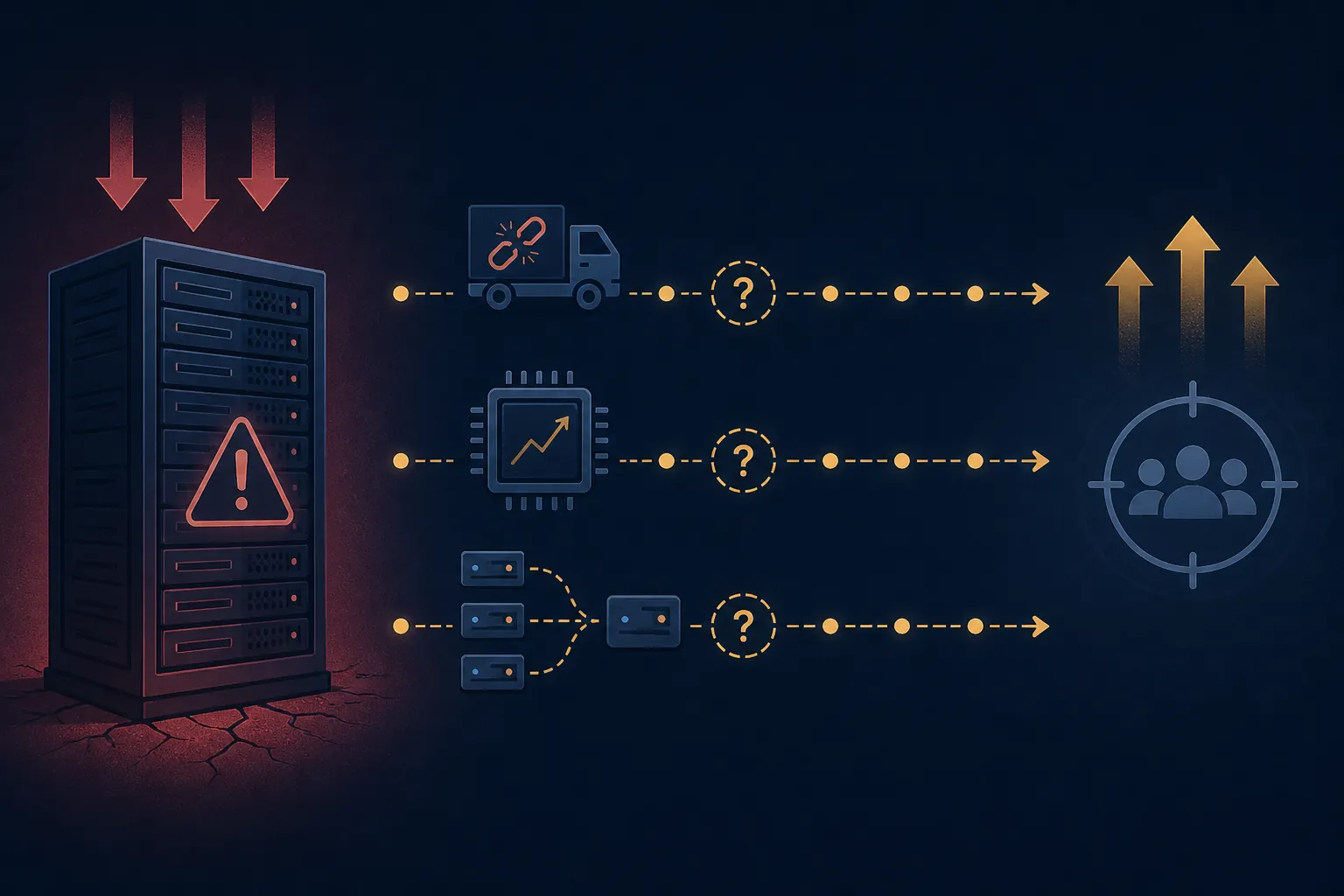
Meta’s Andromeda system is the useful anchor here because it connects ad automation to capacity-intensive infrastructure without pretending CoreWeave debt sets Meta auction prices. Meta Engineering described Andromeda, the retrieval engine powering Advantage+ automation, as “capacity intensive,” running on NVIDIA Grace Hopper and Meta’s MTIA silicon, and already serving more than 15 million GenAI-created ads a month as of its December 2024 engineering write-up.[5]
That is the surface area advertisers actually touch: automated creative generation, candidate retrieval, ranking, bidding, and delivery systems that need inference capacity behind the scenes. If the cost or availability of that capacity changes, a platform has options before advertisers see a line item. It can absorb margin pressure, tune models, shift workloads, delay features, move volume across suppliers, change reservation strategy, or eventually adjust product and auction economics. The tracker only moves to “ad-cost event” when one of those platform-facing links becomes visible.
| Possible transmission path | What would have to happen | What has not been shown as of July 31, 2026 |
|---|---|---|
| Capacity-delivery risk | A platform depending on CoreWeave faces delayed, constrained, or repriced GPU capacity for ad-serving or model-serving workloads | No public platform disclosure ties CoreWeave debt to degraded ad delivery, reduced automation availability, or higher advertiser fees |
| Higher capital cost for next-gen GPUs | Refinancing gets more expensive across GPU-backed infrastructure, raising the reservation price of future capacity | No platform has announced that those costs are being passed through as an AI-compute ad surcharge |
| Supplier concentration | A small group of debt-financed neoclouds becomes systemically important to inference supply | Large compute contracts show demand concentration, not advertiser pass-through |
The contract numbers explain why this is worth watching even without a CPM claim. Meta committed $14.2 billion to CoreWeave and then an additional $21 billion for 2027 through 2032, according to CNBC.[6] I/O Fund has framed OpenAI’s CoreWeave exposure at up to $22.4 billion and Microsoft’s spending across neoclouds at roughly $60 billion.[7] Those are compute-demand numbers. They are not ad-inventory contracts, and they do not say that an advertiser running Advantage+ or Performance Max pays a separate GPU bill.
Inference is the part to watch because it repeats every time systems generate, retrieve, rank, score, and optimize. Spheron, a vendor-published source citing analyst estimates, puts inference at an estimated 55% to 80% of enterprise GPU spend.[8] That estimate is useful directionally, but it should be handled as vendor-published context, not an independent measurement of ad-platform cost structure.
The practical implication for media teams is narrow: CoreWeave debt can belong in an AI infrastructure cost-floor monitor. It does not belong in a CPM forecast unless a platform-level signal appears. For related transmission-mechanism work, the closest dated sibling is Nebius Q2 2026: tracking the GPU cost behind every Advantage+ ad, with additional context in AI inference chip demand and ad costs.
The stock debate is context, not the decision surface
The bearish version is easy to find: debt-heavy AI infrastructure, circular demand fears, and warnings that the GPU buildout has started to look like a bubble. Fortune reported criticism from Kerrisdale and D.A. Davidson around CoreWeave’s debt and the broader AI infrastructure cycle.[9] Morningstar has also assigned CoreWeave a “no moat” view and said it did not expect positive free cash flow or GAAP EPS over the next three years.[10]
The bullish version has real facts too. CoreWeave reported $99.4 billion of contracted backlog and announced an $8.5 billion DDTL 4.0 financing facility described as the first investment-grade-rated GPU-backed financing, priced at SOFR plus 2.25%.[11] Backlog matters because contracted demand can support financing. Investment-grade GPU-backed debt matters because it suggests at least some lenders are still willing to underwrite the asset base at scale.
Neither side settles the advertiser question. Bears can be right that leverage increases fragility without proving that ad auctions reprice. Bulls can be right that demand is contracted without proving that delivery, refinancing, and lease obligations are risk-free. This tracker does not need to decide whether CoreWeave is a good stock. It needs to decide whether the evidence has crossed into ad-cost mechanics. It has not.
Signals that would confirm or falsify the ad-cost link
The next update should not be triggered by every CoreWeave share-price swing. It should be triggered by evidence that one of the transmission paths has moved closer to platform economics.
- CoreWeave Q2 earnings on Aug. 11: the important lines are interest expense, lease obligations, utilization, backlog conversion, customer concentration, and any language about delayed capacity delivery.
- DDTL drawdowns against the $8.5 billion facility: draw timing, use of proceeds, and whether the investment-grade structure remains enough to finance next-generation GPU capacity without more expensive incremental debt.
- Meta and Google capex guidance: Meta’s 2026 capex guide of $125 billion to $145 billion is already large enough that wording changes around AI infrastructure, inference, and supplier exposure matter for ad-platform cost-floor analysis.[6]
- Platform disclosures: any new AI-compute surcharge, SKU-level pricing for ad automation, auction-mechanics change, or explicit statement that compute costs are affecting ad monetization would move this tracker faster than another credit-market quote.
- GPU spot and reserved pricing: older-generation softness and next-generation tightness can coexist, so a headline “GPU prices falling” is not enough. Cast AI has argued that GPU pricing is entering a foundational shift in 2026, DigitalOcean announced GPU price changes effective Aug. 1, and IDC data cited by The Next Platform put Q1 2026 GPU-server revenue at $68.9 billion, up 24.8% year over year.[12][13][14]
The falsification case is just as important. If CoreWeave absorbs financing pressure, keeps delivery on schedule, draws facilities without further pricing stress, and major ad platforms continue to expand AI ad products without compute-linked advertiser charges or delivery degradation, then CoreWeave’s July credit event remains an infrastructure-finance story rather than an ad-cost story.
If the opposite shows up — delayed GPU capacity at platform suppliers, repriced reserved capacity for next-gen clusters, platform capex commentary that links inference cost to monetization pressure, or an actual AI-compute pass-through — the tracker changes. Until then, keep watching the infrastructure cost floor, but do not update media plans or CPM forecasts on CoreWeave debt alone.
References
- CoreWeave Just Slipped Under $50 Billion, 24/7 Wall St. via Yahoo Finance
- CoreWeave Reports Strong First Quarter 2026 Results, CoreWeave Investor Relations
- CoreWeave CRWV Q1 earnings report 2026, CNBC, May 7, 2026
- CoreWeave Said to Sweeten $2.6 Billion Loan, Investing.com via Yahoo Finance
- Meta Andromeda: Advantage+ automation and next-gen personalized ads retrieval engine, Engineering at Meta, Dec. 2, 2024
- Meta commits to spending additional $21 billion with CoreWeave, CNBC, Apr. 9, 2026
- Nvidia, CoreWeave, Nebius: Circular Financing in the GPU Boom, I/O Fund
- AI Inference Cost Economics 2026, Spheron
- CoreWeave earnings debt AI infrastructure bubble, Fortune, Nov. 8, 2025
- Debt-Fueled CoreWeave Surges on AI Boom. Is the Stock a Buy?, Morningstar
- CoreWeave Closes Landmark $8.5 Billion Financing Facility, Achieving First Investment Grade-Rated GPU-backed Financing, CoreWeave Investor Relations
- CAST AI Data Shows GPU Pricing Will See a Foundational Shift in 2026, CAST AI
- Price changes for GPUs, DigitalOcean
- The Server Boom Balances Price Increases Against Chip Shortages, The Next Platform, June 17, 2026
Primary source: https://ir.coreweave.com/news-releases