
AI Inference Chip Demand Is Quietly Inflating Your Ad Costs
Meta and Google CPMs and CPCs have risen 14–28% year-over-year in 2026, driven partly by AI inference demand consuming 70% of global memory chip production. This article traces the supply-side cost pass-through from semiconductor demand to ad platform infrastructure spending, revealing a cost floor that media buyers cannot optimize away.
- Platform
- Meta
- Bid strategy
- Smart Bidding
- Last reviewed
- 0-07-29
No specific Benchmarks record is cited for this tactic yet — treat it as directional, not evidence-backed.
By Q3 2026, the uncomfortable part of a Meta or Google Ads review is not spotting the cost increase. It is explaining why the usual fixes are not absorbing it. Creative has been refreshed. Audiences have been tightened or deliberately loosened. Bid strategy has been tested. Landing pages have not suddenly become worse. Yet the blended bill keeps moving up.
On Meta, the platform reported a 14% increase in average ad price in Q1 2026 while impressions grew 6%, and outside agency data put CPM movement around 20% year over year, from roughly $11.82 to $14.19.[1][2][3] On Google, search CPCs were reported up 18% year over year to $4.22.[4] Those are large enough moves to eat margin before a media buyer gets to show whether the new testing plan is any good.
Competition, privacy, auction density, and creative quality still matter. They always have. But they are not the whole explanation when the platforms themselves are also absorbing a much more expensive infrastructure cycle. The practical question behind the phrase “ai inference semiconductor test demand impact on paid advertising platforms” is not whether a chip shortage can be blamed for every bad CPM. It is whether AI inference demand is raising the operating cost floor under the ad systems Meta and Google sell back to advertisers.

The Chain Worth Watching
No public filing from Meta or Alphabet tells advertisers, “X% of this quarter’s ad price increase came from AI hardware cost recovery.” That number is not disclosed. The documented evidence is a chain of pressure points, and each link has to be kept in its proper scope.
| Link in the chain | What is documented | What it means for ad buyers |
|---|---|---|
| AI inference demand | AI inference accounts for 67% of AI compute, up from 33% in 2023, and is consuming about 70% of global memory chip production.[5][6] | The pressure is not only model training. Everyday AI serving now competes heavily for memory. |
| Memory and component pricing | Server DRAM prices were reported up about 95% in Q1 2026, with broader component increases cited in the 50–90% range depending on part and supplier.[7][8] | The hardware inside data centers is repricing, not just becoming harder to source. |
| Cloud and infrastructure pass-through | OpenMetal cited an OVHcloud CEO expectation of 5–10% cloud infrastructure price increases through Q3 2026.[7] | Infrastructure vendors are signaling that higher component costs do not stay neatly inside procurement. |
| Platform capex and expenses | Meta guided to $115–135 billion of 2026 capital expenditures and cited higher depreciation, data center operating costs, and third-party cloud spend as expense drivers.[1] | The ad platform’s cost base is rising in the same places AI hardware pressure shows up. |
| Ad price movement | Meta reported higher average ad prices, and Google search CPC benchmarks moved higher in parallel.[1][4] | Some cost pressure is visible in the buyer’s dashboard, even though the exact pass-through share is not broken out. |
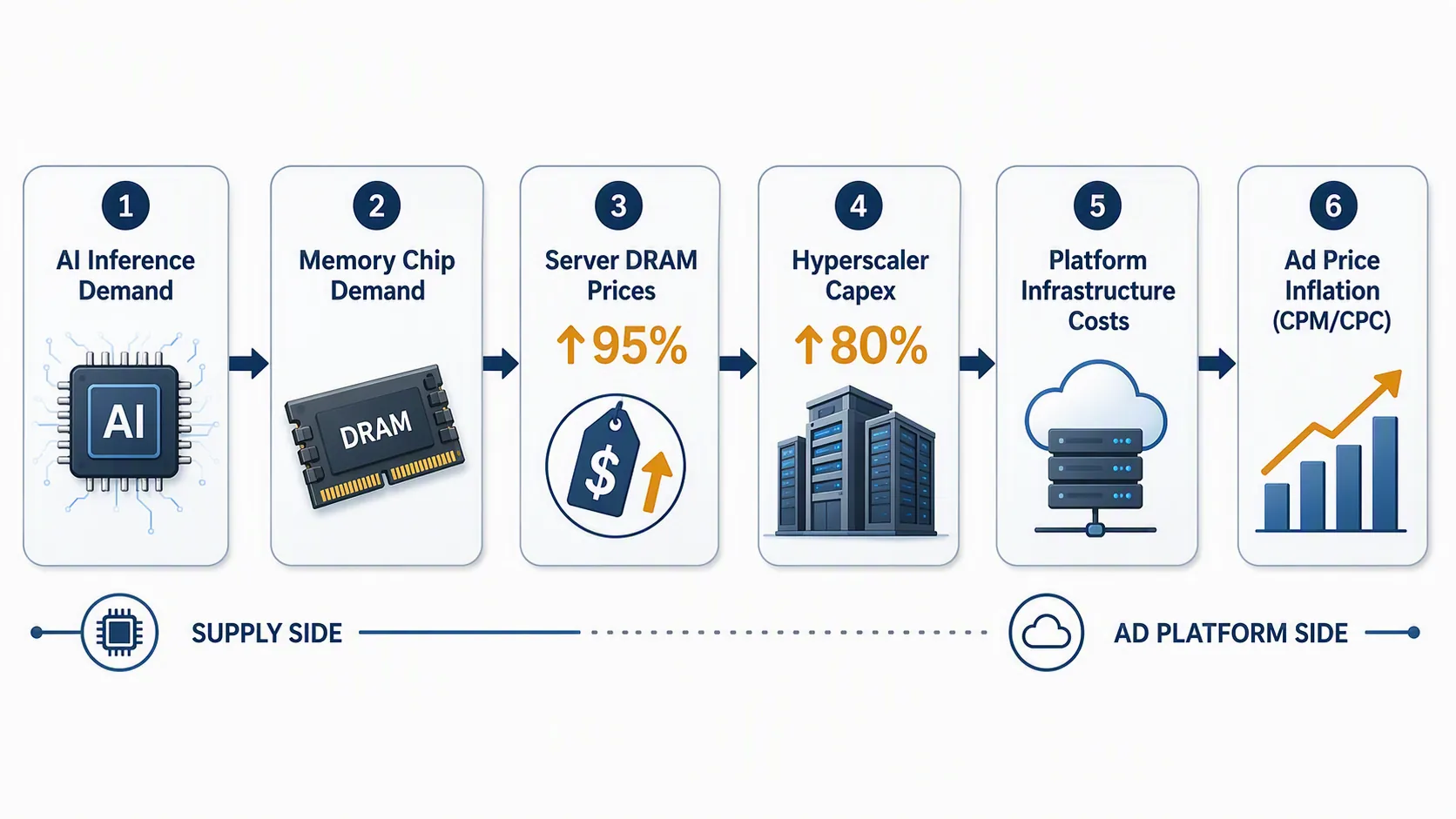
The weakest version of this argument would overclaim: AI chips got expensive, therefore your CPM went up. That is too neat. Auctions still translate advertiser demand into price. Meta and Google still have pricing power for reasons unrelated to DRAM. And semiconductor test demand, specifically, is not documented strongly enough to carry the full case on its own.
The stronger version is narrower and more useful: AI inference has become a major consumer of memory production; memory and server component costs have surged; hyperscalers and ad platforms are spending heavily on data centers; Meta has explicitly named depreciation, data center operating costs, and cloud spend as expense drivers; and advertisers are seeing higher CPMs and CPCs at the same time. That does not produce a precise attribution model. It does produce a planning risk most media reports still treat as someone else’s problem.
Why Inference Hits Memory So Hard
Media buyers do not need a semiconductor lecture to understand the relevant point. AI inference is the act of running a model for users after it has been trained. Every ad ranking call, recommendation, chatbot answer, image generation request, and automated decision has to move data through hardware fast enough to feel instant. The bottleneck is not only compute. It is also memory bandwidth and capacity.
That matters because inference is no longer a sidecar workload. Deloitte’s 2026 semiconductor outlook put inference at 67% of AI compute, up from 33% in 2023, and Bloomberg reported that AI inference demand was consuming about 70% of global memory chip production.[5][6] That is the first number in this story that should make a paid-media operator stop treating AI infrastructure as a separate earnings-call hobby.

A training-heavy AI market would still be capital intensive, but it would be easier to think of the cost as episodic: build the model, improve the model, amortize the model. Inference is different. It is repetitive, user-triggered, latency-sensitive, and permanently hungry. If a platform adds more AI-assisted ranking, generation, personalization, safety review, measurement modeling, and agentic ad tools, it is not simply buying a better lab. It is increasing the amount of AI work that has to run inside daily operations.
The price signal is already visible in server components. OpenMetal, citing Broadcom data, reported a roughly 95% increase in server DRAM prices in Q1 2026, while J2 Sourcing described broader semiconductor price hikes and lead-time pressure across suppliers, with component increases in a 50–90% range depending on the part and window.[7][8] The exact number varies by component and sourcing contract. The direction does not.
This is where a lot of ad-cost commentary stops too early. It sees “AI chip shortage” and jumps straight to GPUs. But memory pressure is the more useful bridge to advertising economics because memory sits inside the infrastructure every large ad platform needs to run targeting, ranking, retrieval, bidding, measurement, moderation, and AI product features at scale. If memory gets more expensive, the cost does not remain isolated in a chip vendor spreadsheet.
From Component Inflation to the Platform Cost Floor
There is a clean way to test whether this is just a semiconductor story dressed up as a media-buying story: look for pass-through signals before it reaches the ad auction.
Cloud infrastructure is one such signal. OpenMetal cited OVHcloud’s CEO expecting 5–10% cloud infrastructure price increases through Q3 2026, tied to the same hardware supply and pricing environment.[7] That does not prove Meta or Google raised ad prices because OVHcloud said cloud prices would rise. It shows that buyers of data-center infrastructure are not magically insulated from component repricing, and some vendors are already talking about passing part of the increase downstream.
The larger signal is in hyperscaler spending. Meta guided to $115–135 billion in 2026 capital expenditures, and its Q1 2026 commentary named higher depreciation, data center operating costs, and third-party cloud spend as expense drivers.[1] Available estimates also place Google’s 2026 capex in a $180–205 billion range and describe both Meta and Google as up roughly 80% year over year, with combined hyperscaler capex above $700 billion.[1] Those are not cosmetic investments. They change the economics of operating the services that carry ads.
Depreciation is the line item media buyers should learn to recognize. When a platform builds or leases more data-center capacity, the cost is not always expensed on day one. It gets spread over the useful life of the assets. That spreading can make the cost look less dramatic than the capex headline, but it also means the platform carries the burden into future quarters. A surge in infrastructure spending can become a recurring expense base, not a one-quarter annoyance.
This is not an argument that Meta or Google price ads by adding a hardware surcharge to every impression. They do not sell media that way. Ads are sold through auctions, and advertiser demand still determines which buyer clears which price. But auction-based businesses can still have margin targets, product investment costs, and pricing incentives shaped by infrastructure expense. When the cost of serving, ranking, measuring, and optimizing ads rises, the platform has reasons to recover some of that cost through the commercial system it controls.
For a buyer, the distinction matters. If costs are rising only because three competitors entered your auction, the remedy is account-specific: change positioning, find cheaper pockets of demand, improve conversion rate, or move budget. If a platform-level cost floor is also rising, the same account work may still be correct, but it should not be expected to pull CPMs or CPCs back to last year’s baseline.
Meta Shows the Clearest Overlap
Meta is the cleaner case because its ad-price movement and expense language sit close together. The company reported a 14% increase in average ad price in Q1 2026 on 6% impression growth.[1] Agency-side data cited CPM movement from about $11.82 to $14.19, a roughly 20% year-over-year increase.[2][3] In the same earnings context, Meta pointed to higher depreciation, data center operating costs, and third-party cloud spend as expense drivers.[1]
That combination does not let anyone say 6 points of the CPM increase came from depreciation and 8 came from auction demand. It does let buyers stop treating rising CPMs as proof that the account team missed something obvious. Meta is spending into AI and infrastructure at a scale that changes its cost base, and the platform is simultaneously reporting higher average ad prices.
The uncomfortable part is that Meta’s AI improvements may also increase advertiser willingness to pay. Better ranking, better creative tools, better automation, and better conversion prediction can make impressions more valuable. That is adoption and product effectiveness showing up in price. It sits beside, not instead of, cost recovery. A stronger ad system can justify higher bids while a more expensive infrastructure stack raises the floor beneath them.
This is why “creative fatigue” has become too convenient as a universal diagnosis. Creative fatigue is real. Bad offer-market fit is real. Lazy account structure is real. But none of those explanations accounts for a platform telling investors that depreciation and data-center operating costs are rising while advertisers see materially higher clearing prices.
Google’s CPC Pressure Points in the Same Direction
Google is harder to read from the outside because search intent, retail competition, AI Overviews, Performance Max behavior, and query mix all interact with CPC. Still, the buyer-visible signal is there: reported Google search CPCs rose 18% year over year to $4.22 in 2026.[4]
The same infrastructure logic applies. Search advertising now runs on a system that is increasingly shaped by AI ranking, generation, retrieval, measurement, and automation. If the company is expanding AI-serving capacity while memory and data-center costs are elevated, the ad business cannot be analyzed as though its only cost input is advertiser competition for keywords.
The caveat is important: a higher Google CPC is not automatically a hardware pass-through. Some of it may be vertical competition. Some may be query mix. Some may be changes in match behavior or campaign automation. Some may be advertisers bidding harder because the traffic still converts. The infrastructure claim is not a replacement for auction analysis. It is an additional layer that explains why even well-managed accounts can feel like they are optimizing against a moving floor.
Where Semiconductor Test Demand Fits, and Where It Does Not
The target keyword includes semiconductor test demand, and that deserves a careful boundary. AI accelerators and high-performance memory require testing, packaging, validation, and supply-chain capacity before they can sit in a data center. In a constrained market, test and validation demand can compound delays. But the available material here does not quantify a testing bottleneck in a way that can be cleanly translated into Meta CPMs or Google CPCs.
So semiconductor testing should not be treated as the main causal driver. The better-supported claim is broader: inference demand is consuming a large share of memory production, server DRAM and related components have repriced sharply, and the platforms that run paid advertising are spending heavily on the infrastructure affected by that repricing. Testing may be part of the supply-chain strain. It is not the evidence that carries the paid-advertising conclusion.
Cheaper Inference Can Still Raise Total Cost
One objection is reasonable: if inference costs are falling, why would AI infrastructure keep pressuring hardware markets? GPUNex reported that per-token inference costs have fallen 1,000 times since 2022.[9] In normal buying language, that sounds like relief.
But cheaper unit cost can increase total consumption. When it becomes cheaper to run inference, platforms can afford to put AI into more surfaces, more decisions, more prompts, more recommendations, and more automated workflows. The unit economics improve, usage expands, and aggregate demand for compute and memory can keep rising. That is the Jevons-style pressure behind the current market: efficiency does not automatically mean lower total infrastructure demand.
This also explains why buyers should be cautious with platform narratives that present AI solely as an efficiency dividend. Automation can absolutely earn its keep inside an account. Better creative generation, better bidding models, and better measurement can improve outcomes. But the platform’s AI stack is also a cost center with physical inputs. The more AI becomes the default operating layer, the more those inputs matter to pricing.
The pressure is not confined to ad platforms. CNBC reported that smartphone prices were expected to rise in 2026 because of the same AI-fueled chip shortage, a useful corroborating signal that the supply crunch is cross-industry rather than a story invented to explain media inflation.[10] Phones are not CPMs, but they show the memory and chip market pushing into end prices elsewhere.
What This Changes in a Q3 2026 Media Plan
The operational mistake is to hear “structural cost floor” and stop optimizing. That would be lazy. Account-level work still determines whether a brand pays the inflated market price efficiently or wastes budget on top of it.
The better adjustment is in expectations, forecasting, and diagnosis. If Meta CPMs are up 20% year over year and the account has already gone through credible creative, audience, bid, and landing-page checks, the next meeting should not automatically become a hunt for a hidden practitioner error. Part of the increase may be a platform-level cost condition. Treating all of it as fixable inside Ads Manager leads to bad planning: underfunded tests, unrealistic CAC targets, and unnecessary churn in strategy.
- Separate controllable variance from market variance before judging the account team.
- Benchmark CPM and CPC movement against platform-wide and vertical-wide data, not only last month’s account history.
- Add a structural inflation assumption to Q3 and Q4 forecasts instead of forcing last year’s media efficiency into this year’s cost base.
- Watch Meta and Alphabet capex, depreciation, data-center cost language, and third-party cloud spend alongside auction metrics.
- Track memory-market updates, especially server DRAM pricing and supply-tightness forecasts, as a media-cost input rather than a pure tech-sector headline.
Budgeting against a structural floor changes the conversation with finance. Instead of promising that a new creative sprint will reverse a 20% CPM increase, the media plan can split the problem: how much efficiency can be recovered through account work, how much must be offset through conversion-rate or AOV improvement, and how much should be treated as market inflation until platform and infrastructure signals cool.
It also changes what counts as a good test. In a rising-cost environment, a campaign that holds CAC flat while CPMs climb may be doing real work. A creative refresh that improves click-through rate but cannot fully neutralize a higher auction floor may still be valuable. The denominator moved. That has to be reflected before the postmortem turns into theater.
The Caveat That Keeps This Honest
The exact pass-through percentage remains undisclosed. Meta and Google do not publish a clean bridge from server DRAM prices to ad auction clearing prices. The complete chain in this article is a synthesis of separately documented facts, not a platform-confirmed formula.
That caveat should narrow the claim, not erase it. AI inference is taking a very large share of memory production. Server memory and components have repriced sharply. Cloud and infrastructure vendors are signaling pass-through. Meta and Google are spending enormous amounts on data centers and AI infrastructure. Meta has named higher depreciation and data-center costs as expense drivers. Advertisers are seeing materially higher Meta ad prices and Google search CPCs.
For Q3 2026 planning, that is enough to stop treating every CPM or CPC increase as an account-level failure. Some portion of rising Meta and Google costs should be budgeted as structural infrastructure inflation. Keep optimizing, but keep a second screen open for capex, depreciation, cloud spend, and memory-market updates. The auction is still the place you buy the media. It is no longer the only place the price is being made.
References
- Meta Q1 2026 Earnings Call Transcript, Meta.
- Why Meta Ads Are More Expensive in 2026, Coinis.
- Meta CPM Trends: What Drives Costs in 2026, AdensLab.
- Google Ads vs Meta Ads Cost 2026, Get-Ryze.
- 2026 Global Semiconductor Industry Outlook, Deloitte.
- Why AI-Driven Memory Chip Shortage is Making Technology More Expensive, Bloomberg.
- What the 2026 Hardware Supply Crisis Means for Your Infrastructure Budget, OpenMetal.
- Semiconductor Price Hikes and Lead Time Crunches: 14 Suppliers Raise Costs in April 2026, J2 Sourcing.
- AI Inference Economics: The 1,000× Cost Collapse Reshaping GPUs, GPUNex.
- Smartphone prices to rise in 2026 due to AI-fueled chip shortage, CNBC.