
Why CoreWeave's Financial Health Matters for AI Ad Platforms
CoreWeave's $99.4B backlog and $25B debt aren't just stock news—they're operational signals for anyone running AI ad campaigns. This article explains why media buyers should track CoreWeave's financial health as a leading indicator for ad platform inference costs and reliability.
- Platform
- Meta Ads
- Campaign type
- Advantage+
- Spend range
- $31B-$35B
- Timeframe
- 2026
- Backlog
- $99.4B
- Verdict
- win
- Industry vertical
- ecommerce
- Last reviewed
- 2026-07-29
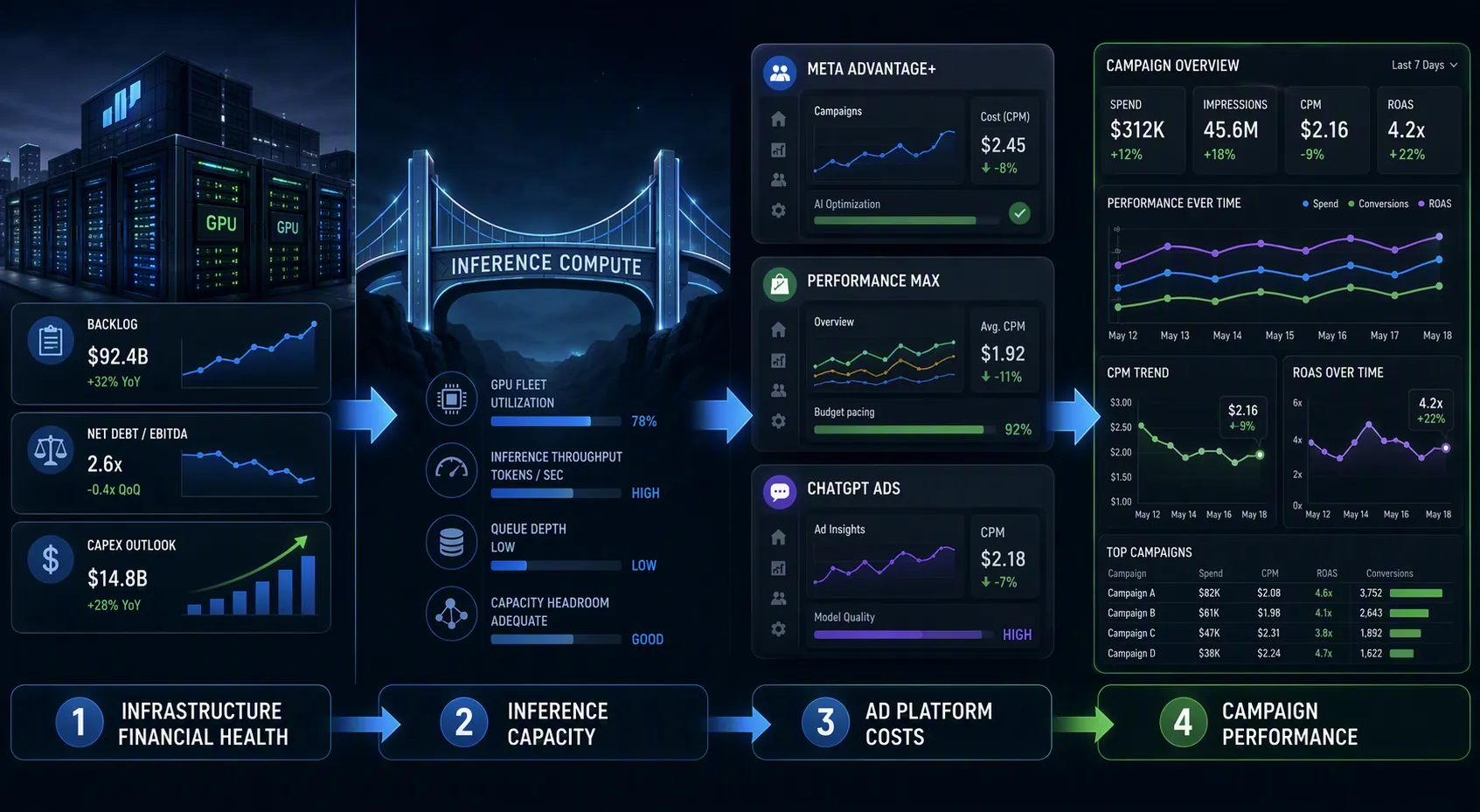
The part of CoreWeave’s story that matters to a media buyer is not whether CRWV is a good trade before earnings. It is whether the compute layer behind AI ad delivery is becoming easier or harder to scale. Advantage+ creative systems, Performance Max-style automation, AI Max search expansion, and emerging ChatGPT ad inventory all depend on inference capacity somewhere in the chain. That capacity is not an abstract cloud expense. It is financed, contracted, powered, depreciated, and resold.
As of late July 2026, CoreWeave is one of the cleanest places to watch that pressure because the numbers are unusually loud: $99.4 billion in contracted backlog, roughly $25 billion in debt, a $31 billion to $35 billion 2026 capex plan, a stock price around $67 after a 46% decline from its 52-week high, and a Q2 2026 earnings date set for Aug. 11, 2026.[1][2] None of that tells you tomorrow’s CPM. It does tell you whether one of the infrastructure providers sitting under AI-heavy ad systems is scaling from strength, from leverage, or from both at once.

The Stock Move Is the Noisiest Signal
A 46% drawdown sounds dramatic because it is dramatic for anyone holding the stock. For campaign operators, it is a weaker signal than it looks. There is no sourced evidence that CoreWeave’s share price maps directly to Meta ROAS, Google auction prices, or ChatGPT ad performance. A stock can fall because expectations were too high, because financing costs shifted, because lockups changed the float, or because investors disagree about the speed of future revenue. That is market information, not campaign telemetry.
The analyst spread makes the same point. MarketBeat data in the brief shows a 37-analyst Moderate Buy consensus, an average target of $136.25, and a target range from $65 to $303.[2] That is not a tight forecast. It is a disagreement wide enough to treat the stock as a volatility gauge rather than as an operating forecast. Wells Fargo cutting its target and Northland setting a $165 target in July 2026 can both fit inside the same unresolved question: can CoreWeave turn enormous contracted demand into profitable, financed, deliverable capacity fast enough?[2]
That question does matter to advertising. But the path is indirect: infrastructure balance sheet, then capacity and pricing, then platform economics, then product behavior, then campaign outcomes. Skipping the middle steps is how stock commentary turns into bad media buying advice.
The Backlog Says Demand Is Real. The Debt Says Delivery Is Not Free.
CoreWeave’s $99.4 billion contracted backlog is the number that deserves the least eye-rolling. The backlog averages about five years in duration, and the company has 10 customers at $1 billion-plus scale.[1] For an AI infrastructure provider, that is not a vibe. It is multi-year demand from customers that expect to keep buying GPU capacity rather than treating it as a short burst of experimentation.
The same number also creates the operating problem. Backlog is not delivered revenue. To serve it, CoreWeave has to build or secure data center capacity, obtain power, deploy GPUs, connect customers, and keep utilization high enough to service the capital structure. The company reported Q1 2026 revenue of $2.08 billion and guided FY2026 revenue to $12 billion to $13 billion, while Q2 guidance missed expectations and left more delivery weight in the back half of the year.[1] That is the part to watch around Aug. 11. If Q2 commentary points to timing slippage, supply friction, or margin pressure, the campaign-relevant read is not “sell AI.” It is “inference capacity may be harder to add cleanly than the product roadmaps imply.”
The debt and capex numbers are the other side of the same trade. CoreWeave carries about $25 billion in debt and plans $31 billion to $35 billion in 2026 capital expenditures.[1] Its technology and infrastructure costs rose 127% year over year to $1.27 billion in Q1, while a 56% adjusted EBITDA margin sat beside a $740 million net loss.[1] That combination is not automatically bad; fast infrastructure buildouts can look ugly before utilization catches up. But it means the economics of AI serving are being financed aggressively, not magically absorbed.
| CoreWeave signal | What it measures | Why a media buyer should care |
|---|---|---|
| $99.4B contracted backlog | Committed future demand, averaging about five years | Suggests major AI customers expect sustained compute needs, not a short testing cycle |
| $25B debt load | Financing burden attached to the buildout | Raises the chance that pricing discipline matters more as capacity scales |
| $31B-$35B 2026 capex plan | How aggressively CoreWeave must keep building | Shows whether platform AI features depend on continued physical expansion |
| 56% adjusted EBITDA margin and $740M net loss | Operating profitability before some costs versus bottom-line loss | Warns against treating gross demand as proof that inference is already cheap |
| Aug. 11, 2026 Q2 earnings | Next dated update on delivery, guidance, margins, and financing tone | Gives campaign teams a concrete checkpoint instead of vague AI infrastructure anxiety |
Where This Touches Meta Campaigns
The Meta connection is the easiest one for media buyers to understand because the dependency is close to the campaign dashboard. CNBC reported that Meta committed an additional $21 billion to CoreWeave on top of existing deals, bringing the cumulative relationship above $35 billion.[3] Meta’s total 2026 capex plan sits at $115 billion to $135 billion.[3] Those are infrastructure commitments at a scale that makes AI ad delivery a capital allocation question, not just a product management choice.
Advantage+ systems depend on model serving across creative optimization, audience expansion, ranking, and delivery decisions. The available reporting supports the practical link that CoreWeave capacity helps support Meta’s AI inference needs.[3] It does not support the stronger claim that a specific CoreWeave cost increase caused a specific CPM change inside a Meta account. That distinction matters. The useful hypothesis is narrower: if Meta’s AI compute inputs become more expensive, constrained, or harder to schedule, Meta has several levers available before any buyer sees the reason clearly.
- It can absorb the cost and protect advertiser-facing behavior, at least while margins allow.
- It can slow feature rollouts, especially for inference-heavy creative and automation tools.
- It can tighten access, defaults, or optimization windows in ways that look like product changes rather than infrastructure constraints.
- It can preserve product availability while letting auction dynamics, recommendation quality, or testing cadence carry more of the pressure.
Anyone who has had to explain a campaign that got more expensive after a platform automation change knows why that chain is worth tracking. Platforms rarely say, “our inference economics changed, so your delivery mix shifted.” They ship an update, change a default, adjust reporting, expand automation, or retire a manual control. The infrastructure cost sits several layers below the account view.
OpenAI Makes the Infrastructure Question More Direct
The OpenAI relationship matters because ChatGPT ads are not just another placement. They are an attempt to monetize a product category with unusually heavy inference costs. CNBC puts OpenAI’s total CoreWeave contracts at $22.4 billion across more than 43 data centers.[4] That is not proof that ChatGPT ads will work. It is evidence that the commercial model for LLM advertising is tied to very large infrastructure commitments before the channel is mature.
The demand side is plausible. EMARKETER projects global LLM ad spend reaching $101 billion by 2030 and expects 63.3 million U.S. shoppers to use AI chatbots for shopping in 2026.[5] StackAdapt now offers programmatic access to ChatGPT ads, but the channel is still early, with limited measurement and evolving formats.[6] Put those facts together and the risk is not simply “will marketers test it?” Marketers will test almost anything that promises new intent signals. The harder question is whether the serving cost, measurement model, and auction design mature fast enough to make the inventory dependable.
This is where CoreWeave’s financial health becomes more than a supplier footnote. OpenAI needs infrastructure partners to keep model serving available at scale. CoreWeave needs large AI customers to validate a balance sheet built around aggressive expansion. ChatGPT ads, if they grow, become one possible revenue path for OpenAI’s inference-heavy user base. But if either side of that dependency hits financing, capacity, or margin stress, the ad product could feel it through slower format development, conservative traffic allocation, limited reporting, or higher effective prices for scarce inventory.
That is not a warning to avoid the channel. It is a reason to separate testing budgets from durable budget assumptions. Early LLM ad inventory should be evaluated with the patience of a new surface and the suspicion of a product whose unit economics are still being proven.
Capacity Scarcity Can Help CoreWeave and Still Pressure Advertisers
Some of CoreWeave’s apparent risk is also its pricing power. Goldman Sachs projects a 10 gigawatt-per-year U.S. data center shortage through 2028.[7] BNP Paribas notes that CoreWeave has about 1 gigawatt of active power versus roughly 200 megawatts at neocloud peers.[8] If those constraints hold, CoreWeave is not selling commodity capacity into a soft market. It is selling scarce infrastructure into customers that cannot easily pause AI roadmaps.
For shareholders, scarcity can support revenue visibility and pricing. For advertisers, scarcity is more ambiguous. If the cost of inference remains high, platforms have to decide how much intelligence to run per impression, per creative variant, per query, or per user session. More model calls can mean better matching, better creative selection, or richer measurement. They can also mean higher platform costs. A platform can hide that tradeoff for a while, but it cannot delete it.
There is also a counterweight: model efficiency. Distillation, smaller specialized models, caching, batching, and better serving architecture can reduce inference pressure. If efficiency gains outpace demand growth, the cost problem becomes less severe. The current CoreWeave data does not let anyone call that outcome. It only says demand for capacity remains large enough that the financing and delivery path deserve attention.
What the Aug. 11 Earnings Call Should Actually Answer
The Q2 2026 call is more useful as an infrastructure checkpoint than as a one-day stock catalyst. CoreWeave has only been public since March 2025, so trading history is thin and forecast confidence should be lower than the headline analyst count suggests.[2] The more useful readout is whether management’s language makes inference capacity sound cheaper, tighter, or more expensive to scale.
- Backlog quality: Are large customers expanding, delaying, renegotiating, or concentrating demand?
- Debt service pressure: Does financing language imply more expensive capital, tighter covenants, or a need for faster utilization?
- Capex pace: Is the $31B-$35B plan moving on schedule, or are power, construction, GPU supply, and deployment timing becoming constraints?
- 2026 guidance delivery: Does the company still sound confident in the $12B-$13B revenue guide after a Q2 guide that missed expectations?
- Margin composition: Does the 56% adjusted EBITDA margin look durable, or is the $740M net loss a better indicator of the strain attached to growth?
The best outcome for media buyers is not necessarily a higher CRWV stock price. It is evidence that the infrastructure layer is scaling predictably: backlog converting into revenue, capex translating into usable capacity, debt remaining serviceable, and major customers continuing to get the compute they contracted. If that picture weakens, the concern is not that campaigns instantly break. It is that ad platforms may become more selective about where they spend expensive inference.
What Not to Conclude
CoreWeave’s financial health should not be treated as a direct ROAS forecast. A falling stock does not mean Meta campaigns will underperform next week. A large backlog does not mean ChatGPT ads will have clean attribution. A high capex plan does not mean AI ad products will become more expensive for advertisers on a visible invoice line. The connection is operational, not one-to-one.
The better conclusion is that AI advertising now has an infrastructure watchlist. Media buyers already monitor platform releases, auction volatility, conversion API quality, creative fatigue, and measurement changes. For AI-heavy campaign systems, supplier economics belong on the same board. They will not explain every delivery swing. They can explain why a platform might change defaults, slow a rollout, narrow reporting, or push automation harder while revealing very little about the cost model underneath.
This is also why CRWV belongs beside other infrastructure notes rather than inside a stock-picking silo. The same cost-pass-through question shows up in how AI stock crashes hit digital ad budgets, in Applied Digital’s quarter and ad tech costs, and in the Nvidia/OpenAI infrastructure angle for ChatGPT ads. CoreWeave is another dated signal in that system: track backlog quality, debt pressure, capex pace, delivery against 2026 guidance, and the Aug. 11 Q2 commentary for signs that inference capacity is becoming cheaper, constrained, or more expensive to scale.
References
- CoreWeave Q1 2026 earnings results, CoreWeave Investor Relations
- CoreWeave analyst ratings and stock data, MarketBeat and Yahoo Finance, July 2026
- Meta commits additional $21 billion to CoreWeave, CNBC, Apr. 9, 2026
- OpenAI CoreWeave contract coverage, CNBC
- LLM advertising and AI chatbot shopping projections, EMARKETER
- Programmatic access to ChatGPT ads, StackAdapt
- U.S. data center shortage projection, Goldman Sachs
- Neocloud power-capacity comparison, BNP Paribas
Built on this evidence
No Bidding tactic or Creative record currently cites this case file. Compare it against other results in Benchmarks.
Related benchmark reading
Report a corroborating or contradicting result
Seeing something different in your own account? Feed the data-integrity loop instead of leaving an open comment.