
How AMD's Core Scientific AI Deal Could Lower Ad Platform Costs
AMD's 2.5GW inference deal with Core Scientific signals that cheaper AI compute is coming—and that could ease upward pressure on ad platform fees or fund more aggressive AI features without raising costs.
- Platform
- Google Ads
- Campaign type
- Performance Max
- Spend range
- Enterprise
- Timeframe
- 0-07-28
- Inference cost
- Decreasing trend
- Verdict
- mixed
- Last reviewed
- 0-07-29
AMD and Core Scientific made the ad-platform cost story more interesting on July 28, 2026. The headline deal is a 529MW firm AI infrastructure partnership under 15-year leases, with an option to expand to 2.5GW. The base contracted revenue is more than $14 billion, with AMD directly leasing 377MW in Texas and Oklahoma and an unnamed cloud provider leasing another 152MW in Alabama and Georgia backed by AMD.[1]
For media buyers, the useful translation is not “another AI data center deal.” It is that a large block of inference-oriented compute may be entering the market with AMD economics behind it. That matters because ad platforms do not run one big model-training job and then stop. They run prediction, ranking, expansion, creative assembly, budget allocation, and auction-time scoring constantly.

That is why the AMD Core Scientific deal is worth reading through the ad stack rather than through the usual chip-market scoreboard. If inference compute gets less scarce, the platforms running Performance Max, Advantage+, AI Max, Symphony-style products, and their equivalents have more room to absorb AI workloads without pushing every marginal cost back toward advertisers. That does not mean CPA falls. It does mean the “AI is expensive, so fees must rise” argument gets a little less automatic.
The Relevant Workload Is Inference, Not Training
Training gets the cleaner story: huge clusters, big model launches, visible capex, dramatic benchmark charts. Advertising automation lives much closer to inference. Each impression opportunity asks a model to evaluate some combination of user context, conversion probability, bid landscape, creative eligibility, merchant feed quality, audience expansion, predicted value, and budget pacing. The model is not being born in that moment. It is being used.
The scale is already tilted that way. AMD CEO Lisa Su said at Advancing AI 2026 that inference now consumes about 60% of global AI compute capacity. Deloitte’s TMT Predictions, as cited in the same market analysis, put inference at about 67% for 2026 and projected 70% to 80% by 2028 to 2030.[2]
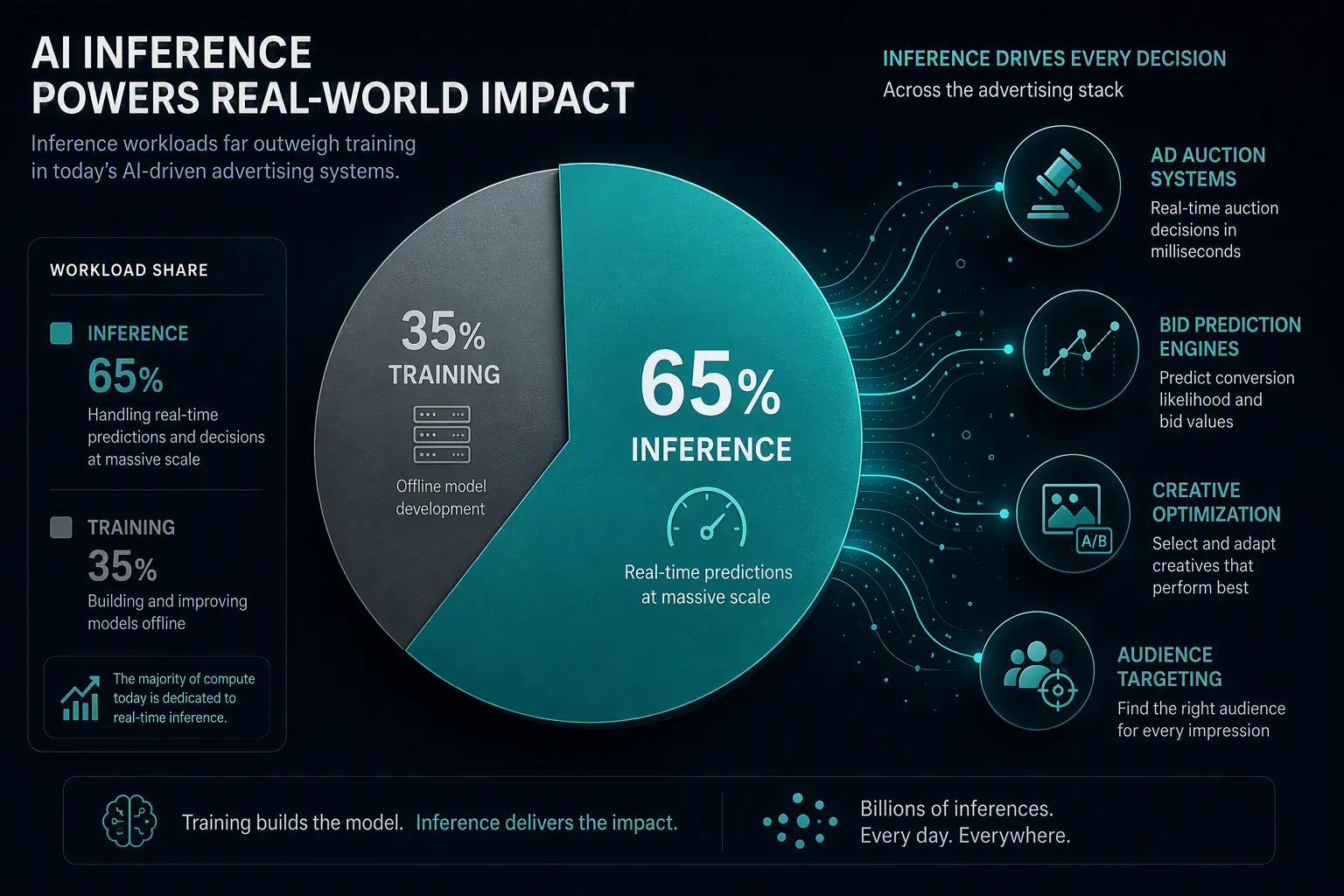
That distinction changes how the deal should be judged. A new supply agreement that only helped frontier-model training would still matter, but less directly for day-to-day campaign economics. A supply agreement that helps inference has a clearer route into ad-platform margins because inference is the recurring meter. It runs when the platform decides which asset to show, when it predicts which search query variant is close enough, when it expands a seed audience, and when it decides whether a marginal auction is worth entering.
The buyer never sees that meter line by line. A platform fee, a media margin, or a black-box product wrapper does not usually say how much went to GPU time, networking, memory, storage, engineering, sales coverage, or margin. But if inference becomes the majority of AI compute, then the cost of inference becomes part of the invisible floor under automated advertising products.
What 529MW Changes Inside the Auction Machine
The firm 529MW commitment is the number that gives this announcement its weight. Capacity talk is cheap when it is framed as aspiration. Firm leases, long terms, named regions, and contracted revenue make it a stronger signal. The optional expansion to 2.5GW is still an option, not guaranteed deployed capacity, but it shows the scale AMD and Core Scientific want the market to believe they can support.[1]
In ad operations terms, more inference supply can show up in two places. The first is margin. If a platform was already planning to run the same bidding and creative models, cheaper or more available compute can simply make those products more profitable. The second is feature intensity. The platform can run more model calls per auction, evaluate more creative variants, refresh predictions more often, or widen eligibility systems without making the advertiser feel a discrete new line item.
That second path is easy to underestimate. A buyer sees “AI creative,” “audience expansion,” or “automated asset testing” as product features. Underneath, those features compete for compute budget. If inference capacity is tight or expensive, the platform has an incentive to ration model calls, simplify decisioning, batch work, delay refreshes, or reserve the heavier workflows for customers and products that justify the cost. If inference capacity gets cheaper and more available, the product team can be more aggressive.
| Ad-platform activity | Why inference cost matters |
|---|---|
| Auction-time bidding | Each eligible impression can require value prediction, bid selection, and pacing decisions. |
| Creative optimization | More variants and placements increase the number of model evaluations the platform may want to run. |
| Audience expansion | Lookalike, broad-match, and intent systems depend on repeated scoring rather than one-time setup. |
| Feed and asset interpretation | Product attributes, landing pages, and creative assets can be parsed repeatedly as campaigns change. |
| Budget allocation | Automated systems need frequent forecasts across campaigns, channels, and conversion goals. |
None of this gives a buyer a clean formula from GPU price to CPA. Auction prices are affected by competition, conversion rates, measurement, bid strategy, budget pressure, and platform policy. Compute is one cost input inside the system, not the clearing price of the auction. The practical claim is narrower: if inference supply expands at lower cost, ad platforms have less infrastructure pressure forcing future fee increases or product constraints.
The AMD Cost Case Is No Longer Just Theoretical
The price gap is the simplest reason this deal matters. Silicon Analysts reported April 2026 dealer-quote ranges of $10,000 to $15,000 for AMD’s MI300X versus $25,000 to $40,000 for NVIDIA’s H100. It also reported MI350X ranges of $20,000 to $30,000 versus $30,000 to $40,000 for NVIDIA’s B200. On cloud pricing, the same analysis placed MI300X instances at $1.50 to $6.98 per hour versus $1.99 to $12.29 per hour for H100 instances.[2]
Those are not buyer-facing ad prices, and they should not be treated that way. They are infrastructure prices. But infrastructure prices still matter when the product being sold is increasingly built from repeated inference calls. If an ad platform can serve comparable inference workloads on cheaper accelerators, it has more room before AI feature growth turns into margin pressure.
There is also a production credibility question. A cheaper GPU that cannot be deployed at scale is just a procurement talking point. The AMD evidence is stronger than it was a couple of years ago: Meta runs 100% of live Llama 405B inference on MI300X, Microsoft runs GPT-3.5 and GPT-4 inference on MI300X via ONNX Runtime, and OpenAI committed to 6GW of MI450 deployment starting in the second half of 2026, according to the same market analysis.[2]
For ad systems, memory also deserves more attention than peak benchmark bragging rights. Silicon Analysts reported MI350X with 288GB of HBM3E versus 192GB on NVIDIA’s B200.[2] For memory-bound inference serving, especially with large models or longer context windows, more memory can reduce the number of GPUs needed for a workload. That can change cost per served prediction even when the buyer never sees the model architecture.
This is where the single deal connects to the broader cost stack. GPU competition can lower one side of the equation; memory supply can push the other way. For readers tracking both pressures, our earlier benchmark on AMD AI chip costs and ad platforms sits next to the separate pressure described in SK Hynix’s memory surge and AI ad platform costs. The AMD-Core Scientific news strengthens the supply-side case, but it does not erase memory as a constraint.
Why Switching Is More Plausible for Inference
The usual objection to any “NVIDIA alternative” story is software lock-in. That objection is real, especially in training, where custom CUDA kernels, mature tooling, and engineering familiarity can dominate the hardware spreadsheet. Inference is not free of lock-in, but it is a better place for price competition to bite.
Silicon Analysts, citing an AMD vice president, described Triton as “the great equalizer” and argued that inference is more price-sensitive and less dependent on custom CUDA kernel optimization than training. The same analysis pointed to frameworks such as vLLM and SGLang that abstract more GPU-specific code and can lower switching costs for inference workloads.[2]
That matters for advertising because many ad-platform AI workloads are serving problems, not frontier research projects. The platform needs stable throughput, acceptable latency, predictable cost, and enough flexibility to run many model variants. If the software layer makes it easier to move serving workloads across accelerator types, procurement teams get a more credible alternative when NVIDIA pricing is too rich or supply is too tight.
The strongest version of the AMD argument is not that every platform will rip out NVIDIA systems. It is that a credible second source changes the negotiation. Even partial workload portability can matter if it lets a large platform place inference expansion on AMD infrastructure while reserving NVIDIA clusters for workloads that still justify them.
What Buyers Should Expect to Feel
The least useful reaction would be to assume cheaper AMD-backed compute flows straight into cheaper ads. That is not how platform economics usually work. If the platform’s infrastructure cost falls, it can keep the difference. It can fund new features. It can offset other cost increases. It can subsidize a product line temporarily. It can also use the savings to preserve margins while auction competition does most of the work advertisers actually feel.
The better expectation is lower upward pressure. When a platform says an AI-heavy product needs higher fees, tighter eligibility, minimum spend, or more bundling because the infrastructure is expensive, a growing AMD inference supply base weakens that argument at the margin. It does not eliminate it. It makes the buyer’s next finance conversation slightly less one-sided.
- Do not expect a direct “AMD discount” in Google, Meta, TikTok, Microsoft, or retail media buying interfaces.
- Watch whether AI features become more aggressive without a visible fee increase: more automated creative testing, broader targeting, faster optimization, or heavier recommendations.
- Treat platform claims about AI cost pressure with more scrutiny when the workload is inference-heavy and portable.
- Separate media outcome metrics from infrastructure economics; cheaper inference can widen platform margins without improving CPA.
This also changes how buyers should interpret AI roadmap announcements. A platform shipping more automated bidding, creative generation, and predictive audience products at the same visible price may not be giving away value. It may be spending a lower compute cost per decision. That is still useful to buyers if the features perform, but it should not be confused with generosity.
The Risk in the Signal
The deal is one day old, and the largest numbers are forward-looking. The 529MW is firm under the announced leases, but the 2.5GW expansion is an option. The $14 billion-plus base contracted revenue depends on execution over long lease terms.[1] Data centers still have to be powered, equipped, interconnected, staffed, and operated through normal procurement messiness.
Core Scientific also brings some residual crypto exposure into the story. CoinDesk reported that the company still held 848 BTC as of June 30, 2026, while describing the AMD deal as part of a bitcoin-mining wind-down.[3] That does not invalidate the AI infrastructure partnership, but it is a reminder that this is not a frictionless hyperscaler buildout with no balance-sheet or execution questions.
The platform-pricing risk is more familiar: cheaper inputs do not require cheaper outputs. Ad platforms have every incentive to turn lower compute cost into margin, product velocity, or ecosystem control before they turn it into buyer-facing relief. Media buyers should read the deal as a cost-curve signal, not a promise of lower take rates.
The Practical Read
The AMD-Core Scientific deal does not prove ad platform fees will fall. It does not guarantee lower CPA. It does not prove every inference workload will move off NVIDIA hardware. What it shows is that AMD-backed AI infrastructure is being contracted at a scale large enough to matter, and that the relevant workload for advertising is increasingly inference.
For performance marketers, the useful conclusion is restrained: inference compute looks like it is moving into more abundant supply. If that holds, platforms have less need to justify future fee pressure with compute scarcity, or they can ship more aggressive AI bidding and creative features without obviously raising the buyer’s cost base. Either outcome changes the negotiation, even if it never appears as a line item in the ad account.
References
- Core Scientific and AMD Announce Infrastructure Partnership, Core Scientific, July 28, 2026.
- AMD vs NVIDIA AI GPU Market Share 2026 — Performance, Price, TCO Comparison, Silicon Analysts, April 2026.
- Core Scientific lands AMD AI deal as bitcoin mining operation winds down, CoinDesk, July 28, 2026.
Built on this evidence
No Bidding tactic or Creative record currently cites this case file. Compare it against other results in Benchmarks.
Related benchmark reading
Report a corroborating or contradicting result
Seeing something different in your own account? Feed the data-integrity loop instead of leaving an open comment.