
Is AMD's AI chip boom driving up ad platform costs?
AMD analyst upgrades in 2026 signal that the compute infrastructure behind AI ad platforms is scaling faster than expected, which likely means higher inference costs passed through to advertisers. This analysis breaks down what media buyers should watch for in Q3–Q4 2026.
- Platform
- Google Ads
- Campaign type
- Performance Max
- Spend range
- Analysis only
- Timeframe
- 0 Q3-Q4
- CPA
- Projected increase
- Verdict
- mixed
- Last reviewed
- 0-07-29
As of July 29, 2026, the useful question for a media buyer is not whether AMD is a buy. It is whether the infrastructure behind Performance Max, Advantage+, AI Max, and the next layer of autonomous campaign systems is getting more expensive before Q4 budgets are locked. The search phrase amd ai chip demand analyst upgrade 2025 may sound like a market note, but the signal sitting underneath it is operational: analysts are re-rating AMD because agentic AI workloads are expanding faster than prior models allowed.
That matters to advertisers because ad-platform automation does not run on slogans. Every extra model call, ranking pass, audience simulation, creative scoring loop, and budget-allocation decision has to be executed somewhere. AMD does not sell chips directly to a Google Ads account or a Meta campaign. The chain runs through hyperscalers, cloud infrastructure, platform-owned data centers, software margins, and auction behavior before it shows up as a CPC, CPM, or conversion cost. So the upgrade wave is not proof that your CPA will rise. It is a credible upstream cost signal that the compute substrate behind automated advertising is under more pressure than it looked earlier in the cycle.

The May 2026 AMD Upgrade Wave Was About Agentic AI, Not Just Chips
The load-bearing date is May 6, 2026. Goldman Sachs upgraded AMD to Buy with a $450 price target after AMD’s earnings, explicitly citing the “proliferation of agentic AI in enterprise and consumer workloads.”[1] Bernstein moved the same day, upgrading AMD to Outperform with a $525 target, modeling more than $14 in 2027 EPS and saying the agentic AI total addressable market had doubled from five months earlier.[2]
Those price targets are less important here than the reason analysts gave for changing them. A normal semiconductor upcycle would still matter, but it would not tell a media buyer much about Q3 and Q4 ad-platform economics. Agentic AI is different because it is the workload class ad platforms are moving toward: systems that plan, test, rank, allocate, and revise with less human instruction. Performance Max and Advantage+ are not identical to enterprise agents, but they depend on the same broad direction of travel: more inference, more orchestration, more memory bandwidth, and more infrastructure sitting behind each visible automation feature.
The upgrade cluster was unusually broad. Business Insider reported that at least six major Wall Street firms raised AMD targets on May 6, 2026 alone, calling it the largest coordinated semiconductor re-rating of 2026.[3] That does not make the analysts right. It does mean several desks changed their demand assumptions at the same time, and the shared rationale was not vague enthusiasm for AI. It was a specific belief that agentic workloads would require more AMD compute.
Why This Reaches Ad Platforms Only Indirectly
A campaign manager should be careful with the causal chain. AMD demand does not become a higher Google Ads CPC by itself. A more defensible chain looks like this: agentic AI demand increases data-center compute requirements; hyperscalers and large platforms buy or reserve more chips, servers, memory, and power; infrastructure costs rise or capacity tightens; platforms decide how much to absorb, how much to offset through pricing, and how aggressively to monetize AI-heavy features; advertisers then see the result through auction pressure, product packaging, minimums, opaque automation costs, or changes in inventory mix.
| Layer | What changed | What advertisers can actually infer |
|---|---|---|
| Chip demand | Analysts upgraded AMD on agentic AI demand | Infrastructure expectations moved higher |
| Hyperscaler and platform capacity | More inference and orchestration require more data-center resources | Platforms may prioritize AI feature velocity, margins, or both |
| Ad-system economics | Automated campaign systems make more machine decisions | Cost pressure is plausible, but not directly observable from AMD notes alone |
| Media-plan impact | CPM, CPC, CPA, or product fees may move differently by platform and vertical | Account-level benchmarks are still needed before making platform-specific claims |
This is why the AMD upgrade wave belongs in a benchmarks file rather than a stock-market explainer. It is not telling a growth team to buy AMD. It is telling the team that the cost base behind automated media buying may be changing faster than the ad platforms will describe in their product releases.
The Constraint Stack Is Bigger Than GPUs
The easiest story is that more AI chips eventually make AI cheaper. The current supply picture is less tidy. KeyBanc analyst John Vinh said AMD was “largely sold out of server CPUs for 2026,” with potential 10% to 15% price increases in Q1 2026.[4] Reuters also reported that AMD guided server CPU revenue to more than 70% year-over-year growth for Q2 2026, the fastest growth rate in that segment’s history.[5]
That CPU detail matters because agentic AI is not only a GPU story. GPUs handle the heavy model math, but large-scale AI systems still need CPUs to coordinate tasks, move data, manage agents, schedule workloads, handle retrieval, and support all the non-model logic wrapped around the model. Lisa Su has said data-center CPU-to-GPU ratios are shifting from a historical 1:4–8 range toward 1:1, and could invert in high-agent-density environments. For ad platforms, that is the part worth underlining: more autonomous decisions can mean more supporting compute around the model, not just a bigger accelerator bill.
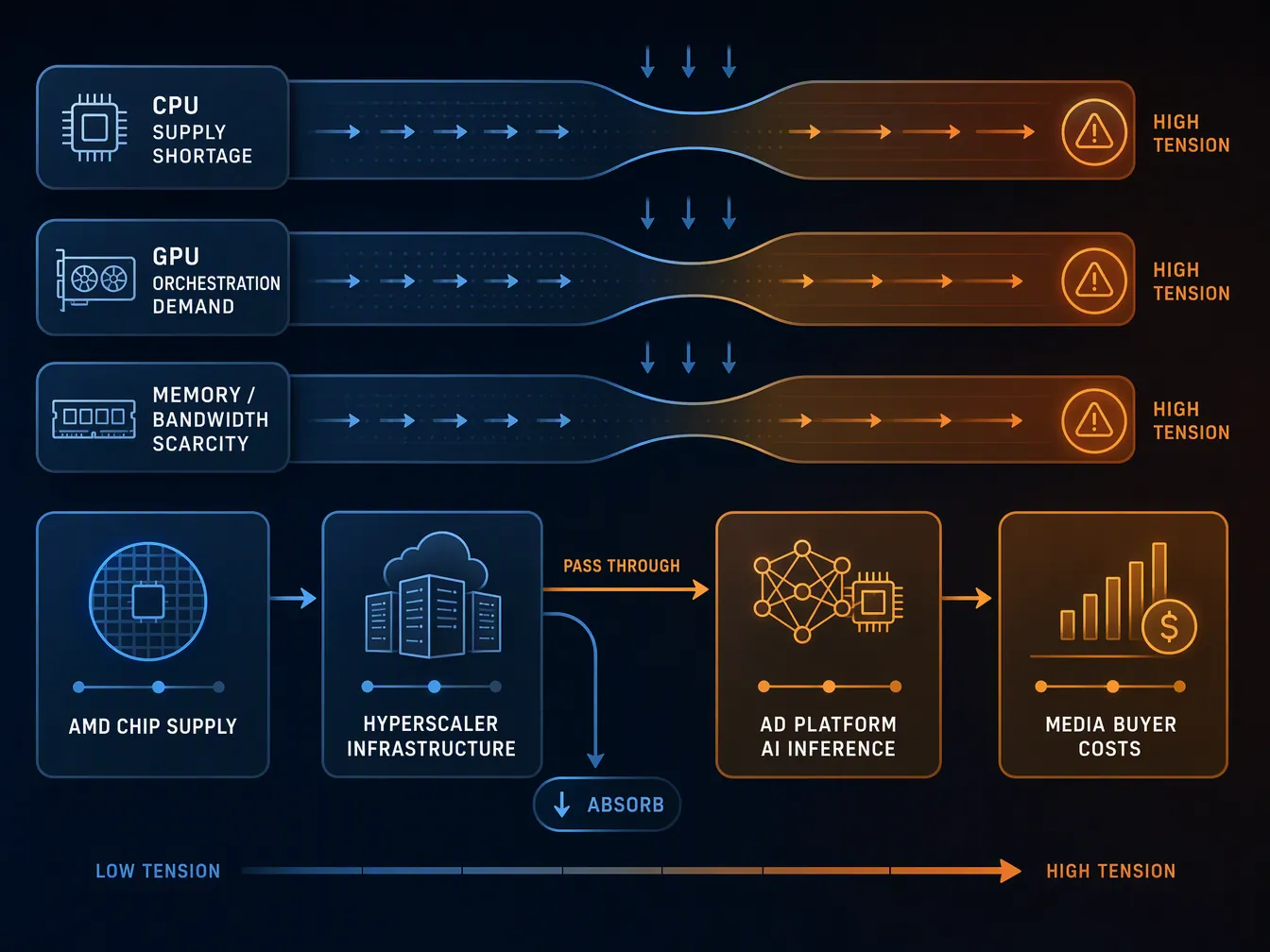
Memory is the second pressure point. Micron’s CEO told CNBC that customers were receiving only “50% to two-thirds of their requirements” because of memory shortages. That is not a footnote to the GPU race. If memory bandwidth and supply are constrained, platforms cannot simply assume that expanding accelerator capacity will make every inference step cheaper on schedule. For AI ad systems, memory pressure can show up as slower rollout, higher internal cost per decision, tighter access to advanced features, or pricing that nudges advertisers toward formats where the platform can recover the cost.
This is also where the October 2025 AMD-OpenAI deal fits. On October 6, 2025, AMD announced a 6GW chip-supply commitment with OpenAI starting in 2026; AMD shares rose 34%, adding about $80 billion in market value.[6] The deal is not evidence about ad-platform pricing. It is evidence that large AI buyers were willing to lock in enormous future capacity before the 2026 upgrade wave arrived.
What Could Reach a Q3–Q4 2026 Media Plan
For planning purposes, the practical question is where platforms choose to place the cost. Hyperscalers and ad platforms can absorb infrastructure pressure for a while, especially when AI feature adoption is strategically important. They can also pass it through indirectly, which is how advertisers are more likely to feel it: not as a line item called “AI inference,” but as changed auction dynamics, higher effective prices for AI-heavy inventory, less transparent optimization logic, or new product packaging around automation.
In Q3 and Q4 2026, the useful watchlist is not a single AMD chart. It is a set of operating signals:
- AI feature rollout pace: faster launches can indicate platforms are spending through the constraint, while delayed access can suggest capacity is being rationed.
- Pricing and packaging changes: watch for fees, minimums, eligibility thresholds, or bundled automation products that make infrastructure recovery less visible.
- CPM and CPC pressure around AI-heavy inventory: treat this as a signal to investigate, not proof of chip-cost pass-through.
- Automation opacity: if platforms increase automated decisioning while reducing levers, the buyer has less ability to separate auction inflation from system-cost recovery.
- Account-level benchmark records: actual campaign data should outrank infrastructure inference when deciding whether to shift budget.
The important budgeting move is not to add an arbitrary AI surcharge to every channel. It is to give Q4 plans enough room for the possibility that platform automation becomes more expensive to run at the same time advertisers are leaning harder on it for holiday volume. If a platform’s AI products keep improving conversion discovery, buyers may still accept higher unit costs. The risk is having to explain that trade-off after the invoices arrive instead of before the plan is approved.
The Counterview: AI Spending Could Cool Before Costs Fully Pass Through
The upgrade wave should not be read as a permanent law of ad costs. Citi analysts warned on November 12, 2025 that the “AI bubble will burst in a couple years,” a view that matters because infrastructure cycles can overshoot. If AI capex slows, if cloud buyers renegotiate, or if supply catches up, some of today’s pressure could be absorbed or moderated before it becomes a durable advertiser cost.
That counterview does not remove the 2026 planning problem. A bubble can still inflate the cost base before it bursts. Media buyers do not need a ten-year semiconductor forecast to care about the next two quarters. They need to know whether the systems making more campaign decisions are drawing on constrained infrastructure while platforms are under pressure to keep AI margins attractive.
How to Use the Signal Without Overclaiming It
The cleanest reading is conditional. The AMD upgrade wave is a credible upstream signal that AI infrastructure demand, especially agentic AI demand, is outrunning earlier expectations. Server CPUs appear tight. Memory is not clearing cleanly. Large AI buyers have already locked in major capacity. Those conditions make higher inference-cost pressure plausible for ad platforms in the second half of 2026.
What the signal does not prove is equally important. It does not prove that Google, Meta, Microsoft, or Amazon will raise advertiser costs in a neat line from AMD supply. It does not prove that every AI campaign type will become less efficient. It does not prove that higher compute cost will overwhelm performance gains from better automation. The pass-through decision sits between infrastructure teams, finance teams, product teams, and auctions.
For Signal & Convert readers, the next stop should be comparative evidence: see also AMD’s $1,250 Price Target and the Future of Ad Platform Economics for the Street-high AMD scenario, SK Hynix’s Memory Surge Is Raising AI Ad Platform Costs for the memory-supply counterpoint, Big Tech’s $724B AI Capex Is Reshaping Ad Costs for broader hyperscaler context, and Benchmarks records with actual campaign data before turning an upstream infrastructure signal into a channel-level budget change.
References
- AMD gets a big upgrade from Goldman Sachs, CNBC, May 6, 2026.
- Goldman and Bernstein Just Doubled Their AMD Price Targets, TIKR.
- Wall Street is rushing to raise price targets for AMD stock, Business Insider.
- AMD stock bets shift after analyst drops $15 billion message, TheStreet.
- AMD forecasts revenue above expectations, Reuters, May 5, 2026.
- AMD's shares surge on deal to supply AI chips to OpenAI, Al Jazeera, October 6, 2025.
Built on this evidence
No Bidding tactic or Creative record currently cites this case file. Compare it against other results in Benchmarks.
Related benchmark reading
Report a corroborating or contradicting result
Seeing something different in your own account? Feed the data-integrity loop instead of leaving an open comment.