
SK Hynix's Memory Surge Is Raising AI Ad Platform Costs
The 307% surge in DDR5 prices and a structural shift of 40% of DRAM output to AI workloads are driving up server costs that ad platforms ultimately pass through to advertisers. This article examines SK Hynix's record profits, China fab exposure, and what memory pricing means for your CPCs and CPAs.
- Platform
- Google Ads
- Campaign type
- Performance Max
- Spend range
- Enterprise
- Timeframe
- 0 Q2
- CPA
- Increasing
- Verdict
- mixed
- Last reviewed
- 0-07-29
If CPCs and CPAs keep grinding higher through late 2026, memory pricing deserves a spot on the diagnostic dashboard. Not as the new all-purpose excuse for weak account work, and not as proof that Meta, Google, Amazon, or retail media networks have raised ad prices because of DRAM. The evidence does not support that claim. But the servers running campaign automation, creative generation, audience modeling, bid prediction, and measurement are becoming more expensive in a way that is harder to dismiss as a temporary parts shortage.
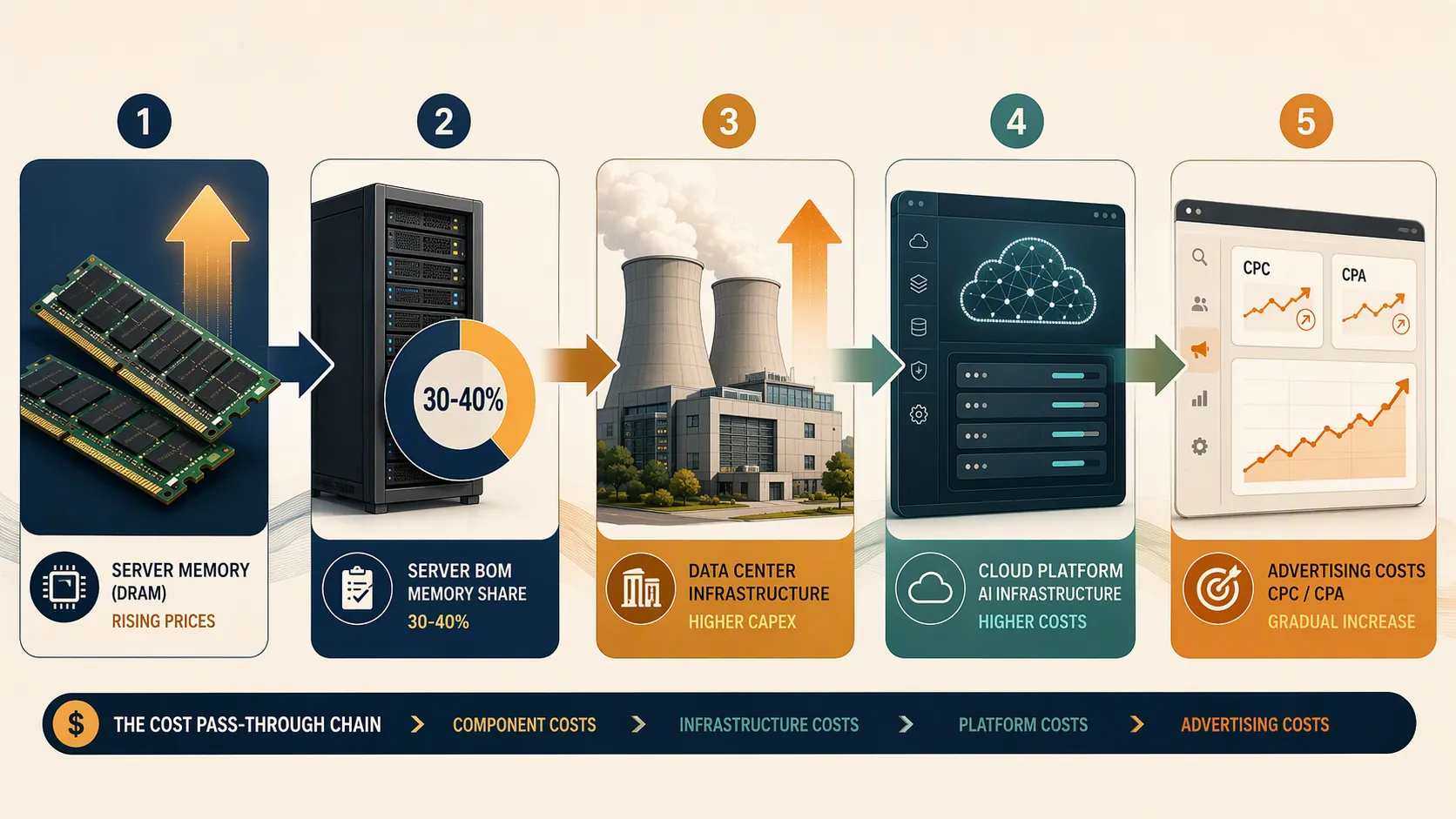
The uncomfortable number is DDR5 server memory. In Worldstream’s October–December 2025 spot data, DDR5 server memory prices rose 307% quarter over quarter, while DDR4 rose 158% over the same period. Memory also moved from roughly 15–20% of server bill of materials to 30–40%, and about 40% of global DRAM output was being directed toward AI workloads.[1] That combination matters more to ad buyers than a supplier earnings headline because it describes a higher cost floor under the infrastructure that platforms increasingly make mandatory.
The Memory Shock Sits Under the Auction, Not Inside the Auction Report
A media buyer does not see DDR5 in Ads Manager. They see a cost-per-click trendline, a CPA that stops responding to bid caps, a campaign type that performs only if more budget is handed to automation, or a client asking why last quarter’s target suddenly looks optimistic. The usual suspects still matter: auction competition, creative fatigue, weaker conversion intent, feed quality, landing-page performance, seasonality, and measurement changes. Memory pricing does not replace any of those explanations.
What has changed is that the infrastructure layer is no longer safely ignorable. When memory becomes a much larger share of server cost, and AI workloads absorb a large portion of DRAM supply, ad-platform automation starts to look less like a pure software margin story and more like a compute service with a rising input cost. Advantage+-style campaign management, Performance Max, generative creative tools, AI-assisted audience expansion, retail media optimization, and video automation all depend on server capacity somewhere upstream.
That does not mean an advertiser can point to a campaign’s June CPA increase and blame SK Hynix. It means the buyer should stop treating hardware inflation as someone else’s spreadsheet. When “free” AI optimization becomes operationally unavoidable, the cost of serving that optimization has to be recovered somewhere: through platform economics, product packaging, auction liquidity, API limits, minimums, or less visible changes in how features are bundled and prioritized.
SK Hynix Confirms the Supplier Side Has Pricing Power
SK Hynix’s latest results put fresh weight behind the memory-price signal. On July 29, 2026, the company reported Q2 2026 record revenue of 79.3 trillion won, up 257% year over year, with a 76% operating margin.[2] For paid-media purposes, the point is not whether SK Hynix is a good stock. The point is that the memory supplier side is not behaving like a weak link being forced to absorb AI demand. It is capturing pricing power.
That pricing power is the practical core of the AI hardware supply concern now showing up in ad-tech cost conversations. AI infrastructure demand has shifted DRAM allocation. Server buyers are paying more for memory. Memory suppliers are reporting unusually strong margins. None of that proves a direct pass-through into CPCs, but it does make the old “auction pressure” answer feel incomplete when every major platform is pushing more decisioning into AI systems.
There is also a supply uncertainty layer that buyers should not exaggerate but should not ignore. East Asia Forum has reported that 30–40% of SK Hynix’s DRAM and NAND production is in China, and those fabs remain exposed to annual U.S. license-renewal risk.[3] If licenses are renewed smoothly, that pressure may stay in the background. If restrictions tighten, memory availability could be affected independently of AI demand. For advertisers, the important point is not the geopolitics itself; it is that DRAM supply has more than one way to become less forgiving.
How a Memory Cost Becomes an Ad-Platform Cost
The pass-through mechanism is unlikely to arrive as a clean line item called “memory surcharge.” Advertising platforms do not price campaign automation that way. The more realistic path is slower and harder to prove from the outside.
| Layer | What Changes | What a Buyer Might Eventually See |
|---|---|---|
| Memory suppliers | DDR5 and DDR4 server memory prices rise as AI demand absorbs more DRAM output | Higher baseline cost for AI-capable servers |
| Server vendors and cloud buyers | Memory becomes a larger share of server BOM, contributing to server-price inflation | More expensive infrastructure behind model training, inference, and campaign serving |
| Hyperscalers and ad platforms | Capex plans expand and cost recovery pressure rises | Feature packaging changes, tighter access to advanced AI tools, or broader platform pricing pressure |
| Advertisers | AI automation becomes more central to campaign delivery | CPC and CPA drift that may mix auction pressure with infrastructure cost recovery |
The server-price layer is already moving. Worldstream and Dell’Oro reported server prices up 5–10% in the first half of 2026, with further increases forecast.[1][4] Dell’Oro also raised its 2026 data center capex outlook above $1 trillion and reported that the top four U.S. cloud providers increased spending 78% year over year.[4] Those numbers do not isolate ad platforms, but they describe the same infrastructure market that large ad systems rely on.
This is where the diagnosis has to stay disciplined. Rising data center capex is not the same as rising ad prices. Server prices rising 5–10% is not the same as a 5–10% increase in CPCs. A platform may absorb some infrastructure cost, offset it with efficiency gains, recover it through cloud contracts, or shift economics through products that advertisers cannot easily compare against older campaign types.
Still, the direction is hard to ignore. Ad-platform AI is not floating above the hardware market. It runs on CPUs, GPUs, memory, power, data center leases, networking, and financing structures. The CPU-side pressure covered in Intel’s AI Data Center Growth Signals Higher Ad Platform Costs, the GPU angle in How NVIDIA Infrastructure Costs Inflate Your Programmatic CPMs, the energy strain in PJM’s data center crisis is making your AI ads more expensive, and the broader capex picture in Big Tech’s $724B AI Capex Is Reshaping Ad Costs all point to adjacent parts of the same cost base. DRAM is the missing input because it turns the server itself into a more expensive unit of AI capacity.
What This Does and Does Not Explain in a Campaign Account
A buyer looking at a rising CPA still has to do the boring account work first. Check whether conversion rate fell. Check whether a top creative exhausted. Check whether the audience mix changed. Check whether the platform expanded into lower-quality inventory. Check whether attribution windows, consent flows, or landing-page speed changed. Hardware inflation is not a substitute for those checks.
Where memory pricing becomes useful is after the obvious account-level causes have been separated from broader platform movement. If multiple accounts, categories, and campaign types show gradual cost pressure while AI-heavy features become harder to avoid, the infrastructure layer becomes a credible context signal. It may not tell the buyer what to change tomorrow morning, but it can change how confidently they explain the difference between controllable performance degradation and market-level cost pressure.
A hypothetical example makes the distinction clear. Suppose an advertiser sees CPA rise after moving budget into an AI-automated campaign type. If creative frequency also jumped and conversion rate fell, the account has an immediate performance problem to solve. If conversion quality is stable, creative rotation is healthy, and similar drift appears across other advertisers using the same automation layer, the buyer has reason to monitor platform economics more closely. The memory-price data does not prove causality in either case; it keeps the infrastructure explanation from being dismissed too early.
The Monitoring List for Q3 and Q4 2026
The practical move is not to rewrite bid strategy around SK Hynix earnings. It is to add memory to the same external watchlist that already includes auction density, platform product changes, energy costs, cloud capex, and GPU availability.
- DDR5 and DDR4 server memory pricing: watch whether the late-2025 surge cools, stabilizes at a higher base, or accelerates again.
- SK Hynix and peer earnings language: look for comments on AI memory demand, supply allocation, margins, and customer commitments.
- Server BOM and server-price commentary: track whether memory remains 30–40% of server cost or begins to normalize.
- Hyperscaler capex revisions: rising cloud and data center budgets do not equal higher ad prices, but they raise the pressure to recover infrastructure spend.
- Ad-platform product changes: pay attention when AI campaign types become default, when manual controls disappear, or when advanced automation is repackaged into higher-value tiers.
- China fab license risk: monitor whether annual U.S. license renewals for China-based memory production remain routine or become a supply shock variable.
The standard should stay modest: useful enough to monitor, not strong enough to blame. As of Q3 2026, memory pricing is not a proven cause of higher CPCs or CPAs. It is, however, a credible early warning signal that the AI features now embedded in ad buying may be carrying a higher infrastructure cost floor than platform dashboards are willing to show.
References
- Worldstream Oct–Dec 2025 server memory spot data — Worldstream, Oct–Dec 2025.
- SK hynix Reports Second Quarter 2026 Financial Results — SK Hynix, July 29, 2026.
- East Asia Forum analysis on SK Hynix China fab exposure — East Asia Forum.
- Data Center Capex Outlook Raised Above $1 Trillion for 2026 — Dell’Oro Group, June 2026.
Built on this evidence
No Bidding tactic or Creative record currently cites this case file. Compare it against other results in Benchmarks.
Related benchmark reading
Report a corroborating or contradicting result
Seeing something different in your own account? Feed the data-integrity loop instead of leaving an open comment.