
How KLA's AI Infrastructure Boom Is Inflating Ad Tech Hardware Costs
The AI data-center buildout driving KLA's record revenue is constraining memory supply and raising ad tech hardware costs — a structural trend media buyers can track to anticipate platform fee increases.
- Platform
- Google Ads
- Campaign type
- Performance Max
- Spend range
- All spend levels
- Timeframe
- 0
- CPM
- Variable
- Verdict
- mixed
- Last reviewed
- 0-07-29
The awkward client call usually starts downstream. A platform fee changes. A CPM floor moves. A managed-service margin tightens. Nobody changed the campaign bids, yet the invoice has a new shape. The tempting explanation is that the platform simply took more margin. Sometimes that is true. But in 2026, one part of the cost stack deserves a closer look before buyers dismiss every increase as sales-room theater: the AI infrastructure buildout is competing for the same memory, servers, cloud capacity, and compute cycles that ad tech uses to run auctions.
KLA is a useful early signal in that chain, not because KLA sets ad prices, and not because its tools sit inside a demand-side platform. KLA sits several steps upstream, in semiconductor process control and inspection. Its FY2025 revenue reached $12.2 billion, up 24% year over year, and it reported record Q2 FY2026 revenue of $3.30 billion as AI-related chip demand continued to support advanced manufacturing investment.[1] Farther down the same infrastructure chain, AI data centers were consuming 70% of global memory production, server-grade DRAM prices had surged roughly 95% in early 2026, and semiconductor lead times reached 40 weeks in March 2026.[2][3]
That is the part media buyers should not ignore. Ad tech does not float above hardware. It runs on servers, memory, storage, networking, and cloud bills. Index Exchange has put the auction-level version plainly: AI-era workloads have made compute “meaningfully more expensive,” and “every request shipped to the cloud pays a toll” across billions of daily programmatic auctions.[4] IAB also warned in April 2025 that rising energy costs and supply-chain disruption can push CPMs upward, with cloud providers positioned to pass infrastructure cost increases to ad-tech customers.[5]
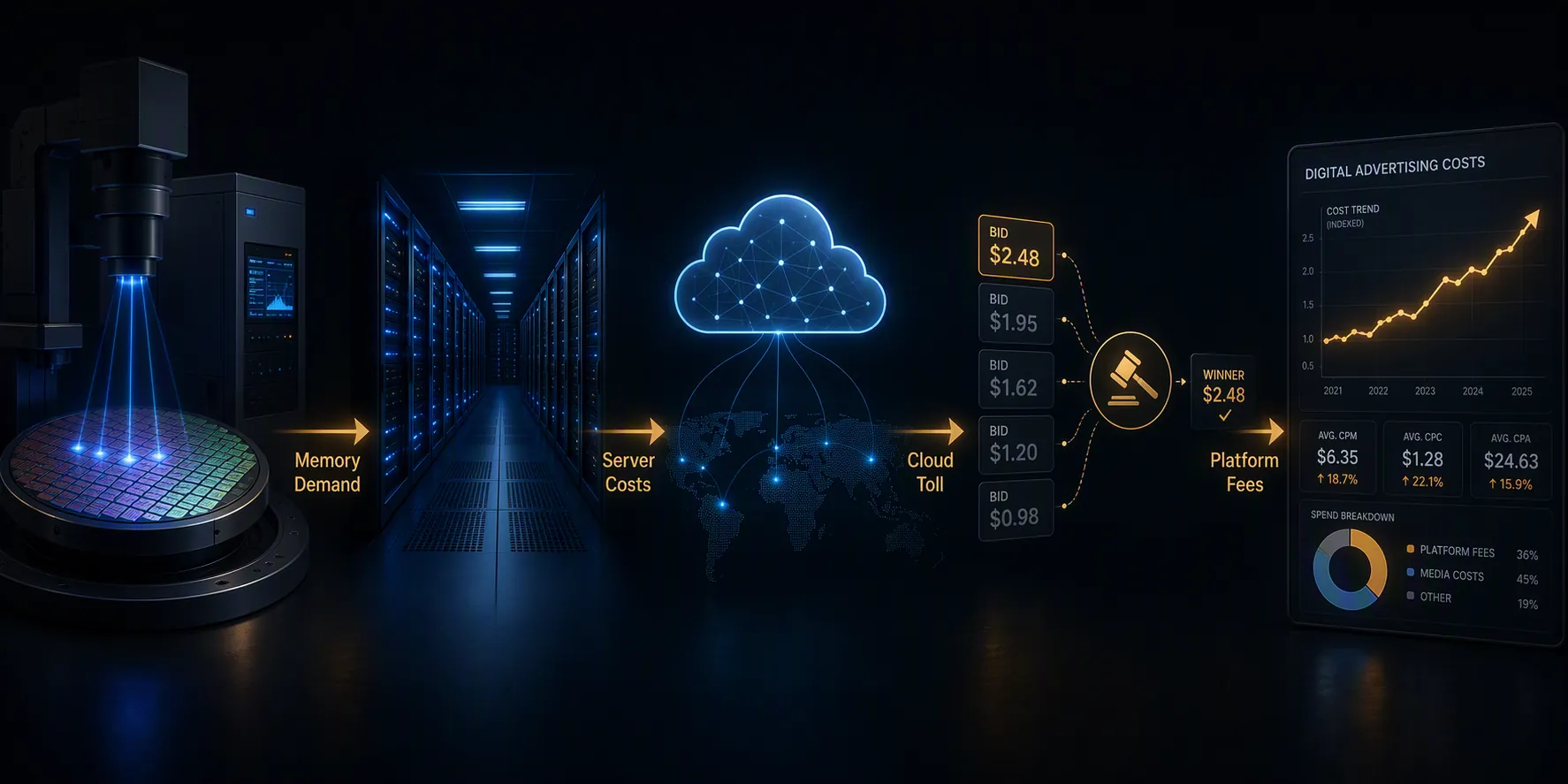
KLA Is Not the Cause of Higher CPMs. It Is a Pressure Gauge.
The cleanest way to read KLA’s AI boom is as a proxy for intensity in the chip-manufacturing layer. KLA sells inspection and process-control equipment used by chipmakers. When AI chips, high-bandwidth memory, and advanced packaging become harder to produce at scale, fabs need more sophisticated yield management. KLA benefits from that demand. But the buyer-facing ad cost does not move because KLA had a strong quarter.
The more defensible chain is longer: semiconductor inspection tools support chip manufacturing; chip manufacturing supports AI data-center expansion; AI data centers consume memory and server capacity; cloud providers absorb higher infrastructure costs; ad-tech platforms then feel those costs in hosting, data processing, model inference, auction routing, and logging. Some of that pressure shows up as platform fees, CPM floors, cloud surcharges, or reduced willingness to discount.
| Layer | What is happening | Why a media buyer should care |
|---|---|---|
| Semiconductor equipment | KLA revenue reached $12.2B in FY2025 and record Q2 FY2026 revenue | Signals heavy investment in advanced chip manufacturing capacity |
| Memory supply | AI data centers consumed 70% of global memory production | Leaves other hardware buyers competing for constrained supply |
| Server components | Server-grade DRAM prices surged roughly 95% in early 2026 | Raises the cost of infrastructure used by clouds and ad-tech vendors |
| Lead times | Semiconductor lead times reached 40 weeks in March 2026 | Makes capacity planning slower and less forgiving |
| Ad-tech compute | Cloud requests and programmatic auctions carry rising compute costs | Turns upstream infrastructure pressure into platform-level economics |
That distance matters. A DSP cannot point to KLA’s revenue and mechanically justify a specific fee increase. A buyer also cannot look at KLA’s stock chart and forecast next month’s CPM. The useful reading is narrower: when the upstream tools, memory allocation, server pricing, and cloud commentary all move in the same direction, the odds increase that ad-tech vendors will try to recover infrastructure cost somewhere.
The Memory Constraint Is the Link That Makes This Operational
Memory is where the infrastructure story becomes less abstract. AI data centers were reported to be consuming 70% of global memory production in 2026, leaving other sectors to compete for the remaining 30%.[2] That does not mean ad tech directly loses a memory allocation battle to a hyperscaler on a purchase order. It means the whole market for servers, upgrades, replacement parts, cloud capacity, and hosted compute has less slack.
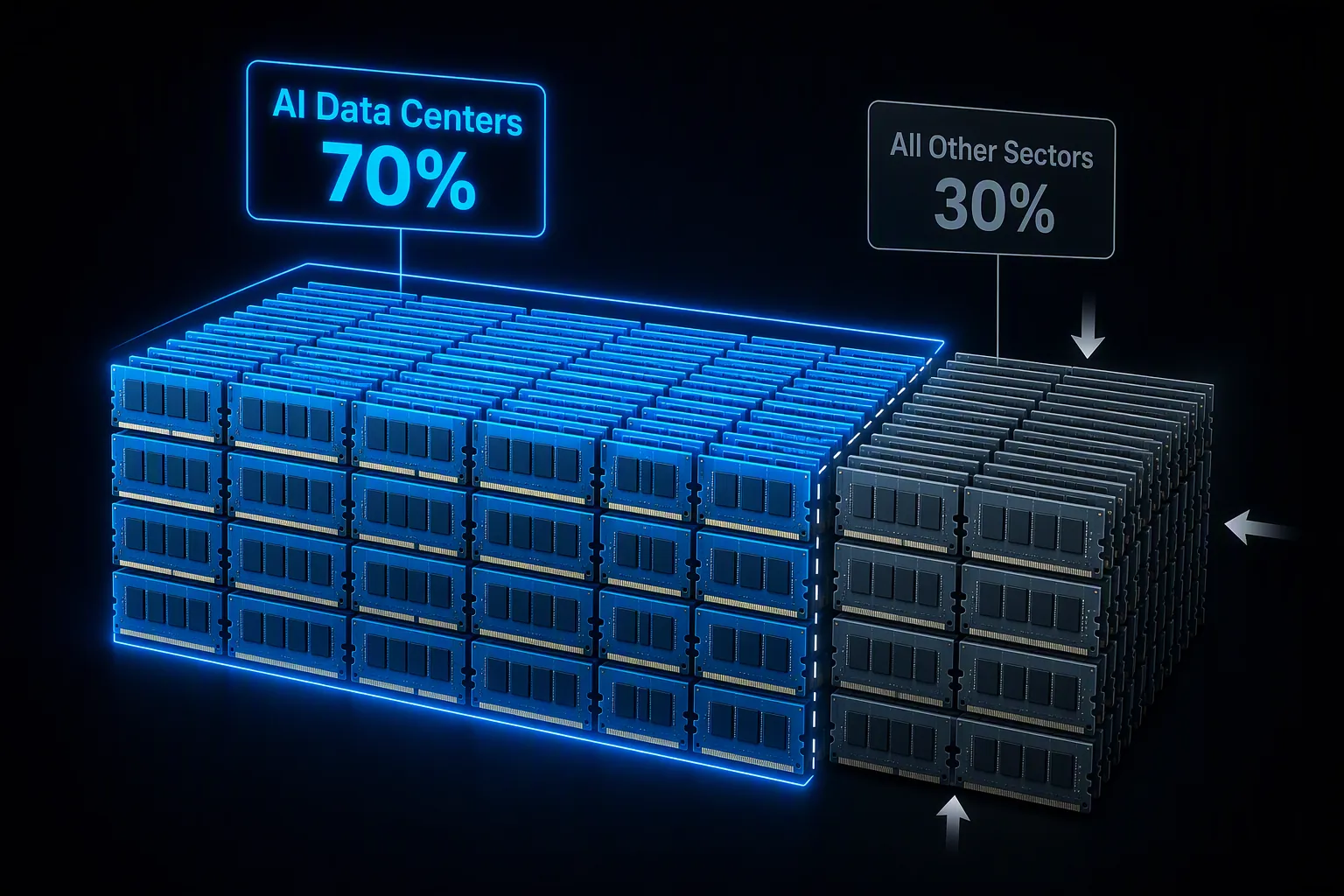
The price signal is already visible in the hardware layer. OpenMetal, citing Broadcom data, said server-grade DRAM prices surged roughly 95% in early 2026. The same analysis noted that Dell, HP, and HPE implemented about 15% server price increases, attributed through ReluTech reporting.[3] Those figures should be handled carefully: the 95% figure is for server-grade DRAM categories, not a blanket statement about every kind of memory a marketer might hear about in consumer-device news. But for ad tech, server-grade memory is exactly the category that matters.
A programmatic exchange, attribution vendor, clean room, bid optimization system, or retail media platform does not only pay for media logic. It pays for the machinery that executes that logic at scale: real-time requests, event ingestion, identity matching, fraud checks, model scoring, reporting queries, storage, and redundancy. If the cost of memory-heavy and compute-heavy infrastructure rises, the platform has three basic choices. It can absorb margin pressure, reduce infrastructure intensity, or pass cost downstream.
Most buyers only see the third option, and usually late. A new fee appears in a renewal. A minimum spend rises. A platform narrows free log-level access. A floor price becomes harder to negotiate. A “cloud optimization” project quietly changes reporting latency or data retention. Those are not all the same thing, and not all of them are caused by memory scarcity. But they are the buyer-facing places where infrastructure pressure can surface.
Lead Times Turn Hardware Inflation Into Planning Risk
Price increases are irritating. Lead times are harder to work around. Semiconductor lead times reached 40 weeks in March 2026, while shortages in power management ICs were expected to persist through 2026.[2] For a media buyer, that sounds distant until a vendor says a product migration, custom reporting environment, private marketplace feature, or clean-room integration now requires a different commercial package because capacity is being rationed.
A 40-week lead time does not automatically translate into a 40-week delay for an ad-tech feature. It does change the bargaining environment. When infrastructure teams cannot easily add capacity, the sales team has less room to treat compute-heavy work as free. The consequence may appear as stricter overage language, higher data-processing fees, reduced log retention, or more aggressive tiering between standard and premium support.
This is also where unchanged bids become a poor comfort metric. A paid-social or programmatic bid is only one line in the economics of delivery. The auction path around that bid can require model inference, targeting checks, brand-safety calls, fraud screening, measurement joins, and reporting writes. If the per-request cost of that surrounding infrastructure rises, the platform can hold the visible bidding interface steady while changing the economics around it.
Cloud Pass-Through Is Where the Hardware Story Enters Ad Tech
Most ad-tech companies are not buying wafers, fab tools, or raw memory at the scale of hyperscalers. They buy cloud services, colocated infrastructure, managed databases, storage, networking, and specialized compute. That is why cloud pass-through is the key translation layer between AI infrastructure and ad-platform costs.
Index Exchange’s explanation is valuable because it does not hide behind a vague AI narrative. It says compute has become meaningfully more expensive and frames every cloud request as paying a toll. In programmatic advertising, that toll is multiplied across billions of daily auctions.[4] A tiny unit-cost change can matter when the unit is repeated at auction scale.
IAB’s warning fills in the broader industry context. Its April 2025 discussion of ad-tech economic uncertainty pointed to rising energy costs and supply-chain disruptions as forces that can push CPMs higher, with cloud providers poised to pass infrastructure cost increases to ad-tech customers.[5] That is not proof that any individual CPM increase is justified. It is a reason to ask better questions when a rep claims the platform’s cost base has changed.
- Ask whether the increase is tied to media inventory, data processing, storage, cloud hosting, measurement, or support.
- Separate a platform’s margin expansion from a documented infrastructure pass-through.
- Request the affected billing unit: impressions, requests, conversions, events, seats, reports, audiences, or log exports.
- Check whether the fee applies to all clients or only high-volume, compute-heavy, or data-heavy accounts.
- Watch for non-price changes such as shorter retention windows, stricter usage caps, or reduced free support.
The useful question is not “Did KLA make my CPM go up?” It is “Which infrastructure layer changed, and where does that layer sit in the platform’s cost model?” A vendor that cannot answer that may still have real cost pressure. It just has not given the buyer enough information to separate pass-through from packaging.
Hyperscaler Spending Keeps the Pressure Visible
The scale of hyperscaler spending helps explain why smaller infrastructure buyers feel crowded out. Fortune, citing Moody’s, reported that the four largest cloud companies were expected to spend more than $600 billion on capital expenditures in 2026. Other estimates run higher, so the conservative reading is enough: the largest buyers are still committing extraordinary capital to AI infrastructure.[6]
That spending does two things at once. It expands long-term capacity, which could eventually ease some bottlenecks. It also intensifies near-term competition for chips, memory, power, data-center space, and specialized technical labor. The ad-tech vendor buying cloud capacity is not negotiating from the same position as a hyperscaler allocating billions to its own AI roadmap.
This is why buyers should monitor capex, but not treat it as a simple price calendar. A large capex number can mean new supply is coming. It can also mean current demand is so strong that the largest firms are locking up capacity before others can get it. The effect depends on timing, component category, geography, power availability, and the specific cloud services an ad-tech platform uses.
Do Not Misread the July 2026 Equipment Selloff
One reason to keep this framework careful is that market signals can look contradictory. KLA shares fell 11.61% on July 2, 2026, during a broader semiconductor-equipment sector correction tied in part to concerns about memory oversupply.[7] That selloff should not be read as a clean reversal of AI infrastructure demand.
A stock move can reflect positioning, valuation, sector rotation, forward-margin concern, or a debate about future memory supply. It does not erase the current evidence that AI data centers have been consuming a large share of memory production, server-grade DRAM prices rose sharply in early 2026, and cloud compute costs are pressing on programmatic economics. The right interpretation is mixed: the equipment trade can correct while the operating cost pressure remains relevant.
What to Track Before the Next Fee Change
Media buyers do not need to become semiconductor analysts. They need a short list of upstream indicators that are close enough to ad-tech cost structures to matter, and far enough upstream to give warning before the renewal deck arrives.
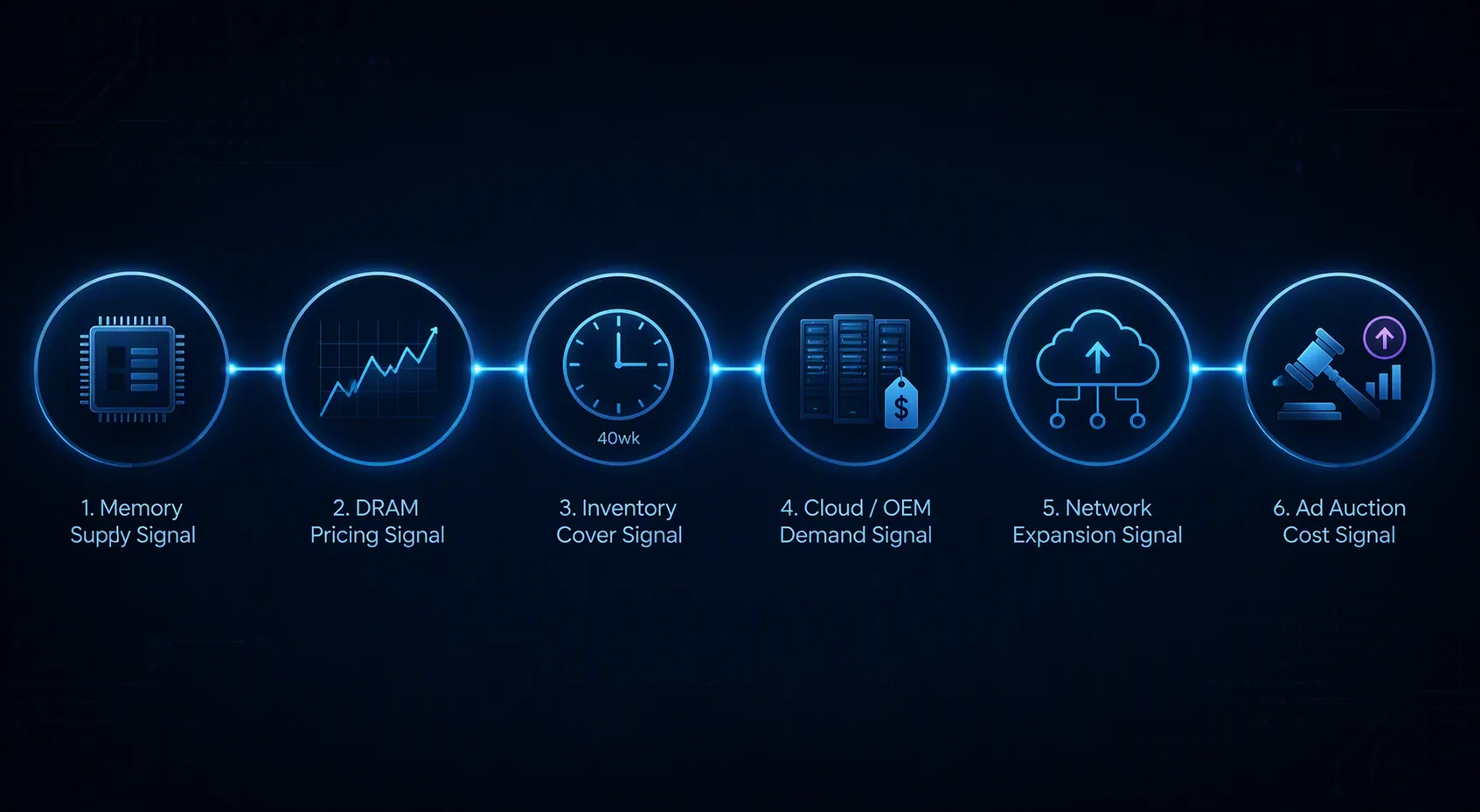
- Memory allocation pressure: if AI data centers continue taking most global memory production, assume other infrastructure buyers face tighter pricing and availability.
- Server-grade DRAM pricing: this is a more relevant signal for ad-tech infrastructure than consumer memory headlines.
- Semiconductor and power-management lead times: long lead times reduce the flexibility of cloud and platform capacity planning.
- Server price increases from major OEMs: higher server acquisition costs can flow into cloud pricing, colocation costs, and managed infrastructure contracts.
- Hyperscaler capex: use it as a demand-intensity signal, not as a direct forecast of ad prices.
- Ad-tech commentary on compute and cloud costs: statements from exchanges, DSPs, SSPs, measurement vendors, and industry bodies are the closest public signals to buyer-facing pass-through.
Those indicators are most useful when they move together. One server-price headline is not a media-plan emergency. A cluster of rising DRAM prices, long lead times, higher cloud commentary, and stricter platform terms is different. That cluster gives buyers a reason to prepare clients before costs appear in the platform UI.
How to Use This in a Budget Conversation
The practical value is not predicting that CPMs will rise by a specific percentage on a specific date. The data does not support that. The value is being able to distinguish inventory inflation from infrastructure inflation, and to ask for the billing logic before accepting a platform’s explanation.
A buyer can say, accurately, that AI data-center demand is tightening memory and server supply, that server-grade DRAM and OEM server pricing have already moved sharply, and that cloud and compute costs are being discussed openly inside ad tech. From there, the platform still has to explain why its specific fee changed, which product area is affected, and whether the increase reflects actual usage or a broad commercial reset.
That distinction protects both sides of the client conversation. It prevents a buyer from treating every increase as fake. It also prevents a vendor from hiding behind the phrase “AI infrastructure” without showing the path from cost to invoice. KLA’s revenue, memory scarcity, DRAM inflation, lead times, hyperscaler capex, and programmatic cloud tolls belong in the same monitoring file. They do not belong in a one-source formula for exact CPM increases.
References
- KLA Corporation AI page, Yahoo Finance comparison, and Money Morning July 3, 2026 sector selloff coverage
- How AI Data Centers Are Reshaping Electronic Component Supply in 2026, Tom's Hardware via Accuris
- What the 2026 Hardware Supply Crisis Means for Your Infrastructure Budget, OpenMetal
- Why Programmatic Efficiency Matters in the Age of AI, Index Exchange
- Ad Tech Economic Uncertainty, Energy Costs, and More, IAB, April 2025
- Fortune via The Current coverage of Moody's hyperscaler capital expenditure estimate for 2026
- Money Morning July 3, 2026 coverage of semiconductor equipment sector selloff
Built on this evidence
No Bidding tactic or Creative record currently cites this case file. Compare it against other results in Benchmarks.
Related benchmark reading
Report a corroborating or contradicting result
Seeing something different in your own account? Feed the data-integrity loop instead of leaving an open comment.