
How NVIDIA Infrastructure Costs Inflate Your Programmatic CPMs
Standard media inflation reports don't track GPU costs, but rising NVIDIA GPU rental prices, DRAM surges, and ad-platform dependency disclosures reveal a hidden cost layer that may be inflating your programmatic CPMs beyond reported media inflation. This article examines the evidence and explains what media buyers should watch.
- Platform
- Programmatic
- Campaign type
- Programmatic Display
- Spend range
- General
- Timeframe
- 0
- CPM
- 0-10% range
- Verdict
- mixed
- Last reviewed
- 0-07-27
The uncomfortable CPM conversation usually starts before anyone says “NVIDIA.” A client sees stable budgets, unchanged audience logic, no obvious creative fatigue, and a programmatic CPM line that still keeps drifting higher. The standard benchmark does not fully explain the gap: DAC reported overall media inflation of 2.5% for 2025, while many buyers are trying to explain account-level programmatic pressure that feels materially higher than that, sometimes in the 5–10% range inside their own books.[1]
That does not make GPU cost the culprit for every CPM increase. Audience competition, seasonality, floor pricing, identity changes, inventory mix, reseller paths, and auction density can all move CPMs without any help from an AI chip. But standard media inflation reports are not built to isolate GPU infrastructure as a campaign cost layer. If ad platforms are spending more to run auctions, recommendation models, prediction systems, and real-time optimization, the buyer usually sees the result only after it has been folded into fees, take rates, minimums, bid dynamics, or ROAS compression.
The cleanest early signal is not an earnings narrative or an “AI bubble” debate. It is rental pricing for the GPUs that sit upstream of the systems now used to make and price ad decisions.
The Q1 2026 GPU rental jump is the signal buyers should not ignore
Silicon Data’s GPU Price Index, reported by Business Insider in April 2026, showed H100 rental pricing rising 20% in Q1 2026, from about $2.20 to about $2.64 per hour. The B200 index rose 22% in the same quarter, from about $4.40 to about $5.35 per hour.[2]
| GPU rental index | Q1 2026 movement | Why it matters to ad buyers |
|---|---|---|
| NVIDIA H100 | Up 20%, from about $2.20/hr to about $2.64/hr | A widely used AI accelerator became more expensive to rent during the same quarter buyers were watching campaign efficiency tighten. |
| NVIDIA B200 | Up 22%, from about $4.40/hr to about $5.35/hr | Newer Blackwell-class capacity also moved higher, which matters for platforms shifting heavier recommendation and inference workloads onto newer GPU infrastructure. |
| Hyperscaler vs. neocloud pricing | H100s cost nearly 3x more from hyperscalers than from neoclouds | An ad platform’s hosting choice can materially change its GPU cost basis before a buyer ever sees a CPM. |
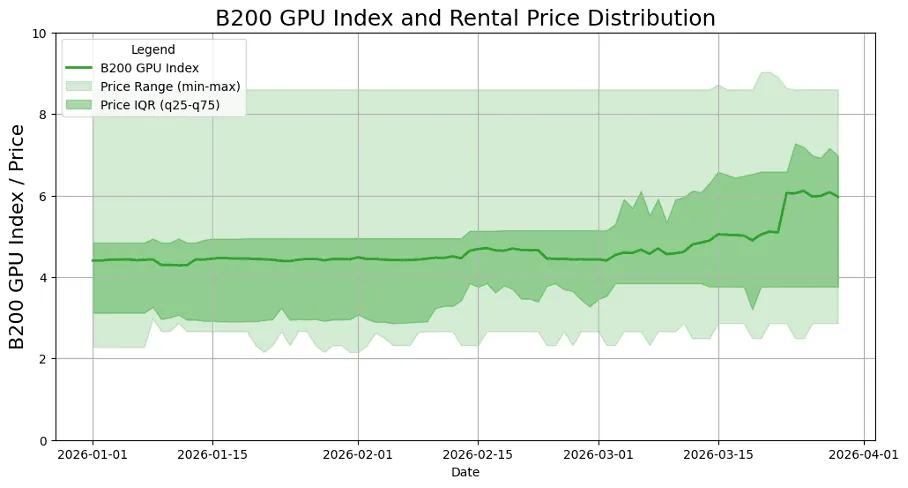
This is a better starting point than a broad “AI makes ads expensive” claim because it is close to an operating input. A platform that runs model inference, bidder logic, recommendation ranking, fraud scoring, or yield optimization on rented GPU capacity has to absorb the hourly compute bill somewhere. The bill may sit inside cloud cost, managed-service pricing, engineering allocation, infrastructure margin, or a vendor contract. It does not have to appear as a line item called “GPU surcharge” to matter.
The caveat belongs right next to the inference: no cited source documents a direct pass-through from H100 or B200 rental prices into PubMatic, Criteo, The Trade Desk, Magnite, Meta, Amazon, or any other platform’s buyer-facing CPMs. Silicon Data is also a young market intelligence source, even though the Business Insider report described its method as ingesting hundreds of thousands of pricing points globally.[2] The index is useful as a directional cost signal, not as a CPM attribution model.
That distinction matters. If a buyer’s CPM rose 8% in a quarter, the right conclusion is not “GPU rental went up 20%, therefore my CPM went up 8%.” The more defensible reading is narrower: one important upstream input for AI-heavy ad infrastructure became sharply more expensive, and the dashboard most buyers use does not separate that input from auction demand, inventory quality, platform fees, or margin.
DRAM pricing makes near-term relief harder to assume
The GPU rental signal is not isolated from the rest of the hardware stack. Datatrack data reported by TechCrunch in July 2026 showed DRAM spot prices rising roughly 10x since August 2025.[3] That matters because memory is part of the bill of materials behind AI hardware. When memory pricing surges, it constrains how easily NVIDIA and its customers can lower the total cost of GPU capacity.
For media buyers, DRAM is not something to model into a campaign forecast. It is a pressure gauge. If GPU rental indexes are rising while memory spot prices are also rising, it becomes harder to argue that compute cost pressure is a temporary procurement quirk. It may still unwind. But a buyer trying to explain programmatic CPM creep should not assume that platform compute costs automatically normalize just because campaign budgets remain disciplined.
NVIDIA’s infrastructure economics are also moving toward recurring platform revenue
The next piece is less about the absolute price of a GPU hour and more about how NVIDIA participates in cloud economics. The Register reported in July 2026, citing NVIDIA’s own blog, that NVIDIA had introduced arrangements where it receives standard product revenue plus a recurring share of cloud revenue. The cited deals included Sharon AI at 40,000 GPUs and Firmus at 170,000 GPUs.[4]
That structure changes the mental model. Traditional hardware procurement looks like a large capital purchase that then gets depreciated, utilized, and priced into services. A product-plus-cloud-revenue-share model can turn part of the infrastructure economics into a continuing platform obligation. For any company buying AI capacity from a cloud provider whose economics include those revenue-share terms, the compute layer may carry recurring cost expectations beyond the hardware purchase itself.
This is where circular financing risk needs discipline. It is relevant because analysts have questioned whether some AI infrastructure demand is being supported by financing structures connected to the same ecosystem that benefits from the demand. IDC’s June 2026 analysis was analyst commentary, not primary financial disclosure, and no source in this brief discloses what proportion of NVIDIA revenue is tied to such arrangements.[5]
So the advertiser implication is not that buyers are directly funding any specific NVIDIA deal. The narrower implication is that AI infrastructure pricing is no longer just a chip price story. If GPU supply, cloud revenue sharing, financing arrangements, and platform AI workloads all interact upstream, ad buyers need to monitor those signals because the operating costs can arrive downstream without being labeled.
Ad-tech’s GPU dependency is no longer theoretical
The cost-chain argument would be weak if ad platforms were only vaguely “using AI.” The disclosures are more concrete than that.
PubMatic said in an October 2025 press release distributed through BusinessWire that its AI overhaul runs on NVIDIA L40S GPUs, NVIDIA Triton Inference Servers, and RAPIDS Accelerator. The same disclosure said the system processes trillions of daily ad decisions at 1 millisecond latency.[6]
That is the kind of sentence a buyer should read twice. “Trillions of daily ad decisions” means GPU-supported infrastructure is not sitting in a lab demo or a quarterly innovation deck. It is close to the actual machinery of auction evaluation, prediction, routing, and yield management. A one-millisecond latency requirement also narrows the room for cheap, slow, loosely coupled infrastructure. Real-time ad decisioning has to pay for speed.
NVIDIA’s Cannes Lions blog in June 2026 gave another useful disclosure: Criteo freed about 17,000 GPU hours per year using Blackwell GPUs for recommendation models. The same NVIDIA blog said AWS deploys NVIDIA Triton for real-time auction bidding.[7]
The Criteo example should not be misread. Freeing 17,000 GPU hours per year is an efficiency gain, not proof that Criteo’s costs rose or that it passed any GPU expense to buyers. But it does prove that GPU hours are a measurable resource inside ad recommendation infrastructure. If an optimization can save GPU hours, then GPU hours were part of the operating equation in the first place.
The AWS auction-bidding reference matters for a different reason. It shows that GPU inference infrastructure is touching real-time bidding workflows, not only creative generation or back-office analytics. Once inference sits inside auction logic, infrastructure cost becomes harder to separate from the transaction cost of media delivery.
Where the cost can surface without being named
A buyer is unlikely to see a separate GPU line in a DSP invoice. The pressure can show up in less direct ways:
- Higher platform fees or less flexible fee negotiations, especially where AI optimization is bundled into the core product.
- Minimum CPM behavior that holds even when demand appears softer.
- Bid shading or optimization systems that protect platform economics before they protect advertiser efficiency.
- ROAS compression where conversion rate, creative quality, and audience logic do not show equivalent deterioration.
- New “AI” product tiers that package compute-intensive features into paid upgrades rather than visible pass-through charges.
None of those signals proves GPU pass-through by itself. They are where a buyer should look when upstream infrastructure gets more expensive and the platform has no reason to itemize the cost for advertisers.
Benchmark reports are still useful, but they are not built for this layer
The point is not to discard media inflation benchmarks. DAC’s 2.5% overall media inflation number gives buyers a useful broad-market anchor, and its 2025 reporting also noted search CPL up about 25% year over year.[1] Those figures help separate account-specific problems from wider market movement.
Meta CPM context can also be useful as a comparison surface. ADEN’S LAB reported Meta CPMs up 28% in Q1 2026, but that figure comes from a blog-sourced comparison point, not Meta’s own earnings disclosure.[8] It is worth watching, not enough to generalize across the market.
The missing layer is infrastructure. A benchmark can tell you whether media prices are broadly rising. It usually will not tell you whether a platform’s cost to run AI inference, auction ranking, or recommendation models rose because H100 rental, B200 rental, DRAM, or cloud revenue-share economics changed upstream.
That matters more as NVIDIA’s data center business keeps expanding into the same supply pool used by hyperscalers, neoclouds, AI infrastructure providers, and ad-tech platforms. Data Center Frontier reported NVIDIA data center revenue of $46.74 billion in Q2 2026, up 56% year over year.[9] A buyer does not need to trade NVIDIA stock to care about that number. It tells you the capacity market ad platforms depend on is large, competitive, and strategically important to many buyers of compute besides ad tech.
A practical GPU cost signal tracker for media buyers
The useful output here is not a forecast. It is a quarterly reconciliation habit. If programmatic CPMs rise faster than your usual inflation benchmark, and campaign fundamentals do not explain the move, add upstream AI infrastructure signals to the review before blaming the buyer, the creative, or the audience plan.
| Signal to track | What it can tell you | What it cannot prove |
|---|---|---|
| H100 and B200 rental indexes | Whether the GPU capacity used in AI-heavy infrastructure is becoming more expensive quarter to quarter. | The exact share of your CPM increase caused by GPU cost. |
| Hyperscaler vs. neocloud GPU pricing spreads | Whether a platform’s hosting choices could materially change its cost basis. | Which cloud provider your platform uses for each workload unless it discloses that detail. |
| DRAM spot pricing | Whether upstream hardware cost pressure is likely to ease or persist. | A direct change in platform fees. |
| New NVIDIA cloud revenue-share deals | Whether GPU economics are shifting from one-time product revenue toward recurring platform participation. | That advertisers are directly funding any specific infrastructure deal. |
| Ad-platform infrastructure disclosures | Which vendors are explicitly using NVIDIA GPUs, Triton, Blackwell, RAPIDS, or related infrastructure in auction and recommendation systems. | That the vendor has passed those costs into CPMs. |
| Platform fee changes and paid AI tiers | Whether compute-intensive features are being monetized more directly. | That NVIDIA is the only or primary cost driver. |
| Minimum CPM behavior | Whether pricing floors remain firm despite weaker campaign demand signals. | The reason those floors are firm without additional evidence. |
| ROAS compression without creative or audience deterioration | Whether unseen cost or auction mechanics may be reducing efficiency. | That GPU cost is the sole cause. |
The standard for using this tracker should be the same standard buyers already use when reconciling platform numbers against invoices and logs: one signal is interesting, several dated signals moving together deserve attention. GPU infrastructure cost is now credible enough to track as a hidden CPM pressure. It is not yet measurable enough to assign a precise percentage of any advertiser’s CPM increase.
References
- DAC 2025 media inflation and search CPL reporting, DAC, 2025
- Silicon Data GPU Price Index, Business Insider, April 2026
- Datatrack DRAM spot pricing report, TechCrunch, July 2026
- NVIDIA cloud revenue-share program coverage, The Register, July 2026
- IDC analysis on circular financing risk, IDC, June 2026
- PubMatic AI infrastructure press release, BusinessWire, October 2025
- NVIDIA Cannes Lions advertising AI infrastructure blog, NVIDIA, June 2026
- Meta CPM Q1 2026 benchmark commentary, ADEN’S LAB, May 2026
- NVIDIA data center revenue Q2 2026 coverage, Data Center Frontier, 2026
Built on this evidence
No Bidding tactic or Creative record currently cites this case file. Compare it against other results in Benchmarks.
Related benchmark reading
Report a corroborating or contradicting result
Seeing something different in your own account? Feed the data-integrity loop instead of leaving an open comment.