
How AI Data Center Power Instability Hurts Your Paid Ad ROAS
When AI data center power stability wavers, ad campaign inference quality degrades before any outage is declared. Learn how this hidden degradation zone creates a ROAS tax that standard dashboards miss, and how to detect it.
- Platform
- Meta
- Campaign type
- Advantage+
- Spend range
- General
- Timeframe
- 0
- ROAS
- Declining trend
- Verdict
- mixed
- Industry vertical
- ecommerce
- Last reviewed
- 0-07-25
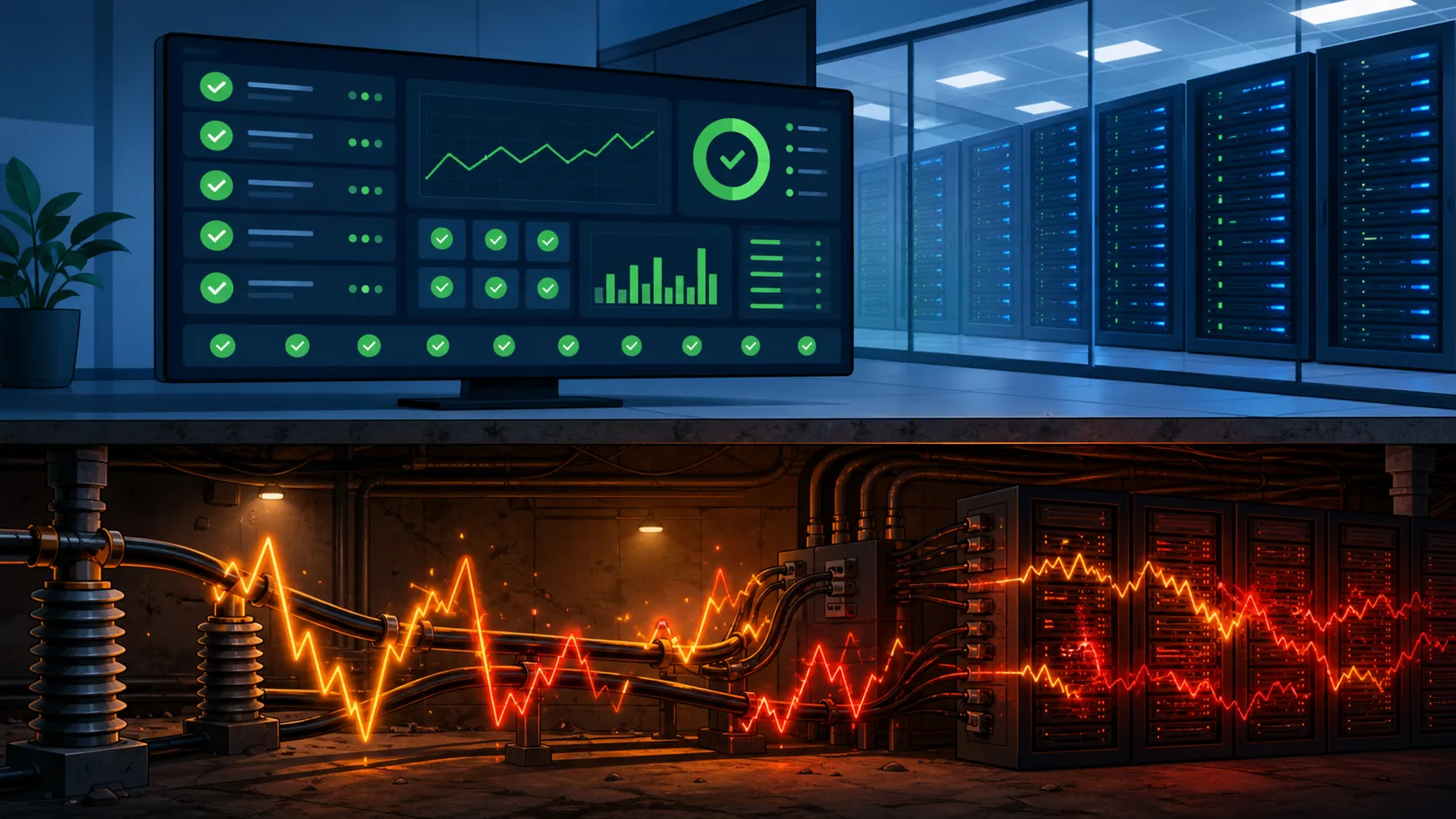
The worst paid-search or paid-social problem is not the clean outage. A clean outage at least gives you a timestamp, a status-page link, and something to show the client when yesterday’s spend stops matching yesterday’s revenue. The more expensive problem is the gray window before that: Performance Max, Advantage+, AI Max, and Symphony keep buying, the platform UI keeps looking usable, and the model decisions behind the spend may already be getting worse.
That is where AI data center power stability risks become paid-ad bidding problems rather than a distant infrastructure story. If an AI-heavy ad system is still technically online but the compute layer is unstable, the account-level symptom is unlikely to arrive as a neat red banner. It is more likely to show up as odd pacing, weaker conversion quality, rising CPC pressure without a matching intent lift, or ROAS sliding just enough that the buyer starts questioning creative, feed quality, audience overlap, or bid settings.
The Auction Does Not Wait for a Status Page
AI ad systems are not making one daily decision and then calmly executing it. They are constantly estimating which impression is worth entering, which user signal matters, which asset or product variant should be shown, and how much risk to take in the auction. Those decisions depend on inference systems that have to respond inside tight serving windows.
That timing matters because the power side of AI infrastructure is no longer behaving like a slow, predictable background load. IEEE Spectrum reported in July 2026 that high-density AI compute can create “abrupt” electricity-demand changes at millisecond scale, a pattern different from prior grid loads because the ramp can happen almost instantly across dense clusters of accelerators.[1]
In programmatic advertising, milliseconds are not trivia. AWS’s RTB Fabric documentation says real-time bidding systems need “consistent single-digit millisecond latency,” and that every added millisecond can reduce win rates.[2] That is vendor documentation, not an independent benchmark, so it should not be treated as a universal measurement of every auction. But it does establish the operating premise buyers already live with: auction systems reward speed and consistency, not just eventual availability.
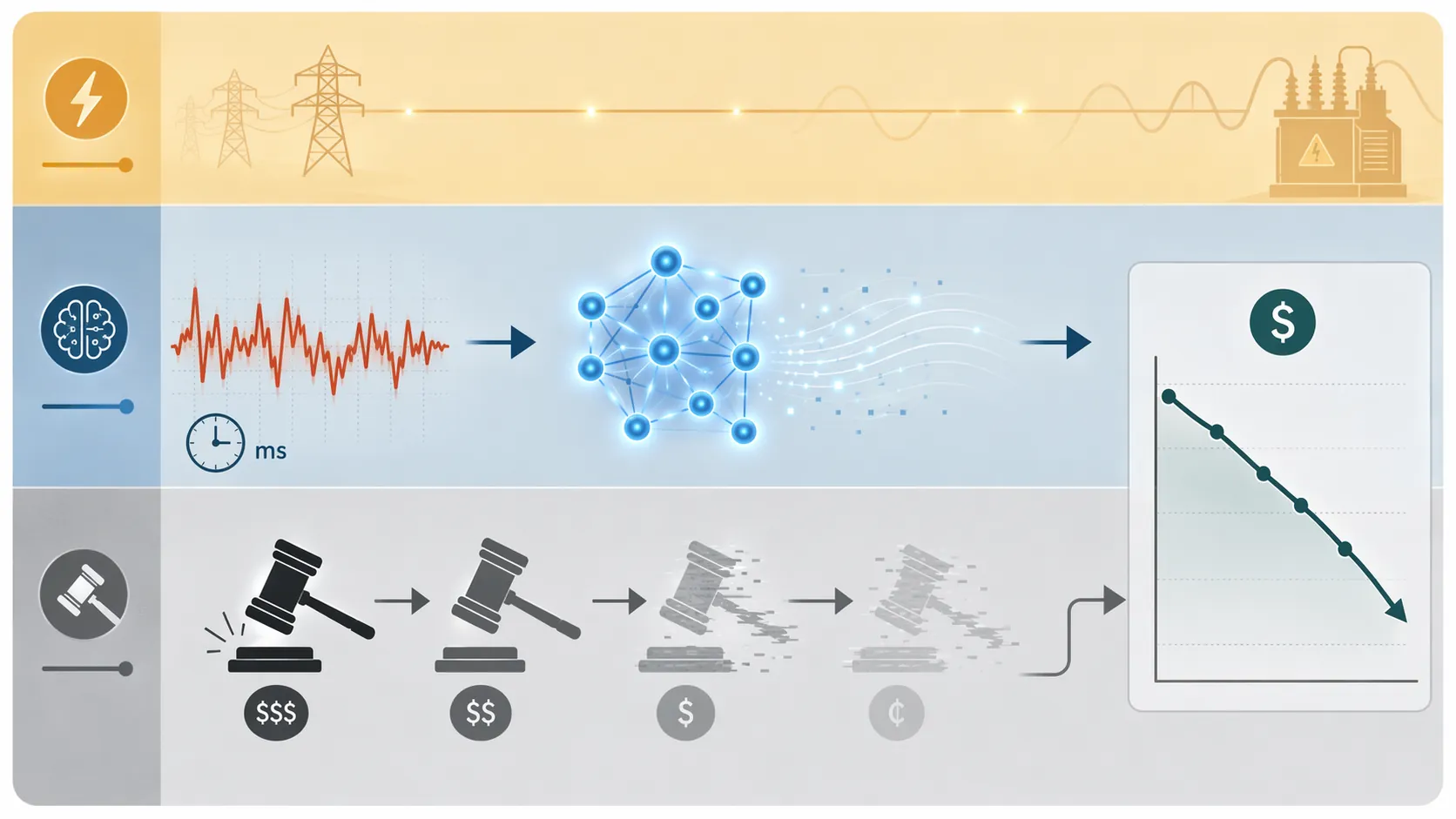
Put those two facts beside each other and the concern becomes practical. If AI compute loads can jolt power demand in milliseconds, and ad auctions punish latency and inconsistency in milliseconds, then the zone between “everything is fine” and “the platform is down” deserves its own line in a media buyer’s post-mortem. It is not proof that any specific bad ROAS day was caused by a power event. It is a credible mechanism for why campaign quality can degrade before anyone posts an incident.
Power Loss Is Not an Edge Case Inside Large Platforms
The easy dodge is to say modern platforms have redundancy, so a buyer should only care when the status page turns red. Meta’s own engineering writing makes that too comforting. In its Power Loss Siren post, Meta described power loss events as a source of “correlated unplanned server outages” that “can affect thousands of servers simultaneously.” The post was published in 2021, so it should not be read as a current incident-rate report. Its value is narrower and still important: power loss is recurring enough, and correlated enough, that Meta built a system specifically to detect and respond to it.[3]
That admission changes how a buyer should read an all-green dashboard. A platform can be architected for resilience and still have internal infrastructure events that do not immediately appear as a customer-facing outage. The account is not connected to a single server; it is connected to a decision system. If enough of that system is degraded, rerouted, throttled, or slower, the effect may be visible first in bid quality and conversion mix rather than total delivery failure.
Utility Dive’s March 2026 reporting on TerraFlow Energy adds the grid-side version of the same concern. The report described AI data center equipment wearing out faster than expected, backup systems behaving unpredictably, and newly energized data center phases being told to disconnect because volatility was destabilizing local feeders. TerraFlow’s comments in that coverage framed those conversations as neither theoretical nor rare.[4]
None of that says, “this Meta campaign lost ROAS because a feeder wobbled.” It says the physical layer underneath AI inference is being stressed in ways that can be abrupt, correlated, and operationally messy. For paid media, that is enough to justify a diagnostic category between normal variance and declared outage.
What Degradation Looks Like in an Ad Account
A full outage is blunt. Spend drops, ads stop serving, reporting breaks, or conversion pipelines fail badly enough that everyone sees the same smoke. The degradation zone is harder because delivery often continues. In that window, the platform may still spend the budget, but the quality of the decisions behind that spend can slip.
| Account Signal | Why It Matters | What Not to Assume |
|---|---|---|
| Spend pacing remains normal while ROAS drifts down | The buying engine is still active, but auction or inference quality may be weaker | Do not assume the campaign structure broke without checking timing |
| Conversion volume holds while value per conversion weakens | The model may still find converters but allocate toward lower-quality demand | Do not treat all conversion stability as performance stability |
| CPC or CPM rises without matching downstream quality | Auction selection may be less efficient, or competition may have shifted | Do not attribute it only to competitors unless benchmarks agree |
| Asset, product, or audience mix changes sharply | Automated systems may be leaning into different predictions under degraded signals | Do not rewrite creative strategy from one unstable window |
| Platform status stays green while operator dashboards look wrong | Customer-facing incident declaration can lag the first performance symptom | Do not wait for a status page before preserving evidence |
The key is not to diagnose power instability from one bad metric. Paid accounts already have seasonality, auction crowding, delayed attribution, tracking gaps, promo calendars, inventory swings, and creative fatigue. The useful move is to ask whether several symptoms changed together inside a narrow time window, especially when multiple accounts, regions, or campaign types moved in a way that does not match their normal benchmark behavior.
For example, a hypothetical agency might see Advantage+ maintain spend from midmorning through afternoon while purchase value per conversion drops across several unrelated ecommerce accounts. That does not prove an infrastructure problem. It does mean the team should avoid immediately blaming one client’s creative, one catalog, or one bid strategy before checking external incident logs and adjacent account behavior.
Why Standard Dashboards Miss the Gray Zone
Ad dashboards are built to show campaign delivery and reported outcomes. They are not built to expose the health of the inference layer, the routing path, the accelerator cluster, the local utility feeder, or the failover sequence serving that auction. A buyer sees spend, impressions, clicks, conversions, value, and modeled attribution. The platform sees much more, but the buyer does not get a per-auction note saying, “this decision was made during degraded infrastructure conditions.”
That creates an accountability gap. The platform can be internally investigating, partially mitigating, or not yet classifying a condition as an incident while the buyer is already accumulating spend. By the time an outage note appears, if it appears at all, the damage in the account is mixed into the same reporting view as ordinary campaign performance.
This is why “platform status was green” is weak evidence in a ROAS post-mortem. It tells you the platform had not declared a customer-facing incident at that time. It does not tell you inference quality was normal, auction latency was normal, model routing was normal, or conversion-quality selection was unaffected.
Use Incident History as Support, Not as Proof
Recent platform incidents show that ad delivery and serving systems do fail in ways advertisers can feel. They do not prove the hidden-degradation thesis by themselves.
Inc. covered Meta outages in June 2026, including incidents on June 12 and June 23, as examples of business dependence on large platforms when service interruption becomes visible.[5] AdStatus documented a Meta ads delivery outage on January 22, 2026, and separately classifies a large share of tracked Meta incidents as ad delivery failures; the 53% figure comes from AdStatus’s own tracking, not from Meta.[6]
Google had its own serving failure example before 2026. PPC Land reported that an October 3, 2025 Google data center issue disrupted search results in multiple regions.[7] Again, that does not establish a power-instability cause for paid-ad ROAS drift. It does remind buyers that data center issues can surface as user-facing and advertiser-facing serving problems, not just as abstract infrastructure news.
The disciplined reading is narrow: declared incidents are the visible tail of a larger operational distribution. Some problems tip into public failure. Others may be mitigated internally or experienced as quality degradation. The buyer’s job is not to turn every weak day into an outage conspiracy; it is to preserve enough timing evidence to avoid a lazy diagnosis.
A Practical Detection Pass for ROAS Drift
When ROAS drifts and there is no declared outage, start with timing. Pull the smallest reliable reporting interval the platform gives you, then compare it against your own benchmark windows. Hourly data is often noisy, but it can still show whether the change started abruptly, spread across accounts, or aligned with a known incident window.
- Mark the first interval where spend quality changed, not just the day ROAS looked bad.
- Separate delivery metrics from quality metrics: spend, impressions, clicks, CPC, CPM, conversion count, conversion value, value per conversion, and new-customer share where available.
- Compare affected campaigns against stable controls: branded search, manual campaigns, smaller geos, email revenue, direct traffic, or owned-audience revenue.
- Check platform status pages, AdStatus records, and trade coverage for incident windows before changing bids, budgets, feeds, or creative.
- Record whether performance recovered without an account change. A self-resolving drop is not proof of infrastructure degradation, but it changes the post-mortem.
This evidence pass matters most for automated systems because they can convert a short decision-quality problem into a longer learning or allocation problem. If an AI campaign spends into lower-quality auctions for several hours, the account may carry the effect into delayed attribution, budget pacing, and model feedback. By the next morning, the dashboard presents a campaign-performance problem, not an infrastructure-timing problem.
The comparison should also include money. If you already model outage exposure by spend tier, fold gray-zone degradation into the same review rather than treating it as a separate mystery. A clean outage-cost model, like What Meta Outages Actually Cost Advertisers by Spend Tier, gives the finance conversation a base case. The gray-zone version is usually harder: spend may continue, refunds may not apply, and the loss shows up as lower efficiency rather than missing delivery.
The Benchmark Window Should Be Boring on Purpose
Do not use the prior day as the only control unless the account is unusually stable. Use same-day-of-week comparisons, recent non-promo windows, and channel-adjacent signals. If paid social ROAS drops but email, direct, branded search, and checkout conversion rate all drop at the same time, the problem may be site-side or demand-side. If only AI-heavy auction campaigns weaken while simpler controls hold, the infrastructure-degradation hypothesis becomes more worth investigating.
Also watch for geography. Power and data center events do not have to map cleanly to the geos in your campaign settings, because serving, inference, and routing can be distributed. Still, regional weirdness is useful evidence. If one market cluster weakens while another holds, preserve that split before the daily rollup hides it.
The Broader Infrastructure Context Is Getting Worse
Paid-ad teams do not need a long detour into utility planning to make the bidding point, but the context is not neutral. Gartner predicted, as cited by Enki AI, that power shortages would restrict 40% of AI data centers by 2027.[8] Data Center Knowledge reported that NERC flagged AI data center grid risks, putting the concern into reliability-planning language rather than marketing language.[9]
For advertisers, those pressures show up in two ways. One is cost pass-through: more expensive and constrained infrastructure can raise the cost base of AI-heavy ad delivery. That is the pricing side covered in Data Center Electricity Costs Are Raising Your Ad Prices in 2026. The second is stability risk: even when the platform absorbs the infrastructure cost, buyers may still absorb quality loss if auction decisions degrade before the incident is declared.
That distinction matters. Higher ad prices are visible in CPMs, CPCs, and platform economics. Stability problems are harder because they can masquerade as normal campaign variance. A buyer can negotiate, reforecast, or shift budget around visible cost inflation. It is much harder to respond to a hidden ROAS tax unless the team has already decided what evidence would make it credible.
How to Write the Post-Mortem Without Overclaiming
The wrong post-mortem says, “power instability caused our bad day,” when the evidence only shows a suspicious timing overlap. The equally wrong post-mortem says, “no outage was declared, so the campaign must have failed on its own.” Both are too clean for how automated ad systems actually behave.
A better write-up separates what is known, what is observed, and what is inferred. Known: AI data center loads can create abrupt millisecond-scale demand volatility, power loss can affect thousands of servers simultaneously, and real-time ad auctions are latency-sensitive.[1][2][3] Observed: the account’s spend quality changed during a defined window. Inferred: infrastructure degradation is a plausible contributor if the timing, cross-account pattern, and external incident records support it.
That wording protects the team from two expensive mistakes. It avoids giving the platform a free pass just because the dashboard stayed green. It also avoids freezing campaign optimization because every soft metric gets blamed on invisible infrastructure.
Owned-audience records help here. If email, SMS, app push, loyalty audiences, or direct traffic held up while automated acquisition weakened, the incident review gets cleaner. If owned channels also weakened, the cause may sit elsewhere. The mitigation side belongs in an owned-audience plan, such as Owned-audience-first AI strategy after Meta outages, but the diagnostic point is simple: independent demand signals make platform explanations easier to challenge.
The Hidden ROAS Tax
Power instability is not a reason to distrust every AI campaign. Automation still wins when it finds demand faster than a manual structure could and prices auctions cleanly. The issue is accountability. The buyer pays for the traffic, explains the variance, and usually has less infrastructure visibility than the platform selling the automation.
Treat AI data center power instability as a hidden ROAS tax to investigate, not as a proven cause for every bad day. Track the timing of unexplained ROAS drift, compare it with incident records and benchmark windows, keep outage-cost modeling close to spend-tier exposure, and preserve owned-audience controls. The useful diagnostic category is neither “the campaign broke” nor “the platform was down.” It is the gray zone where the system may still be spending while inference quality is worse than the dashboard admits.
References
- AI's Volatile Power Use Quietly Tests Grid Limits, IEEE Spectrum, July 2026.
- Next-generation programmatic advertising: How AWS RTB Fabric redefines the game, AWS.
- Power Loss Siren: Making Meta resilient to power loss events, Engineering at Meta, Dec 2021.
- AI data centers are stressing power infrastructure. Storage is the answer., Utility Dive, March 2026.
- Meta Went Down Twice in 11 Days. The Outages Exposed a Risk Many Businesses Ignore, Inc.
- Meta Ads Delivery Outage — January 22, 2026, AdStatus.
- Google data center issue disrupts search results in multiple regions, PPC Land.
- AI Data Center Grid Strain: Power Halts Growth in 2026, Enki AI.
- NERC Flags AI Data Center Grid Risks in Report, Data Center Knowledge.
Built on this evidence
No Bidding tactic or Creative record currently cites this case file. Compare it against other results in Benchmarks.
Related benchmark reading
Report a corroborating or contradicting result
Seeing something different in your own account? Feed the data-integrity loop instead of leaving an open comment.