
How Hochul's Data Center Moratorium Impacts AI Ad Performance
Kathy Hochul's New York data center moratorium signals a structural shift for AI ad infrastructure. This analysis explains why media buyers should watch for latency and ROAS reliability signals, not immediate CPC changes.
- Platform
- Meta Ads
- Campaign type
- Advantage+
- Spend range
- Various
- Timeframe
- May 0 - May 2025
- ROAS
- 0
- Verdict
- mixed
- Last reviewed
- 0-07-25
The practical answer for media buyers tracking Hochul's data center moratorium is not that Meta or Google CPCs get a new New York surcharge this week. The useful answer is narrower and more uncomfortable: the moratorium lands in the same infrastructure layer that already decides whether AI ad systems can score auctions quickly enough, often enough, and close enough to the user for automated bidding to behave.
That distinction matters. A regulation headline is too blunt to explain a Monday morning CAC jump. But pretending data center capacity is somebody else's problem is also out of date. Performance Max, Advantage+, AI Max, and similar products depend on real-time inference. The dashboard may show ROAS, CPA, and learning status. Underneath that, model predictions have to clear latency budgets at auction speed.
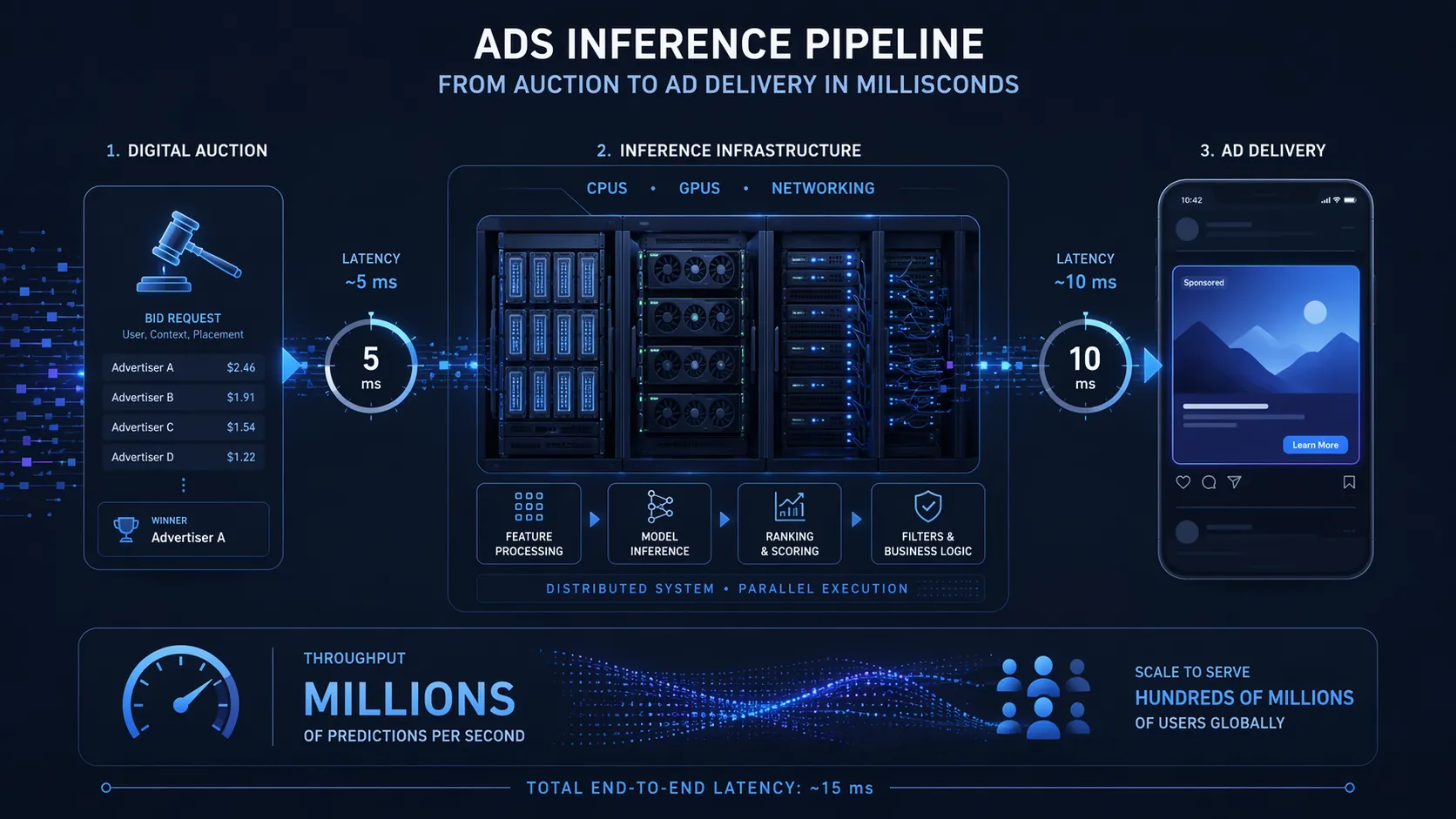
The Auction Already Depends on Inference Capacity
Meta's own engineering write-up is the place to start because it shows the machinery, not the marketing layer. Meta says ads inference requires significant capacity across CPUs, GPUs, storage, networking, and databases, and that its ads systems handle millions of model predictions per second. In the same note, Meta reported that tail-utilization work delivered 35% more work with the same resources, reduced timeout errors by two-thirds, and cut p99 latency in half.[1]
Those are not vanity infrastructure metrics. A timeout is not an abstract cloud problem when the model prediction is part of the ad-serving path. P99 latency is not a facilities KPI when the slowest slice of requests can shape which auctions get fully scored, which candidates get considered, and how confidently the system can act inside its deadline.
This does not mean every account-level wobble is caused by compute. Creative fatigue, feed quality, tracking loss, offer changes, seasonality, and auction competition still explain plenty of bad weeks. The point is that AI ad performance is no longer separable from inference operations. Meta's engineering evidence proves that capacity management can change the amount of work completed, the error rate, and the latency profile without changing the advertiser-facing product name.
That is why the New York order belongs in an ads infrastructure watchlist. Not because Albany flipped a switch inside Ads Manager. Because the systems buyers rely on have already become sensitive to the same capacity constraints now drawing policy intervention.
What Hochul's Moratorium Actually Does
On July 14, 2026, New York Governor Kathy Hochul issued Executive Order No. 62, described as a first-in-the-nation statewide pause affecting hyperscale data centers above 50 MW. The order halts discretionary state environmental permits for up to one year while New York develops a Generic Environmental Impact Statement, with 12 GW of data center load already in the NYISO interconnection queue.[2]
For the regulatory background, the broader moratorium piece is the better place to linger: Is the NY Data Center Moratorium a Turning Point for AI?. For media buyers, the important feature is the threshold. A 50 MW cutoff is not aimed at a small server closet. It points at the class of large, power-hungry facilities that matter when AI inference is moving from occasional model use to constant auction participation.
The timing also matters. The order was signed only 11 days before this analysis. There is no live measurement tying it to higher CPCs, weaker delivery, or a specific platform's auction behavior. Meta and Google also operate large, geographically diversified infrastructure fleets, so a one-state permitting pause does not directly constrain their current ad delivery in a clean, immediate way.
But infrastructure planning does not break only when a dashboard flashes red. New capacity has to be sited, powered, interconnected, permitted, cooled, and connected into a network that can meet service-level expectations. A one-year pause in a major market is not the whole story. It is a dated signal that the approval environment around large AI facilities is becoming less predictable.
The Bottleneck Is Bigger Than New York
The sharper concern is the combination of policy friction and longer capacity timelines. Deloitte reports that inference accounts for roughly two-thirds of all AI compute in 2026, which means the pressure is not only about training frontier models. Serving, ranking, scoring, generating, and optimizing at run time are now the heavier recurring burden.[3]
Data center build timelines have also stretched. Analyst sources cited for this analysis say facilities took 18–24 months from announcement to operation in 2021, compared with 3–5 years in 2026.[4] That does not prove any single ad platform is short on capacity. It does mean the buffer between demand growth and usable new supply has thinned.
| Signal | What it means for ad buyers |
|---|---|
| Meta reports millions of ad model predictions per second | Auction quality depends on inference systems completing work inside tight latency budgets |
| New York pauses permits for hyperscale facilities above 50 MW | Large AI infrastructure now faces more visible state-level permitting risk |
| Build timelines stretch from 18–24 months to 3–5 years | Capacity relief is slower when demand or policy conditions change |
| Inference becomes the majority of AI compute | Serving ads and optimizing campaigns are exposed to recurring compute constraints, not only one-time model training |
Gartner projects that 40% of AI data centers will be power-constrained by 2027, and scenario analyses put inference-cost increases for AI services at 15–40% by the end of 2027.[5] Those are projections, not observed ad-cost pass-through. The range is wide, and the outcome depends on power markets, permitting, grid upgrades, chip supply, and where platforms can shift workloads.
Still, this is the same pressure pattern covered in PJM's data center crisis is making your AI ads more expensive. Power markets, interconnection queues, and hyperscale siting decisions are no longer background scenery. They are part of the cost and reliability base under automated media buying.
The policy environment is widening too. Industry analyses note 36 U.S. data center projects delayed or blocked between May 2024 and June 2025, disrupting an estimated $162 billion in investment, and an NPR investigation found 32 states with pending or enacted data center legislation in 2026.[6][7] New York is not isolated; it is a high-visibility example of a broader local and state reaction to load growth.
Why Location and Latency Still Matter
It is tempting to assume the largest platforms can route around every local constraint. Often, they can route around more than advertisers will ever see. Their fleets are enormous, their capex budgets are defensive weapons, and their infrastructure teams have more options than a smaller AI vendor.
But routing around a constraint is not free. Real-time ad systems care about where compute sits relative to users, inventory, conversion signals, and other platform services. When inference has to happen repeatedly inside an auction path, proximity and network quality can affect how much useful work gets done before the decision deadline.
That is the lens for reading infrastructure deals such as the one covered in What the Verizon-Google Dark Fiber Deal Means for Google Ads. Dark fiber, interconnection, and metro-adjacent capacity sound far away from campaign management until a model has to score another auction and return an answer fast enough to be useful.
This is also where the incumbents get insulation. Alphabet, Meta, Amazon, and Microsoft can spend through bottlenecks, reserve power, pre-lease capacity, and redesign parts of their serving stacks. That does not make them immune. It makes the impact less likely to show up as a simple line item and more likely to show up as product behavior, reporting opacity, or widening gaps between what the platform optimizes for and what the advertiser's P&L feels.
For more on that capex shield, see What Alphabet's $175B AI CapEx Signals for Google Ads Strategy and Does AI Chip Spending Improve Ad Results or Just Lock You In?. The buyer-facing consequence is not that big platforms fail first. It may be that they absorb the stress in ways advertisers cannot easily audit.
The Account-Level Signals Worth Watching
If a New York permitting pause does not directly raise CPCs today, the wrong move is to open every account and hunt for a moratorium effect. The better move is to improve observability around the kinds of degradation that automated systems can hide until budget pain is already visible.
- Latency-adjacent symptoms: sudden delivery unevenness, delayed budget pacing, or campaigns that spend normally in aggregate but miss expected high-value windows.
- Auction stability: abrupt changes in impression mix, placement mix, or match quality without corresponding creative, bid, budget, or audience changes.
- CAC and ROAS divergence: platform ROAS staying flat while new-customer CAC, contribution margin, or backend payback deteriorates.
- Conversion reporting reliability: longer lag, noisier modeled conversions, or unexplained swings between platform-reported and first-party revenue.
- Degradation windows: repeatable weak periods by hour, region, device class, or campaign type that do not match normal demand patterns.
The Pixis campaign analysis is relevant here, but it needs the right label. Pixis reported a 55,000-campaign analysis in which Advantage+ new-customer CAC doubled from $257 to $528 between May 2024 and May 2025 while platform-reported ROAS held near $4.52.[8] Signal & Convert has not independently verified that methodology, and the divergence should not be treated as proof of infrastructure-driven degradation.
It is still the kind of gray window buyers should take seriously. When platform ROAS looks stable and business economics worsen, the issue might be attribution, incrementality, customer quality, auction mix, creative fatigue, or conversion modeling. Infrastructure stress belongs on that list as a possible contributor only after the closer campaign explanations have been checked.
That same gray-window problem is the focus of How AI Data Center Power Instability Hurts Your Paid Ad ROAS. The uncomfortable part is not that dashboards lie in a cartoonish way. It is that automated systems can continue reporting familiar metrics while the underlying mix of decisions gets less aligned with what the advertiser needs.
A Practical Monitoring Pattern
For the next several quarters, infrastructure signals should sit beside normal account diagnostics, not replace them. A useful weekly review does not need to mention New York unless the account evidence gives you a reason to look beyond campaign mechanics.
- Start with the controllables: creative age, offer changes, feed errors, tracking changes, budget edits, bid strategy resets, and landing-page issues.
- Compare platform ROAS with first-party revenue, new-customer CAC, gross margin, refund rate, and payback period.
- Slice unexplained weakness by hour, geography, placement, device, campaign type, and conversion lag.
- Track whether degradation repeats across multiple AI-heavy products, such as Advantage+, PMax, AI Max, or automated creative systems.
- Escalate infrastructure as a hypothesis only when normal account causes fail to explain the pattern.
This is deliberately slower than the usual headline-to-CPC argument. A buyer who jumps straight from Executive Order No. 62 to a bid change is likely reacting to the wrong object. A buyer who ignores the order completely may miss a signal that the infrastructure assumptions behind black-box optimization are getting tighter.
What This Means for Q3 2026 Planning
The safest planning judgment is restrained: Hochul's moratorium is not evidence that AI ads are getting more expensive today. It is evidence that large AI infrastructure is meeting more public, permitting, and power-system resistance at the same time ad platforms are asking inference systems to do more live work per auction.
Over the next 12 to 24 months, that combination can matter even if it never appears in Ads Manager as an infrastructure warning. It can show up through noisier optimization, less reliable modeled performance, wider gaps between reported ROAS and actual customer economics, or higher platform costs that are blended into auction dynamics rather than itemized.
For now, the moratorium is not a panic trigger, not a CPC forecast, and not a reason to abandon automated products. It is a credible policy signal that inference constraints are moving from engineering footnote to media-buying risk.
References
- Tail utilization: A faster, more efficient approach for ads inference at Meta, Meta Engineering, July 10, 2024.
- Executive Order No. 62, Governor of New York, July 14, 2026.
- Inference compute share analysis, Deloitte, 2026.
- Data center build timeline analysis, Interconnected Capital and AI Magicx, 2026.
- AI data center power constraint projection, AI Magicx citing Gartner, 2026.
- U.S. data center projects delayed or blocked analysis, AI Magicx, 2025.
- Data center legislation investigation, NPR, 2026.
- 55,000-campaign Advantage+ CAC analysis, Pixis, 2025.
Built on this evidence
No Bidding tactic or Creative record currently cites this case file. Compare it against other results in Benchmarks.
Related benchmark reading
Report a corroborating or contradicting result
Seeing something different in your own account? Feed the data-integrity loop instead of leaving an open comment.