
What the Verizon-Google Dark Fiber Deal Means for Google Ads
The Verizon dark fiber deal (announced July 24, 2026) tackles a core latency bottleneck in Google's AI ad-serving infrastructure. This article explains how reduced inter-data-center latency can improve bid timing and signal processing for Performance Max and AI Max campaigns, and what campaign managers should realistically expect from the investment.
- Platform
- Google Ads
- Campaign type
- Performance Max
- Spend range
- All tiers
- Timeframe
- Q0 2026
- ROAS
- 0% more conversions
- Verdict
- mixed
- Last reviewed
- 0-07-25
Verizon signed a deal worth more than $1 billion to provide Google with dark fiber infrastructure, announced July 24, 2026, with Verizon CEO Dan Schulman confirming the agreement and signaling that more large AI-network deals may follow.[1] For Google Ads buyers, the useful question is narrower than the headline: if Google gets more dedicated, lower-latency paths between data centers, where would that actually show up in ad serving?
The restrained answer is: structurally meaningful, operationally invisible, and unlikely to produce a clean step-change in ROAS. This is not a new Google Ads lever. There will not be a “Verizon fiber” toggle in Performance Max, AI Max, or Search. If the investment helps, it should appear as slightly better auction-time decisions, more room for inference at serving time, and gradual conversion-volume gains at similar efficiency—not as a neat before-and-after line in one account graph.
Why dark fiber matters to ad auctions
Dark fiber is not magic bandwidth. It is unused fiber optic capacity that a buyer can light, control, and tune for its own network requirements. In this case, the practical value is not that Google can move bigger files someday; it is that Google can make parts of its AI-serving network communicate with less delay and more predictable routing.
That distinction matters because modern ad serving is not a batch report. A single ad opportunity can require fast coordination among models that estimate conversion probability, value, user intent, query meaning, landing-page fit, creative eligibility, asset quality, budget pacing, and policy constraints. The system has to decide before the impression is gone.
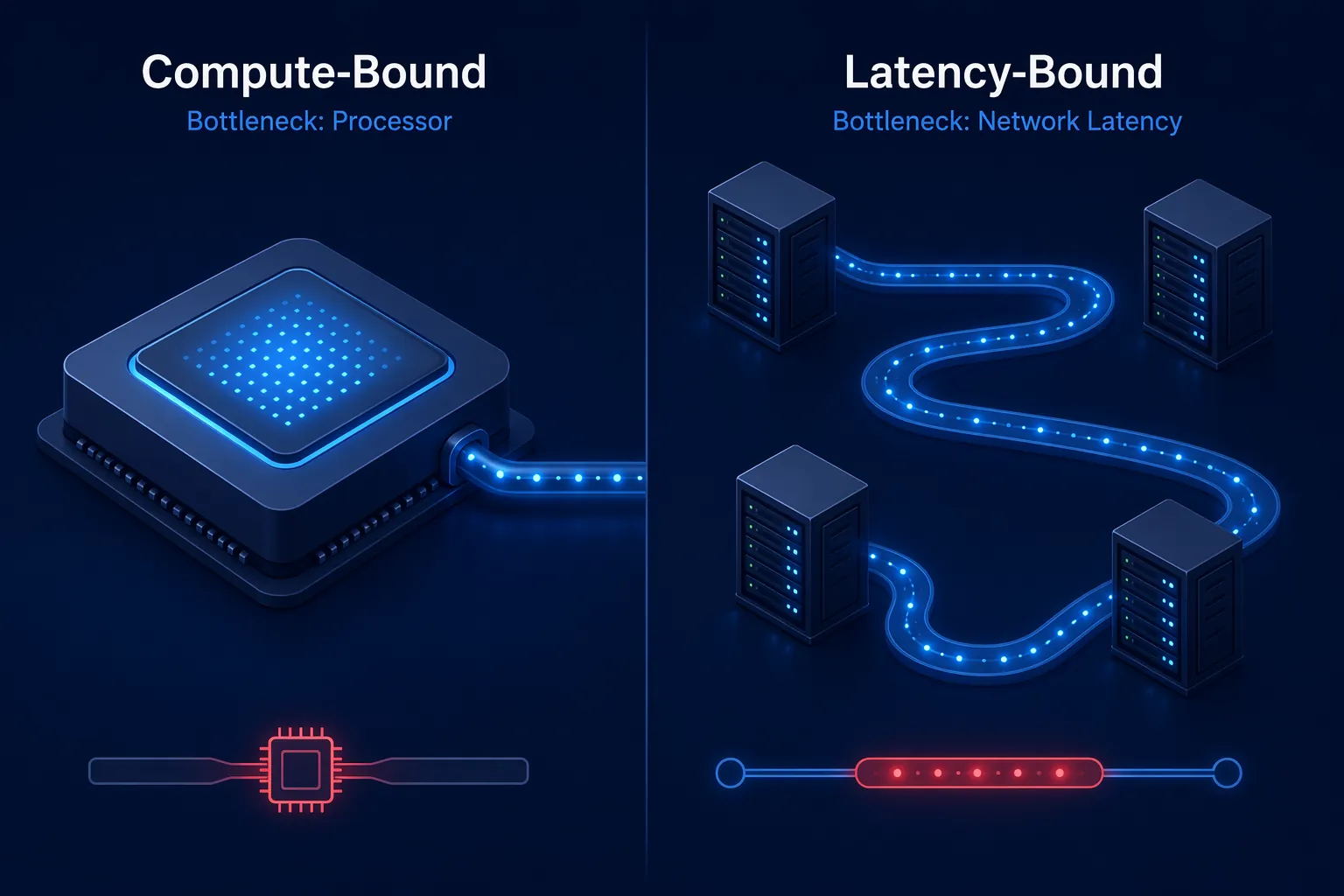
Google’s own AI-inference engineering argument is the cleanest way to understand the deal. In January 2026 coverage of work by Google engineers Ma and Patterson, SDxCentral summarized the core constraint this way: “latency trumps bandwidth for frequent, small messages in a big network.” The argument was that large-scale LLM inference is fundamentally constrained by network latency and memory movement, not only raw compute.[2]
That maps uncomfortably well to ad serving. Google Ads does not need one giant answer ten seconds later. It needs many small judgments now. The more AI Max, Performance Max, and broad-match Search depend on real-time interpretation, the more the platform’s quality depends on how quickly distributed systems can exchange signals before the auction closes.
| Ad-serving layer | What lower inter-data-center latency could improve | What the campaign manager would see |
|---|---|---|
| Bidding | Faster coordination among value, conversion probability, budget, and auction-context models | More stable bid behavior over time, not a visible new bid control |
| Signals | More room to process intent, audience, query, product, and landing-page signals within the auction window | Gradual improvement in eligible traffic quality, especially where automation already has enough data |
| Creative and assets | Quicker scoring of which text, image, video, or landing-page combination fits the user and placement | Better asset selection patterns, but still mixed with normal reporting noise |
| Reporting outcomes | Cleaner serving decisions may compound across many auctions | Possible conversion-volume lift at similar ROAS, without a provable account-level causal line |
The mechanism is bid timing, not a better dashboard
A useful way to think about the Verizon-Google AI data center deal is to separate the campaign interface from the serving system underneath it. The interface changes when Google launches a feature, adds a report, or rewrites a recommendation. The serving system changes when Google can make more calculations, with fresher information, inside the same auction deadline.
Suppose an ad request arrives for a Search query or a PMax placement. The system may need to evaluate the advertiser’s predicted value, the user’s inferred intent, the match between available assets and the surface, competing eligibility, budget constraints, recent conversion feedback, and whether a different combination of creative or landing page would likely perform better. This is a simplified example, not a description of Google’s exact serving path, but it captures the operational problem: the decision is distributed and time-limited.
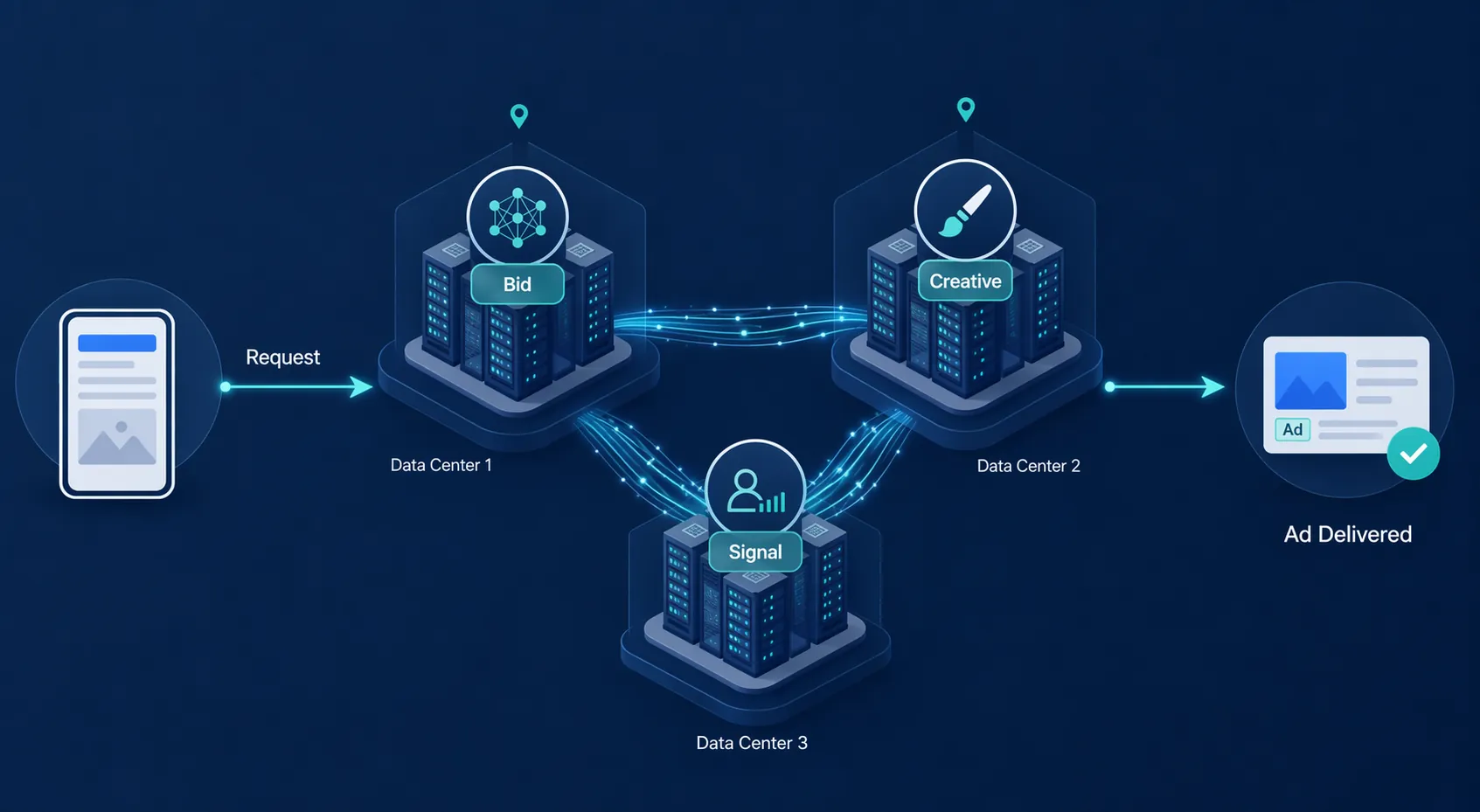
When the network is the bottleneck, faster chips do not solve the whole problem. A model may be ready to score, but it still needs inputs from another cluster. A creative-ranking system may have enough candidates, but it still needs to retrieve or compare context quickly enough. A value model may be stronger in theory, but if the serving path cannot afford the communication cost, the platform has to simplify, cache, approximate, or skip work.
Dedicated low-latency fiber paths can reduce those compromises. The value is not that every auction suddenly becomes brilliant. It is that across billions of small decisions, Google may be able to spend a little more inference on the auctions where that extra work changes the expected outcome.
That is why this infrastructure story belongs in the same notebook as campaign change logs. If AI Max starts matching broader intent more confidently, if Performance Max becomes less jumpy when asset groups and product feeds change, or if Search automation tolerates more query ambiguity without efficiency falling apart, the explanation may not be only “the model improved.” The model, the serving budget, and the network path are now part of the same practical system.
Where Performance Max and AI Max are most likely to feel it
Performance Max is the obvious surface because it already asks Google to coordinate across inventory, audiences, assets, feeds, conversion values, and budget constraints. The more surfaces a campaign can serve on, the more important the serving system’s ability to compare alternatives quickly. Lower latency does not make weak inputs strong, but it can give the system more room to decide among messy options before the ad slot disappears.
AI Max for Search is the cleaner test of intent processing. It depends on Google’s ability to interpret query meaning, landing-page relevance, creative fit, and advertiser goals beyond the old keyword-control frame. For readers who need the product split rather than the infrastructure layer, the practical companion is Google AI Max for Search vs. Performance Max. The infrastructure point is that those judgments are more valuable when they can happen close to auction time instead of being over-simplified in advance.
Search campaigns outside AI Max can still benefit indirectly. Smart Bidding and broad match already rely on auction-time signals. Any reduction in serving friction gives Google more opportunity to use the signals it has, though that does not mean every advertiser gets the same improvement. Accounts with better conversion data, cleaner value tracking, stronger landing-page alignment, and broader eligible volume are still better positioned to benefit from automation.
The mistake would be to treat fiber as a substitute for account hygiene. A faster serving network does not fix bad conversion imports, under-specified value rules, thin creative, broken feeds, or a budget that keeps campaigns out of auctions. It can make the machine more responsive; it cannot make poor advertiser inputs disappear.
The performance evidence is encouraging, but not causal proof
The number that will get quoted in client decks is the Q2 2026 claim that Performance Max and AI Max customers were achieving 50% more conversions at similar ROAS.[3] It is relevant because it shows Google’s AI ad products are already producing material outcome claims in the same period that Alphabet is sharply increasing AI infrastructure spend. It does not prove that the Verizon dark fiber deal caused those outcomes.
The timing alone prevents that claim. The Verizon agreement was announced July 24, 2026.[1] The Q2 performance commentary came before the market had any public route maps, deployment timeline, connected data-center list, or latency benchmark for this specific fiber arrangement.[3] Google has not published advertiser-facing measurements that compare ad inference on dark fiber paths versus shared network paths.
AI Max adoption gives a second useful signal, with the same caveat. Futurum Group reported that AI Max had exited beta with 500,000 advertisers.[4] That is adoption, not effectiveness. It tells us Google has enough advertiser participation to put pressure on serving systems at scale; it does not tell us that those advertisers are all seeing durable gains, or that fiber investment is the reason.
Still, the infrastructure pressure is real. CNBC reported in November 2025 that Amin Vahdat, Google’s VP of ML, Systems and Cloud AI, told employees the company needed to double AI serving capacity every six months to meet demand.[5] That is the kind of operating constraint that makes low-latency private network capacity matter. If serving demand has to double that quickly, efficiency in the network is not a side quest.
Alphabet’s spending comments also put ads directly in the frame. In February 2026, CFO Anat Ashkenazi said 2026 capex was allocated partly to “improve the user experience and drive higher advertiser ROI in Google services.”[6] CNBC later reported that Q2 2026 capex reached $44.9 billion, up 100% year over year, and that Alphabet raised FY2026 capex guidance to $195 billion to $205 billion.[3] That does not isolate this Verizon deal, but it does make advertiser ROI one of the explicit business justifications for the infrastructure buildout.
What to expect in accounts over the next few quarters
If the Verizon-Google dark fiber buildout helps Google Ads, the account-level evidence will probably be dull. That is not a criticism. Good infrastructure often shows up as fewer bad decisions, less wasted time, and more consistent eligibility—not as a dramatic new feature launch.
- Expect gradual conversion-volume improvement before expecting a visible ROAS break. The supported claim is more conversions at similar ROAS, not guaranteed higher ROAS for every account.
- Watch auction and query behavior around AI Max and broad-match Search, especially where intent expansion previously looked promising but unstable.
- Review Performance Max asset and feed diagnostics, because better serving infrastructure can only choose well among the eligible inputs it receives.
- Keep dated notes on Google Ads product updates, bidding changes, conversion-tracking changes, budget moves, and landing-page changes before attributing performance movement to infrastructure.
- Treat short-term ROAS swings as account noise until there is a longer run of stable volume, spend, conversion lag, and tracking conditions.
The right monitoring window is measured in quarters, not days. A fiber deal has to become route planning, deployment, capacity allocation, and production-serving behavior before a campaign manager could plausibly observe any effect. Even then, the effect will be mixed with model updates, advertiser adoption, privacy changes, competitive pressure, seasonality, and normal auction churn.
This is where dated infrastructure notes help. If you already compare hyperscaler AI capex against ad-platform performance, keep that work separate from week-to-week campaign diagnosis. The broader question belongs with pieces like How AI Capex Drives Digital Ad Spend; the Monday-morning question still belongs in the change log.
What not to change Monday morning
Do not raise budgets because Verizon sold Google dark fiber. Do not loosen targets because the network might improve. Do not explain a July or August ROAS movement to a CFO as if a public infrastructure announcement has already passed through Google’s serving stack and landed in your account.
The more defensible move is to make sure the campaigns most likely to benefit from better inference are not being held back by avoidable account problems. For AI Max, that means staged expansion, clean exclusions, landing pages that actually represent the offer, and conversion goals that reflect the business outcome. For a practical setup path, use How to Set Up AI Max for Search Campaigns rather than treating infrastructure news as an optimization instruction.
For Performance Max, the useful work is even less glamorous: audit conversion value, watch new-customer settings, segment by product economics where possible, maintain feed quality, and avoid reading every asset-reporting movement as model intelligence. If automation fails sharply, diagnose it as a bidding and signal problem first; infrastructure is too broad an explanation to be useful at the account level. The failure-mode checklist belongs closer to When AI PPC Automation Fails than to a telecom announcement.
The broader AI-network story is useful, but secondary
Verizon is positioning AI Connect around network infrastructure for AI workloads, and its materials cite the idea that a large share of AI workloads will shift toward real-time inference by 2030.[7] That macro framing is plausible enough to explain why telecom capacity is suddenly part of the AI conversation, but it should not carry the advertiser argument by itself. The advertiser argument is narrower: Google Ads is already a real-time inference system, and real-time inference is sensitive to latency.
The Verizon deal matters because faster private paths between AI data centers are a credible way to improve bid responsiveness, signal processing, and creative selection under auction-time constraints. It does not give campaign managers a new lever, and it does not turn infrastructure spend into a tidy ROAS forecast.
Track the dated platform updates. Keep the account change log clean. Look for incremental improvement in AI Max, Performance Max, and automated Search behavior over multiple quarters. And when performance moves next week, resist the satisfying explanation unless the account evidence actually supports it.
References
- Verizon signs deal with Google worth over $1 billion, Reuters, July 24, 2026.
- AI inference crisis: Google engineers on why network latency and memory trump compute, SDxCentral, January 2026.
- Google (GOOG) Q2 2026 earnings report: Live updates, CNBC, July 22, 2026.
- Alphabet Q2 FY 2026: Google Cloud Leads Growth Amid Rising AI Investment, Futurum Group, July 23, 2026.
- Google must double AI serving capacity every 6 months to meet demand, CNBC, November 21, 2025.
- Alphabet resets the bar for AI infrastructure spending, CNBC, February 4, 2026.
- Verizon AI Connect: AI Network Infrastructure and Workload Solutions, Verizon.
Built on this evidence
No Bidding tactic or Creative record currently cites this case file. Compare it against other results in Benchmarks.
Related benchmark reading
Report a corroborating or contradicting result
Seeing something different in your own account? Feed the data-integrity loop instead of leaving an open comment.