
Why Alphabet's Negative Free Cash Flow Changes Google Ads
Alphabet's historic -$5.9B free cash flow in Q2 2026 is the financial signal behind a cluster of Google ad platform changes—from AI Max to Universal Commerce Protocol—that media buyers must account for to avoid rising CPCs and shrinking campaign control.
- Platform
- Google Ads
- Campaign type
- AI Max
- Spend range
- Various
- Timeframe
- Q0 2026
- CTR
- 0%
- Verdict
- loss
- Last reviewed
- 0-07-24
On July 22, 2026, Alphabet gave media buyers the number that belongs at the top of the scratch spreadsheet: -$5.9 billion in free cash flow for Q2 2026. Not a softness comment. Not a vague AI investment posture. A negative free-cash-flow print of a size Alphabet has not historically made search advertisers account for in campaign planning. CFO Ruth Porat Ashkenazi also warned that free cash flow would “remain under pressure” through multiple quarters, while management flagged tougher Q3 search comparisons.[1]
That is the operating signal behind this Tracker entry. The question for paid-search teams is not whether Google has interesting AI ad products. It is what platform behavior to expect when Google’s AI infrastructure bill needs ad-margin protection while search still carries the commercial load.
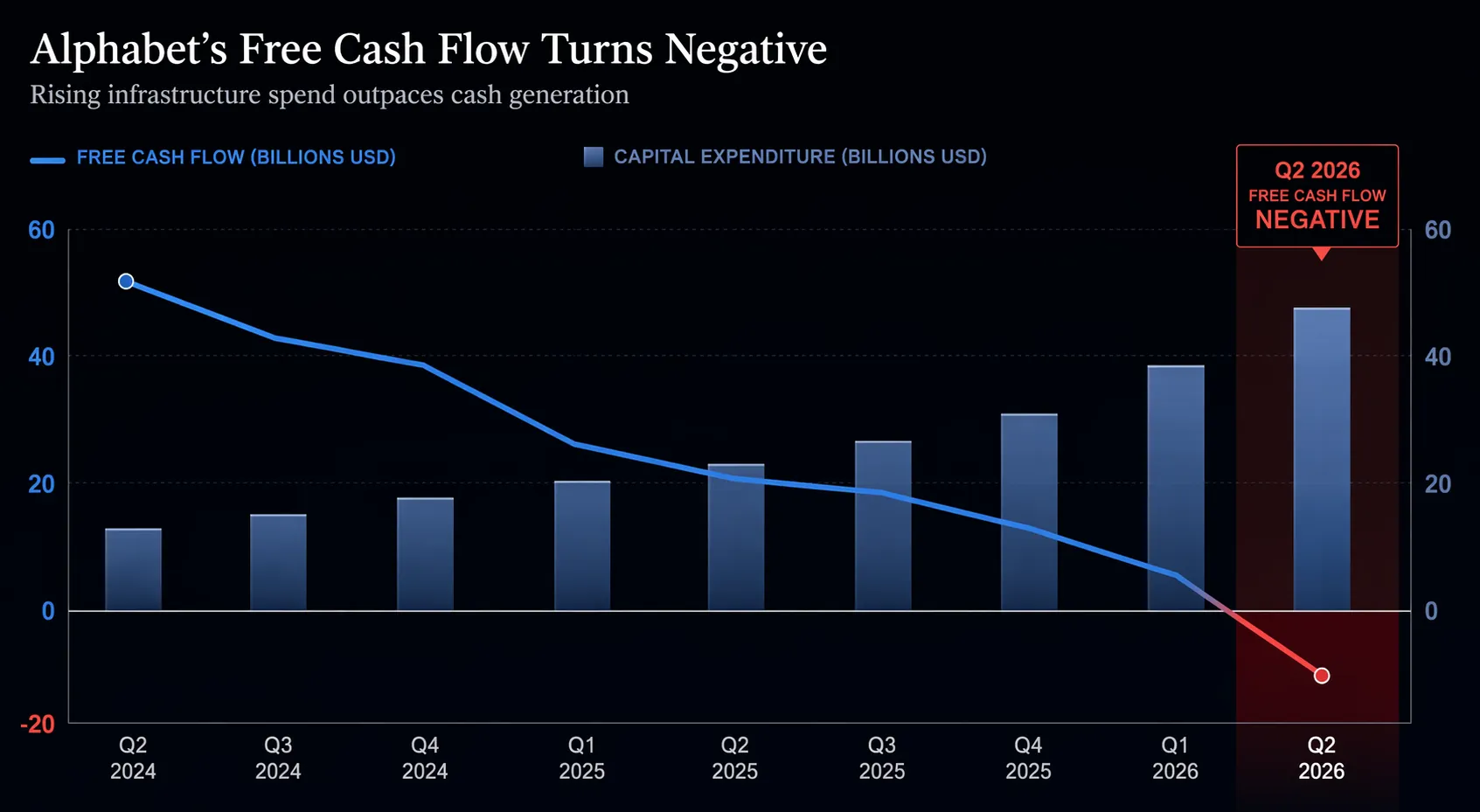
Alphabet raised its 2026 capex path to $195 billion–$205 billion and guided to a “significant increase” in 2027. Analyst numbers for 2027 are not guidance: FactSet consensus sits around $257 billion and Evercore has floated $262 billion, but those remain projections rather than commitments from Alphabet.[1][2] Even with that caveat, the direction is not ambiguous. Search monetization is being asked to coexist with an infrastructure buildout that is absorbing cash faster than the old ad-margin model was designed to tolerate.
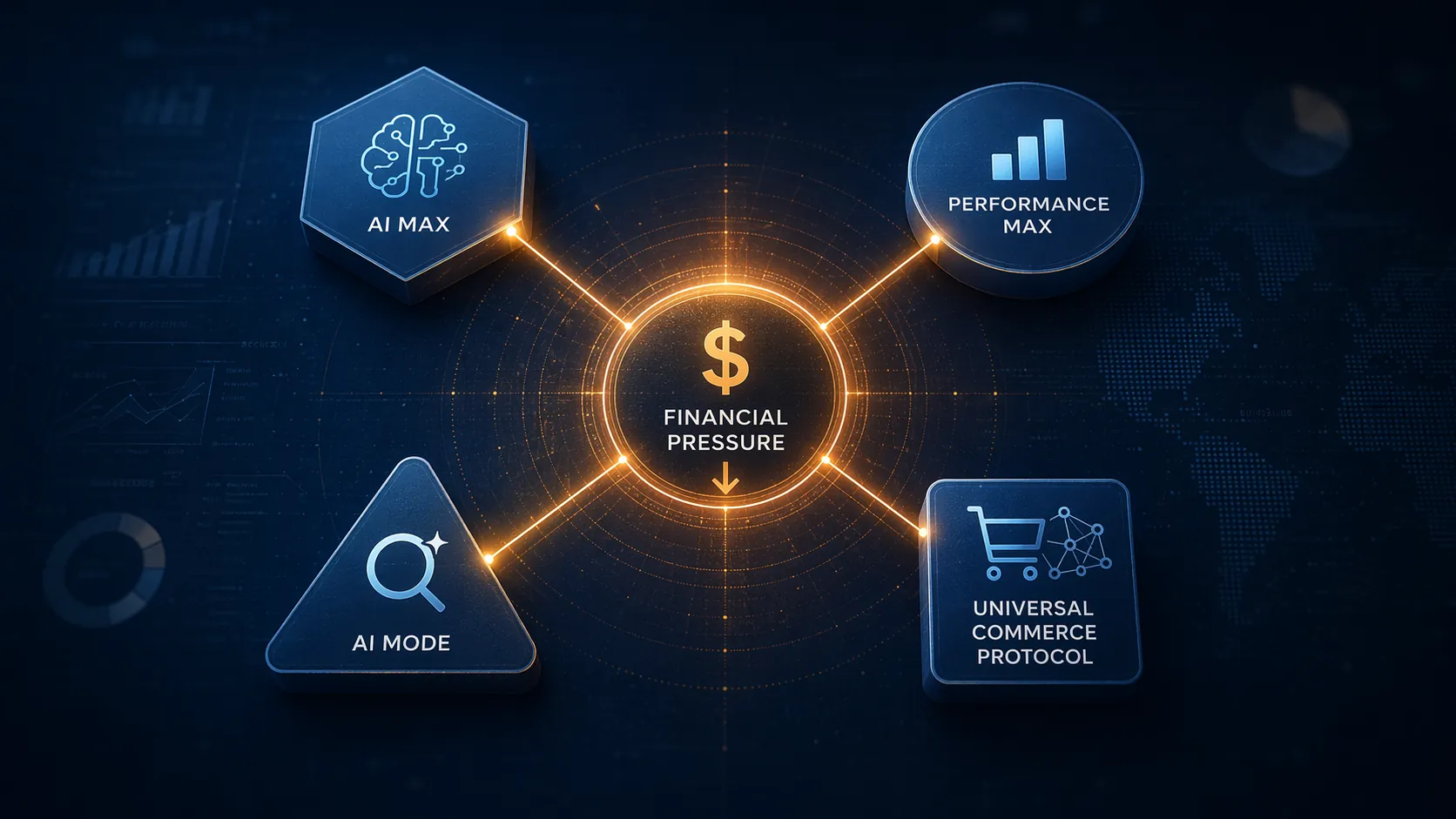
That is why AI Max, AI Mode placements, Performance Max gravity, and Universal Commerce Protocol should be read together. They are not identical products, and they do not affect buyers in the same way. But they all move Google toward broader matching, more owned-surface monetization, and fewer clean lines between query, placement, creative, and checkout.
AI Max Is the Near-Term Pressure Point
AI Max matters because it sits closest to the buyer’s weekly budget meeting. Google took AI Max out of beta in April 2026, shortly after the Q1 capex raise to $180 billion–$190 billion. Digiday reported on May 6, 2026 that agency clients were seeing 10%–15% year-over-year CPC increases tied to AI Max, with some accounts up to 25%.[3]
Those are agency-reported figures, not a Google-disclosed causal study. They still matter. Paid-search teams rarely get a lab-grade measurement environment when platform defaults shift. They get the same client targets, a broader query map, a recommendation tab that rewards adoption, and a CFO asking why the campaign “using the same strategy” is clearing fewer efficient clicks.
The practical implication is that AI Max should not be treated as a side feature that can be tested once and parked. The history of Google Ads automation is that optional settings often become the operating condition around which inventory, reporting, and auction pressure reorganize. The buyer can still decide how fast to adopt, how tightly to segment, and where to set guardrails. But the market around that buyer may not wait.
This is where the financial signal changes the read. If Alphabet were expanding automation from a position of comfortable free-cash-flow surplus, AI Max would be easier to evaluate as product experimentation. With free cash flow at -$5.9 billion and capex moving higher, the same product shift looks less optional. Google needs search demand discovery, query expansion, and bidding automation to preserve yield while AI infrastructure costs rise.
Performance Max Already Showed the Pattern
Performance Max is the bridge, not the main event. It shows buyers what happens after an automation layer becomes normal enough that budget follows it. Adthena and Digiday data put Performance Max at 35% of total Google Ads spend, with a 71% adoption rate.[4]
Adoption is not proof of effectiveness. A campaign type can gain spend share because it works, because inventory access is easier through it, because account teams push it, because internal teams lack bandwidth to fight it, or because reporting makes comparison difficult. The important part for this Tracker entry is more basic: buyers have already lived through one cycle in which a more automated Google product moved from “test this” to “explain why you are not using this.”
AI Max enters a market trained by Performance Max. That lowers the friction for Google. It also raises the burden on advertisers to keep their own baselines: exact-match cohorts, negative-query review, incrementality checks where possible, and separate notes for platform-driven eligibility changes versus real demand changes.
The Surface Shift: From Search Results to AI Answers and Agentic Checkout
The second pressure point is less about a campaign setting and more about where the ad can appear. Google has to protect monetization as user behavior moves into AI answers, AI Mode, and commerce agents. If the query becomes a conversation and the purchase path becomes an agentic flow, the old search results page is no longer the only surface that matters.
Search Influence’s 2026 analysis found paid CTR falling from 19.70% to 6.34% when AI Overviews were present.[5] That number should be handled carefully: Search Influence is a consultancy, not Google, and the figure should not be generalized as a universal CTR law. But it does point to the core buyer problem. If AI answers compress the visible click opportunity, Google has to rebuild ad opportunities inside or around those answers.
AI Mode placements are one answer to that problem. They let Google keep commercial messages inside an owned AI experience rather than watching intent leak into unmonetized assistant behavior. Universal Commerce Protocol is the commerce-side version of the same move. Industry reporting has described Amazon, Meta, and Microsoft joining the protocol, while Ulta Beauty launched agentic checkout in AI Mode on April 23, 2026.[6]
For advertisers, the control issue changes shape. In classic search, the fight was over query matching, bid control, ad copy, landing page, and auction position. In an AI Mode or agentic commerce flow, the fight moves upstream and downstream at the same time: whether the brand is selected into the answer, whether the ad is eligible inside the assistant surface, whether the checkout path preserves merchant economics, and whether reporting explains enough to separate media performance from platform routing.
This is where the AI attention stack benchmark framework is useful. AI Max maps to search-embedded automation. AI Mode moves into assistant-native attention. Universal Commerce Protocol reaches into retail commerce AI. The buyer’s budget may still sit in Google Ads, but the surfaces absorbing that budget are no longer just search-result inventory.
Owned Surfaces Matter More When Network Revenue Weakens
Google has another reason to pull monetization toward surfaces it controls. PPC Land’s analysis of Alphabet Q1 2026 earnings showed Google Network ad revenue down 4%, a $285 million decline.[7] Q2 2026 network-specific revenue was not available in the research window for this entry, so that Q1 figure should not be overstated as a current-quarter trend.
The direction still fits the platform pattern. Jason Kint of Digital Content Next, citing PPC Land analysis from August 2025, has pointed to more than 90% of Google ad revenue coming from owned properties.[8] When owned surfaces already carry that much of the ad business, and the network side is not the growth engine, Google has less incentive to preserve the old web-distribution bargain at the expense of its own AI surfaces.
That does not mean every publisher placement disappears or every network dollar gets redirected overnight. It means the strategic center of gravity is obvious. The company with a rising AI infrastructure bill will prefer monetization it can control, measure, package, and defend inside its own products.
The Capacity Pressure Is Not Theoretical
The balance-sheet details are supporting evidence, not the story by themselves. Alphabet raised $49.6 billion in equity, issued $20.3 billion in notes, and debt reached roughly $100 billion. Reporting also described a SpaceX compute deal at $920 million per month, a signal that third-party capacity is being used as a bridge while internal infrastructure scales.[9]
Those facts do not prove that a specific Google Ads control was removed to pay for a specific server rack. Campaign managers should avoid that kind of neat causality. They do show that AI capacity pressure is real enough to appear in financing, debt, external compute arrangements, capex guidance, and free cash flow. Once that pressure is visible in several places at once, ad-platform changes deserve to be interpreted as part of the same operating environment.
What Buyers Should Put in the Operating Model
The safest operating assumption for Q3 2026 is that Google automation features tied to query expansion, AI surfaces, and commerce routing will behave less like optional add-ons and more like structural defaults. That does not require panic. It requires a different baseline.
| Signal | Buyer implication |
|---|---|
| Alphabet prints -$5.9B free cash flow and says pressure will continue | Treat AI ad-product expansion as margin defense, not only product innovation |
| 2026 capex path rises to $195B–$205B | Expect monetization pressure to show up in auction design, eligibility, and reporting defaults |
| AI Max exits beta after the Q1 capex raise | Assume broader matching and higher CPC exposure need active guardrails |
| Performance Max reaches large adoption and spend share | Expect automation products to become budget centers once enough advertisers participate |
| AI Mode and Universal Commerce Protocol expand owned AI surfaces | Track whether control shifts from keyword and landing page management to eligibility inside assistant and checkout flows |
CPC pressure is already visible in commercial market analyses, with the usual caveats. Ryze AI’s analysis of more than 10,000 accounts reported average search CPC at $2.96, up 12% year over year, with professional services up 28%–34% and B2B software up 31%.[10] Ryze AI is a vendor, not an independent research institution, so the number is best used as directional context rather than a universal benchmark.
Adthena’s auction analysis reported 35% more advertisers in search auctions year over year.[4] That is also commercial data. Still, it lines up with what buyers would expect when automation expands eligibility and more advertisers are pushed into broader auction participation: more competition, less clean query isolation, and more pressure on account teams to explain why old CPC assumptions no longer hold.
A practical Q3 2026 model should separate three things that platform dashboards often blend together:
- True demand growth: more qualified searches, stronger conversion intent, or better offer-market fit.
- Eligibility expansion: AI Max, Performance Max, broad matching, or AI-surface inclusion increasing the number of auctions entered.
- Platform routing changes: clicks, impressions, or transactions shifting into AI Mode, owned surfaces, or agentic checkout paths where reporting may be less comparable to classic search.
The weekly budget conversation changes when those three are not separated. A campaign can look stable at the strategy level while auction eligibility widens underneath it. CPC can rise without a creative change. Conversion rate can move because traffic quality changed, because the surface changed, or because the platform found incremental demand that is genuinely useful. The buyer’s job is to keep those possibilities apart long enough to make a budget decision.
This is also why the existing Alphabet AI capex marketing-tools Tracker entry belongs next to this one. The tools angle and the ad-platform-defaults angle are different, but the pressure source is the same: Alphabet is funding a much larger AI operating base, and the advertising system is one of the places where that cost has to be absorbed.
The Q3 2026 Read
The responsible inference is narrower than “Google Ads is broken” and stronger than “Google is launching new AI features.” Alphabet’s negative free cash flow, higher capex path, and management’s warning about continuing pressure create a financial context in which Google has strong incentive to protect ad margins through automation, owned-surface monetization, and broader auction participation.
For media buyers, that means AI Max deserves tighter monitoring than a normal feature rollout. AI Mode placements and Universal Commerce Protocol deserve surface-level reporting questions before they become material budget paths. Performance Max should be treated as the prior case study for how automation becomes the center of gravity. CPC and auction-competition figures from vendors should be used carefully, but not ignored.
The dated signal is the -$5.9 billion free-cash-flow print. The campaign-management implication is rising CPC exposure, more auction competition, and shrinking control over where Google finds and monetizes intent.
References
- Alphabet Q2 2026 earnings release and call coverage — Business Insider, Yahoo Finance, CNBC, and Senanni Substack analysis of official earnings slides — July 22, 2026 — link
- Alphabet capex guidance reporting — Reuters — February 4, 2026 — link
- ‘CPC pain is real’: One year on, Google’s AI Max has pushed up search budgets – and costs — Digiday — May 6, 2026 — link
- Performance Max adoption and auction analysis — Adthena and Digiday — 2026 — link
- Search Influence 2026 AI Overviews paid CTR analysis — Search Influence — 2026 — link
- Universal Commerce Protocol and Ulta Beauty agentic checkout reporting — Industry reporting — April 23, 2026 — link
- Alphabet Q1 2026 earnings analysis — PPC Land — April 29, 2026 — link
- Google owned-property ad revenue analysis cited by Jason Kint — Digital Content Next and PPC Land — August 2025 — link
- Alphabet Q2 filings and SpaceX compute deal reporting — Alphabet filings and reporting — 2026 — link
- Search CPC analysis of 10,000+ accounts — Ryze AI — 2026 — link
Built on this evidence
No Bidding tactic or Creative record currently cites this case file. Compare it against other results in Benchmarks.
Related benchmark reading
Report a corroborating or contradicting result
Seeing something different in your own account? Feed the data-integrity loop instead of leaving an open comment.