
How Google's AI Investment Boosts Stock but Hurts Advertisers
Google's AI investments drove its stock to all-time highs in 2025, but for advertisers running Google Ads, the same AI features are reducing organic clicks and raising costs. This article examines the structural divergence between Wall Street's enthusiasm and the campaign-efficiency reality facing media buyers.
- Platform
- Google Ads
- Campaign type
- Search
- Spend range
- Multiple budget levels
- Timeframe
- 0
- CTR
- 0-40% decrease
- Verdict
- loss
- Last reviewed
- 0-07-24
Google’s 2025 AI investment created a clean market story and a messier advertising story. On the market side, CNBC reported that Google stock finished 2025 up 65%, its best year since 2009, as investors became more comfortable that Alphabet could spend aggressively on AI and still defend the economics of Search.[1] On the operator side, the same search page now asks a familiar account-level question: if fewer people need to click out of Google, how much of that lost demand has to be bought back through Google Ads?

That is the core tension behind Google’s 2025 AI investment story. Alphabet’s AI spending helped reassure Wall Street that Google was not being displaced by generative search. But for advertisers, reassurance at the platform level does not automatically translate into better marginal economics inside campaigns. A search results page can become more valuable to Google while becoming less forgiving for the businesses paying to appear on it.
The Stock Story Is Real, But It Is Not the Whole Benchmark
The investor case did not come out of nowhere. CNBC reported in July 2025 that Alphabet beat earnings expectations and raised its spending forecast, while Google’s advertising revenue reached $71.3 billion in Q2 2025.[2] Reuters framed the same earnings season around Google’s message that deep AI investments were powering ad sales and calming anxious investors.[3] Later in the year, CNBC put Google inside a broader Big Tech AI capex wave, reporting that Google, Meta, Amazon, and Microsoft were collectively expected to spend about $380 billion on AI in 2025.[4]
Financial Times reporting on Alphabet’s 2025 results added the larger revenue-and-profit context, citing roughly $224.5 billion in full-year 2025 revenue and $132 billion in profit, with the usual caveat that preliminary reported figures can differ from final audited results.[5] For a market reading the AI race as a test of whether Google could protect Search, those numbers made the bullish interpretation easy to understand.
But ad buyers do not grade the platform on Alphabet’s multiple. They grade it on query coverage, impression mix, CPC, conversion quality, incrementality, and whether the blended acquisition number still survives a budget review. The awkward part of 2025 is that Google could win the AI narrative precisely by changing the surface where those account-level numbers are produced.
AI Overviews Change the First Click Before They Change the Ad Auction
The cleanest place to start is organic displacement. Ahrefs analyzed search results with AI Overviews and found that the number-one organic result had a 34.5% lower click-through rate when an AI Overview was present.[6] That number does not say every brand loses exactly one-third of its organic traffic. It says the top unpaid position becomes less productive when Google inserts an answer layer above or around the traditional results.
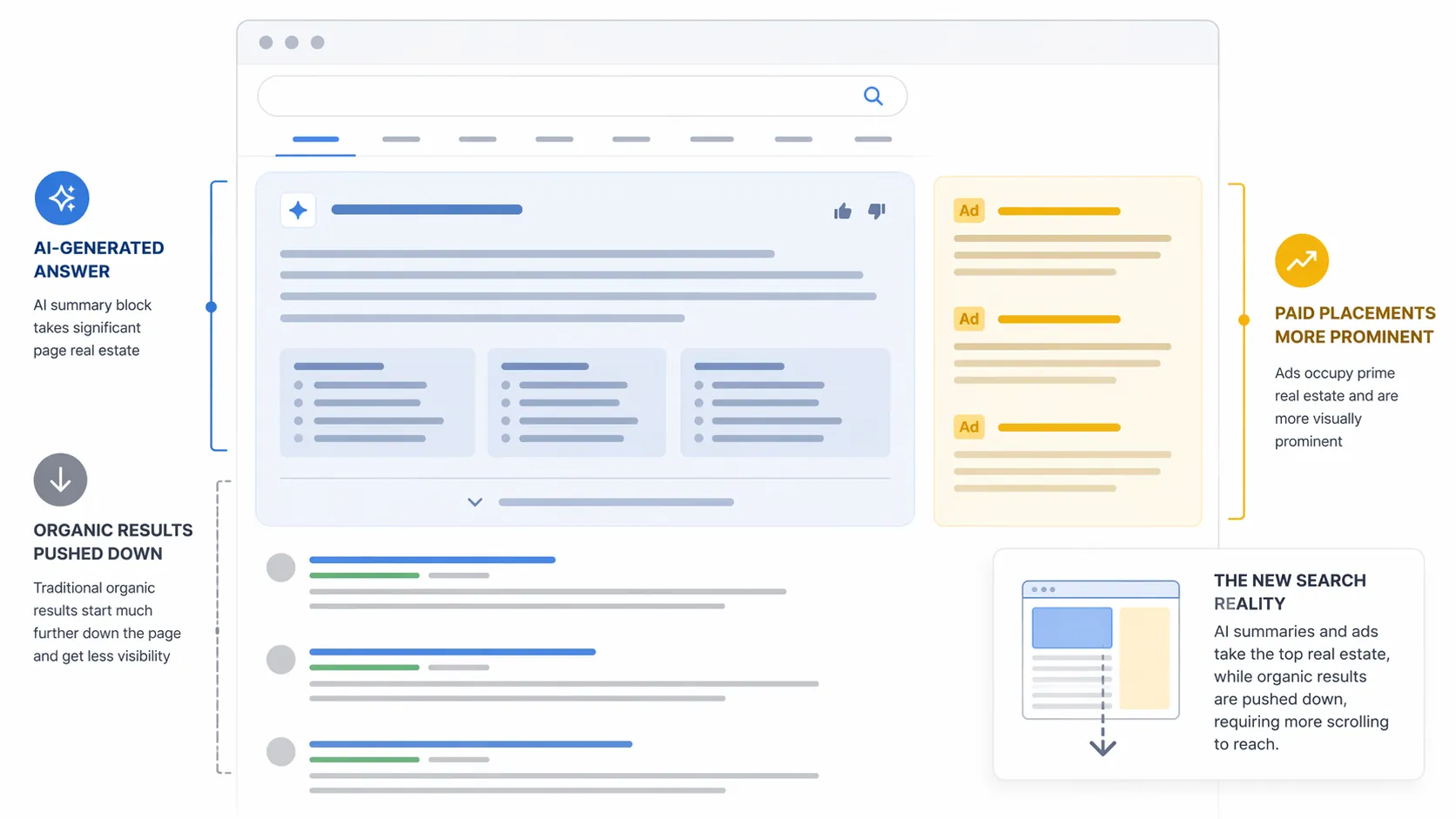
Pew Research Center measured the behavior from a different angle. In a July 2025 analysis, Pew found that Google users were less likely to click links when an AI summary appeared, that only 1% of user visits resulted in a click on an AI Overview citation link, and that 26% of sessions with an AI summary ended without any further interaction.[7] This is not the same metric as Ahrefs’ number-one organic CTR study. It is also useful because it confirms the same mechanism from user behavior: the answer block can satisfy or slow the user before a publisher, retailer, software vendor, or local business receives the visit.
For SEO teams, that is a traffic problem. For paid-search teams, it is also a demand-recapture problem. If organic listings produce fewer visits on informational and mid-funnel queries, the business has to decide whether to accept fewer prospects, shift spend to other channels, or buy more of the remaining Google surface. In many accounts, that decision does not arrive as a neat strategy memo. It arrives as a higher paid share of search sessions that used to include more free contribution.
That is where the stock-market story starts to detach from the media plan. An AI Overview can reduce outbound traffic while still making Google’s page more useful, stickier, or more monetizable. The platform does not need every displaced organic click to become an ad click for the economics to tilt in its favor. It only needs enough commercial intent to remain inside Google-controlled inventory.
The Paid-Search Cost Cascade
The paid-search evidence is narrower than the organic evidence, but it is the evidence advertisers should watch most closely. Search Engine Land published Adthena analysis of more than 5 million ads across six industries, using a late-December 2025 to January 2026 window, and reported 20% to 40% CTR drops on queries where AI Overviews were present, along with CPC increases on technology and telecom terms.[8] The commercial context matters: Adthena sells search monitoring tools, and the Search Engine Land piece is commercially adjacent to that category. The methodology and sample still deserve attention because they connect AI Overview presence to paid-ad metrics rather than only to organic clicks.
| Evidence | What it measures | What it supports | What it does not prove |
|---|---|---|---|
| Ahrefs: 34.5% lower CTR for the #1 organic result when AI Overviews appear | Organic result click-through behavior | AI Overviews can reduce unpaid traffic even for high-ranking pages | It does not quantify every advertiser’s paid-search cost change |
| Pew: 1% of visits click an AI Overview citation; 26% end without further interaction | User behavior around AI summaries | Many sessions do not pass meaningful traffic to cited sites | It does not isolate commercial-intent queries or ad auction outcomes |
| Adthena/Search Engine Land: 20% to 40% paid CTR drops on AI Overview queries; CPC increases in technology and telecom | Paid-search ad performance across monitored industries | AI Overviews may weaken ad CTR and raise costs in affected auctions | It does not prove AI Overviews are the only cause of CPC inflation |
Those three findings should not be collapsed into one magic number. Ahrefs looks at the top organic result. Pew looks at user interaction with AI summaries and links. Adthena looks at paid ads in monitored categories. Put together, they describe a sequence that any search manager can recognize: the answer layer absorbs attention, fewer users click through unpaid results, paid listings compete for a smaller or more distracted pool of clicks, and the auction becomes less efficient for advertisers who still need volume.
CPC inflation has more than one cause. Competitive intensity, budget pressure, match-type expansion, quality signals, macro demand, and automated bidding behavior all matter. The useful claim is narrower: AI Overviews are a structural accelerator. They change the page layout and the user journey before the auction even prices the click. Once that happens, automated bidding systems are not optimizing inside the old search environment; they are bidding inside a page where Google’s answer product has already taken some of the available attention.
This is also why Performance Max, AI Max, and other automated Google products sit inside the cost cascade rather than outside it. They can find conversions across more surfaces, including Google-owned inventory, but they also make it harder for the advertiser to separate search demand creation, demand capture, and remarketing pressure. For a tactical comparison of Google’s automated ad model against Meta’s, the related benchmark on Google Performance Max vs Meta Advantage+ is the more appropriate place to go deep. Here, the important point is simpler: the more spend shifts into automated, platform-controlled surfaces, the harder it becomes to prove that higher spend is buying incremental demand rather than replacing traffic the same ecosystem displaced.
Google’s Monetization Claim Is the Sentence Advertisers Should Read Twice
Google has argued that AI Overviews can monetize at the same rate as traditional search. Search Engine Journal reported comments from Google’s VP and GM of Advertising describing internal controlled experiments that compared query sets with and without AI Overviews.[9] If that claim is true at platform level, it explains why investors could look past the fear that AI answers would destroy Search monetization.
The problem is not that the claim is impossible. The problem is that advertisers cannot audit it. Google does not publish enough methodology for outside replication, and Search Console does not disambiguate AI Overview click behavior in a way that lets publishers and advertisers cleanly verify what happened to their own query mix.[9] A platform saying monetization is healthy is not the same as an account manager being able to explain why nonbrand CPC rose, organic contribution fell, and blended CAC moved in the wrong direction.
The Register made the same structural point from the publisher side, analyzing how Google can profit even as AI summaries reduce traffic to the open web.[10] That logic matters to advertisers because publishers and advertisers sit on different sides of the same click displacement. If fewer users leave Google through organic links, the open web loses visits. If commercial demand still needs to be captured, advertisers buy more visibility inside Google’s remaining monetized surfaces.
That is not a conspiracy theory; it is a margin transfer. Google can maintain or improve monetization per search while the businesses depending on that search traffic experience weaker free distribution and more expensive paid recovery. The financial statements can look better at the same time the media plan gets harder to defend.
What to Benchmark Inside the Account
The practical response is not to declare every CPC increase an AI Overview tax. It is to separate the pieces that can be checked from the pieces Google asks the market to accept on trust. A useful benchmark starts with query groups where AI Overviews commonly appear, then compares them against similar query groups where they do not. The cleanest version tracks organic CTR, paid CTR, CPC, impression share, conversion rate, and blended acquisition cost over the same window.
- Segment brand, nonbrand, competitor, category, and informational queries before blaming AI Overviews for aggregate movement.
- Track paid CTR and CPC separately; a flat CPC with falling CTR can still mean less efficient demand capture.
- Compare organic contribution against paid spend on the same commercial themes, not just against total site sessions.
- Watch whether Performance Max or other automated campaigns absorb spend after organic declines, especially on Google-owned surfaces.
- Keep platform-reported conversion gains separate from incrementality until the account has a credible holdout, geo split, or budget test.
The uncomfortable benchmark is blended, not channel-isolated. If SEO loses qualified visits and paid search replaces only part of that demand at a higher price, the account may still show conversions while the business loses margin. That is the situation a dashboard can hide when it celebrates automated campaign volume without showing what organic used to contribute for free.
The Divergence Is Structural
Google’s AI investment was accretive to Alphabet’s 2025 market story. The stock performance, ad revenue, capex guidance, and investor-soothing earnings narrative all support that conclusion. But the same investment changes the economics of traffic acquisition by moving more user attention into Google’s own answer layer and by increasing advertisers’ dependence on paid, automated, and less transparent surfaces.
Advertisers should not expect that divergence to reverse just because Google says AI Overviews monetize well. Platform monetization and advertiser margin are not the same metric. The more useful question for future benchmark entries is whether AI-Overview-affected queries show a continuing squeeze in organic CTR, paid CTR, CPC, and blended acquisition cost — or whether the pressure stabilizes enough to price into account planning.
References
- Google stock wraps best year since 2009 as AI excites Wall Street, CNBC, Dec. 31, 2025.
- Alphabet beats earnings expectations, raises spending forecast, CNBC, July 23, 2025.
- Google says deep AI investments powering ad sales, soothing anxious investors, Reuters, April 24, 2025.
- How much Google, Meta, Amazon and Microsoft are spending on AI, CNBC, Oct. 31, 2025.
- Alphabet revenue and profit figures from Q4 2025 preliminary results, Financial Times, 2025.
- AI Overviews Reduce Clicks by 34.5%, Ahrefs.
- Google users are less likely to click on links when an AI summary appears, Pew Research Center, July 22, 2025.
- What industry data reveals about Google’s AI Overviews on paid search, Search Engine Land.
- Google Marketing Live: AI Overviews monetize at the same rate as traditional search, Search Engine Journal.
- How Google profits even as its AI summaries reduce web ads, The Register, July 29, 2025.
Built on this evidence
No Bidding tactic or Creative record currently cites this case file. Compare it against other results in Benchmarks.
Related benchmark reading
Report a corroborating or contradicting result
Seeing something different in your own account? Feed the data-integrity loop instead of leaving an open comment.