
How Google's $205B AI Bet Is Reshaping Your Ad Budget
Google's record AI capex and first-ever negative free cash flow create structural pressures on ad costs and campaign control. This analysis breaks down three concrete ways media buyers should adjust their Q4 2026 and 2027 budget planning.
- Platform
- Google Ads
- Campaign type
- AI Max for Search
- Spend range
- All levels
- Timeframe
- Q0 2026
- Conversions
- 0% increase
- Verdict
- mixed
- Industry vertical
- ecommerce
- Last reviewed
- 0-07-24
Alphabet just showed advertisers the awkward version of the AI-spending story behind Google Ads earnings: the company produced $119.8 billion in Q2 2026 revenue, up 24% year over year, and still posted $5.9 billion in negative free cash flow, described as Google’s first-ever negative free cash flow quarter.[1] The stock fell about 3% after earnings and was down roughly 9% since the end of April, but the stock move is not the useful planning signal by itself.[2]
The useful signal is simpler and more operational: the ad machine is still doing the funding, while the ad product is moving more budget decisions into automated surfaces. That does not mean Google Ads is unstable. It does mean Q4 2026 and 2027 budget plans need to account for platform incentives, not just last-click ROAS in the account this week.

The AI Bill Is No Longer Background Noise
Capital expenditure is now large enough to matter to paid-search planning. Alphabet spent $44.9 billion on capex in Q2 2026, up 100% year over year, and raised 2026 capex guidance to $195 billion to $205 billion.[3] Reuters also reported the raised guide and noted CFO Anat Ashkenazi’s comment that 2027 would see a “significant increase,” with FactSet consensus around $257 billion.[4]
That spend is not being funded by a diversified set of equally sized businesses. Alphabet’s ad revenue was $81.63 billion in the quarter, about 68% of total revenue. Google Cloud grew 82% to $24.8 billion, but ads remained the main engine financing the buildout.[5]
This is where the earnings call becomes more relevant than the stock chart. Ashkenazi said Alphabet was “still in a supply-constrained environment” and described third-party capacity as a bridge that created “modest margin pressure.”[3] CNBC separately reported a SpaceX compute arrangement at $920 million per month, though the exact contract terms were not confirmed in SEC filings.[6] None of that proves CPCs will rise next Tuesday. It does make it harder to treat every new automation default as a neutral product decision.
When capacity is constrained, traffic is valuable, and the largest revenue pool is advertising, the platform has a stronger incentive to monetize more queries, more surfaces, and more campaign types with less friction. Buyers do not need to turn that into a conspiracy theory. They do need to stop treating infrastructure spend as something that only cloud analysts track.
The Control Change Has Dates Attached
The part that changes account work is not the capex line; it is the migration path already on the calendar. Google says Dynamic Search Ads will upgrade to AI Max in September 2026. Automatically created assets and campaign-level broad match upgrades follow in February 2027.[7]
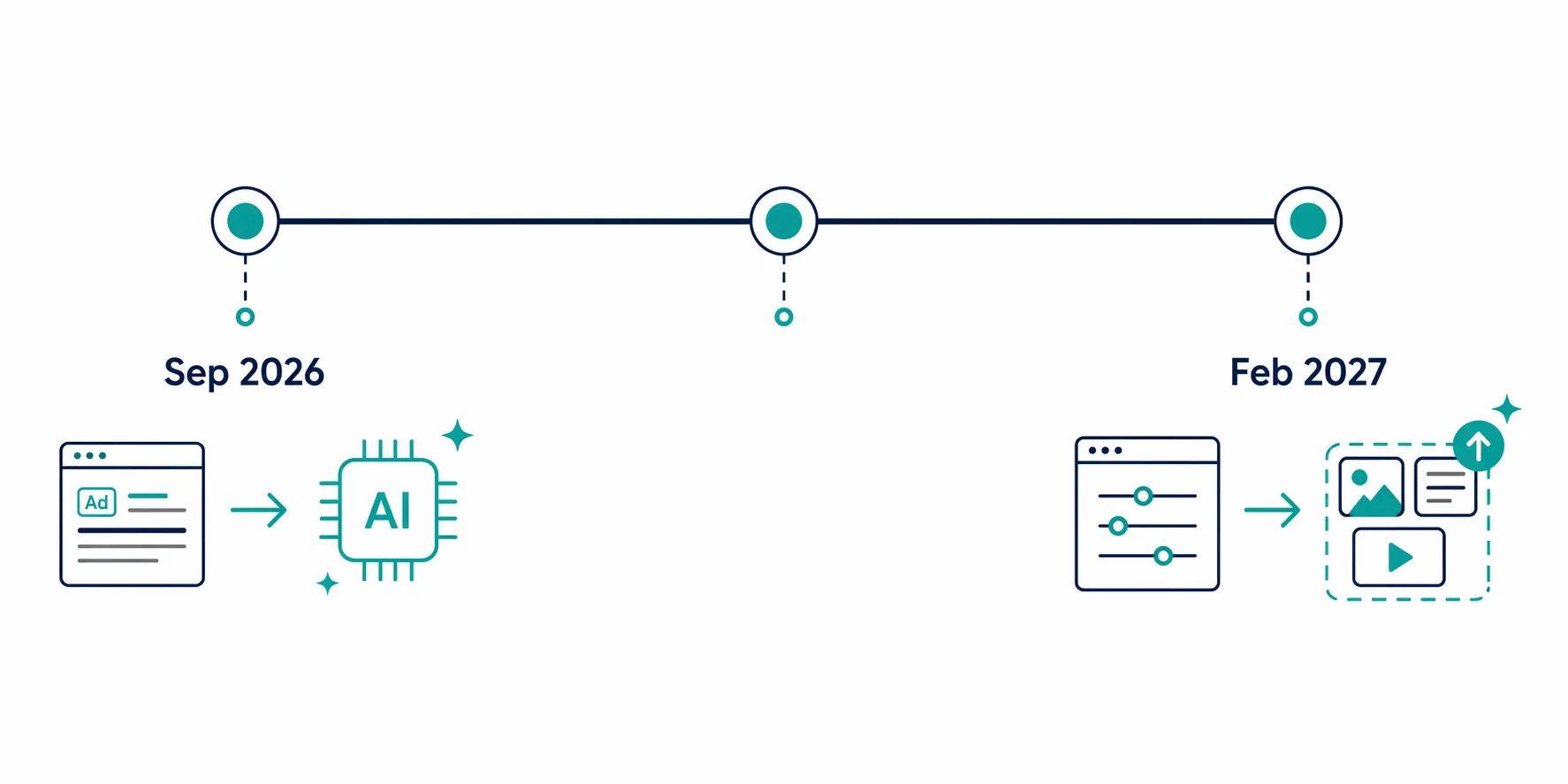
That timeline should sit inside Q4 planning files now, especially for accounts still using DSA as a controlled expansion layer rather than a primary campaign architecture. A DSA campaign that used to sit behind exact and phrase coverage can become part of a broader AI Max system with different query coverage, asset assembly, and matching behavior. The practical question is not whether AI Max can work. It is whether the upgrade preserves the role that campaign was playing in the account.
| Date | Google change | Budget-planning consequence |
|---|---|---|
| September 2026 | Dynamic Search Ads upgrade to AI Max | Audit which DSA campaigns are expansion layers, brand-defense tools, or long-tail capture before their role changes. |
| February 2027 | Automatically created assets upgrade | Review asset approval, compliance, landing-page coverage, and brand-language controls before defaults expand. |
| February 2027 | Campaign-level broad match upgrade | Set query, negative, brand, and budget guardrails before matching behavior broadens at the campaign level. |
The campaigns most likely to need manual review are not always the largest ones. They are the campaigns where structure is doing a job the algorithm cannot see from the interface label: separating margin tiers, protecting sales teams from low-quality lead volume, isolating regulated copy, keeping brand and nonbrand pacing apart, or preventing one category from absorbing shared budget because it has easier conversion paths.
For Q4 2026, the change log should not just say “AI Max enabled.” It should record the previous campaign function, the matched-query mix before and after, the asset sources allowed, the negative strategy, and the budget owner who signs off if spend shifts. That is the difference between testing automation and discovering after the fact that an upgrade rewired the account.
Treat Google’s Lift Claims as Inputs, Not Forecasts
Google’s AI performance claims deserve attention, but not blind insertion into a media plan. On the earnings call, management said advertisers using AI-powered campaigns saw “50% more conversions on average at a similar ROAS,” but the statement was verbal and did not disclose methodology in the materials cited here.[3] Google’s own AI Max blog claim is more specific and more modest: advertisers using the full AI Max feature suite saw 7% more conversions.[7]
Both numbers are Google-supplied. Neither is an independent benchmark for a buyer’s category, margin model, creative constraints, or lead-quality threshold. They can justify a test. They should not justify removing the holdout logic that tells finance why the extra conversions were worth paying for.
The revenue line also argues for restraint. Search ad revenue grew 17% to $63.3 billion, in line with StreetAccount estimates rather than a clear acceleration from AI tooling.[3] Ashkenazi also warned that Q3 2026 search comparisons would be tougher because Alphabet would be lapping an acceleration that began in Q3 of the prior year.[3] That matters because slower growth against tougher comps is not the same as product failure, and it is not evidence that advertisers should pull budget. It is evidence that growth claims need account-level verification.
Where Auction Pressure Could Show Up
There is no clean line from negative free cash flow to next-month CPC. Auction pricing still depends on competitor bids, query mix, conversion rates, quality, seasonality, and budget caps. The more defensible planning view is that Google’s incentives are tilting toward broader monetization while compute and capacity are expensive.
That pressure can appear without a published price increase. A campaign can spend into more marginal queries after matching expands. A Performance Max or AI Max system can find volume in placements or terms that were not previously part of the buyer’s mental model. AI Overviews and AI Mode can create new ad inventory patterns that are harder to compare against historic search-only baselines. Each case lands in the same place for the operator: more time explaining why cost, mix, or conversion quality moved when the budget did not.
The supply constraint matters here because it makes monetization discipline more likely, not because it proves an immediate auction shock. If Google is spending toward a $195 billion to $205 billion capex year and still using outside capacity as a bridge, the company has a clear reason to push successful ad formats into AI surfaces quickly.[3][4] Buyers should expect more tests, more defaults, and more bundled automation where measurement arrives after rollout.
AI Overviews and AI Mode Need to Earn Their Keep
AI Overviews and AI Mode should be watched as monetization surfaces, not just search-experience features. The company is building expensive AI capacity while its largest funding source remains ads. That does not tell buyers exactly which format will win, but it does make it risky to assume AI search inventory will stay experimental, lightly monetized, or operationally separate from core Google Ads planning.
For budget owners, the key distinction is adoption versus effectiveness. If Google expands ad serving around AI answers, that is adoption. It is not yet proof that the traffic has the same commercial intent, lead quality, conversion lag, or incrementality as traditional search. The first wave of reporting may also be too aggregated to answer those questions cleanly.
This is where account design has to compensate for platform opacity. Segment where possible. Keep brand and nonbrand readouts clean. Watch assisted conversion paths rather than only last-click totals. Compare new inventory against margin and lead-quality signals, not just platform conversion count. The wrong response is refusing new AI surfaces on principle; the equally wrong response is letting them blend into totals before anyone knows what they replaced.
Do Not Pull Budget Just Because Free Cash Flow Turned Negative
The platform is still producing volume, and the ad business is still massive. A negative free cash flow quarter is not a media-allocation rule. A stock dip is not a bidding signal. The planning adjustment is to add monitoring triggers around the areas where corporate pressure can reach the account: migration behavior, auction cost, search growth, and AI surface monetization.
| Signal to monitor | Why it matters | What to do if it moves |
|---|---|---|
| Quarterly free cash flow and capex guidance | Shows whether AI infrastructure pressure is easing or intensifying. | Revisit assumptions about automation pressure and new inventory rollout speed. |
| Search ad revenue growth | Indicates whether the core ad engine is still carrying the AI buildout comfortably. | Separate tougher comps from real demand softness before changing allocation. |
| AI Max upgrade behavior | Directly affects campaign architecture, matching, assets, and budget routing. | Document pre-upgrade baselines and require post-upgrade query and cost reviews. |
| Account-level CPC, CPA, ROAS, and lead-quality movement | Captures the buyer’s actual exposure better than corporate averages. | Hold spend steady if quality holds; tighten budgets or guardrails if marginal volume rises. |
| AI Overviews and AI Mode reporting changes | Shows whether AI search surfaces are becoming meaningful paid inventory. | Demand separate readouts where available before blending performance into core search assumptions. |
The budget stance for Q4 2026 and 2027 is disciplined, not dramatic: keep Google in the plan where it is delivering profitable volume, but stop treating automation defaults as isolated product improvements. Alphabet’s AI spend has become large enough that campaign controls, inventory expansion, and auction behavior deserve to be read together.
References
- Even Google couldn't out-earn its AI spending this quarter, Business Insider, 2026-07-22
- Alphabet Stock Falls Despite Earnings Beat, Barron's, 2026-07-22
- Alphabet earnings call coverage, CNBC, 2026-07-22
- Alphabet raises capex forecast on AI infrastructure demand, Reuters, 2026-07-22
- Alphabet earnings recap, Yahoo Finance, 2026-07-22
- SpaceX compute deal coverage, CNBC, 2025-06
- AI Max for Search campaigns, Google Ads Blog, 2026
Built on this evidence
No Bidding tactic or Creative record currently cites this case file. Compare it against other results in Benchmarks.
Related benchmark reading
Report a corroborating or contradicting result
Seeing something different in your own account? Feed the data-integrity loop instead of leaving an open comment.