
How a Data Center Grid Outage Can Wreck Your AI Ad Campaigns
When unexplained CPA spikes or budget overspends hit your AI campaigns, a data center power outage—not an algorithm change—may be the real cause. This article maps the predictable failure chain from grid event to ad delivery collapse, so you can diagnose infrastructure issues and protect your spend.
- Platform
- Meta Ads
- Campaign type
- Advantage+
- Spend range
- All tiers
- Timeframe
- 0-2026
- CPC
- +0% to +300%
- Verdict
- loss
- Last reviewed
- 0-07-25
The first clue usually does not look like infrastructure. It looks like a campaign that was stable yesterday and irrational today: CPA jumps without a meaningful edit, a daily budget disappears before anyone has finished coffee, delivery freezes while spend has already posted, reporting lags behind the billing tab, or a learning status resets after the platform says the incident is over. That is the moment to ask a less comfortable question: is the bidding system making a bad decision, or is part of the ad machine missing the signals it needs to make any decision at all?
A data center grid outage does not wreck AI ad delivery through a mystical “the algorithm broke” story. The useful version is a failure chain: power disruption at or near a facility, UPS or power-path degradation, cloud-region impairment, interrupted model inference or refresh jobs, delayed conversion and budget-state updates, and then a delivery system that either stops bidding or keeps bidding with stale guardrails. The ugly part is not that ads go down. Downtime is obvious. The expensive part is when delivery remains partially alive while budget tracking, reporting, conversion ingestion, or API controls are degraded.
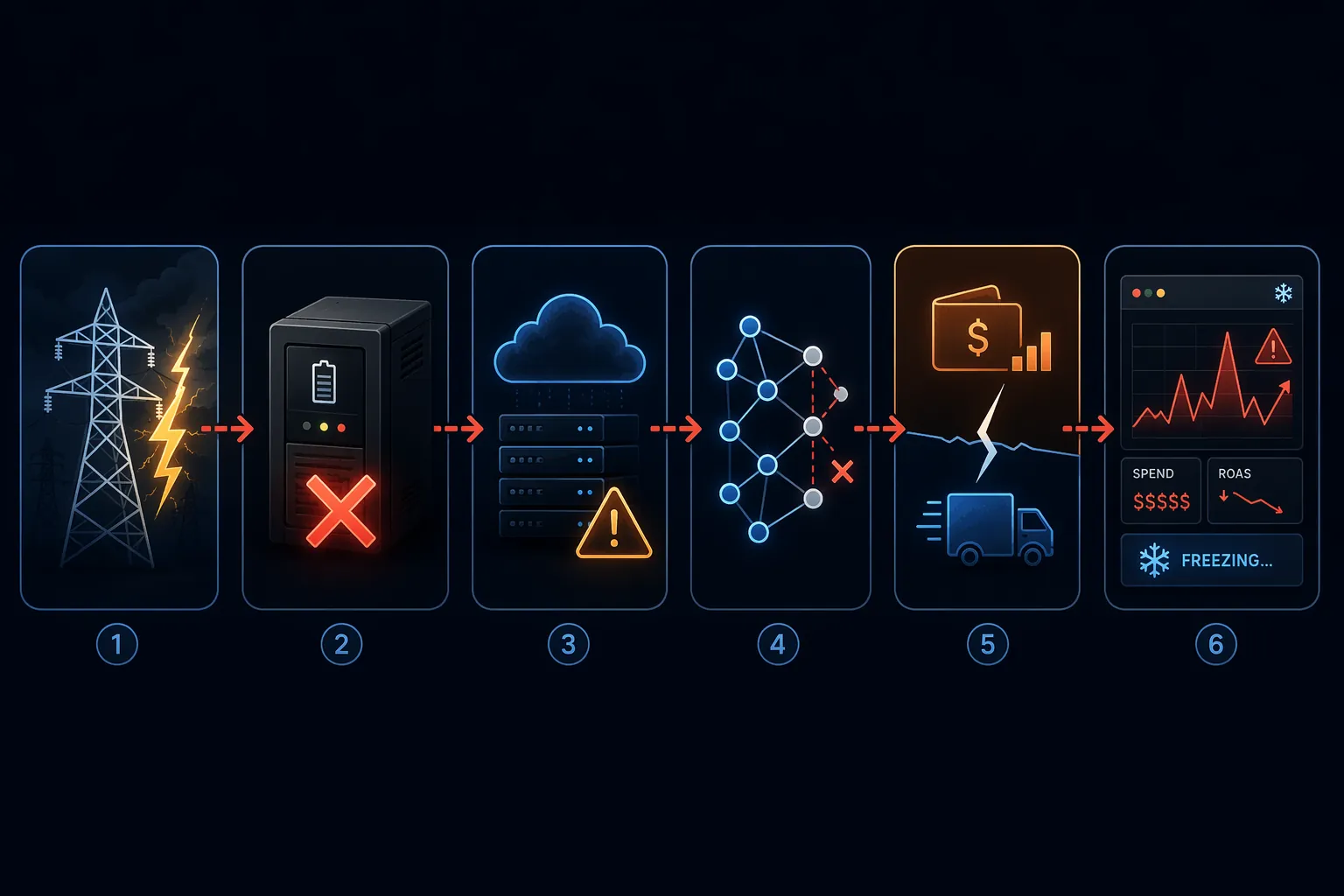
The failure chain that turns an outage into bad spend
Power is not a fringe reliability problem for data centers. Uptime Institute figures cited by EnerSys say 45% of impactful data center outages in 2025 were power-related, and related outage reporting notes that one in five operators said their most recent severe outage cost more than $1 million.[1][2] That does not mean every ad-platform incident starts with a utility fault. It means power remains a common enough failure class that media buyers should not treat infrastructure as an exotic explanation when multiple services fail at once.
For campaign operations, the chain matters more than the root-cause label. A grid disturbance may never touch the dashboard directly. It may affect a power path, which affects a data center or cloud region, which slows or degrades the services that refresh bid models, ingest conversion events, reconcile budgets, or expose API state. By the time the buyer sees it, the symptom is not “power outage.” It is duplicated edits, delayed reporting, campaigns refusing to publish, budget pacing going vertical, or a learning reset that appears after the platform claims recovery.
The critical mechanism is separation. Practitioner post-mortems summarized by Vibemyad describe Meta ad delivery and budget-limit behavior as running through separate infrastructure paths, with cases where delivery continued while budget-limiting controls appeared impaired.[3] That is not the same as a published Meta architecture diagram, and it should not be treated as one. But it fits the operational pattern buyers care about: a system can still find auctions and spend money while the service that should throttle, reconcile, or expose the correct budget state is delayed.
That distinction explains why some incidents feel worse than clean downtime. If the delivery service is down, spend stops and everyone is annoyed. If reporting is down, the buyer is blind but may still have payment-level caps. If conversion ingestion is delayed, the model optimizes against stale feedback. If the budget limiter is degraded while delivery keeps submitting bids, the account can spend through a daily cap before a human has enough trustworthy data to intervene. The dashboard may look indecisive; the bill may not.
Why AI bidding can amplify stale signals
AI bidding is useful precisely because it reacts faster than a buyer watching a report. That strength becomes a liability when the input stream is degraded. If conversion events are delayed by a cloud incident, the model may keep pushing into inventory that recently looked promising but no longer has confirmed outcomes. If attribution signals arrive late, a campaign can look conversion-poor during the incident and then noisy during recovery. If budget state is stale, pacing logic may behave as if there is still room to spend.
Meta’s Andromeda update is relevant here, but it should be handled carefully. AdExchanger describes Andromeda as changing how Meta retrieves and ranks a much larger set of ads before final auction decisions, part of a more AI-driven optimization stack.[9] Separately, outage records and practitioner reports show delivery, reporting, API, and budget symptoms clustering during platform disruptions. The reasonable inference is that faster optimization cycles can propagate bad or missing signals faster. That is an inference from documented behavior patterns, not a platform admission that Andromeda causes outage overspend.
The practical takeaway is narrow: when an automated system depends on frequent state refreshes, delayed state is not neutral. It is an input. A stale conversion stream, a stale budget counter, or a stale campaign status can be treated as reality long enough to burn money or suppress delivery. The more automated the account, the less time a buyer has to notice that the plumbing, not the audience, has changed.
What the recent incidents actually prove
No public source proves a complete end-to-end chain from a specific electrical grid event to a specific Meta campaign overspend. The stronger evidence is assembled from adjacent records: data center outage causes, cloud-region impairments, ad-platform status incidents, API behavior, and practitioner spend anomalies. That is enough to build a triage model. It is not enough to blame a named grid fault for a named account’s CPA spike unless the timestamps and sources line up.
AWS us-east-1 showed how far a cloud-region incident can reach
The October 2025 AWS us-east-1 outage is useful because it moved infrastructure failure out of abstraction. The Growth Shark’s marketer-focused breakdown describes an incident tied to a DynamoDB DNS race condition, lasting about 15 hours and affecting more than 3,500 companies across over 60 countries. It also cites practitioner reporting that Amazon Sponsored Ads clicks fell 14%, with Amazon DSP hit harder.[4] EnerSys, citing Insurance Times, put insured loss estimates for the event in a wide range from $38 million to $581 million.[1]
The ad lesson is not that AWS equals Amazon Ads equals every platform. It is that a cloud-region incident can reach ad products in measurable ways. When a dependency that handles identity, storage, queues, reporting, DNS, or model-serving degrades, the front-end symptom may be ad delivery, not a neat cloud error message. A buyer who waits for the ad platform alone to explain the whole thing may lose the useful part of the timeline.
Meta BFCM showed the spend pattern buyers remember
The November 2025 Meta BFCM crisis is the cleaner campaign-operations warning. AdStatus described a 10-day period in which practitioners saw CPC increases of 50% to 300%, campaigns spending full daily budgets in under 10 minutes with zero conversions, and a concurrent Cloudflare outage that compounded landing-page and CAPI event failures.[5] That combination is exactly why a single metric rarely tells the truth during an incident. CPC can spike because the auction is stressed. CPA can spike because conversion events are delayed. Spend can accelerate because pacing or budget controls are impaired. Landing-page and CAPI failures can make the model believe demand disappeared even while buyers are still paying for clicks.
A bad Black Friday account review can easily misfile all of that as “algorithm volatility.” Some of it may be auction volatility. Some may be creative saturation. But when creation, delivery, reporting, API, landing-page events, and status chatter deteriorate in the same window, creative fatigue is no longer the first explanation to test.
June 12, 2026 showed why recovery can break the account twice
The June 12, 2026 Meta pattern matters because the failure was not a single clean switch from down to up. AdStatus’ later outage timeline points to simultaneous Ads Creation, Delivery, Reporting, and API incidents, while Startup Fortune’s analysis describes the fragility exposed by that kind of multi-service failure.[6][7] In operator terms, this is the chain-of-resets problem: creation fails, delivery destabilizes, reporting lags, API controls become unreliable, and then recovery events can push campaigns back through learning-phase behavior.
That recovery phase is where teams often make the second expensive mistake. They see the platform come back, immediately duplicate or relaunch aggressively, and then wonder why learning status, attribution windows, and budget pacing do not behave like a normal day. An outage can corrupt the pre-incident signal stream; recovery can then change the state of the campaign again. Treating the all-clear as the end of the incident is too optimistic.
How to tell infrastructure failure from ordinary campaign trouble
The danger in learning this pattern is overusing it. Not every CPA spike is a cloud incident. Most bad days are still caused by auctions, offers, tracking, creative, budgets, or account edits. The point is to separate failure modes quickly enough that the response fits the cause.
| Symptom cluster | More likely explanation | What to check before changing bids |
|---|---|---|
| Spend surges while reporting lags or freezes | Budget tracking, reporting, or API degradation | Billing spend, account-level cap status, platform incident pages, third-party outage trackers, API response errors |
| CPA rises after CPC rises across many unrelated campaigns | Auction stress or delivery-system incident | Cross-account CPC movement, status-page delivery incidents, peer reports in the same window |
| Clicks continue but conversions disappear suddenly | Landing page, pixel, CAPI, or cloud dependency failure | Site uptime, checkout flow, server events, CAPI error rate, Cloudflare or hosting status |
| One creative or ad set decays gradually | Creative fatigue or audience saturation | Frequency, CTR trend, comment quality, placement mix, recent creative edits |
| Performance shifts after a known platform update but systems stay healthy | Algorithm or ranking change | Platform announcements, benchmark movement, unchanged tracking, no concurrent API or reporting incidents |
| Learning resets after an outage window | Recovery-phase state reset | Edit history, delivery restart time, status resolution time, budget changes made during the incident |
A useful incident diagnosis starts with timestamp discipline. Mark the first abnormal spend or CPA movement, the first reporting delay, the first failed edit, the first API error, and the first external status report. Then compare those to account changes. If the only major event was a creative upload two days earlier, do not force an outage story. If five unrelated accounts across different clients all show delivery, reporting, and API symptoms inside the same hour, stop rewriting ads and start protecting spend.
The strongest infrastructure clue is cross-surface inconsistency. Ads Manager says one number, billing says another, API calls time out, edits fail to publish, and conversion events arrive late or not at all. A bidding problem usually leaves the platform usable. A tracking problem usually leaves spend controls usable. A broader infrastructure incident makes the control plane itself feel unreliable.
The triage routine when spend looks wrong
The first move is not to rebuild the campaign. It is to preserve the timeline and cap the damage. If delivery is spending faster than reporting can explain, use the highest-level spend control still available. Account-level spending limits are valuable because practitioner guidance describes them as sitting closer to payment infrastructure than campaign-level budget controls.[3] They are blunt, and they can interrupt healthy campaigns, but blunt is acceptable when the alternative is a daily cap evaporating in minutes.
- Freeze unnecessary edits. Every budget, bid, campaign duplication, or learning-sensitive change made during degraded state makes the post-mortem harder.
- Check billing spend separately from Ads Manager reporting. If the two disagree, trust the more financially binding surface until reconciliation finishes.
- Poll platform status pages directly and capture screenshots with timestamps. Do not rely only on delayed RSS or email alerts.
- Check API health if your operation uses rules, scripts, bid tools, or reporting connectors. A working dashboard does not guarantee a working automation layer.
- Verify landing-page and server-event health before blaming delivery. A CAPI or checkout failure can make a live campaign look algorithmically broken.
- Document peer evidence carefully. A Slack thread is useful for triage, but it is not proof unless it shares platform, geography, timestamp, and symptom type.
Third-party monitoring earns its keep in the gap between practitioner pain and official acknowledgement. AdStatus’ analysis of Meta incidents counted 45 documented service disruptions in the 12 months from October 2024 to October 2025, reported a 316% increase in frequency from early to late 2025, and found Ads Delivery accounted for 53% of incidents.[8] Those figures cover acknowledged incidents and may miss unacknowledged degradations, but they explain why relying on a sanitized platform status page after the fact is not enough.
Direct polling matters because incident communication can lag the operating reality. Practitioner guidance recommends polling status pages directly rather than depending on RSS feeds, including a measured 90-minute RSS lag around July 16, 2026 reporting.[3] Even if the exact lag varies by incident, the operational point holds: the buyer with live spend needs a signal before the post-incident write-up is polished.
Budget controls need to survive the system that is failing
Campaign-level budgets are not useless, but they are not a complete incident plan. During normal operation, they guide pacing. During degraded operation, the relevant question is whether the service enforcing the budget is healthier than the service spending it. If both sit inside the same degraded control path, the cap may be late exactly when it matters.
That is why account-level limits, payment-level controls, and external alerting deserve more respect than they usually get. They are inelegant. They do not optimize ROAS. They may stop campaigns that could have kept spending profitably. But they give the operator a last-resort brake when Ads Manager is making confident-looking choices with compromised state.
For larger budgets, distribution is also a control. That can mean spreading spend across platforms, regions, accounts, cloud dependencies, or landing-page infrastructure where the business model allows it. Distribution will not make a Meta delivery incident disappear, and it will not protect a single-platform acquisition model from single-platform risk. It can, however, keep one degraded service from owning the entire day’s revenue target.
Recovery is not just turning campaigns back on
The recovery workflow should assume three kinds of residue: delayed reporting, delayed conversion ingestion, and changed learning state. If conversions arrive late, yesterday’s CPA may improve after the panic. If learning resets, tomorrow’s delivery may be unstable even after the incident is resolved. If buyers made emergency edits during the outage, the account now has both infrastructure noise and human noise in the same window.
- Wait for reporting reconciliation before declaring the final loss, especially when billing, Ads Manager, and analytics disagree.
- Separate outage-window performance from normal benchmark reporting so future budget decisions do not learn from polluted data.
- Review rules and scripts that may have fired during degraded API or reporting conditions.
- Reintroduce paused spend in stages when learning status has reset instead of restoring every budget at once.
- Keep a short incident note with timestamps, symptoms, controls used, and what evidence was confirmed versus inferred.
That last distinction is not legalistic hair-splitting. It is what keeps the post-mortem useful. “Meta delivery, reporting, and API incidents overlapped with our spend anomaly” is a defensible operating conclusion if the timestamps match. “A grid outage caused our CPA spike” is a stronger claim and needs stronger sourcing. The point of this framework is not to find a more satisfying villain. It is to stop wasting the first hour of an incident debating creative fatigue when the control plane is already showing cracks.
Media buyers cannot prevent grid failures, cloud-region incidents, or platform recovery bugs. They can make those failures less mysterious. When spend breaks before the status page admits anything happened, the useful questions are concrete: which service stopped updating, which service kept spending, which signal went stale, which cap still works, and which recovery actions will reset learning again. Answer those quickly, and the next infrastructure-driven collapse becomes an incident to manage rather than another Friday blamed on the algorithm.
References
- Data Centers in 2026: 5 Trends Reshaping Power, Cost, and Resilience, EnerSys
- Data Center Outage Trends, Coresite
- Meta Ads Down Again? Here’s How To Protect Your Budget When Facebook Breaks, Vibemyad
- AWS Outage Breakdown for Marketers, The Growth Shark
- Meta BFCM Crisis November 2025, AdStatus
- Meta Ads Delivery Outage July 16, 2026, AdStatus
- Meta’s Outage Shows How Fragile Its Ad Machine Has Been, Startup Fortune
- Meta Outage Analysis, AdStatus
- What Meta’s Andromeda Update Actually Changes — And What It Doesn’t, AdExchanger
Built on this evidence
No Bidding tactic or Creative record currently cites this case file. Compare it against other results in Benchmarks.
Related benchmark reading
Report a corroborating or contradicting result
Seeing something different in your own account? Feed the data-integrity loop instead of leaving an open comment.