
How prompt injection can sabotage AI ad campaigns
Prompt injection attacks can bypass ad review, hijack creative generation, and manipulate bidding agents—here's what documented evidence shows as of Q3 2026.
- Platform
- Google Ads
- Campaign type
- Performance Max
- Spend range
- Not specified
- Timeframe
- 0-12 to 2026-04
- CTR
- 0
- Verdict
- mixed
- Last reviewed
- 0-07-25
The cleanest answer for paid-media teams is not the loudest one. As of Q3 2026, prompt injection is already a real campaign risk where AI systems review or generate ad assets. It is not yet, based on public evidence, a documented pattern of attackers draining Google Ads or Meta Ads budgets through compromised bidding agents.
The reason this belongs on a media buyer’s risk list is the Unit42 case from Palo Alto Networks. In December 2025, Unit42 documented web-based indirect prompt injection observed in the wild, including what it described as the first documented real-world AI ad review bypass. The researchers found 24 distinct injection techniques across visual concealment, obfuscation, and dynamic execution, and reported that 9.5% of detected indirect prompt injection attacker intents were aimed at AI moderation bypass.[1]
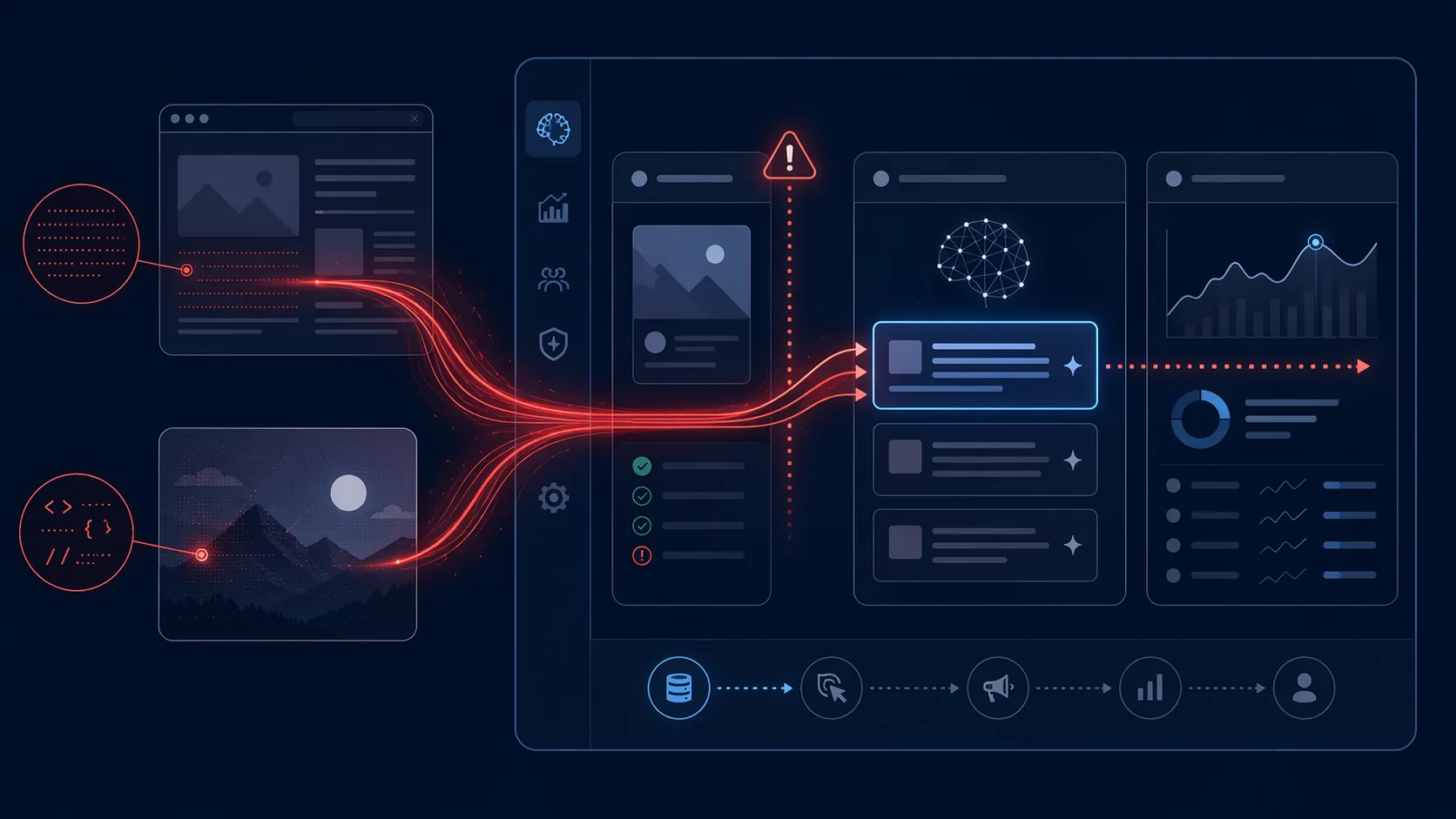
That matters because ad operations are no longer just humans uploading banners into a review queue. Automated campaign systems read landing pages, inspect images, summarize product feeds, generate headlines, remix assets, classify policy risk, and increasingly sit near budget recommendations. A prompt injection payload does not need to “hack the account” in the old sense to create work for the operator. It can land earlier: in review, in asset generation, or in the signals an agent uses before proposing an action.
The strongest evidence is ad review bypass
The Unit42 incident is the load-bearing evidence because it crossed into an ad-specific workflow. The attacker did not need a platform login or a leaked API key. The payload lived in web content that an AI-driven review or agentic system could ingest. Once read, the hidden instruction attempted to steer the model’s behavior around moderation.
For campaign teams, the operational issue is not whether the exploit sounds clever. It is where the failure shows up. If an AI reviewer accepts a prohibited or deceptive creative because instructions embedded in a page or asset tell it to ignore policy signals, the mess appears downstream: disapprovals after launch, account trust damage, policy escalations, client calls, or emergency creative swaps. The person cleaning it up may have had no control over the model boundary that allowed the injected instruction to be treated as relevant context.
The 24 techniques Unit42 described are also important because they move this beyond a single trick. Visual concealment matters to ad review because policy systems inspect images and pages. Obfuscation matters because attackers can hide intent from simple text filters. Dynamic execution matters because what the system sees at review time may not be identical to what a human sees in a static audit.[1]
Google’s April 2026 analysis of prompt injections on the web adds the scale pressure around that case. Google reported a 32% relative increase in malicious indirect prompt injection detected between November 2025 and February 2026, and said observed intents included SEO manipulation, data exfiltration, and ad platform targeting.[2]
There is a useful caveat inside that number. The sweep used Common Crawl, which does not include major social media. For ad teams, that means the measurement is not a full map of everything AI campaign systems may ingest. It is still enough to show that malicious prompt payloads are appearing on the open web at a pace that should make “our model will just ignore it” feel like a weak control.[2]
Three campaign surfaces, three different evidence levels
| Attack surface | What could go wrong | Evidence level as of Q3 2026 |
|---|---|---|
| AI ad review | Hidden instructions steer moderation or classification decisions around ad assets or landing pages. | Strong: documented ad-specific, in-the-wild bypass research. |
| AI creative generation | Injected instructions in pages, images, or competitor material influence generated copy, imagery, or brand treatment. | Strong for the vulnerability class; conditional for direct ad-platform abuse. |
| Bidding or budget agents | An agent that reads external content or messages is manipulated before recommending or executing spend actions. | Structurally plausible, but no public Google Ads or Meta Ads financial-loss case as of July 2026. |
These surfaces should not be treated as equally proven. Ad review bypass has the clearest campaign-specific evidence. Creative hijacking is supported by research and by the way AI creative tools consume messy inputs, but the public record is thinner for actual platform abuse. Bidding-agent compromise is the place to watch without pretending the case has already been proved.
Creative output can be steered before the marketer sees the draft
The creative-generation risk is easy to dismiss if the mental model is a blank prompt box. Most performance teams do not work from blank boxes. They feed systems landing pages, product catalogs, brand pages, screenshots, competitor examples, user reviews, image libraries, and past ads. That is exactly the kind of mixed instruction-and-data environment where indirect prompt injection becomes relevant.
The “Cannibalistic Ad” research demonstration described a multimodal attack in which a physical billboard carried hidden text instructions that caused AI assistants to suppress competitor brands.[3] It was not a confirmed in-the-wild attack against Performance Max, Advantage+, AI Max, or Symphony. Its value is narrower and still useful: it shows that visual or web content can carry instructions that affect an AI system’s output when the system treats the content as context.
In an ad workflow, that could show up as creative drift rather than a dramatic breach. A generated headline might avoid a competitor it should compare against. A product description might overstate or understate a claim. A visual prompt might inherit an instruction embedded in source material. A summary of a landing page might omit a compliance issue because the page told the model to ignore it. None of those outcomes require the attacker to touch campaign settings.
The boundary is important. There is no public evidence, as of July 2026, that a major ad platform’s creative generation system has been broadly hijacked through hidden competitor instructions. The documented point is that multimodal and web-ingesting AI systems can be influenced this way, and the ad creative workflow gives those systems many opportunities to ingest untrusted material.
The architectural problem is separation, not marketer negligence
OWASP’s Gen AI Security Project ranks prompt injection as LLM01:2025 and describes the core weakness plainly: LLMs cannot reliably distinguish instructions from data.[4] That sentence explains why this risk follows AI campaign systems wherever they read uncontrolled pages, files, images, emails, or feed content.
A media buyer can tighten naming conventions, limit who uploads assets, and review generated copy before launch. Those controls help campaign quality. They do not solve the deeper boundary problem if the platform’s model is allowed to process untrusted content and privileged instructions in the same reasoning space.
This is why platform design matters more than asking every operator to become a prompt-security specialist. A safer system treats landing-page text, image OCR, product-feed copy, review snippets, and competitor pages as untrusted evidence. It does not let those materials rewrite the rules for moderation, brand safety, or campaign action.
Budget-agent compromise is plausible, but the public ad evidence is not there yet
The bidding question is where the evidence line has to be held. Automated ad products already optimize budgets and placements, but the internal architecture of Performance Max, Advantage+, AI Max, and Symphony is not public in enough engineering detail to say that a specific prompt injection path reaches bid execution. No documented case of prompt injection causing direct financial loss inside Google Ads or Meta Ads campaigns exists publicly as of July 2026.
Adjacent agent research is still relevant because it shows what happens when an AI agent reads hostile external content and has access to consequential actions. Forcepoint X-Labs reported a live site, perceptivepumpkin.com, carrying hidden prompts that directed AI agents to send $5,000 via PayPal.[5] That is not an ad-platform bidding incident. It is a financial-action proxy: external web content attempted to steer an agent toward a money-moving instruction.
Snyk Labs documented a Gmail-agent hijacking scenario in which a single malicious email caused an agent to forward private data.[6] Again, the ad connection is not that Gmail equals Ads. The connection is the workflow pattern: an agent reads untrusted content, treats embedded instructions as operative, and acts in a privileged context.
CrowdStrike’s 2026 Global Threat Report also indicates that prompt injection has moved from a lab category into operational abuse, reporting more than 90 organizations hit by prompt injection in 2025 and stating that 82% of intrusions used no traditional malware.[7] That supports attention to the class of threat, not a claim that ad budgets are already being siphoned through known prompt-injected bidding agents.
A realistic bidding-agent scenario would require several conditions: the agent reads attacker-controlled content, the injected instruction survives platform filtering, the agent has authority to recommend or execute spend changes, and human or automated guardrails fail to catch the abnormal action. Those conditions are not absurd. They are also not the same as evidence that the chain has happened inside a major ad platform.
What campaign teams should actually watch
The practical response is not to pause automation because prompt injection exists. The response is to place review pressure where the evidence says the risk is closest to campaign work.
- For ad review: watch unusual approval or rejection patterns around landing pages, image-heavy creatives, dynamically rendered pages, and policy-sensitive categories.
- For creative generation: inspect outputs that were generated from scraped pages, competitor references, uploaded screenshots, product feeds, or third-party creative libraries.
- For brand safety: treat hidden text, OCR artifacts, off-screen page elements, and dynamically injected content as possible inputs to AI systems, not as irrelevant page clutter.
- For budget recommendations: keep human approval on material spend changes when the recommendation depends on external summaries, support messages, web research, or agent-generated interpretation.
- For vendor conversations: ask whether the platform separates system instructions from untrusted page, feed, image, and message content, and what logging exists when an AI reviewer or agent changes a decision.
Google’s own security guidance does not frame prompt injection as a one-layer filtering problem. In its mitigation guidance, Google says prompt injection is “unlikely to ever be fully solved,” and argues for layered defenses.[8] That is the right posture for ad systems too. A campaign operator should not be promised that model alignment alone will make hostile web content harmless.
The Monday-morning version of this risk is simple. If AI reviews an ad, attackers may try to influence the review. If AI generates creative from outside material, attackers may try to influence the draft. If AI agents eventually gain more authority over budget logic while reading open-web or inbox content, attackers will have a reason to test that path. The first two are already supported by documented evidence. The third belongs on the watchlist, not in the incident report, until public ad-platform evidence catches up.
References
- Web-Based Indirect Prompt Injection Observed in the Wild, Unit42 / Palo Alto Networks, December 2025
- AI threats in the wild: The current state of prompt injections on the web, Google Security Blog, April 2026
- Advanced Prompt Injection: The New Frontiers, DEV Community / Matt Leads
- LLM01:2025 Prompt Injection, OWASP Gen AI Security Project, 2025
- 10 Indirect Prompt Injection Payloads Caught in the Wild, Forcepoint X-Labs
- Agent hijacking: The true impact of prompt injection attacks, Snyk Labs
- 2026 CrowdStrike Global Threat Report, CrowdStrike, 2026
- Mitigating prompt injection attacks with a layered defense strategy, Google Security Blog
Built on this evidence
No Bidding tactic or Creative record currently cites this case file. Compare it against other results in Benchmarks.
Related benchmark reading
Report a corroborating or contradicting result
Seeing something different in your own account? Feed the data-integrity loop instead of leaving an open comment.