
CFTC and State Bans Reshaped Prediction Market Ad Compliance
CFTC rule changes opened prediction market ads nationally in early 2026, but state enforcement actions quickly triggered Google to expand state-level restrictions, creating a fragmented compliance map. This article details the current restricted states, Google's 'related products' compliance trap, and the geo-targeting audit process media buyers need to implement.
- Platform
- Google Ads
- Campaign type
- Search
- Spend range
- Varies by account
- Timeframe
- 0-01-21 to 2026-07-13
- Restricted state count
- 0
- Verdict
- mixed
- Industry vertical
- Sports prediction markets
- Last reviewed
- 0-07-25
The practical impact of CFTC sports prediction market regulation on sports betting ads is not a clean national permission slip. In the account, it looks more like this: a campaign that appeared eligible under Google’s early-2026 prediction markets policy now needs state exclusions, landing-page review, and a calendar reminder before the next court or regulator moves.
Google opened the door on January 21, 2026, when it said prediction market ads could run under strict conditions, including advertiser certification and limits tied to regulatory status.[1] Eight days later, the CFTC withdrew its proposed ban on sports contracts and said new rules were coming, reinforcing the federal signal that made prediction market advertising commercially viable in a way buyers could not ignore.[2] But the policy layer that now matters inside Google Ads has not been driven by new CFTC rulemaking. It has been driven by state enforcement.
The Current Map Is a Google Policy Map, Not Just a CFTC Map
For campaign setup in Q3 2026, the first distinction is simple but easy to miss: CFTC-regulated status may support eligibility, while Google’s state restrictions decide where the ads can actually run. A federal agency posture can make the category possible; it does not stop an ad platform from carving out states after local regulators act.
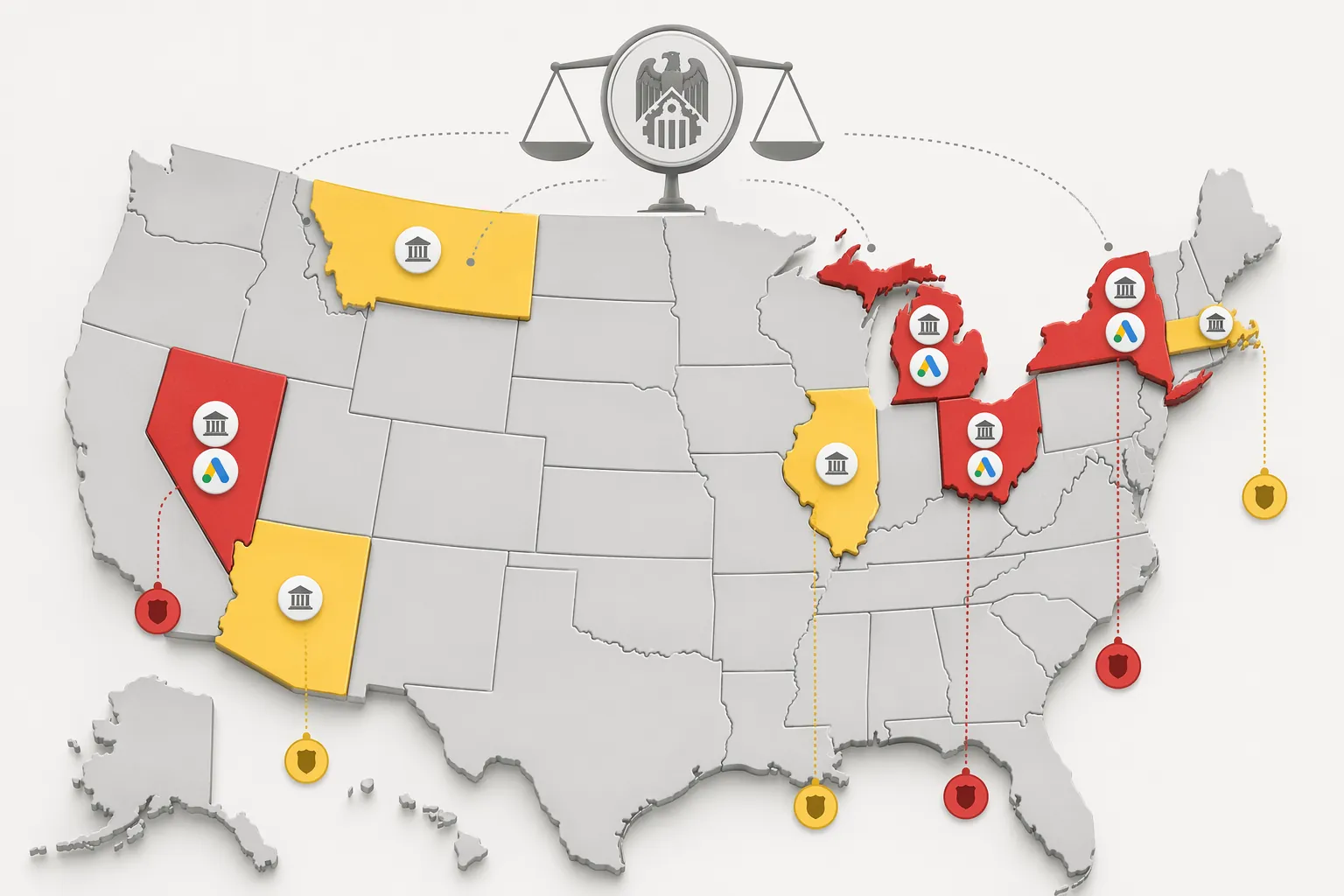
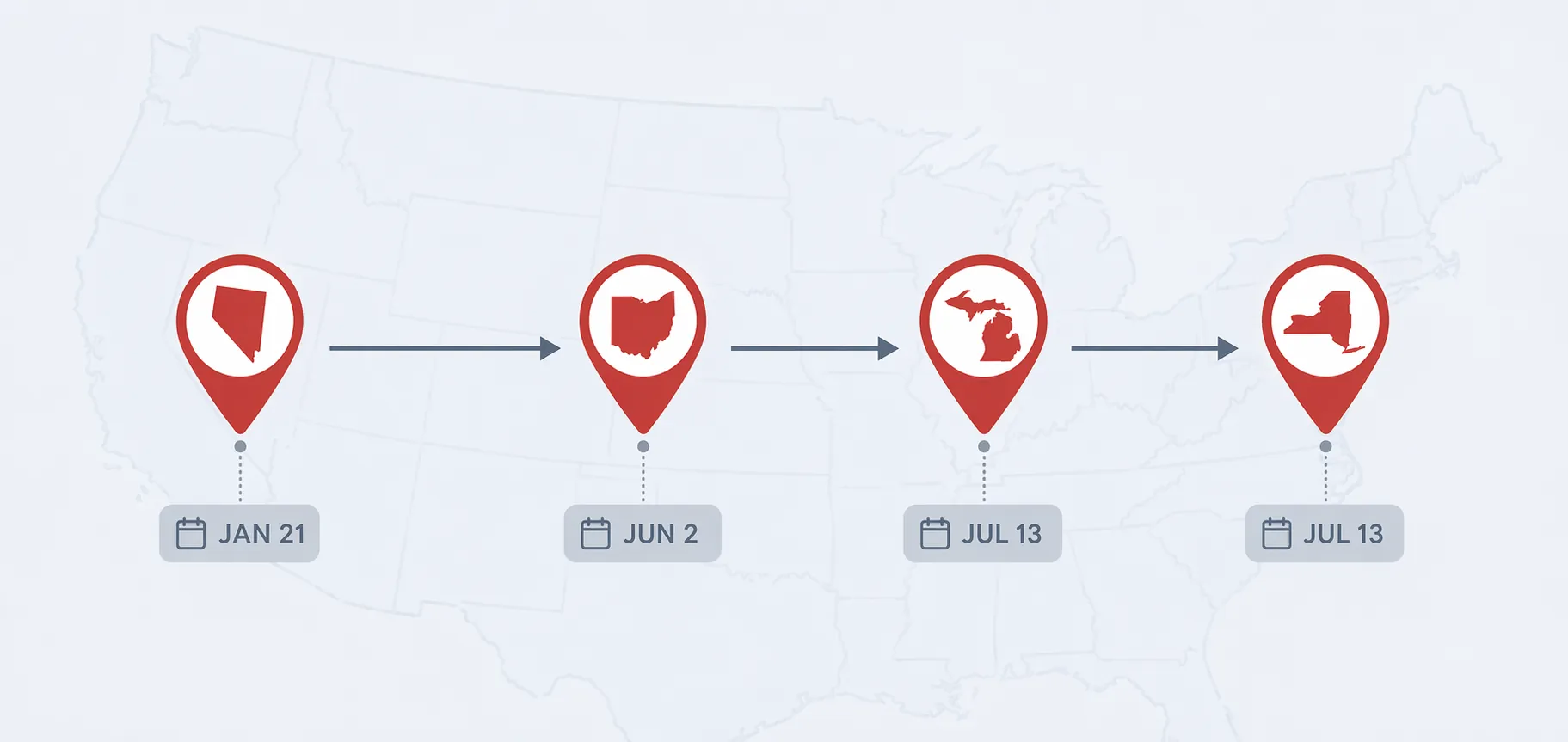
That is what has happened through July. Google’s restricted-state list expanded in three visible steps: Nevada was restricted at launch, Ohio was added in June, and Michigan plus New York were added in July. The operational consequence is that a buyer cannot treat the January approval logic as durable. The approved category and the approved geography are now separate controls.
| Policy date | State impact | Operational read |
|---|---|---|
| January 21, 2026 | Google allowed certified prediction market ads but restricted Nevada | Build certification into launch QA and exclude Nevada from eligible campaigns |
| June 2, 2026 | Ohio was added to Google’s restricted-state list after the state enforcement fight escalated | Update geo exclusions and check whether Ohio traffic is still reachable through broader campaign settings |
| July 13, 2026 | Michigan and New York were added to the restricted-state list | Treat the map as a live compliance variable, not a launch-time setting |
Ohio is the cleanest example of why this is not just a federal-regulatory story. The restriction followed a federal court denying prediction market platforms’ preemption arguments and leaving room for state gaming control to operate, according to PPC Land’s reporting on the dispute.[3] Google’s own July policy update then reflected the expanded state restrictions buyers have to implement in-platform.[4]
Why the Timeline Matters More Than the Category Label
A lazy read says prediction markets became federally regulated, therefore they can advertise nationally. That is not how the ad account behaves. The account behaves according to the most current combination of platform policy, advertiser certification, state-level restrictions, and review interpretation.
The sequence matters because it tells the trafficking team what to monitor. If Google had expanded restrictions after a new CFTC rule, then the federal docket would be the primary policy trigger. Instead, the 2026 changes followed state enforcement disputes. Nevada appeared in the launch restriction set, Ohio followed its court fight, and Michigan plus New York arrived in the July update.[1][3][4]
That changes the audit behavior. The buyer is not only watching the CFTC. They are watching state gaming regulators, state attorney general actions, platform policy notices, court orders, and the quiet lag between a legal development and a Google Ads policy page update.
AuditSocials’ coverage of the Michigan and New York update described the July restriction as a state geo-restriction compliance issue for advertisers, which is the right operational frame: this is not only about whether a platform may list contracts, but whether paid media can target users in a specific state without triggering ad disapproval or account risk.[5]
The “Related Products” Trap
The most annoying sentence in this policy area is not a statute. It is Google’s language around prediction markets and related products. The July 2026 policy update does not merely create concern for ads that directly promote exchange-listed sports event contracts. Its wording can pull in adjacent paths that a media team may have treated as outside the main prediction market campaign.[4]
That ambiguity matters because paid search campaigns rarely live in perfect product silos. A branded campaign may land on a homepage with sports contracts one click away. A nonbrand finance campaign may use sitelinks that expose event trading. A sportsbook testing a prediction product may share navigation, app-store screenshots, bonus language, responsible gaming pages, or account registration flows with other regulated products.
The safest review assumption is that Google may evaluate the ad, keyword, landing page, destination experience, and reachable product path together. That does not mean every adjacent page is automatically prohibited. It means the buyer should not build compliance around the narrowest possible reading of the ad copy alone.
- Check whether restricted-state users can reach prediction market products through homepage navigation, deep links, app prompts, or account creation flows.
- Review sitelinks, callouts, structured snippets, image assets, and app assets for language that points toward prediction-adjacent products.
- Separate campaigns for prediction markets, sportsbook products, financial trading products, and brand defense where the landing-page paths differ.
- Document why a campaign is considered outside the policy scope when it uses shared brand infrastructure.
The documentation point is not bureaucracy for its own sake. It is what keeps a Friday disapproval from becoming a blind scramble through change history. If a reviewer flags a campaign as a related product issue, the team needs to know which landing page, asset, and state-targeting decision was approved internally and when.
The Restricted List Can Still Move
The map is not settled in July 2026. Track360 describes a federal preemption split in which Tennessee granted an injunction while courts in Nevada and Ohio denied preemption arguments, with appellate activity still relevant across the 3rd, 4th, and 9th Circuits.[6] For buyers, the point is not to handicap constitutional doctrine. The point is that the same underlying product can face different ad eligibility outcomes depending on state action and how Google responds to it.
Track360 also identifies Massachusetts, Arizona, Illinois, and Montana as states with pending enforcement actions to watch in the Q3–Q4 2026 window.[6] Those states should not be treated as restricted unless Google or another relevant platform says so, but they do belong on the campaign QA calendar. A watch-list state is where the media team prepares the exclusion workflow before the policy email arrives.
This is where regulated-account muscle memory helps. If a state is under active enforcement scrutiny, the buyer should already know which campaigns include it, which shared budgets depend on it, which bid strategies may be affected if it is removed, and which reports will be used to verify that spend stopped after exclusion.
What to Change in the Account
The account process should start with the current Google policy page, not with a screenshot from launch week. As of the July update, Nevada, Ohio, Michigan, and New York are the state restrictions that need direct treatment in Google campaign settings.[4] If an account still carries a January-era geo plan, it is stale.
- Verify the current Google Ads prediction markets policy before launch, before major budget increases, and after any state enforcement development involving the client.
- Apply restricted-state exclusions at the campaign level and confirm account-level location settings do not reintroduce those states through broad targeting.
- Export and retain proof of geo settings, certification status, landing-page URLs, final URLs, tracking templates, and asset approvals.
- Review landing pages for related-product exposure, especially shared navigation, app download flows, logged-out product pages, and cross-sell modules.
- Maintain a watch list for Massachusetts, Arizona, Illinois, and Montana during Q3–Q4 2026, with a prebuilt exclusion checklist ready if platform policy changes.
- Set a recurring legal-and-media review around appellate developments rather than waiting for disapprovals to reveal that the map changed.
The verification step should include both inclusion and exclusion. It is not enough to confirm that restricted states are excluded. The buyer also needs to confirm that approved states are still intentionally included, because sudden bulk edits and portfolio bid changes can quietly alter coverage. In regulated categories, accidental underdelivery is usually less dramatic than accidental prohibited delivery, but both distort performance reporting.
For reporting, separate performance views by eligible, restricted, and watch-list states. Restricted states should show no served spend after the exclusion date. Watch-list states deserve their own line because they are the first places a compliance change will affect forecast, pacing, and bid learning. If a client asks why volume was held back in an otherwise attractive state, the answer should point to the documented policy and enforcement review, not a vague compliance concern.
Responsible Messaging Still Belongs in the QA Pass
Prediction market platforms and sportsbooks will keep arguing over whether these products should be treated like derivatives, gambling, or something else. A media buyer does not have to settle that fight to run a better review. If the creative touches sports outcomes, money, markets, odds-like language, or app registration, responsible-use messaging should be part of the same QA pass as state targeting and certification.
That is especially true for brands operating near both sportsbook and prediction-market demand. Even when the legal theory differs, the user sees a sports outcome, a price, and a financial upside. Platform reviewers may not parse the distinction the same way counsel does, and consumers will not read the CFTC docket before clicking an ad.
A Living Geo Workflow for Q3 2026
For the rest of Q3, the working model is straightforward: CFTC regulation made prediction market ads possible, while state enforcement and Google policy enforcement decide where they are runnable. Treating that as a one-time setup is how restricted-state traffic survives in old campaigns, shared budgets, and brand assets nobody rechecked.
The durable process is a loop: check Google’s current policy page, compare it with state enforcement developments, update exclusions, review related-product paths, document the account state, and schedule the next review before the next appellate or regulator-triggered change. That loop is now part of buying media for sports prediction markets in the United States.
References
- Update to Prediction Markets, Google Ads Policy,
- CFTC scraps proposed ban on sports contracts, says new rules coming, CNBC, Jan. 29, 2026,
- Google bans prediction market ads in Ohio as state gambling fight escalates, PPC Land,
- Update to Prediction Markets, Google Ads Policy,
- Google Ads Prediction Markets Ban 2026: Michigan & NY, AuditSocials,
- Prediction Market Regulation 2026: CFTC vs State Gaming Law, Track360,
Built on this evidence
No Bidding tactic or Creative record currently cites this case file. Compare it against other results in Benchmarks.
Related benchmark reading
Report a corroborating or contradicting result
Seeing something different in your own account? Feed the data-integrity loop instead of leaving an open comment.