
Martha Stewart's Three-Layer AI Audit for Performance Marketers
A reusable framework for performance marketers to audit AI vendor claims across product, creative, and commerce layers, using Martha Stewart's 2026 initiatives to reveal where platform-level performance data is consistently missing.
- Platform
- Meta Ads
- Campaign type
- Advantage+
- Spend range
- $0k-$500k
- Timeframe
- Q0 2026
- CTR
- 0
- Verdict
- mixed
- Industry vertical
- ecommerce
- Last reviewed
- 0-07-24
The useful part of Martha Stewart’s 2026 AI run is not that a celebrity entered AI. It is that the activity is unusually clean to audit. In the same cycle, she appears in an AI home-management product, an AI-generated advertising campaign, and an AI-enabled commerce environment. That does not prove a coordinated “Martha Stewart AI stack”; no published source establishes Hint, RitualAds, and Shopify as one formal strategy. It does give performance marketers a tidy way to rehearse the question that eventually lands in a QBR: which parts of the story are operationally real, and which parts are being allowed to sound like media performance?
The distinction matters because the visible work is not flimsy. Hint disclosed a $10 million seed round led by Slow Ventures, with Martha Stewart, Yih-Han Ma, and Kyle Rush as founders.[1] Its landing page showed an 8,490+ waitlist counter, address-first onboarding, and referral mechanics that rewarded the top three referrers with a personalized Martha video and the top 100 with access to a virtual launch event.[2] RitualAds published a case study for Elm Biosciences saying the campaign used 100% AI-generated environments and zero practical sets, with a Times Square debut tied to roughly 1.5 million daily out-of-home impressions.[3] Shopify, meanwhile, positioned Martha Stewart inside a commerce narrative about older founders, noting that one in five Shopify merchants over 55 had launched in the prior year.[4]
Those are launch facts, production facts, and positioning facts. They are not, by themselves, CTR, CPA, ROAS, conversion rate, spend, platform mix, attribution window, or incrementality. The audit starts there.

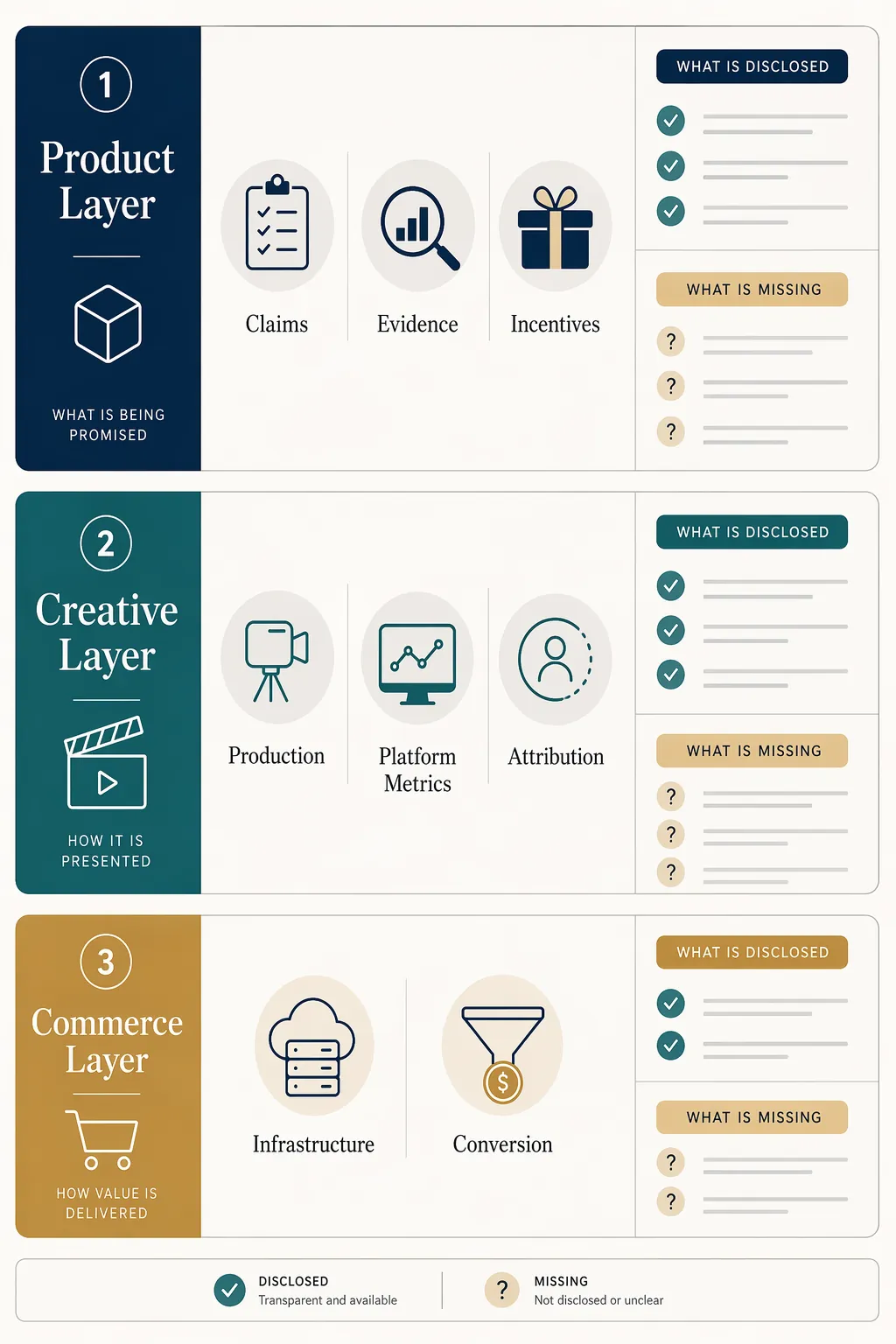
The three-layer audit
A performance marketer does not need to decide whether the Martha Stewart association is valuable. It clearly is valuable for attention, cultural translation, and launch credibility. The narrower job is deciding what claim can safely move from a vendor deck into a budget recommendation.
| Layer | What is being claimed | What is disclosed | What is still missing | Budget-safe reading |
|---|---|---|---|---|
| AI product: Hint | AI can help manage the home through address-specific guidance and Martha Stewart-backed expertise. | $10M seed round; founders; waitlist counter; address-first onboarding; referral incentives; investor concern that recommendations must be blind to commercial deals.[1][2] | Paid acquisition spend, waitlist conversion rate, referral conversion rate, activation, retention, recommendation behavior after launch. | Strong product-launch evidence, not proof that AI-assisted recommendations will create efficient paid growth. |
| AI creative: RitualAds for Elm Biosciences | AI can replace physical sets and create culturally legible premium ad environments around Martha Stewart. | Vendor case study says 100% AI-generated environments, zero practical sets, Times Square debut, and about 1.5M daily OOH impressions.[3] | Campaign-specific CTR, CPA, ROAS, spend, channel mix, audience, testing design, baseline, and attribution method. | Credible production-efficiency story; no disclosed platform-level performance proof for the Martha Stewart campaign. |
| AI commerce: Shopify | Commerce infrastructure can support entrepreneurship and AI-enabled selling workflows around modern storefronts. | Shopify profiled Martha Stewart in an ageless entrepreneurship feature; reported 1 in 5 merchants over 55 launched in the past year; RitualAds says Shopify powered the Elm Biosciences storefront.[3][4] | Attributed conversion lift from AI tools, feed-to-creative contribution, checkout impact, audience-level revenue, and media-to-commerce attribution. | Useful commerce context, not evidence that AI creative or AI commerce drove incremental paid performance. |
That table is the reusable part. Product teams, creative vendors, and commerce platforms often disclose different kinds of proof because they are solving different selling problems. The product layer wants legitimacy. The creative layer wants speed, novelty, and production confidence. The commerce layer wants infrastructure inevitability. None of those incentives naturally produce the same evidence a media buyer needs to approve spend.
Hint is a product launch with a recommendation problem
Hint is the cleanest place to see the difference between product traction and performance evidence. The disclosed ingredients are real: a $10 million seed, named founders, a waitlist, address-first onboarding, and referral incentives that give the launch a measurable growth loop before paid media even appears.[1][2] That is more operational substance than a generic “AI assistant for the home” announcement.
The sharper issue is not whether the waitlist exists. It is what the product will optimize for once it starts making recommendations. Fortune reported that lead investor Kevin Colleran raised affiliate-fee incentives as a condition of investment, saying recommendations must be “blind to commercial deals.”[1] That is exactly the kind of sentence a performance team should underline, because it names the conflict before the product has enough public usage data to resolve it.
Address-first onboarding also deserves more scrutiny than a normal email capture. Asking for an address can make the product feel immediately useful: the system can tailor home guidance to the actual property rather than to a vague profile. It also means the first conversion event is heavier than a standard waitlist signup. Without disclosed funnel data, the 8,490+ counter tells us interest exists; it does not tell us how many visitors refused the address step, how many referred others, or how many would become active users after launch.[2]
For a paid-growth decision, Hint would need a different evidence package. A marketer would ask for visitor-to-waitlist rate by source, address-completion rate, referral participation, cost per qualified signup if paid media has run, and early activation once users receive recommendations. If affiliate commerce enters the model, the audit should also ask whether recommendation ranking separates user fit from commercial payout. The investor’s public concern does not prove a problem; it defines the control that has to be verified.
RitualAds is where production proof starts sounding like media proof
The RitualAds layer is the advertising creative layer: Martha Stewart, AI-generated environments, a premium beauty-adjacent product context, and a public-facing campaign asset. It is also the layer most likely to create attribution confusion.
The disclosed production claim is specific. RitualAds says the Elm Biosciences Martha Stewart campaign used 100% AI-generated environments and zero practical sets.[3] That is a meaningful operational claim. If accurate, it implies fewer physical production dependencies, less location complexity, and a different creative iteration model than a conventional set-based shoot. For a creative operations lead, that is worth testing even before performance data exists.
The Times Square debut is also real as a visibility claim, not a conversion claim. The case study ties the launch to roughly 1.5 million daily OOH impressions.[3] Out-of-home impressions can help a launch feel culturally present, especially with a figure like Stewart whose value is partly trust and recognizability. But unless the campaign discloses a measurement design, those impressions do not tell a buyer what happened on Meta, TikTok, YouTube, CTV, search, or the Shopify storefront after exposure.
The tempting number is on the RitualAds homepage, not the Martha Stewart case study. RitualAds displays “+0.43 ROAS vs baseline,” but the research materials do not attribute that figure to the Elm Biosciences Martha Stewart campaign, and no methodology is disclosed for the metric.[5] That is the kind of number that travels badly. In a meeting, it can become “the Martha AI campaign lifted ROAS,” even though the public evidence does not support that sentence.
A safer reading is narrower: RitualAds has disclosed a production method and a public launch placement; it has not disclosed campaign-specific platform performance for this Martha Stewart creative. There is no published CTR, CPA, ROAS, spend level, platform breakdown, holdout design, creative-test structure, or attribution window for the campaign in the supplied sources.
Directional benchmarks make the gap more important, not less. DigitalApplied’s 2026 AI ad creative benchmark, based on more than 50,000 variants, reported a 12% CTR advantage for AI creative on Meta, an 8% conversion gap on purchases above $100 AOV, and a 17% trust penalty when users detected AI.[6] Those figures are not Martha Stewart results and should not be treated as RitualAds campaign outcomes. They do explain why a click-only proof point would be insufficient even if one were disclosed.
This is the same CTR-versus-conversion problem covered in the AI creative advertising threshold: AI creative can earn attention and still underperform later in the funnel if the promise, price point, trust signal, or landing experience does not carry through. For broader missing-data patterns, the 2026 AI digital advertising benchmark playbook is the better comparison set. The Martha Stewart case simply gives the audit a visible creative artifact.
The trust penalty is especially relevant because Stewart’s brand equity is built on confidence, taste, and domestic authority. If users detect AI in a way that makes the ad feel synthetic rather than polished, the creative could borrow trust from the celebrity while also introducing a trust drag from the production method. DigitalApplied’s 17% trust penalty is aggregated benchmark context, not campaign-specific evidence.[6] It still belongs in the pre-test brief because it changes what should be measured. A buyer should not only ask whether the AI creative gets cheaper impressions or higher CTR; they should ask whether post-click behavior, add-to-cart rate, and purchase completion hold up among users who notice the AI treatment. The related AI ad perception gap is the right lens for that part of the test.
What to request before approving an AI creative test
- Campaign scope: which assets used AI, which did not, and whether AI was used for concepting, environments, editing, copy, localization, or all of them.
- Baseline definition: whether the comparison is against brand creative, human-produced performance creative, prior campaign averages, platform benchmarks, or a controlled split test.
- Platform-level results: CTR, CPC, CPA, conversion rate, ROAS, spend, frequency, placement, audience, and time window by channel.
- Funnel separation: whether the AI creative improved thumb-stop and click behavior only, or whether it also improved qualified traffic, checkout behavior, and revenue.
- Attribution method: click-through and view-through windows, holdout or geo test design, incrementality method, and whether OOH exposure is included in the model.
- Disclosure and perception: whether users noticed the AI treatment and whether detection changed trust, purchase intent, or refund behavior.
A vendor can still pass an initial test without answering every question perfectly. Early-stage creative pilots rarely arrive with complete incrementality studies. The issue is whether the buyer knows which claim is being tested. “We can produce premium environments faster” is a production hypothesis. “This creative improves ROAS” is a media-performance hypothesis. They require different evidence.
Shopify adds the commerce layer, but not the missing attribution
Shopify’s role changes the audit because it moves the question from ad creative into the transaction layer. Shopify’s ageless entrepreneurship feature profiled Martha Stewart and reported that one in five Shopify merchants over 55 had launched in the past year.[4] RitualAds also says Shopify powered the Elm Biosciences storefront connected to the campaign.[3] That gives the story a credible commerce endpoint: the ad is not floating in brand space; it points toward a storefront infrastructure.
But the commerce layer still does not supply the missing performance bridge. A Shopify storefront can support cleaner product data, faster merchandising, checkout, and creative-to-product continuity. It does not automatically prove the AI-generated Martha Stewart creative drove incremental revenue. To make that claim, a buyer would need traffic source data, product-page behavior, checkout conversion, revenue by audience, and a view of how campaign exposure connected to store sessions.
The broader platform context is that commerce tools are being positioned as more agentic. Salesforce Connections 2026 coverage described Shopify Magic and Sidekick within a larger shift toward AI-assisted commerce workflows.[7] That matters for media buyers because feed quality, merchandising logic, and creative generation are moving closer together. The relevant audit is no longer just “did the ad work?” It becomes “which system decided what to show, which product data informed it, and where did the conversion evidence appear?”
That is where a feed-to-creative pipeline audit becomes useful. If AI tools generate creative from product feeds, a performance team has to inspect both sides: whether the feed contains accurate pricing, claims, availability, and variant data, and whether the creative output preserves those facts without exaggeration. The Shopify layer is valuable because it shows where AI commerce could make creative more responsive. It is not a substitute for campaign attribution.
The missing-number pattern
Across the three layers, the public evidence gets less useful as the claim moves closer to spend. Hint gives enough detail to evaluate launch mechanics, but not enough to judge paid acquisition or post-launch recommendation quality. RitualAds gives enough detail to evaluate production ambition, but not enough to judge platform performance for the Martha Stewart campaign. Shopify gives enough context to understand the commerce environment, but not enough to attribute revenue lift to AI creative or AI tooling.
That pattern is familiar in AI vendor marketing. The most concrete facts often sit upstream: funding, waitlists, asset volume, production method, launch venue, number of variants, time saved. The least concrete facts often sit where budget decisions happen: CPA, ROAS, incrementality, payback period, and conversion quality. Production data may be completely real and still be insufficient for a media plan.
| If the vendor says | Treat it as | Ask for |
|---|---|---|
| The AI product has a large waitlist. | Interest or launch momentum. | Source mix, signup conversion rate, completion rate, activation rate, retention, and paid acquisition cost. |
| The AI campaign used no physical sets. | Production-method evidence. | Cost comparison, asset count, revision speed, approval time, and platform-level performance against a defined baseline. |
| The campaign debuted in a high-visibility OOH placement. | Reach and PR evidence. | Measurement design, exposed versus unexposed comparison, site traffic lift, store sessions, and conversion impact. |
| AI creative beat the baseline. | A claim that depends entirely on baseline and method. | Baseline definition, spend, platform, timeframe, audience, attribution window, and whether results are campaign-specific. |
| AI commerce tools powered the storefront. | Infrastructure context. | Checkout conversion, revenue by source, product-feed usage, merchandising changes, and incrementality. |
The RitualAds homepage ROAS claim is the cleanest stress test for this discipline. “+0.43 ROAS vs baseline” is formatted like a performance proof point, but without campaign attribution or methodology it cannot be carried into a Martha Stewart campaign readout.[5] It might be true for some set of work. It might be calculated on a specific platform, client group, period, or baseline. The public page does not say enough for a buyer to know.
A careful buyer does not need to dismiss it. The right response is to quarantine it until the vendor supplies the missing context. Which campaigns are included? What was the baseline? Was spend normalized? Were creative tests randomized? Were audiences held constant? Was ROAS measured on click-through only, view-through included, or blended platform reporting? Was the result audited by the client, the platform, or the vendor? Those questions are not procurement theater. They determine whether the number can survive contact with a budget.
A reusable audit behavior
Martha Stewart’s involvement makes the examples easier to see, but the framework is not celebrity-specific. Any AI vendor stack can be sorted the same way: product claim, creative claim, commerce claim. At each layer, separate disclosed evidence from implied performance.
- At the product layer, ask whether the disclosed metric measures attention, signup intent, activation, retention, revenue, or recommendation quality.
- At the creative layer, ask whether the evidence proves production efficiency, engagement, conversion, revenue, or incrementality.
- At the commerce layer, ask whether the platform improved infrastructure readiness or whether it actually changed attributed purchase behavior.
- Across all layers, ask for platform, spend, timeframe, baseline, attribution window, methodology, and whether the metric belongs to the specific campaign being discussed.
The fair conclusion is not that AI creative claims are empty. Hint shows real launch construction. RitualAds shows a production model worth watching. Shopify provides a commerce layer that could matter more as AI tools connect product data, storefronts, and creative output. The issue is narrower and more practical: production proof and launch proof are not platform-level media proof.
Before the Martha Stewart AI story becomes a line item in a media plan, the buyer needs the missing numbers: CTR, CPA, ROAS, conversion rate, spend, platform, timeframe, attribution, and methodology. If those are absent, the story can still justify a test. It should not be allowed to masquerade as the result of one.
References
- Exclusive: Martha Stewart AI startup Hint seed funding Slow Ventures, Fortune, May 13, 2026
- Hint, Hint
- Martha Stewart, RitualAds
- Ageless Entrepreneurship, Shopify, October 2025
- RitualAds, RitualAds
- AI Ad Creative Benchmark 2026: CTR & ROAS Data, DigitalApplied
- Salesforce Connections 2026: Future of Marketing Agentic, SalesforceBreak, June 3, 2026
Built on this evidence
No Bidding tactic or Creative record currently cites this case file. Compare it against other results in Benchmarks.
Related benchmark reading
Report a corroborating or contradicting result
Seeing something different in your own account? Feed the data-integrity loop instead of leaving an open comment.