
Audit AI Animal Video Creative for Compliance Before It Serves
Media buyers must pre-audit AI-generated animal video creative for platform detection sensors, jurisdiction-specific disclosure requirements, and brand-loyalty risks before launching campaigns in 2026.
- Platform
- YouTube
- Campaign type
- Video
- Spend range
- Confidential
- Timeframe
- 0
- Views
- 0
- Verdict
- mixed
- Industry vertical
- Insurance
- Last reviewed
- 0-07-25
The AI-generated fox video is exported, resized, and sitting in the upload queue. It looks good enough to run on Meta, Google, TikTok, or YouTube. That is exactly when the creative stops being just a video variant and becomes an evidence problem: what metadata is attached, what platform systems may detect, which markets require disclosure, and whether the brand can defend the choice when viewers notice the animal is synthetic.
For media buyers, fake-detection risk around AI-generated animal videos in advertising is no longer a viewer-side guessing game. In 2026, the practical question is whether the team can prove what the asset is before spend starts. A photoreal rescue dog, a wildlife backdrop, or a surreal fox may all be usable. What is not usable is a handoff that says “AI-ish, probably fine” and leaves the trafficker to answer platform review, legal, and brand teams after submission.

| Pre-launch risk | What the buyer can know before upload | What remains uncertain |
|---|---|---|
| Platform detection | Whether the file carries C2PA-style metadata, whether a detector flags likely AI generation, and whether the platform has a public AI-labeling surface. | Exact proprietary classifier thresholds, especially where platforms do not publish review logic. |
| Jurisdiction disclosure | Whether the campaign runs in markets with AI-content labeling requirements, including New York and EU markets in 2026. | Edge cases around partially generated content and whether a specific depiction could deceive a viewer. |
| Brand loyalty | Whether the concept depends on viewers emotionally accepting the animal as authentic. | How a specific audience will react once comments, press, or creators frame the ad as fake. |
What Platforms Are Likely To See
Start with the file itself. If an AI video tool or post-production workflow preserves provenance metadata, a platform may not need to “guess” that the animal was generated. C2PA Content Credentials are designed to carry cryptographic provenance signals about how media was created or edited, and major advertising platforms are reading or implementing that kind of metadata as part of AI-content labeling workflows as of July 2026.[1]
That does not mean every platform is using the same scanner or applying the same enforcement threshold. Public information supports a practical map, not a complete reverse-engineering guide.
| Platform or system | Known public signal | Buyer takeaway |
|---|---|---|
| Meta | Reported use of C2PA metadata scanning plus proprietary classifiers. | Check metadata before upload and document AI-generation status; do not assume the classifier details are public. |
| Google / YouTube | SynthID is part of Google’s AI-content ecosystem, and Google added a “How this ad was made” transparency panel in July 2026. | Expect AI involvement to be surfaced to users when Google’s systems or disclosures support it. |
| TikTok | Upload-time detection prompts are part of reported AI-labeling workflows. | Do not treat the prompt as a last-minute copy field; decide disclosure before the upload session. |
| Microsoft | Upload workflows can parse cryptographic Content Credentials. | Assume provenance metadata may travel with the asset unless intentionally stripped or overwritten. |
| C2PA | A metadata standard, not an ad-review policy by itself. | Use it as evidence in the audit file, not as proof that every platform will approve the ad. |
Google’s transparency surface matters because it changes the viewer experience, not just the back-end review process. MediaPost reported that Google’s “How this ad was made” panel was added to give users more information about AI-generated ads, alongside broader platform movement toward C2PA support.[2] A buyer should assume that AI involvement may become visible after serving, even if the creative passed review cleanly.
Meta and TikTok deserve more caution in planning documents. It is reasonable to prepare for metadata checks, upload prompts, and automated detection. It is not reasonable to claim exact trigger thresholds unless the platform has published them. A pre-flight note that says “possible proprietary classifier review” is much better than a confident claim that a specific fur artifact will cause rejection.
Disclosure Is Now A Market Decision, Not A Caption Preference
The disclosure decision has to be made by market, placement, and creative version. In the United States, secondary guidance summarized by HumanAds.ai says sponsored AI-influenced content may require both sponsorship disclosure and AI-involvement disclosure, with FTC penalties described as up to $53,088 per violation and enforcement cases reported as up 40% in 2025.[3] Because that source is not an FTC primary document, the safer operational use is not to treat it as the final legal answer. Treat it as a reason to route the ad through the same disclosure review you would use for any materially sensitive claim.
New York adds a clearer state-level checkpoint for many advertisers. AFS Law describes a New York AI disclosure law effective June 2026 that requires conspicuous disclosure when ads contain “substantially generated” AI content, including more than 50% AI-created text or AI-generated visual elements, with fines up to $10,000 for repeat violations.[4]
EU campaigns add another date to the launch calendar. AFS Law also identifies EU AI Act Article 50 requirements taking effect August 2, 2026, requiring labeling of AI-generated or manipulated content for campaigns running in EU markets.[4] If a Q3 2026 buy includes EU delivery, the disclosure plan cannot be copied from a U.S.-only campaign.
Industry guidance leaves one gray area that matters for animal creative. AdExchanger reported that the IAB transparency framework treats AI-generated depictions of animals as needing disclosure when they could “deceive” a viewer.[5] That distinction may feel obvious when the asset is a cartoon penguin wearing sunglasses. It is less obvious when the asset is a photoreal shelter dog, injured wildlife, or nature documentary-style scene. The buyer’s job is not to win a philosophy argument about deception. The buyer’s job is to record why the team treated the asset as disclosable or not disclosable before launch.
The Pre-Flight Workflow
The workflow should happen before trafficking, not while the buyer is staring at a platform warning. A clean audit file does not need to be theatrical. It needs to be dated, specific, and boring enough that someone else can reconstruct the decision two weeks later.
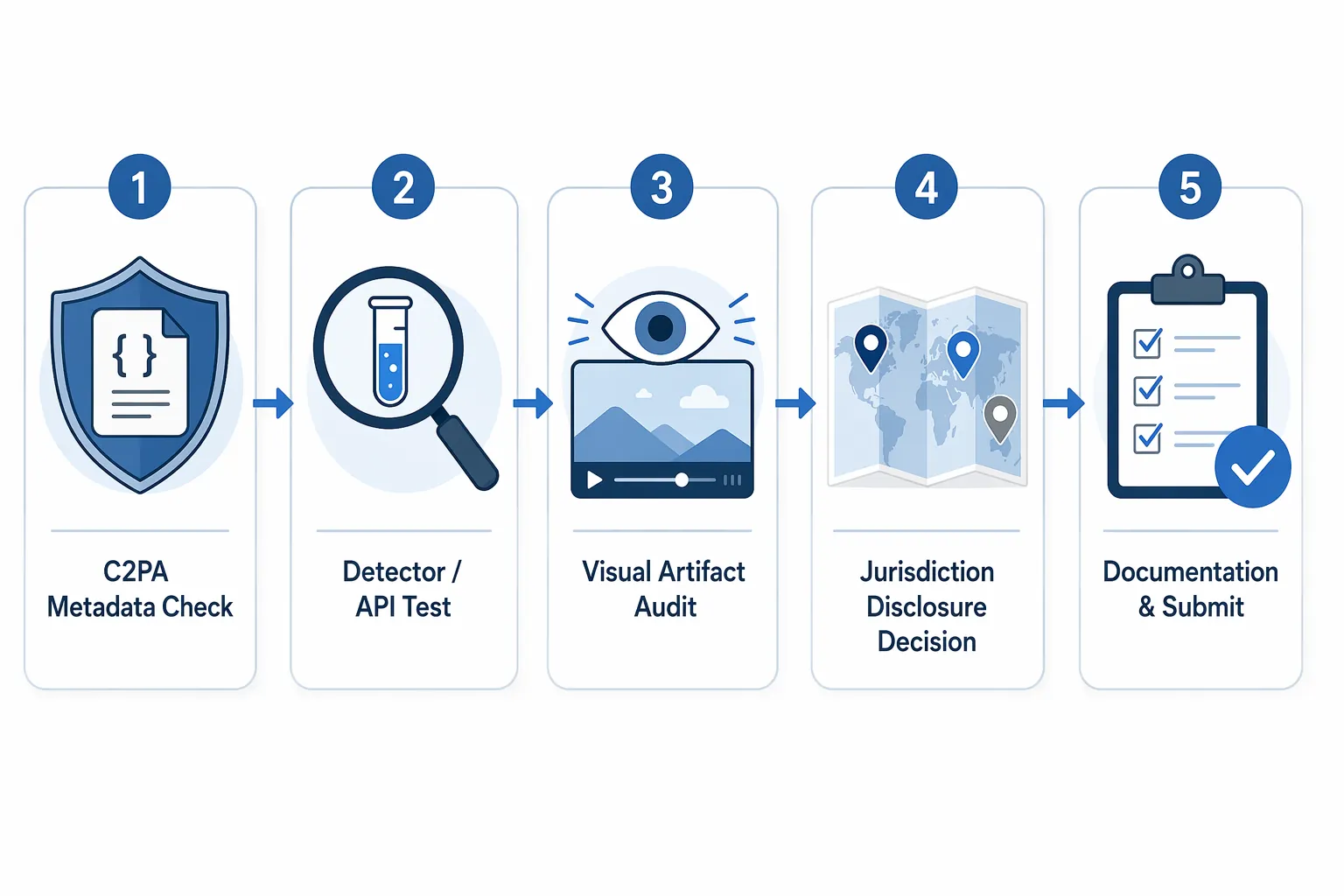
1. Preserve and inspect provenance metadata
Keep the original export from the AI generation or editing tool. Then inspect the final trafficking file for Content Credentials or comparable provenance metadata. Record whether metadata is present, absent, stripped during editing, or overwritten by compression. If the creative has multiple cutdowns, check each file. A 15-second vertical version may not carry the same metadata state as the 30-second horizontal master.
This step is not about making the file look less detectable. It is about knowing whether the platform may receive a machine-readable signal that contradicts the team’s upload disclosure. If the platform sees AI provenance and the buyer selected a no-AI option because “the dog looks real,” the problem was created before review.
2. Run an available detector test, then file the result carefully
A third-party detector is not a platform verdict, but it is useful pre-launch evidence. Hive Moderation says its AI Detection API returns confidence scores and likely generative model attribution, giving advertisers a way to test assets before submitting them to ad review.[6] The right use of that result is limited: save the date, asset ID, version tested, output score, and any model attribution. Do not translate a low score into “safe” or a high score into “rejected.”
If the detector strongly flags the video as AI-generated, the disclosure file should say so plainly. If it does not, the file should still carry the known production facts. Detector uncertainty does not erase the agency, freelancer, or internal production history that produced the animal.
3. Audit animal-specific visual signals
Animal videos create their own failure patterns. The viewer may not notice a distorted background sign, but they will notice when a dog’s gait slides, a fox’s shadow detaches from the floor, or fur repeats like wallpaper. Siwei Lyu of the University at Buffalo identifies unnatural movement physics, lighting and shadow inconsistencies, and fur texture pattern repetition as reliable visual artifacts in AI-generated wildlife images and videos.[7]
That conservation-focused work should not be misquoted as ad-platform policy. It does not prove that Meta, Google, TikTok, or YouTube will reject a specific animal ad. It does give a buyer a practical inspection list before the file goes live.
- Movement physics: scrub frame by frame through jumps, turns, paw placement, tail movement, blinking, and weight shifts.
- Lighting and shadow: compare the animal’s shadow direction, contact point, reflection, and brightness against the environment.
- Fur texture: look for repeated patches, melting edges, inconsistent markings, or patterns that reset between cuts.
- Species plausibility: check whether the creative depends on viewers believing the animal behavior is real, rescued, endangered, trained, or documented.
- Comment risk: note any frame or claim likely to invite “fake,” “AI,” “scam,” or “animal cruelty” reactions.
The visual audit is where animal creative differs from a synthetic product render. A fake chrome bottle may create a compliance issue if the product claim is misleading. A fake animal can create a trust issue even when the product claim is fine, because viewers attach emotion to rescue, wildlife, pets, and welfare cues.
4. Make the disclosure call by jurisdiction
Build the market list before writing labels. A U.S.-only test, a New York-targeted retail campaign, and a multinational YouTube buy do not carry the same disclosure map. For each market, the audit file should identify whether the asset contains AI-generated visual elements, whether those elements are substantial to the ad, whether the animal could be mistaken for real footage, and where the disclosure will appear.
The disclosure should also match the placement. A label buried in landing-page copy will not solve a platform upload prompt. A production note inside an internal creative brief will not help if a user-facing panel asks how the ad was made. The point is not to write the longest possible label. The point is to make the same factual decision visible in the places that matter: platform field, on-ad treatment when required, landing-page support when relevant, and the internal audit file.
5. Attach the evidence before submission
The final file should not move to trafficking until the audit package is attached to the creative record. At minimum, that package should include the source of the animal asset, AI tool or vendor if known, metadata status, detector-test result if used, visual audit notes, jurisdiction disclosure rationale, exact labels selected or copy applied, reviewer name, and review date.
This is the part teams tend to skip because it feels administrative. It becomes much less administrative when an ad is rejected, a platform asks for clarification, or a brand lead wants to know why customers are calling the campaign fake. The person who pressed publish should not have to reconstruct the production chain from Slack threads.
Why Approval Is Not The Same As Brand Safety
Progressive’s “Drive Like an Animal” campaign is the case that should sit in every AI-animal creative review. Ad Age reported that the campaign used AI-generated animals and achieved 10× production time savings compared with traditional VFX or animation.[8] That is the part performance teams understandably like: faster production, more variants, lower friction.
The other half is the launch-day tax. Marketing Dive reported that Razorfish data showed a 37% negative brand-loyalty impact tied to the campaign, while the YouTube spot had more than 142,000 views and predominantly negative comments as Progressive tried to balance AI efficiency with authenticity concerns.[9] Nothing in that case proves that all AI animal ads damage loyalty. It proves something narrower and more useful: passing through production and distribution does not guarantee that viewers will accept the synthetic animal as fair creative.
That distinction matters for media buyers because platform compliance and audience trust are separate gates. A platform may allow a disclosed AI-animal ad to serve. The comment section may still frame the brand as cheap, deceptive, or emotionally manipulative. If the campaign uses animals to borrow authenticity—rescue, loyalty, endangered wildlife, companionship—the loyalty risk should be reviewed before the media budget is attached.
Where The Gray Areas Sit
Some animal creative is obviously synthetic. A neon raccoon piloting a spaceship is unlikely to deceive a reasonable viewer into believing the footage is documentary evidence. A photoreal injured puppy in a donation ad is a different category of risk. The IAB’s “could deceive” framing is useful because it points to viewer interpretation, but it also leaves the buyer with judgment calls that cannot be fully automated.[5]
There is also a boundary around fraudulent rescue content. The IAB framework discussed in the research does not solve outright animal-rescue scams or donation fraud. If an ad implies a real animal, real rescue, real shelter, or real conservation outcome, the AI disclosure workflow is not enough. The claims themselves need substantiation.
Scale should be handled carefully too. A 2024 SMACC scan found more than 1,000 fake rescue videos with 572 million views during a six-week window, but no newer systematic audit was identified in the materials for this article.[10] That supports a warning about known visibility and engagement around fake rescue content, not a precise claim about the current 2026 volume.
The Launch Desk Rule
AI animal content can run in advertising when it is treated as a flagged creative class, not a normal video variant with prettier rendering. The buyer does not need to prove exactly how every platform classifier works. The buyer does need dated evidence showing what the asset is, how it was made, what detector tools reported before upload, what jurisdictions require, and what disclosure choices were made.
If the team cannot show metadata status, detector-test result or reason it was not used, visual artifact notes, jurisdiction-by-jurisdiction disclosure rationale, and final labeling decisions, the creative is not ready to serve.
References
- Cross-Platform AI Content Labeling Requirements 2026 Comparison Guide, AuditSocials.
- Google Adds Transparency To AI-Generated Ads, MediaPost, July 2026.
- FTC AI-Generated Content Disclosure: 2026 Rules Explained, HumanAds.ai.
- Advertising Law Compliance in 2026: Five Developments Every Advertiser Should Know, AFS Law.
- IAB's New AI Regulations Give Advertisers A Starting Point, AdExchanger.
- Hive AI Detection API, Hive Moderation.
- Threats to conservation from AI-generated wildlife images and videos, Conservation Biology.
- AI ad of the week: Progressive features AI-generated animals, Ad Age.
- How Progressive balances AI use with authenticity as scrutiny persists, Marketing Dive.
- Fake animal rescue videos on social media, SMACC, 2024.
Built on this evidence
No Bidding tactic or Creative record currently cites this case file. Compare it against other results in Benchmarks.
Related benchmark reading
Report a corroborating or contradicting result
Seeing something different in your own account? Feed the data-integrity loop instead of leaving an open comment.