
The real cost of Discord outages for advertisers
Discord's ad platform suffers from frequent outages with no contractual remedy for advertisers. This article examines the outage record through mid-2026 and what it means for media buyers considering or running Quest campaigns with $100K+ minimums.
- Platform
- Discord
- Campaign type
- Quest
- Spend range
- $0K-$150K
- Timeframe
- 0-09 to 2026-07
- CPI
- sub-$0.50
- Verdict
- mixed
- Industry vertical
- gaming
- Last reviewed
- 0-07-25
A Discord Quest buy looks clean on the spreadsheet until the launch calendar gets involved. The format asks users to opt in, complete a task, and claim a reward, which is a better starting point than forcing a pre-roll into a feed where nobody asked for it. Discord has claimed a 99% Quest completion rate and a 30% CPI reduction for Marvel Snap, while coverage of its ad push has cited a 96% video completion rate from internal December 2025 data.[1][2] A third-party aggregator, MythOS, has also listed sub-$0.50 CPI benchmarks and reported minimums of $100,000 for Game Quests and $150,000 for Video Quests, with $22–$30 CPM pricing.[3]
Those numbers are good enough to deserve attention. They are not good enough to ignore the harder question behind Discord outage risk for advertisers: if the campaign window is short, and Discord becomes unavailable during the hours that matter, who actually absorbs the loss?
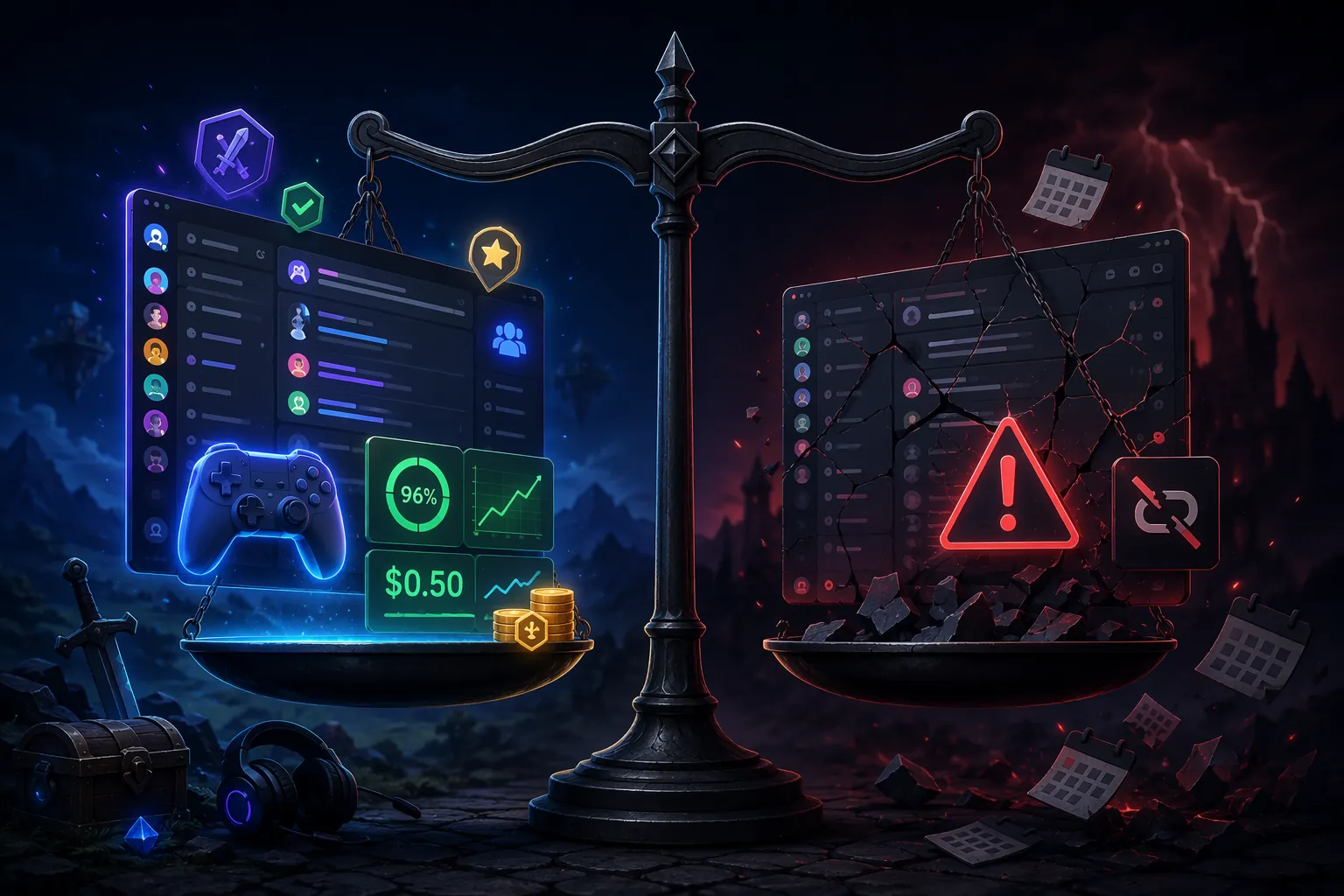
The answer is not sitting in the completion-rate claim. It is sitting in the outage record and in the advertising terms. Discord’s Self-Service Advertising Terms say that Discord does not guarantee “any level of delivery, reach, results,” and that campaigns are provided “as is” and “as available.”[4] For a flexible test budget, that may be a tolerable platform risk. For a launch-week media plan, it is a different kind of exposure.
Why Quests Are Tempting Anyway
Discord’s ad pitch has one advantage many social products do not: the action is voluntary. A Quest is not just an impression unit; it asks a user to watch, play, stream, or otherwise complete a defined action in exchange for a reward. That makes the reported completion metrics commercially interesting, especially for game advertisers who care less about cheap reach than about getting the right players to take a measurable next step.
Discord has also tried to reduce the usual measurement objection. Its ad expansion has included measurement partnerships with AppsFlyer and Gamesight, giving buyers a more familiar path for attribution and performance reporting than a purely platform-native dashboard would provide.[1][2] That matters because experimental budget usually dies when the channel cannot be compared, even roughly, with the rest of the plan.
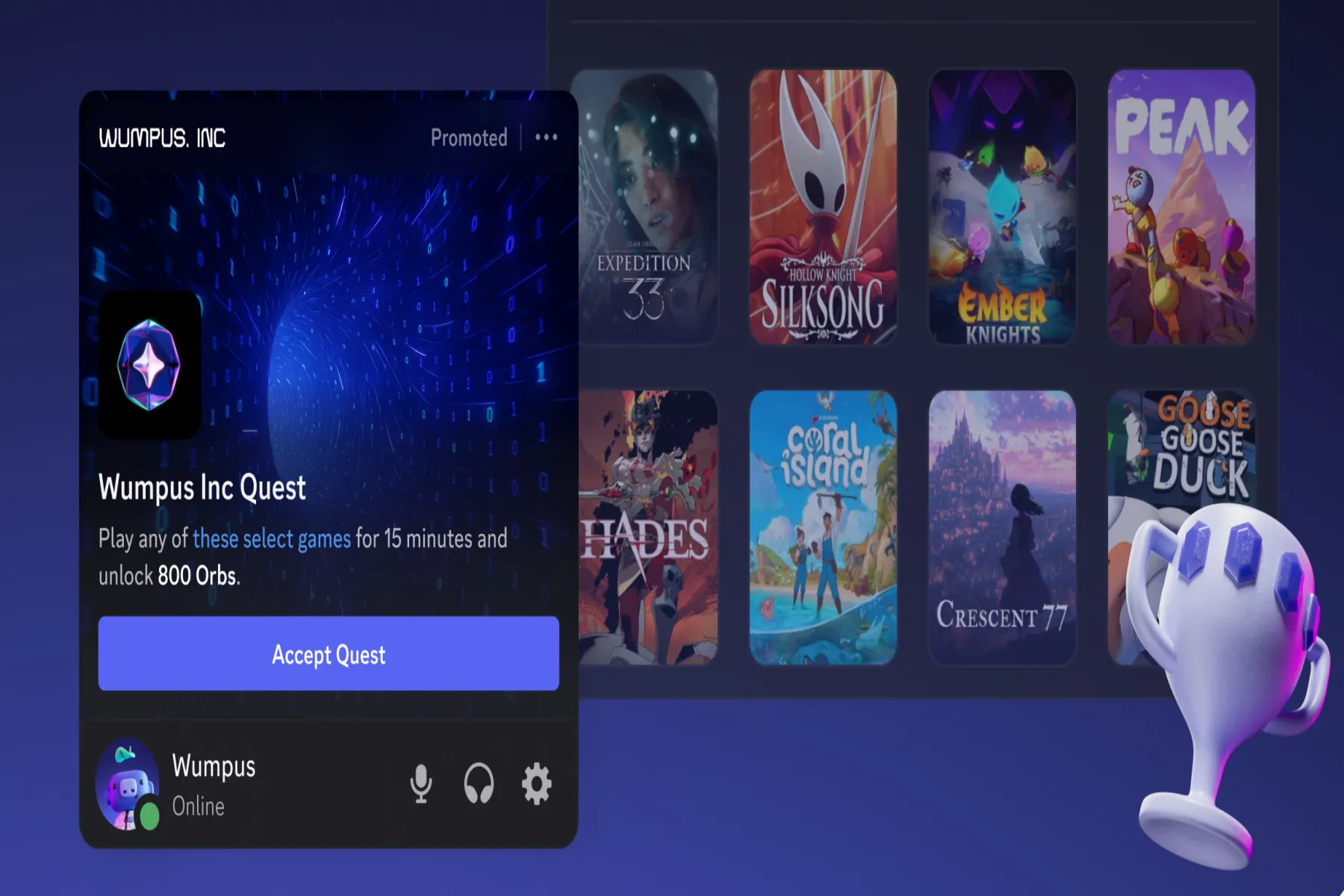
The caveat is that these are still mostly platform-published or platform-adjacent wins. A 96% video completion rate may reflect the strength of an opt-in audience, but it may also reflect the self-selection built into a reward-based format.[2] A reported 30% CPI reduction for Marvel Snap is a useful case, not a universal CPI promise.[1] And the MythOS minimums are not Discord’s official rate card; they are third-party reported pricing for a market where direct deal terms can vary.[3]
Still, none of that makes Quests unserious. It makes them exactly the kind of product that can win a test line in a media plan: high-intent action, clean completion logic, gaming-native context, and a price point large enough that the buyer needs to understand the failure mode before signing.
The Outage Record Buyers Have To Price In
The cleanest reliability evidence is not a spike on Downdetector. It is Discord’s own engineering post-mortem from March 25, 2026. Discord said a routine Kubernetes scale-down caused a cascading failure that dropped 17% of sessions and took more than three hours to recover. The company also said a larger re-architecture was still in progress.[5]
That post-mortem was about voice infrastructure, not a public ad-serving incident report. It does not prove that every Quest impression, completion, or reward path failed during that window. It does prove something narrower and still important: a routine infrastructure change inside Discord could produce a multi-hour, platform-level reliability event, and Discord itself was not yet describing the underlying architecture work as finished.[5]
For advertisers, that distinction matters. If the campaign is evergreen, a three-hour disruption may be absorbed into pacing. If the campaign is tied to an embargo lift, a launch stream, a tournament window, a trailer drop, or a limited-time reward, those same three hours can be the difference between paid media doing its job and paid media missing the moment.
| Incident | What the source supports | What advertisers should not overclaim |
|---|---|---|
| Sept. 8, 2025 | About 94,000 Downdetector reports and coverage of guild unavailability affecting voice and text. | Downdetector reports do not directly measure Quest delivery or paid impression loss. |
| Mar. 25, 2026 | Discord’s engineering post-mortem: routine Kubernetes scale-down, cascading failure, 17% session drop, more than three hours to recover, larger re-architecture still in progress. | The post-mortem covers voice infrastructure; it does not publish a separate ad-serving failure analysis. |
| May 8, 2026 | About 38,000 user reports of platform issues were covered by USA Today. | User reports are a reliability signal, not a campaign-level delivery log. |
| July 2026 | Discord status data showed additional incidents in the prior 90-day window. | Status-page incidents do not automatically equal paid campaign make-good eligibility. |
The September 2025 incident generated about 94,000 Downdetector reports and was covered as guild unavailability affecting voice and text.[6] The May 8, 2026 incident generated about 38,000 reports of platform issues.[7] Discord’s status data also showed additional incidents in the 90-day window into July 2026.[8] None of those figures should be treated as exact ad-delivery loss. They are user-reported or status-level reliability signals, not advertiser delivery audits.
But a buyer does not need perfect ad-serving telemetry to treat repeated availability problems as a planning variable. The job is not to prove that every outage destroyed every Quest campaign. The job is to decide whether a six-figure buy can tolerate a platform going dark at the wrong hour.
The March incident is the one that changes the conversation
A user-report spike can be noisy. A vendor post-mortem is different. Discord’s March 25 account described the mechanical path of failure: a routine Kubernetes scale-down, an interaction with existing system behavior, a cascading reliability event, and a recovery that took more than three hours.[5] That is not rumor. That is the platform explaining why a meaningful share of sessions disappeared.
The 17% session drop is especially relevant because advertisers do not buy Discord in the abstract. They buy access to users who are online, reachable, and able to complete the action. A Quest completion metric is only valuable when the user can get into the environment where the Quest appears, perform the required action, and receive the reward without friction.
There is also an operational burden that rarely shows up in the platform pitch. When a paid channel fails during a launch, the person who bought the media still has to explain it in the recap. Legal may call it accepted digital risk. Procurement may point to the signed terms. The client may only remember that a major launch placement underdelivered when demand was highest.
The Contract Leaves The Buyer Holding The Risk
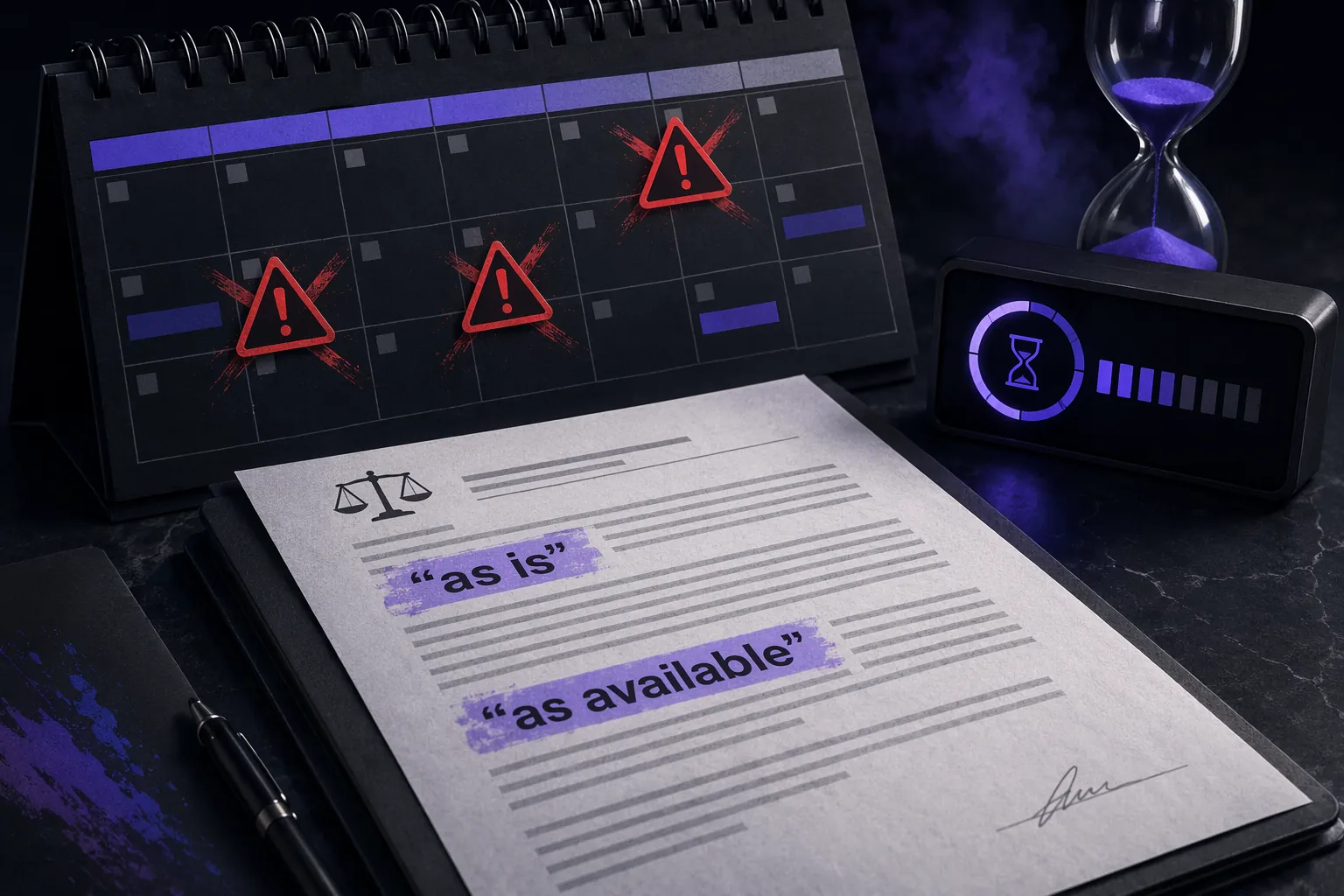
The outage record would be easier to tolerate if the remedy were clear. Discord’s Self-Service Advertising Terms do the opposite. The accessible official snippet says Discord does not guarantee “any level of delivery, reach, results,” and that advertising is provided “as is” and “as available.”[4] For a media buyer, those phrases are not decorative boilerplate when the reported campaign commitment is $100,000 to $150,000.[3]
No published advertiser refund or make-good policy for outage-affected Quest campaigns is available in the materials reviewed. That does not prove Discord has never issued private credits. Large direct buys often include negotiated terms that never appear in a public help-center article. But a buyer cannot plan around an unpublished exception. If the only visible terms say no guaranteed delivery and no guaranteed results, the default assumption has to be that the advertiser carries the outage risk unless separate protections are negotiated.
This is where Discord’s elegance as an ad format runs into the practical standard used for launch media. The channel can be promising and still be poorly matched to a narrow window if the contract does not bound the downside. A high completion rate helps only after delivery exists.
What to ask before a Quest buy goes live
- Is there a written make-good or credit if Discord availability prevents delivery during the booked flight?
- Does the agreement define the outage threshold: full platform unavailability, Quest module failure, reward redemption failure, or underdelivery against booked volume?
- Can the campaign flight be extended automatically if Discord has a material service disruption?
- Who verifies the disruption: Discord status page, third-party monitoring, campaign logs, or a written account-team confirmation?
- Is the Quest tied to a deadline that cannot move, such as a launch date, embargo, event, or limited reward inventory?
If those answers stay vague, the buy should be treated as an experimental channel with asymmetric downside, not as a guaranteed launch lever.
Reliability Is Already A Media-Buying Issue Elsewhere
Discord is not the only platform where availability belongs in the media plan. Meta’s 2021 six-hour outage reportedly cost the company more than $60 million in ad revenue, and major platforms have established processes for credits or make-goods in some outage contexts.[9] That comparison is not about scale; Meta’s ad business is not a fair proxy for Discord’s. It is about the principle that delivery infrastructure and advertiser remedies are normal commercial questions.
The same logic applies to Google-style credit frameworks, where service availability and advertiser compensation are treated as operational matters rather than vague platform goodwill.[10] Buyers may still accept downtime risk, but they usually want to know the measurement standard, the credit mechanism, and the path for escalation before the campaign is live.
That is the gap Discord has not closed publicly. It has performance claims, measurement partners, and a format with real strategic appeal. What it does not have, in the visible materials, is an advertiser-facing reliability remedy that matches the size and timing sensitivity of the reported Quest commitments.
When The Risk Is Tolerable, And When It Is Not
For evergreen acquisition, community growth, or flexible testing, Discord Quests can still make sense. The format is native to gaming behavior, the completion claims are strong enough to test, and AppsFlyer or Gamesight measurement can help compare results against other channels.[1][2] In that context, the buyer can model Discord as a high-intent experimental placement and avoid making it the only path to a launch outcome.
The calculus changes for a short flight. A Quest tied to a release day, a creator event, a closed beta, an esports schedule, a trailer reveal, or a limited reward window has less room to recover. If Discord is unavailable during the highest-value hours, later delivery may not replace the missed intent. The calendar, not the average CPI, becomes the constraint.
The practical decision rule is simple: do not price Discord only by expected CPI or completion rate. Price it by what the contract says happens when delivery disappears. If the answer is “as is,” “as available,” and no guaranteed delivery, then the buyer needs either negotiated protection or a campaign window that can survive the outage.
References
- Discord Quest performance and AppsFlyer/Gamesight measurement partnership, Discord press release
- Discord ad expansion coverage and 96% video completion rate, Digiday and Tubefilter
- Discord Quest minimums, CPMs, and CPI benchmark, MythOS
- Discord Self-Service Advertising Terms, Discord Support
- March 25, 2026 engineering post-mortem on cascading failure, Discord Engineering Blog, March 25, 2026
- September 8, 2025 Discord outage coverage, Reuters, Mint, and PC Gamer, September 8, 2025
- May 8, 2026 Discord platform issue coverage, USA Today, May 8, 2026
- Discord status page 90-day incident data, Discord Status
- Meta 2021 outage and lost ad revenue coverage, CNBC
- Google Ads service-level credit framework, Google Ads
Built on this evidence
No Bidding tactic or Creative record currently cites this case file. Compare it against other results in Benchmarks.
Related benchmark reading
Report a corroborating or contradicting result
Seeing something different in your own account? Feed the data-integrity loop instead of leaving an open comment.