
How Open-Weight AI Models Create a Data Moat for Advertisers
Open-weight AI models let advertisers fine-tune on their own campaign data, creating a performance moat that closed API models cannot match—but the infrastructure investment only pays off at scale. This article breaks down the evidence and the honest limits.
- Platform
- Meta
- Campaign type
- Advantage+ Creative
- Spend range
- Enterprise
- Timeframe
- 0
- CTR
- 0% lift
- Verdict
- win
- Last reviewed
- 0-07-25
If Meta can fine-tune an ad text model on real campaign performance, the obvious question for a large advertiser is not whether open models are philosophically better. It is whether the same loop can be owned outside Meta: take years of account history, train a model toward the ads that actually earned response, and stop renting generic creative intelligence from someone else’s interface. That is where open-weight AI models start to matter for digital advertising.
Meta’s AdLlama paper is the cleanest public evidence so far. Meta fine-tuned Llama 2 7B with Reinforcement Learning from Performance Feedback, using historical click-through-rate signals to train a reward model, then tested the system on Facebook ad text. Across 35,000 advertisers and 640,000 ad variations over 10 weeks, AdLlama produced a 6.7% advertiser-level CTR lift, with p=0.0296. Advertisers using it also created 18.5% more ad variations.[1]

That is not a small benchmark bump in a lab task. It is a platform-scale ad experiment, tied to an optimization target media buyers recognize, and large enough to deserve attention. It is also not proof that every advertiser should start fine-tuning models next quarter. The paper is Meta-published, the measured outcome is CTR rather than conversions or ROAS, and Meta’s infrastructure is not what most in-house teams have sitting beside Ads Manager.[1]
The moat is the feedback loop, not the model label
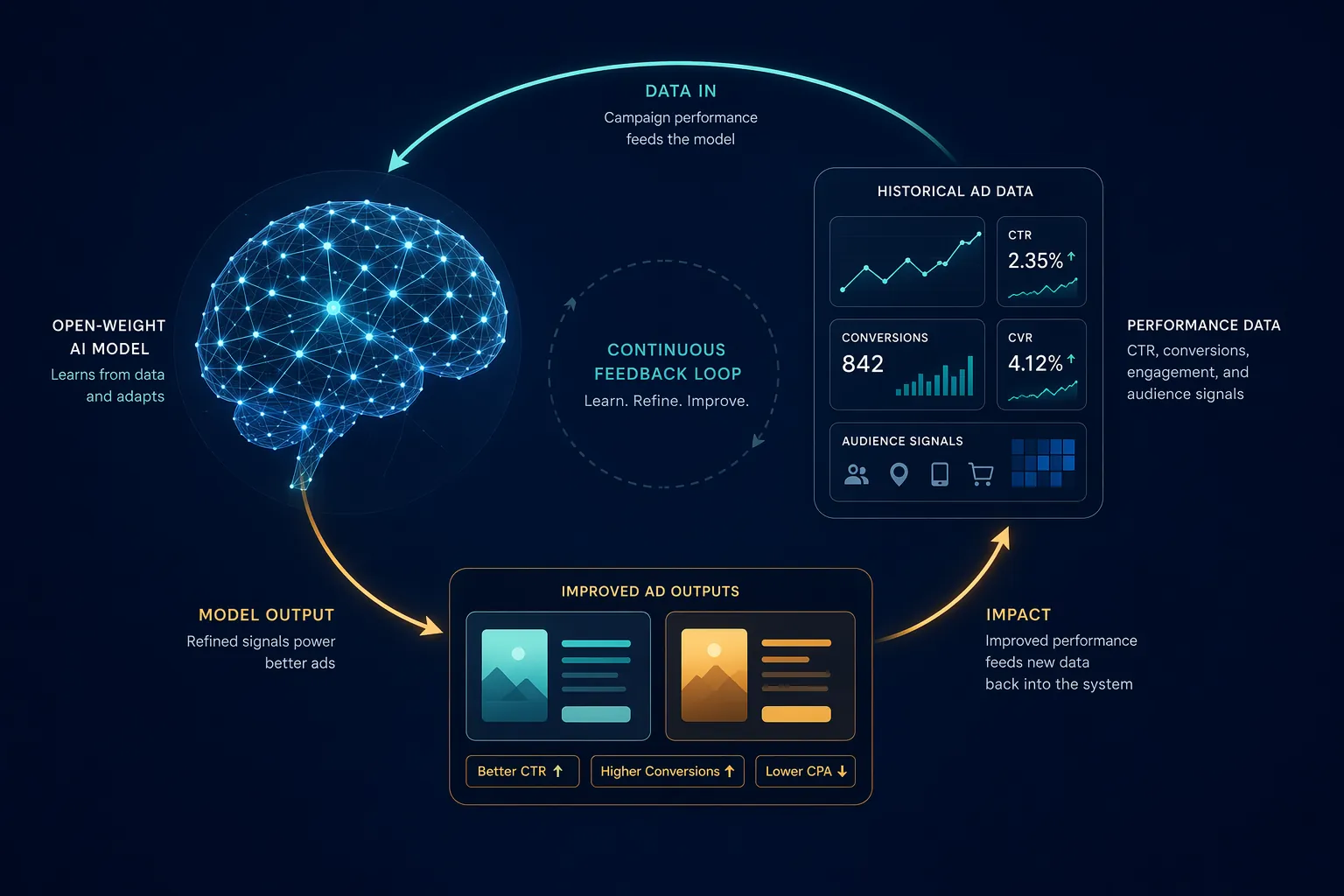
Open-weight models matter in advertising because they can be adapted to proprietary performance data. The model weights are accessible enough for a team, platform, or managed infrastructure provider to continue training or fine-tuning the model around a specific task. In this case, the task is not “write a better headline” in the abstract. It is “write variants that resemble the patterns our performance data has rewarded, while still producing usable ad text.”
Closed model APIs can still be useful. They can draft, classify, summarize, and generate variants quickly. But the advertiser usually does not control the learning loop. The model provider owns the base system, decides what gets trained, exposes only selected controls, and may not let an advertiser fine-tune deeply against account-level outcomes. The marketer gets access to intelligence; they do not necessarily get ownership of the performance memory.
That distinction is easy to lose when the market argues about open versus closed as if it were only a cost or ideology question. In paid social, the more practical question is whether the system can learn from the same messy loop operators live in: creative goes live, auction conditions move, CTR changes, poor variants die, promising patterns get iterated, and the next batch of text should be smarter because of what happened before.
What AdLlama actually tested
AdLlama did not merely ask a language model to imitate good ad copy. Meta trained a reward model from historical CTR data, then used that reward model to fine-tune Llama 2 7B with Reinforcement Learning from Performance Feedback. The reward model was built from about 7 million preference pairs, and the LLM training used 5.5 million text variation examples.[1]
That volume is doing a lot of work. A few winning ads exported from a reporting dashboard are not the same thing as millions of structured comparisons between variants and outcomes. The open-weight model is only one ingredient; the more defensible asset is the performance-labeled corpus that tells the model what the account, vertical, audience, placement mix, and auction environment have historically rewarded.
The most interesting part of the paper is that the performance-feedback approach beat an imitation-style alternative. Meta compared AdLlama with an “Imitation LLM” that used supervised fine-tuning on curated examples, and the RLPF system performed better in the reported test.[1] That is the piece marketers should not skip. Curated “good ads” are somebody’s editorial judgment. CTR feedback is still imperfect, but at least it is connected to observed user behavior.
The 18.5% increase in ad variations is also worth reading carefully. It suggests operators found the outputs usable enough to create more variants, which matters because creative volume is a real constraint inside Meta accounts.[1] It does not prove those extra variations improved profit. More assets can create more testing surface, but they can also feed the platform more material to sort through without answering whether downstream business outcomes improved.
CTR is useful evidence, with an uncomfortable ceiling
CTR is not a vanity metric when the question is ad text relevance. If a model consistently produces copy that earns more clicks across a large advertiser sample, that is signal. It means the model is learning something about attention, match quality, or user response that survived a live platform test.
But CTR is not ROAS. A click can be cheap curiosity, low-intent traffic, or the start of a profitable path. The AdLlama result should therefore be treated as evidence that performance-feedback fine-tuning can improve an upper-funnel ad interaction metric, not as evidence that it improves contribution margin, incrementality, or customer quality.[1]
This is where procurement language should get more precise. If a vendor says its model is trained on performance data, the next question is: which performance data, tied to which optimization goal, measured over what window, and validated against what business metric? A model trained toward CTR may be valuable for ad text generation, but a lead-gen advertiser, subscription brand, or retailer with noisy post-click behavior will still need a downstream read.
Where this touches the Meta surface operators already use
For most buyers, AdLlama-style progress will first show up through platform automation rather than a custom model project. That means the operating question is less “should we replace Meta’s AI?” and more “which controls do we still need while Meta’s models generate, vary, and test more of the creative surface?”
That is why the practical conversation belongs next to Meta’s existing creative controls, not in a generic AI tools debate. If a team is already deciding when to allow text variations, image expansion, music, backgrounds, or other Advantage+ enhancements, the sharper question is which automated changes are harmless testing surface and which ones can alter claims, compliance, offer framing, or brand positioning. The control layer matters more as the model layer gets better.
Teams still mapping that surface can use the Meta Advantage+ Creative Controls breakdown for the control framework, and the creative enhancement decision matrix for deciding which toggles deserve testing versus tighter review.
The economics are getting less absurd
The cost case for open models is real, but it should sit behind the performance loop rather than replace it. MIT Sloan research by Nagle and Yue found open models costing $0.23 per million tokens versus $1.86 for closed models, while achieving about 90% of closed-model performance in the analysis. The same research estimated that optimal substitution could save the global AI economy about $25 billion annually.[2]
Those numbers do not automatically transfer to every ad team. The MIT Sloan cost analysis used OpenRouter data representing about 1% of global AI inference spend, and enterprise or platform pricing can differ from public routing data.[2] Still, the direction matters. If a large advertiser is generating, scoring, rewriting, localizing, and QA’ing creative at high volume, inference cost becomes part of whether owning a customized model is tolerable or silly.
Production adoption signals point the same way. Together AI reports enterprises building model-agnostic harnesses that let applications swap models underneath with near-zero switching cost, and reported token processing growth from 30 billion to 400 trillion tokens per month in 9 months. The same reporting described open versus closed inference cost differences of 6x to 60x at production scale.[3]
This does not make open-weight fine-tuning cheap in the way a SaaS subscription is cheap. It means the unit economics are moving closer to something a high-volume operation can model: training runs, inference, evaluation, monitoring, storage, and engineering time against expected lift, faster testing, or lower dependency on vendor-controlled creative systems.
The execution threshold is higher than most decks admit
AdLlama’s training requirements are the part that should sober up any advertiser imagining a quick copywriting-model side project. About 7 million preference pairs and 5.5 million text variation examples are platform-scale assets.[1] A brand with a few dozen active ads per month does not have that history. Even many healthy performance programs will have too little clean variation data once campaigns are split by market, product, language, objective, placement, offer, audience, and measurement quality.
| Requirement | Why it matters |
|---|---|
| Large historical creative volume | The model needs enough variant-outcome comparisons to learn patterns rather than memorize a few winners. |
| Reliable performance labels | CTR, conversion, revenue, lead quality, or other outcomes must be connected to the creative unit cleanly enough to train against. |
| Experiment discipline | If old data reflects inconsistent testing, heavy confounding, or constant offer changes, the model learns the mess. |
| Fine-tuning and inference workflow | Someone must manage training data, model versions, evaluation, deployment, latency, cost, and failure modes. |
| Review and governance | Ad text still needs brand, legal, compliance, and platform-policy checks before scale makes errors expensive. |
Hosted fine-tuning options from providers such as Together AI, Fireworks, AWS Bedrock, and Replicate can lower the infrastructure burden. They do not remove the hard part. The hard part is assembling clean training data, choosing the right reward signal, evaluating whether the model improves the metric that matters, and keeping the workflow alive after the first impressive demo.
For an agency, the question gets even more complicated. Pooling data across clients may create enough scale, but it raises permission, confidentiality, vertical leakage, and governance issues. Client-specific fine-tuning protects the moat better, but it also fragments the data and makes each model harder to justify unless the account is large enough.
Open weights do not remove evaluation risk
Open-weight access can make a model more controllable, but it does not make the model automatically safer, more reliable, or better evaluated. RAND reviewed 37 open-weight model families and found that only 1 fulfilled basic proportional evaluation criteria.[4] That caveat belongs in the advertising conversation because fine-tuned ad systems are still production systems: they can hallucinate claims, overfit to low-quality signals, drift after a model update, or optimize toward the wrong proxy.
This is another reason the AdLlama result should be read narrowly. Meta reported a strong CTR test for generative ad text on Facebook, not a general guarantee that open-weight models will outperform closed systems across bidding, budgeting, creative strategy, feed ranking, incrementality measurement, or compliance review.[1] The method is the interesting transferable asset. The exact lift is not something an advertiser can copy-paste into a business case.
Who should consider owning the loop
The best candidates are not simply “brands that use AI.” They are advertisers or agencies with enough spend, creative throughput, and historical variation data that a custom feedback loop could plausibly outperform generic generation. They also need a team that can treat model work as an operating system, not a one-off innovation project.
- A large advertiser with years of clean paid social history, high creative testing volume, and measurable post-click outcomes may have a real case for custom fine-tuning.
- A performance agency with many similar accounts may have enough aggregate learning, but only if client data rights and model governance are handled explicitly.
- A mid-market team with limited variation history is more likely to benefit from better platform controls, structured creative testing, and selective use of generic AI tools before owning a model.
- A small advertiser should usually avoid custom fine-tuning unless a platform or vendor absorbs the data and infrastructure burden on its behalf.
The adoption line is not moral. Renting a closed model can be the correct decision when the account lacks scale, the creative bottleneck is basic production, or the team cannot maintain evaluation. Owning an open-weight loop starts to make sense when the advertiser has enough proprietary performance data that giving every tool the same generic input becomes the constraint.
The procurement question for 2026
The useful question is no longer “does this tool use AI?” It is barely even “does it use an open model?” A closed system trained on strong real performance feedback may beat an open-weight system fine-tuned on weak data. An open-weight model with excellent account history may create an advantage a generic API cannot touch. The model category matters because of what it allows the operator to own.
When evaluating AI creative, bidding, or campaign tools in 2026, ask three questions before getting impressed by the interface: does the system learn from real performance feedback, whose data does it learn from, and does your own scale justify owning that loop instead of renting a closed model’s general intelligence?
References
- Improving Generative Ad Text on Facebook using Reinforcement Learning, arXiv, 2025.
- AI open models have benefits. So why aren't they more widely used?, MIT Sloan, 2025.
- Open-weight AI models drive shift to data control, SiliconANGLE, July 14, 2026.
- Open-Weight AI Models Require Proportional Evaluation Approaches, RAND, May 2026.
Built on this evidence
No Bidding tactic or Creative record currently cites this case file. Compare it against other results in Benchmarks.
Related benchmark reading
Report a corroborating or contradicting result
Seeing something different in your own account? Feed the data-integrity loop instead of leaving an open comment.