
The Core Scientific-AMD Deal Reshapes Ad-Tech AI Economics
The Core Scientific-AMD partnership dedicates up to 2.5 GW of data-center capacity to AMD Instinct GPUs, creating the first large-scale alternative to NVIDIA for ad-platform AI inference — but what does that mean for media buyers running AI-driven campaigns today? This article traces the infrastructure economics to show when and how platform costs and defaults could shift.
- Platform
- Google Ads
- Campaign type
- Performance Max
- Spend range
- Not a campaign test
- Timeframe
- 0-07-29
- ROAS
- Not measured
- Verdict
- mixed
- Last reviewed
- 0-07-29
If you are buying through Performance Max, Advantage+, AI Max, Symphony, or a programmatic DSP this quarter, the practical answer is short: the Core Scientific-AMD deal does not change your account controls today. It does not make an AI campaign mode cheaper in the UI, it does not prove that Google, Meta, Amazon, The Trade Desk, or Basis has moved production inference onto AMD Instinct GPUs, and it does not explain a CPA swing in July 2026.
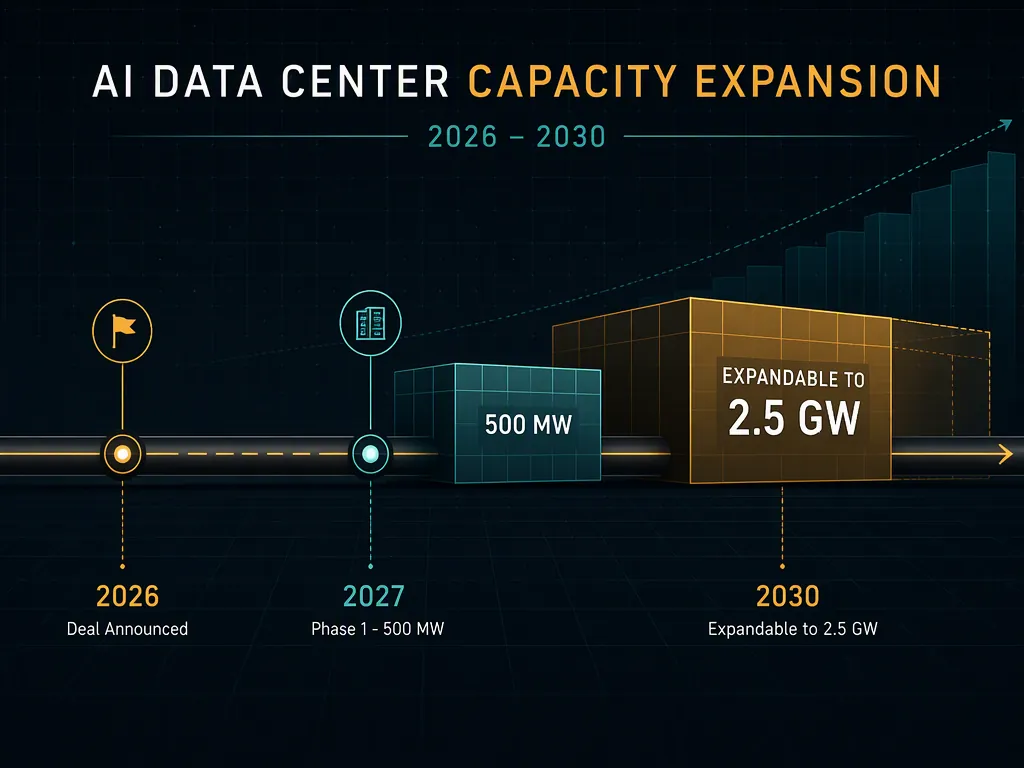
What it does change is the cost map underneath those platforms. Core Scientific and AMD announced a dedicated AI infrastructure partnership on July 28, 2026, with more than 500 MW of firm capacity for AMD Instinct GPUs, expandable to 2.5 GW, under 15-year leases expected to generate more than $14 billion in contracted revenue for Core Scientific.[1] Phase 1 is scheduled for 2027. That timing matters more than the headline capacity number: any meaningful ad-platform cost or feature effect is a late-2027-or-later question, unless the near-term effect is simply NVIDIA facing more pricing pressure before the capacity is live.

Why A Data-Center Lease Can Reach The Media Plan
Ad buyers do not buy megawatts. They buy outcomes, audiences, conversions, incrementality studies, creative variants, and platform promises about automated optimization. But the auction systems doing that work need inference: model calls that score users, predict conversion value, assemble or rank creative, estimate bid prices, decide whether to enter an auction, and select the least-bad tradeoff among reach, cost, and likelihood of action.
That is why hardware economics eventually matter. In a real-time bidding path, a platform may have only about 40 to 120 milliseconds to decide whether and how to bid. In that window, inference cost and latency are not abstract infrastructure concerns; they shape how many models can be consulted, how often they can be refreshed, and which features can be made default without wrecking margin.
The buyer usually sees the downstream version of this. A product team makes a campaign type the recommended path. A default changes. Creative expansion becomes harder to avoid. A targeting control disappears into a model. The platform says performance improved. The infrastructure reason, if there is one, is rarely shown in the same release note.
The Deal Is Large Enough To Treat As Infrastructure, Not Chip PR
The load-bearing fact is not that AMD found another customer. It is that Core Scientific is dedicating utility-scale AI data-center capacity to AMD Instinct GPUs, beginning with more than 500 MW of firm capacity and a path to 2.5 GW.[1] The agreement also includes 15-year leases, contracted revenue above $14 billion, and warrants for AMD.[1] Those are not campaign-feature numbers, but they are the kind of scheduling and capacity numbers that can alter platform economics if the capacity is adopted by cloud providers, model operators, or ad platforms.
Core Scientific’s own revenue mix makes the shift clearer. In Q2 2026, AI colocation generated $136.7 million, equal to 83% of total revenue, while self-mining revenue fell 66% to $21.5 million.[2] That is a business-model pivot, not a side bet. The former crypto-infrastructure company is being repriced around AI colocation, and AMD is using that capacity to create a large dedicated footprint for Instinct GPUs.
| Item | What It Means For Ad-Tech |
|---|---|
| 500+ MW firm capacity | Enough scale to matter for inference economics if adopted by platforms or cloud intermediaries |
| Expandable to 2.5 GW | A potential multi-year alternative supply base, not a single deployment |
| 15-year leases | Capacity planning, not short-term opportunistic GPU rental |
| $14B+ contracted revenue | A revenue commitment large enough to change Core Scientific’s center of gravity |
| Phase 1 in 2027 | No plausible account-level impact before the capacity is live and integrated |
Where The Advertising Economics Could Move
There are three realistic paths from cheaper or more available inference to the buying interface. The first is lower platform cost. If a platform can run the same model workload at a lower unit cost, it can protect margin, spend more on model calls per impression, or use the savings to compete on pricing elsewhere. The buyer may never see a separate “AI compute discount,” because ad platforms rarely expose that line item.
The second path is broader feature availability. A model-heavy optimization that once made sense only for larger budgets or higher-value conversion goals can become viable across more accounts when inference cost falls or capacity expands. This is the route that usually feels like product strategy from the outside: more AI recommendations, more automated asset generation, more modeled audiences, more campaign modes that work only when the platform can afford to score far more possibilities than a human buyer could review.
The third path is defaults. When a platform’s economics improve, the product team can be more aggressive about making AI optimization the path of least resistance. The operational consequence lands on the buyer later, when the old manual workflow becomes unsupported, degraded, or simply less favored by the interface.
None of those paths requires the platform to pass savings directly to advertisers. In fact, falling inference cost can disappear into higher usage. Deloitte reports that AI inference costs fell 280-fold over two years, while some enterprise monthly AI bills still reached the tens of millions because usage expanded into the available efficiency.[3] That pattern is easy to recognize in ad tech: cheaper scoring does not necessarily mean cheaper campaigns; it can mean more scoring per auction, more creative permutations, more modeled surfaces, and more automation made default.
The AMD Evidence Is Directional, Not Platform Proof
AMD has published favorable evidence for Instinct economics. In a TensorWave case study, AMD says the AMD Instinct GPU cloud provider delivered 40% to 60% cost savings and up to 2x performance versus comparable alternatives.[4] That is useful directional evidence for the argument that AMD can pressure inference economics. It is not proof that the same savings would appear inside Meta’s ranking stack, Google’s campaign automation, Amazon’s retail media systems, The Trade Desk’s bidder, or Basis’s planning and activation workflow.
This is the point where the broad NVIDIA-versus-AMD story becomes operational for media buyers. The strategic marketing frame is covered more broadly in Marketing Playbooks from the NVIDIA vs AMD AI Chip War. For ad-tech inference, the question is narrower: can AMD offer enough cost, capacity, and software maturity to make a platform consider moving real production workloads away from NVIDIA’s CUDA-centered ecosystem?
There are signs that large enterprises are willing to use the newer AMD stack for serious AI work. AMD says AT&T trained on AMD Instinct MI355X systems and achieved 94% efficiency in that case study.[5] Again, that matters as evidence of technical viability, not as evidence of ad-platform deployment. Training success at a telecom enterprise and production inference inside an ad auction are related only at the infrastructure layer.
The missing disclosure is still missing: no major ad platform has publicly said it is running production inference on AMD Instinct GPUs. Until that changes, any connection from Core Scientific-AMD capacity to Performance Max, Advantage+, AI Max, Symphony, or open-web bidding is an inference from economics, not a documented platform migration.
What NVIDIA Still Has That AMD Has To Dislodge
Capacity alone does not move a backend. NVIDIA’s advantage is not only GPU availability; it is the developer and operations gravity around CUDA, existing model optimization work, tooling, staff familiarity, performance tuning, and procurement patterns. For an ad platform, switching costs are not theoretical. A migration that introduces latency instability, model-serving friction, or engineering drag can erase much of the apparent hardware saving before it reaches the auction.
That is why ROCm maturity is one of the watch points, not a footnote. AMD can have a credible cost story and still face adoption friction if platform teams decide the software migration is too risky for systems that evaluate impressions continuously at auction speed. The more standardized and cloud-accessible the AMD stack becomes, the easier it is for ad platforms to test and gradually shift workloads without making a dramatic public announcement.
There is also a timing constraint. Phase 1 capacity is slated for 2027.[1] Even if a platform wants a second-source GPU strategy, it needs capacity to come online, contracts to be signed, workloads to be ported or routed, reliability to be proven, and product teams to decide what to do with the resulting economics. That sequence does not fit into Q3 2026 campaign planning.
How This Could Show Up In Accounts Later
The most likely account-level signal is not a banner saying a platform has adopted AMD compute. It is a product change that suddenly makes heavier AI usage feel economical at scale. A campaign mode may expand from selected advertisers to general availability. A creative-generation feature may stop looking like a premium add-on and start appearing inside default setup flows. A bidding system may accept more signals, refresh predictions more frequently, or make automated recommendations more forceful.
A visible price cut is possible but less likely as the first sign. Platforms have many places to absorb compute savings: model quality, latency buffers, margin, sales incentives, cloud commitments, and competitive feature packaging. For buyers, the better question is whether a platform’s AI behavior expands faster than its public product story explains.
- If defaults expand before late 2027, the Core Scientific-AMD deal is probably not the direct cause; the capacity is not live yet.
- If cloud providers announce broad AMD Instinct availability tied to this capacity, the path from infrastructure to ad platforms becomes more plausible.
- If an ad platform discloses AMD Instinct production inference, the story moves from inferred economics to operational evidence.
- If AI campaign defaults broaden sharply after Phase 1 is live, compute economics should be part of the explanation buyers ask for.
Tracker Judgment As Of July 29, 2026
As of July 29, 2026, the Core Scientific-AMD deal creates the first credible data-center-scale NVIDIA alternative for ad-platform inference economics. It is credible because the commitment is large, scheduled, long-dated, and tied to a Core Scientific revenue mix that has already shifted toward AI colocation. It is not yet an advertising product event.
Buyers should not expect account-level cost or feature changes until Phase 1 capacity is live in 2027 and adopted by platforms or their infrastructure providers, making this a late-2027-or-later account question. The near-term effect is competitive pressure on NVIDIA pricing and procurement conversations. The later effect, if adoption follows, could be lower platform costs, broader AI optimization access, or more aggressive defaults.
The next things to watch are public cloud availability for this capacity, ad-platform infrastructure disclosures, ROCm migration signals, and any sudden expansion of AI defaults that looks economically enabled rather than merely product-marketed.
References
- Core Scientific and AMD Announce Infrastructure Partnership, Core Scientific, July 28, 2026.
- AMD Secures 2.5 GW AI Infrastructure Partnership with Core Scientific, Yahoo Finance.
- Tech Trends 2026: AI infrastructure compute strategy, Deloitte.
- TensorWave: Reliable, resilient, cost-optimized AI cloud, AMD.
- AT&T achieves 94% efficiency for AI training with AMD, AMD.
Built on this evidence
No Bidding tactic or Creative record currently cites this case file. Compare it against other results in Benchmarks.
Related benchmark reading
Report a corroborating or contradicting result
Seeing something different in your own account? Feed the data-integrity loop instead of leaving an open comment.