
Three Signals That Big Tech Is Cutting AI Ad Spend
Investor skepticism, platform control concessions, and mounting underperformance data all point to a correction in AI ad spending. Media buyers who watch these three signals can anticipate changes in platform pricing and campaign performance before they happen.
- Platform
- Google Ads
- Campaign type
- Performance Max
- Spend range
- Industry-wide
- Timeframe
- July 0
- ROAS
- 0x
- Verdict
- mixed
- Last reviewed
- 0-07-29
The most useful signal that AI spending pressure could hit digital advertising platforms is not a CFO quote or a bearish thread about data centers. It is a checkbox showing up inside a live buying workflow.
On July 24, Digiday reported that Google is testing Performance Max opt-out controls for Search Partners and the Display Network with select advertisers, describing the move as “an unprecedented level of control over how PMax works” after years of buyer frustration with the product’s bundled inventory model.[1] That matters because PMax has been one of Google’s clearest assertions that broader automation needs broader trust. If the test expands, buyers would not just get another setting; they would get a way to separate automation they value from inventory exposure they have not always wanted to defend.
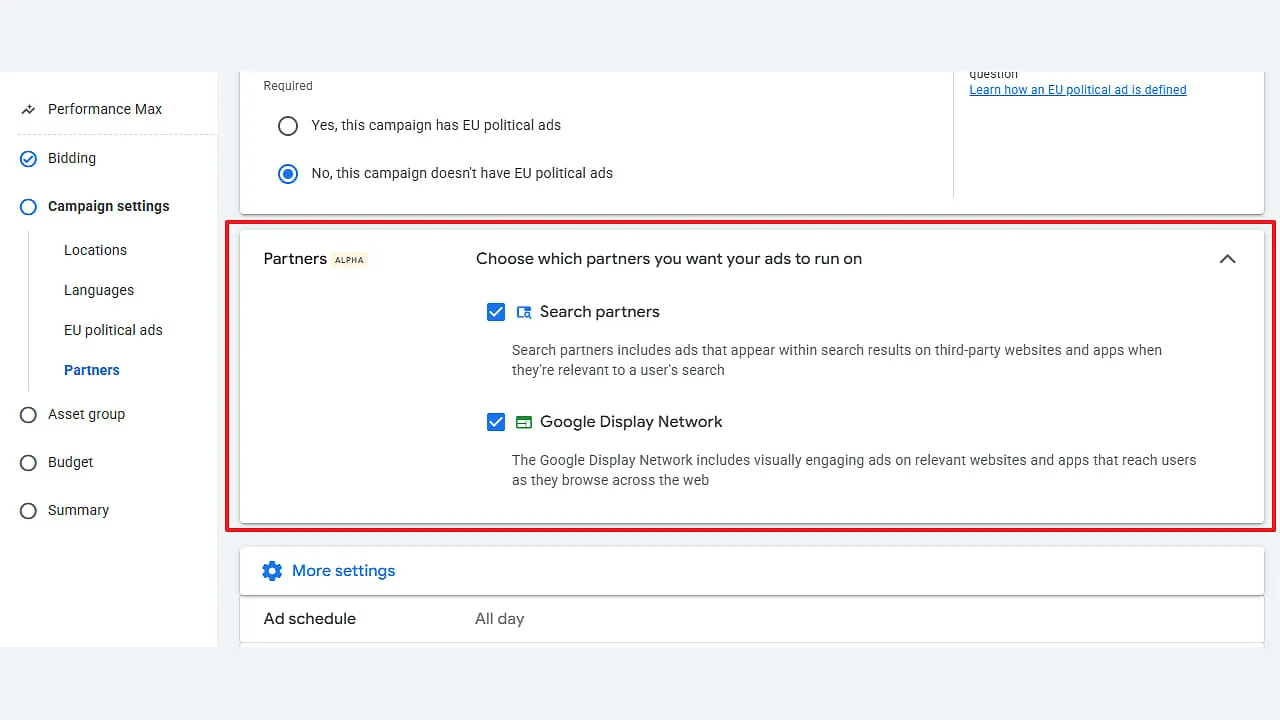
A test is not a rollout. Select-advertiser access is not an account-wide policy change. Still, platform tests are where pressure often appears before the official story changes. Controls that were once framed as unnecessary suddenly become “flexibility.” Support teams start acknowledging edge cases. Roadmaps that used to push buyers toward one automated surface begin to make room for exception handling.
That is why the PMax test belongs in the same watchlist as Meta adding more AI creative controls around Brand Memory and Muse Image, and OpenAI lowering the entry point for its ad product from a high initial minimum to a lower one. Those moves can be read as normal product maturation. They can also be read as platforms finding out that “trust us” is a weaker sales argument when budgets are being rechecked, creative teams are seeing sameness, and finance teams are asking when AI spending turns into defensible margin.
Signal 1: Control Returns To The Buyer
Campaign controls rarely come back because buyers asked nicely. They come back when the platform decides the cost of withholding them is higher than the cost of adding complexity. That cost can be lost spend, slower adoption, louder agency resistance, or simply too many budget reviews where the account team cannot explain where the money went.
For PMax, the operational issue has always been concrete. A buyer can believe in automated bidding, feed-based creative assembly, and cross-channel optimization while still needing to say: do not send this campaign into this inventory pool. When that distinction is impossible, the buyer owns the result but not the steering. When it becomes possible, even in a limited test, Google is acknowledging a boundary that many teams have been drawing in spreadsheets, placement reports, and postmortems for years.
The distinction matters because the next phase of AI ad products is unlikely to be a clean retreat from automation. More likely, platforms keep the automated core and selectively restore controls around the parts that cause budget friction: inventory exclusions, brand memory, generated imagery, approval flows, and minimum spend thresholds. Buyers should not wait for a product blog post announcing a philosophical change. They should watch the places where the platform quietly reduces the number of arguments an agency has to win with a client.
| Signal to track | Why it matters in accounts |
|---|---|
| Inventory opt-outs inside automated campaigns | Shows whether platforms are conceding that automation still needs buyer-defined boundaries. |
| More creative memory, image, or approval controls | Shows whether AI creative products are meeting brand-safety and differentiation requirements without manual correction. |
| Lower ad product minimums | Shows whether early demand at premium thresholds was strong enough to hold. |
| Forced migration away from older campaign types | Shows whether platforms are using defaults and sunsets to preserve AI adoption even if buyer confidence softens. |
The useful tracker entry is not “Google is losing faith in AI.” That is too broad. The useful entry is narrower: Google is testing specific PMax inventory opt-outs with select advertisers, and that test gives buyers a verifiable place to watch whether control concessions remain isolated or start spreading across automated buying surfaces.[1]
For an account-level companion view, the earlier piece on AI ad bubble signals tracks how performance symptoms show up closer to the campaign report. The control-concession signal is earlier. It appears before the CPA miss, before the budget pause, and often before the platform admits there is a broader commercial reason to add back knobs.
Signal 2: The Funding Model Has Less Room For Patience
The capex debate only matters to media buyers if it eventually changes product behavior. It can. Infrastructure pressure becomes ad-platform pressure when companies need AI revenue to arrive faster, preserve margins, or justify the next round of compute spending. That is when defaults get more aggressive, support gets thinner, experiments get renamed, and products that used to be optional become the preferred path through the buying interface.
The market argument has grown too large to ignore, even if some of the loudest summaries should be treated carefully. Forbes framed the 2026 debate around a possible $1.7 trillion AI bubble, reflecting widening concern that infrastructure investment may be running ahead of monetization.[6] David Shapiro’s January analysis argued that AI could be entering a “digestion phase,” drawing on sources including Gartner, Bank of America, S&P Global, and SK Hynix earnings commentary; that framing is his synthesis, not a platform disclosure.[7]
The most account-relevant detail in that debate is the cash-flow constraint. Shapiro cited Bank of America consensus estimates showing Big Tech AI capex consuming 94% of operating cash flow.[7] That number should be verified against the original BofA work before anyone treats it as a standalone model input. But as a pressure signal, it is hard to wave away: if AI investment is absorbing that much operating cash flow, the tolerance for slow ad-product monetization shrinks.
This does not require a crash forecast. A pullback can look much less dramatic from inside an ad account. Model update cadence slows. Certain ad-serving features slip a quarter. Compute is allocated more selectively to products with clearer revenue paths. Platforms push buyers harder into AI-assisted campaign types because the commercial story depends on adoption. CPMs may reprice as platforms try to maintain revenue while advertisers rotate budgets across surfaces.
There is also a parallel advertiser-budget pressure. Digiday reported that brands were set to cut open web display spend by 30% in response to AI search, citing Forrester work.[8] That is not the same thing as Big Tech cutting AI infrastructure spending. But both pressures can hit the same planning meeting: one side questions the supply economics of AI, while the other questions where demand should move when search behavior and discovery paths shift.
The practical read is simple enough for a Q3 budget review: watch whether platforms behave as if they still have endless room to subsidize adoption. If credits shrink, minimums fall, legacy campaign types are sunset faster, or sales teams start selling AI products as margin protection rather than experimentation, the capex story has moved from investor deck to media plan.
For a deeper infrastructure-cost view, Big Tech's AI capex and ad costs and SK Hynix's memory surge are the better places to follow the cost side. In this tracker, the point is narrower: high AI spend becomes relevant when it changes the incentives behind ad-platform defaults.
Signal 3: Spend Rises While Confidence Softens
A correction does not need falling spend to begin. Sometimes the more useful warning is a widening gap between adoption and confidence. That is the uncomfortable shape of the 2026 AI advertising data: money is still moving into AI-powered buying and creative systems, but the people exposed to the output are not all moving in the same direction.
IAB’s January 2026 “AI Ad Gap Widens” study surveyed 505 Gen Z and Millennial consumers and 104 ad executives. It found that 82% of executives believed consumers felt positive about AI-generated ads, while only 45% of consumers actually did, a 37-point gap that widened from 32 points in 2024. The same study found that 39% of Gen Z consumers were negative toward AI ads, nearly double the 20% share among Millennials.[2]
That is not a proof that AI ads fail. It is a warning about who is grading the work. If the dashboard measures faster asset production and the consumer experiences a cheaper-looking brand, the platform can still report adoption while the campaign loses distinctiveness. The buyer then has to explain a performance change that began upstream in creative generation, not in a bid adjustment.
Jasper’s 2026 marketing report adds a different version of the same tension. In a survey of 1,400 marketers, confidence in AI ROI fell from 49% to 41%, even though 60% of respondents who tracked ROI reported at least a 2x return.[3] The split by role is sharper: 61% of CMOs said AI ROI was proven, compared with 12% of individual contributors.[3] Jasper is an AI content platform, so vendor context matters. The directional decline still deserves attention because it comes from a market participant with every incentive to find optimism.
Smartly’s 2026 Digital Advertising Trends Report points to the creative problem buyers keep seeing in reviews. In its survey of 450 marketing leaders, 86% said they had seen AI outputs resembling competitor content, and 75% worried that AI creative makes brands look the same.[4] That is not a small aesthetic complaint. If multiple brands use similar prompts, models, templates, and optimization goals, the auction may become more efficient while the ads become less memorable.
At the same time, eMarketer projected AI-powered ad spend would grow 63% to $57 billion in 2026.[5] That figure keeps the story honest. The market is not walking away from AI advertising. Buyers are still funding it, platforms are still packaging it, and executives are still approving it. The pressure is that spend growth and confidence are no longer telling the same story.

What A Pullback Would Look Like Before Anyone Calls It One
The first visible impact of an AI spending cut on digital advertising platforms may not be a press release saying AI budgets are lower. It may look like a product manager choosing not to ship a feature, a rep steering buyers into a more automated campaign type, or a reporting surface that gets simplified in a way that makes exception management harder.
A few account-level symptoms are worth separating from normal platform noise:
- Automated campaign types receive more migration pressure while non-AI or semi-manual options lose visibility in setup flows.
- Support teams become slower to escalate edge cases that require engineering review.
- New AI creative or bidding features arrive with broader defaults and fewer reporting breakdowns.
- Platforms reintroduce selective controls only where buyer resistance is blocking spend.
- CPM or CPC movements become harder to attribute because platform monetization pressure and advertiser budget rotation are moving at the same time.
None of those symptoms, alone, proves a capex correction. A platform can add controls because the product is maturing. It can lower minimums because the market is expanding. It can change defaults because the model genuinely performs better. The point is to track convergence. A control concession means more when it appears beside investor pressure and independent evidence that buyers, executives, and consumers disagree about AI ad value.
For Q3 and Q4 planning, the useful habit is to maintain three columns in the tracker: platform concessions, funding pressure, and performance-confidence gaps. Put the PMax opt-out test in the first column. Put AI capex and cash-flow constraints in the second, with the caveat that secondary summaries should be checked against primary reports before they become budget assumptions. Put the IAB, Jasper, Smartly, and eMarketer tension in the third.
That combined view gives earlier warning than waiting for CPMs, defaults, or campaign results to move after the fact. By the time a Friday CPA miss shows up in the pacing sheet, the platform incentive may already have changed.
References
- Google quietly gives ground on PMax controls, Digiday, July 24, 2026.
- IAB — The AI Ad Gap Widens, IAB, Jan 2026.
- New Research: The State of AI in Marketing 2026, Jasper, Jan 2026.
- Smartly 2026 Digital Advertising Trends Report, Smartly.
- AI-powered ad spend will hit $57 billion in 2026 as brands go all in, eMarketer.
- The State Of The $1.7 Trillion AI Bubble: The End Of Thinking, Forbes, Feb 2026.
- Why AI is slowing down in 2026, David Shapiro's Substack.
- Brands set to cut open web display spend 30% in response to AI search, Digiday.
Built on this evidence
No Bidding tactic or Creative record currently cites this case file. Compare it against other results in Benchmarks.
Related benchmark reading
Report a corroborating or contradicting result
Seeing something different in your own account? Feed the data-integrity loop instead of leaving an open comment.