
How Trump's AI Deregulation Is Reshaping Ad Tech Performance
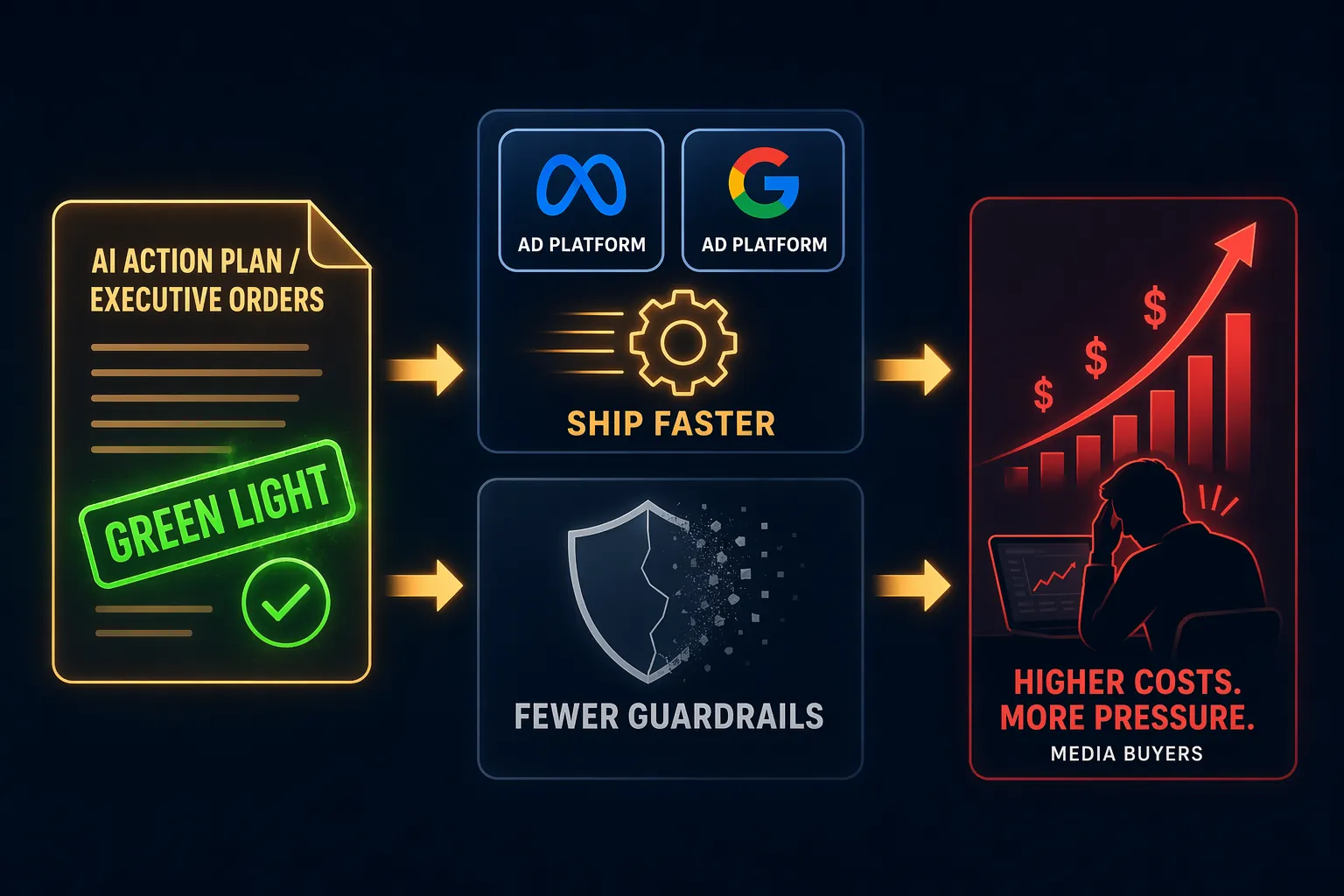
The Trump administration's AI deregulatory agenda is enabling Meta and Google to ship AI ad products faster with fewer advertiser protections, driving up CPMs and CPAs across campaigns. This article breaks down the policy changes, their documented impact on ad performance, and what media buyers should do about reduced regulatory recourse.
- Platform
- Meta Ads
- Campaign type
- Advantage+
- Spend range
- Low to mid
- Timeframe
- March 0
- CPM
- 0-40% increase
- Verdict
- loss
- Last reviewed
- 0-07-25
The uncomfortable part of the March 2026 Meta Ads reports was not that costs moved. Costs move all the time. The uncomfortable part was how many small and mid-sized accounts appeared to move at once, with no clean account-level switch to isolate what had changed.
Digital Applied’s advertiser-account analysis tied the disruption to Meta’s March 2026 delivery-system overhaul, described as a shift from auction-based optimization toward outcome-based optimization. In its sample, retail, lead-gen, and ecommerce accounts with fewer than 50 weekly conversions saw CPM increases of 15% to 40% after the change.[1] That is the kind of jump that turns a normal pacing conversation into a budget triage call.
The CPA backdrop was already worse. Mintec data put Meta’s average CPA at $38.19 in 2026, up 38.1% from $27.66 in 2025.[2] That average is not a forecast for every account, and it should not be treated as one. A high-volume retail account, a local lead-gen account, and a new ecommerce store do not absorb auction movement the same way. But it gives the March CPM reports a harder edge: advertisers were not absorbing an isolated pricing blip inside an otherwise forgiving cost environment.
That is where the question behind trump ai funding impact on ad tech becomes practical rather than ideological. The most useful question is not whether a federal policy memo personally caused a Meta algorithm update. It did not establish that kind of direct command chain. The better question is what changed in the incentive environment that made faster AI ad rollouts easier to ship, harder to challenge, and more expensive for buyers to learn through live spend.

The March 2026 change landed hardest where Meta had the least data
The accounts called out in the Digital Applied analysis share one operational feature that matters more than the vertical labels: fewer than 50 weekly conversions.[1] Below that threshold, campaign learning is already fragile. Budget changes take longer to read. Creative tests need more patience. A few bad days can distort the week. When the delivery system changes underneath that setup, the buyer does not have much statistical cushion.
A 15% CPM increase is not just a line-item annoyance. It reduces the number of impressions available at the same spend, which can reduce click volume, which can delay conversion feedback, which can make the next optimization cycle thinner. At 40%, the tradeoffs become blunt: cut prospecting reach, narrow creative testing, lower daily budget, accept a higher CPA target, or move spend elsewhere before the system has enough post-change data to stabilize.
Outcome-based optimization is not automatically bad. In theory, buyers want platforms to optimize toward business outcomes instead of cheap impressions. The problem is the handoff. If the model decides outcomes differently, ranks opportunities differently, or explores inventory differently, the advertiser still pays for the transition period. The platform can call that learning. The buyer has to call it March performance.
This is why the account-size detail matters. Large accounts can often compare many campaigns, cohorts, geographies, or products. Smaller accounts may have only one or two campaigns producing enough signal to matter. When the default delivery logic changes, they may not be able to run a clean holdout. They see higher CPMs, weaker CPA, and a support reply that rarely says enough to separate market movement from platform behavior.
The policy chain reduced friction before buyers saw the cost
The Trump administration’s AI Action Plan, released in July 2025, pushed federal AI policy toward faster deployment and lighter liability pressure. One of the most advertiser-relevant pieces was its instruction for the FTC to review Biden-era AI investigations and “ensure they do not advance theories of liability that unduly burden AI innovation.”[3][4]
That sentence does not mention Meta Ads, Google PMax, AI Max, Advantage+, or CPMs. It still matters to ad tech because platform AI products live in the gap between product experimentation and legal accountability. If the agency most likely to scrutinize unfair or deceptive AI practices is told to revisit investigations through the lens of whether they burden innovation, large platforms can reasonably read that as a lower-friction environment.
The December 2025 executive order seeking to preempt state AI laws pushed in the same direction. Gibson Dunn described the order as an attempt to preempt state-level AI regulation, which had been one of the remaining sources of uneven but real compliance pressure on AI deployment.[5] For ad platforms operating nationally, fewer state-by-state obligations can mean fewer reasons to slow a rollout, preserve manual controls, or document every model behavior before release.
The NIST piece also matters, though indirectly. The AI Action Plan directed NIST to remove references to “misinformation, Diversity, Equity, and Inclusion, and climate change” from its AI Risk Management Framework.[3] A risk framework is not an ads UI. But it helps set the language institutions use when they decide what counts as a model risk worth testing, disclosing, or governing. Narrow the official risk vocabulary, and companies have more room to define risk in product-friendly terms.
This is not a direct-command story
It would be too neat to say Trump changed AI policy, then Meta changed the delivery system, then CPMs rose. The materials support a narrower claim. Federal policy changed the permission structure around AI deployment. Meta and Google still made their own product decisions. Auction competition, seasonality, creative fatigue, tracking quality, budget concentration, and vertical-specific demand still affect CPM and CPA.
That distinction matters because media buyers need diagnosis, not a political shortcut. If a lead-gen account’s CPA rose after March 2026, the buyer still has to check audience overlap, conversion volume, landing-page speed, CRM lag, attribution windows, creative mix, and competitor pressure. Policy context does not replace account work.
But policy context does help explain why the cleanup work keeps landing on the advertiser. When platforms believe the federal environment favors fast AI deployment, the default product motion changes. More automation becomes opt-out or non-optional. More decisions move into model logic. Documentation arrives after behavior changes, if it arrives at all. The advertiser gets a new system to learn; the platform gets velocity.
AI ad incidents were already common before governance caught up
The IAB’s July 2025 survey of 125 ad executives shows why faster rollout is not a harmless default. Seventy percent of marketers said they had already experienced AI-generated advertising incidents such as hallucinations, bias, or off-brand content; 40% said they had to pause or pull ads as a result; 37% believed AI ads would erode consumer trust; and less than 35% planned to increase AI governance investment.[6]
That survey is not a census of the entire advertising market. It is still useful because it separates adoption from control. The industry can be moving quickly into AI-generated and AI-delivered advertising while governance budgets lag behind. For a buyer, that means the weak point may not be only the model. It may be the absence of a process for catching model behavior before spend, brand equity, or lead quality takes the hit.
This matters even more when creative generation, delivery optimization, and audience selection are bundled together. If an AI creative enhancement changes the asset, an AI delivery model changes the audience path, and an automated campaign type changes budget allocation, the account report may show one blended outcome. The buyer then has to reverse-engineer which part changed performance.
Defaults are where deregulation becomes daily workflow
The most visible shift for buyers is often not a policy announcement or a model paper. It is a default toggle. Available reporting notes that Meta expanded Advantage+ creative defaults and reduced manual targeting options in late 2025, with Basis analysis used as supporting context for how the Trump administration could affect the digital advertising industry.[7]
Defaults change behavior because they change the burden of proof. If a manual control exists but is buried, weakened, or removed, the advertiser has to spend time defending the old setup. If an enhancement is on by default, the advertiser has to find it, document it, test it, and explain any damage later. That is not just a user-interface issue. It is a risk-transfer mechanism.
Google’s PMax and AI Max direction fits the same broader pattern, even though the concrete March 2026 performance evidence here is Meta-specific. The common platform incentive is to consolidate more targeting, creative, bidding, and placement decisions inside automated systems. The fewer external guardrails platforms expect, the less reason they have to keep every manual lever available while those systems mature.
What to track when the platform changes faster than the documentation
A media buyer cannot litigate federal AI policy from Ads Manager. The practical response is to treat AI defaults and delivery changes as dated account events, not vague platform weather. The goal is to make the before-and-after visible enough that a client, finance lead, or internal stakeholder can see what changed, when it changed, and what the account did next.
| What changed | What to record | Why it matters |
|---|---|---|
| Delivery-system update | Date first observed, CPM, CPC, CTR, CVR, CPA, spend, conversion volume | Separates auction price movement from downstream conversion problems |
| AI creative or enhancement default | Screenshots, asset previews, toggle state, affected campaigns | Preserves evidence when the platform changes the ad or asset behavior |
| Targeting or control removal | Old setup, new available controls, campaign objective, audience exclusions | Shows whether performance changed after a manual lever disappeared |
| Support or platform explanation | Case ID, response date, exact wording, linked help documentation | Creates a record when recourse is thin or generic |
| Budget response | Cuts, reallocations, holdouts, test windows, stakeholder approval | Documents who absorbed the financial consequence |
For sub-50-weekly-conversion accounts, the record needs to be especially plain. These accounts often cannot prove causality with clean statistical confidence. They can still show a disciplined timeline: performance before the observed platform change, performance after it, what was held constant, what was changed, and which tradeoffs were made because the account could not keep spending through volatility.
The useful benchmark window is not universal. A stable ecommerce account may have enough volume to compare shorter pre- and post-change periods. A lead-gen account with slower sales feedback may need to include CRM quality, booked appointments, or qualified opportunities before deciding whether the platform found cheaper-looking but worse leads. The point is to avoid letting the platform’s blended optimization score become the only source of truth.
The financial risk lands on the buyer first
Trump-era AI deregulation does not mechanically cause every CPM increase, every CPA spike, or every bad week in Advantage+ or PMax. The evidence is cleaner than that and more useful than that. The policy sequence lowered the pressure on major platforms to slow down, document, or preserve advertiser controls before shipping AI systems. The March 2026 Meta delivery change is the clearest performance-side example in the available material because it connects a platform AI rollout to account-level cost movement.
That leaves buyers in a familiar position, just with fewer regulatory hooks to grab. New AI defaults should be presumed unproven until verified in-account. Platform explanations should be saved, not trusted as sufficient. Before-and-after benchmarks should be built around dates, not vibes. When the next automated improvement arrives as a default, the safest working assumption is simple: the platform has already decided to ship, and the advertiser will find out what it costs.
References
- Meta Ads Performance Dropped March 2026? AI Algorithm Changes, Digital Applied
- Meta CPA trajectory, Mintec data, Mintec
- Unpacking Trump’s AI Action Plan: Gutting Rules and Speeding Rollout, TechPolicy.Press
- Trump Administration Releases Sweeping AI Action Plan, Fenwick
- President Trump’s Latest Executive Order on AI Seeks to Preempt State Laws, Gibson Dunn
- AI Adoption Is Surging in Advertising — But Is the Industry Prepared for Responsible AI?, IAB, July 2025
- How the Trump Administration Will Impact the Digital Advertising Industry, Basis
Built on this evidence
No Bidding tactic or Creative record currently cites this case file. Compare it against other results in Benchmarks.
Related benchmark reading
Report a corroborating or contradicting result
Seeing something different in your own account? Feed the data-integrity loop instead of leaving an open comment.