
What Applied Digital's $258.7M Quarter Means for Ad Tech Costs
Applied Digital's Q4 FY2026 revenue of $258.7M confirms that the AI compute behind ad platforms is funded by decades of irreversible infrastructure commitments. But with hyperscaler capex exceeding $660B and energy costs squeezing ad tech margins, media buyers face a structural cost pass-through risk that makes incremental ROAS the real metric to watch in H2 2026.
- Platform
- Google Ads, Meta, TikTok
- Change category
- bidding
- Effective date
- 2026-07-27
- Change type
- policy or regulatory shifts
- Impact level
- High
Applied Digital reported Q4 FY2026 earnings on July 27, 2026, and the number that matters for ad tech is not subtle: $258.7 million in quarterly revenue, up 407% year over year, with $240.4 million in adjusted revenue and a result that beat estimates by more than 3x.[1] For a media buyer, the practical read is narrower than the market reaction. This does not prove that PMax, Advantage+, AI Max, or Symphony will get cheaper, smarter, or more profitable next month. It does prove that the compute layer those systems increasingly depend on is being financed through hard contracts, live power, and construction schedules rather than through a vague promise that “AI will scale.”
That distinction matters. Applied Digital’s AI data center earnings do not amount to a direct ad-pricing announcement. Applied Digital did not say its leases will raise CPMs, and it does not set auction prices for Google, Meta, Amazon, TikTok, or Microsoft. The useful signal is upstream: infrastructure commitments are becoming less reversible, while ad platforms keep asking buyers to hand more campaign decisions to automated systems that consume more inference, more data-center power, and more capital.

What the quarter actually proves
Start with the accounting before the narrative. Applied Digital reported $611.3 million in FY2026 revenue, up 167% year over year. Adjusted revenue was $539.7 million, up 274%, and adjusted EBITDA reached $107.2 million, a 5.5x improvement from $19.6 million.[1] Those adjusted figures are useful for reading operating momentum, but they should not be treated as the whole income statement.
The GAAP result still includes a $110.6 million net loss. That loss sits alongside $127.8 million in stock-based compensation and $53.3 million in derivative gains, which is exactly why clean metric handling matters here.[1] If the point is to understand whether AI infrastructure is becoming a durable cost layer under ad automation, adjusted EBITDA helps. If the point is to decide whether every dollar of reported growth is already profitable cash economics, GAAP still needs to stay on the page.
| Metric | Reported figure | Operating read for ad tech |
|---|---|---|
| Q4 FY2026 revenue | $258.7M, +407% YoY | Fresh evidence that AI data center demand has moved into reported revenue, not just pipeline |
| FY2026 revenue | $611.3M, +167% YoY | Full-year acceleration supports a structural buildout read |
| Adjusted EBITDA | $107.2M, up from $19.6M | Shows operating improvement, but should be kept separate from GAAP loss |
| GAAP net loss | $110.6M | Prevents overreading adjusted figures as clean profitability |
| Base-term contracted backlog | $36B | The strongest evidence of long-duration customer commitment |
| Backlog with renewal options | $86B | Conditional figure; useful only if labeled as not guaranteed |
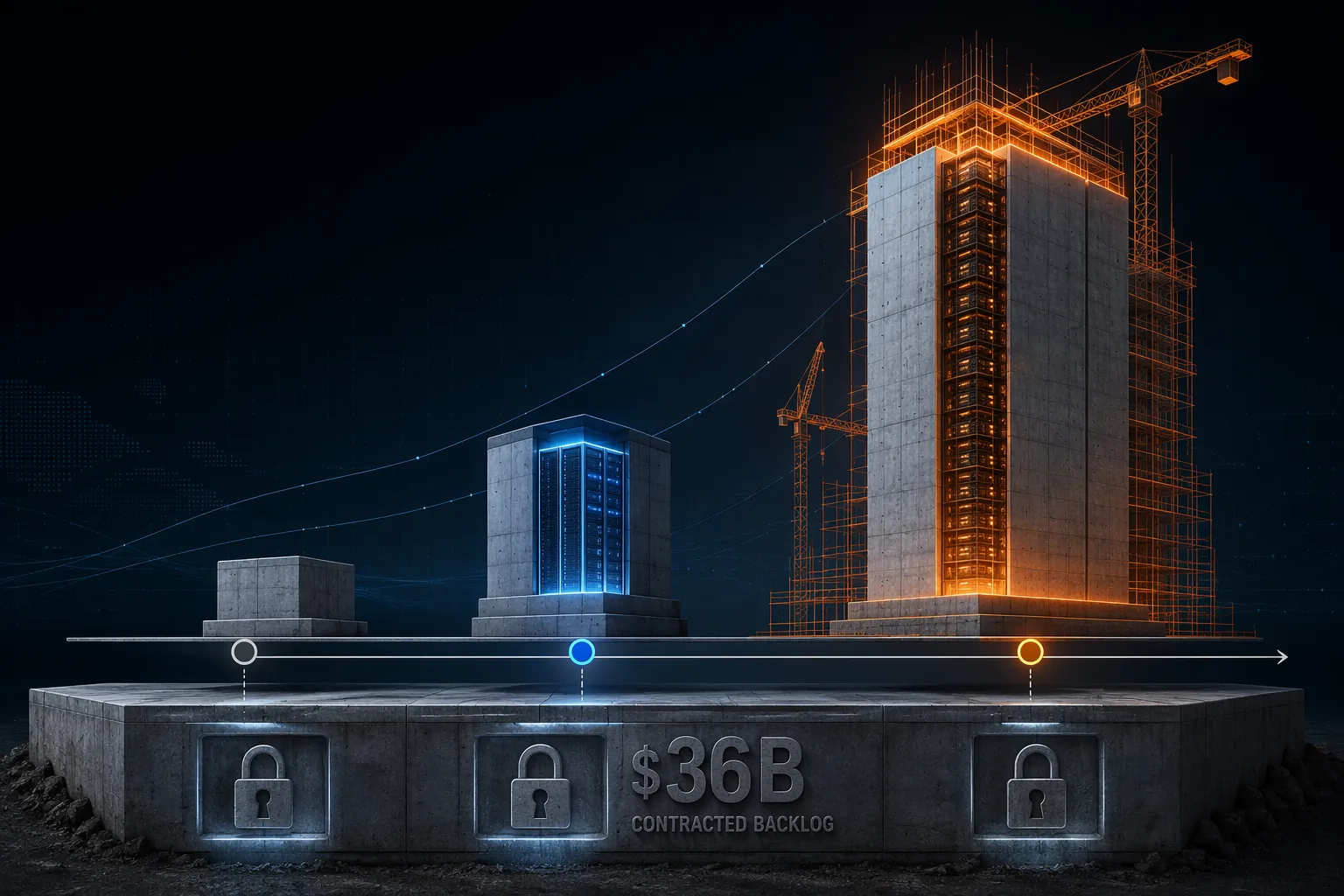
The more important line is backlog. Applied Digital disclosed $36 billion of contracted hyperscaler revenue on a base-term basis. The larger $86 billion figure includes renewal options, so it belongs in a different mental bucket: possible future revenue, not the same thing as committed base-term revenue.[1] For budget operators, that difference is not pedantry. It is the difference between a signed insertion order and a hopeful forecast.
The quarter also included three new take-or-pay leases with the same investment-grade customer: Delta Forge 1 at $7.5 billion for 300 MW, Polaris Forge 3 at $7.5 billion, and Delta Forge 2 at $5.2 billion.[1][2] Take-or-pay is the part that changes the flavor of the story. A customer can optimize usage, shift workloads, or renegotiate future behavior around the edges, but the base commitment is not a casual experiment that disappears after one soft quarter.
Capacity moved from slideware to megawatts
The live-capacity timeline is the cleanest way to separate hype from buildout. Applied Digital had 0 MW live in May 2025. By June 2026, after the post-quarter-end Phase 1 at Polaris Forge 1, live capacity reached 175 MW, with roughly 1.2 GW under construction.[1] That does not tell a buyer what Meta’s next Advantage+ cost curve will be. It does say the physical layer under AI workloads is no longer theoretical.
Ad buyers are used to platform announcements arriving as interface changes: a new campaign type, a broader match setting, a creative-generation toggle, a reporting label that moves from beta to default. Applied Digital’s quarter is a different kind of artifact. It is the invoice-side version of the same shift: space, power, cooling, debt, leases, and customers willing to commit years ahead of realized workload value.
That is why this update belongs next to earlier tracker signals such as CoreWeave vs Applied Digital and the Intel data center cost signal, rather than inside a stock-picking note. One record showed AI compute suppliers getting pulled forward by demand. Another showed server-side cost pressure. Applied Digital’s Q4 adds a lease-and-megawatt record to the same file.
The ad platform connection is indirect, but not imaginary
The cautious sentence is the right sentence: Applied Digital’s results do not mechanically cause higher ad prices. Auction prices are shaped by advertiser demand, conversion rates, targeting constraints, competition, inventory, platform pacing, and model behavior. But the infrastructure behind AI-heavy ad products is a real cost base, and that cost base is expanding across the same hyperscalers that own, sell into, or power major ad systems.
Futurum Group and Goldman Sachs put aggregate 2026 hyperscaler AI capex in the $660 billion to $690 billion range.[3][4] Campaign US also framed the scale at the company level: Meta capex of $115 billion to $135 billion supporting $200 billion in ad revenue, Google at $175 billion to $185 billion, Amazon around $200 billion, and Microsoft above $120 billion.[5] Those numbers should not be mashed into one fake CPM formula. They do, however, make it hard to argue that AI ad automation is being funded out of spare change.
The better operating question is where the cost eventually lands. Platforms can absorb some infrastructure expense, offset it with efficiency, monetize it through cloud contracts, or pass parts of it through in ad pricing, measurement products, creative tools, or bidding dynamics. The buyer only sees the surface: CPMs, CPCs, CPA, ROAS, conversion volume, learning-period behavior, and whether the platform’s recommended budget increases arrive with enough incremental value to justify them.
Energy is the line item buyers rarely see
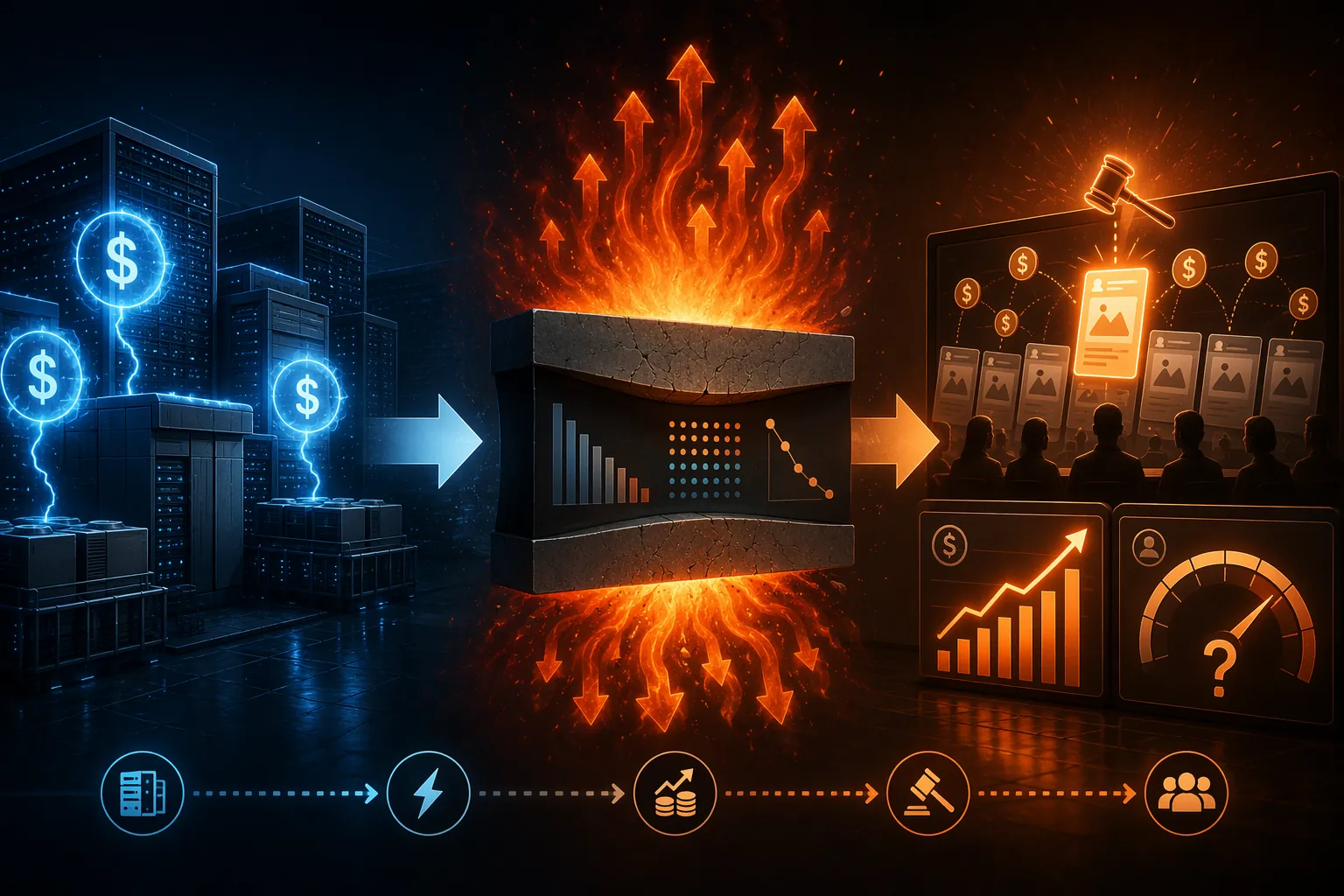
The IAB’s warning is useful because it sits closer to ad tech economics than a generic AI infrastructure forecast. Its data indicates that data center energy costs are an unhedged variable in ad tech’s cost structure and can squeeze margins, with potential to raise CPMs.[6] “Potential” is doing important work there. It is not a receipt for next week’s auction inflation; it is a cost-pressure channel that should be monitored instead of hand-waved.
Deloitte’s long-term power-demand trajectory makes the issue harder to dismiss as a temporary buildout bulge. It projects AI data center power demand could grow 30x by 2035 to 123 GW.[7] If that trajectory is even directionally right, energy and capacity planning become part of the permanent economics under AI ad tooling, not a one-cycle supply-chain annoyance.
This is where buyer panic usually gets sloppy. A rising CPM by itself does not prove platform abuse, just as a falling CPM does not prove media efficiency. If higher inference capacity improves matching, creative assembly, prediction quality, budget allocation, or fraud filtering, the buyer may accept a higher clearing cost because the account produces more profitable conversions. If costs rise and output quality does not, the same CPM move becomes margin leakage with better branding.
How to read this inside a live account
For H2 2026, the useful monitoring frame is not “will CPMs go up?” It is whether any increase in platform cost is matched by incremental ROAS that could not have been achieved with the prior campaign setup. That requires comparing outcomes before and after AI-heavy feature changes, not just staring at auction cost in isolation.
- Track CPM, CPC, CPA, ROAS, and conversion volume together; CPM is the pressure gauge, not the verdict.
- Mark platform-reported AI changes by date, including new defaults, creative automation, bidding changes, audience expansion, and measurement updates.
- Separate auction inflation from mix changes; a budget shift into higher-value audiences can raise CPM while improving account economics.
- Ask whether incremental spend produces incremental profit, not whether the platform’s blended ROAS looks stable after budget reallocation.
- Treat vendor explanations as inputs, then verify against holdouts, geo splits, campaign experiments, or clean pre/post periods where possible.
The Applied Digital quarter supports the idea that AI capacity is real, funded, and increasingly locked in. It does not support a clean claim that ad prices must rise by a specific amount or on a specific date. Infrastructure permanence raises cost pass-through risk, while the same infrastructure may produce better campaign decisions if the platforms use it well.
That is the budget-review handoff. Watch CPMs, but do not let CPM alone become the story. Watch the spread between added platform cost and incremental ROAS. Watch whether AI feature changes create measurable lift in real accounts. Watch whether auction movement arrives with better conversion quality or only with a more expensive path to the same outcome.
References
- Applied Digital Reports Fiscal Fourth Quarter and Full-Year 2026 Results, Applied Digital Investor Relations, July 27, 2026.
- Applied Digital signs AI data center leases, Reuters, June 8, 2026.
- Hyperscaler AI capex outlook, Futurum Group, February 2026.
- AI infrastructure capital expenditure forecast, Goldman Sachs, December 2025.
- Hyperscaler capex and ad revenue context, Campaign US.
- Data center energy costs and ad tech margins, IAB.
- AI data center power demand projection, Deloitte.
Primary source: https://ir.applieddigital.com/news-releases/2026-07-27