
How AI Stock Crashes Actually Hit Digital Ad Budgets
The ongoing AI stock correction is already reshaping digital ad budgets. Historical data from three prior downturns shows typical declines of 10–15% with fast digital recovery, but 2026 introduces a structural difference: ad platforms themselves face investor pressure over unsustainable AI capex, compressing CPMs more directly than in past cycles.
- Platform
- Google Ads
- Campaign type
- Performance Max
- Spend range
- >$0K
- Timeframe
- 0-07
- Ad Spend Decline
- 0-15%
- Verdict
- mixed
- Last reviewed
- 0-07-29
The practical question inside the Q3 2026 AI stock selloff is not whether someone on the team can produce a chart showing lower CPMs. The question is whether those CPMs arrive at the same time finance is asking for a 20% cut to Meta, Google, or Amazon spend before the next board update.
That is now a live budget problem. In July 2026, the Magnificent 7 lost $797 billion in market value in a single day, Alphabet’s free cash flow turned negative in Q2 for the first time since its 2004 IPO, and Fortune reported projected 2026 Mag 7 capex of $724 billion as investors pushed back on AI spending. Alphabet fell 7% in one day, while Meta was down 9.8% year to date in the same report’s market snapshot.[1]

For media buyers, that creates two different questions that often get blurred together. One is old: do advertisers cut budgets when markets fall? Usually, yes. The other is newer: what happens when the companies operating the ad auctions are themselves under pressure for AI capital spending? That second question is what makes the AI stock selloff affect digital ad budgets differently from the dot-com crash, the financial crisis, or the COVID shock.
The Historical Pattern Is Budget Cuts, Not Digital Immunity
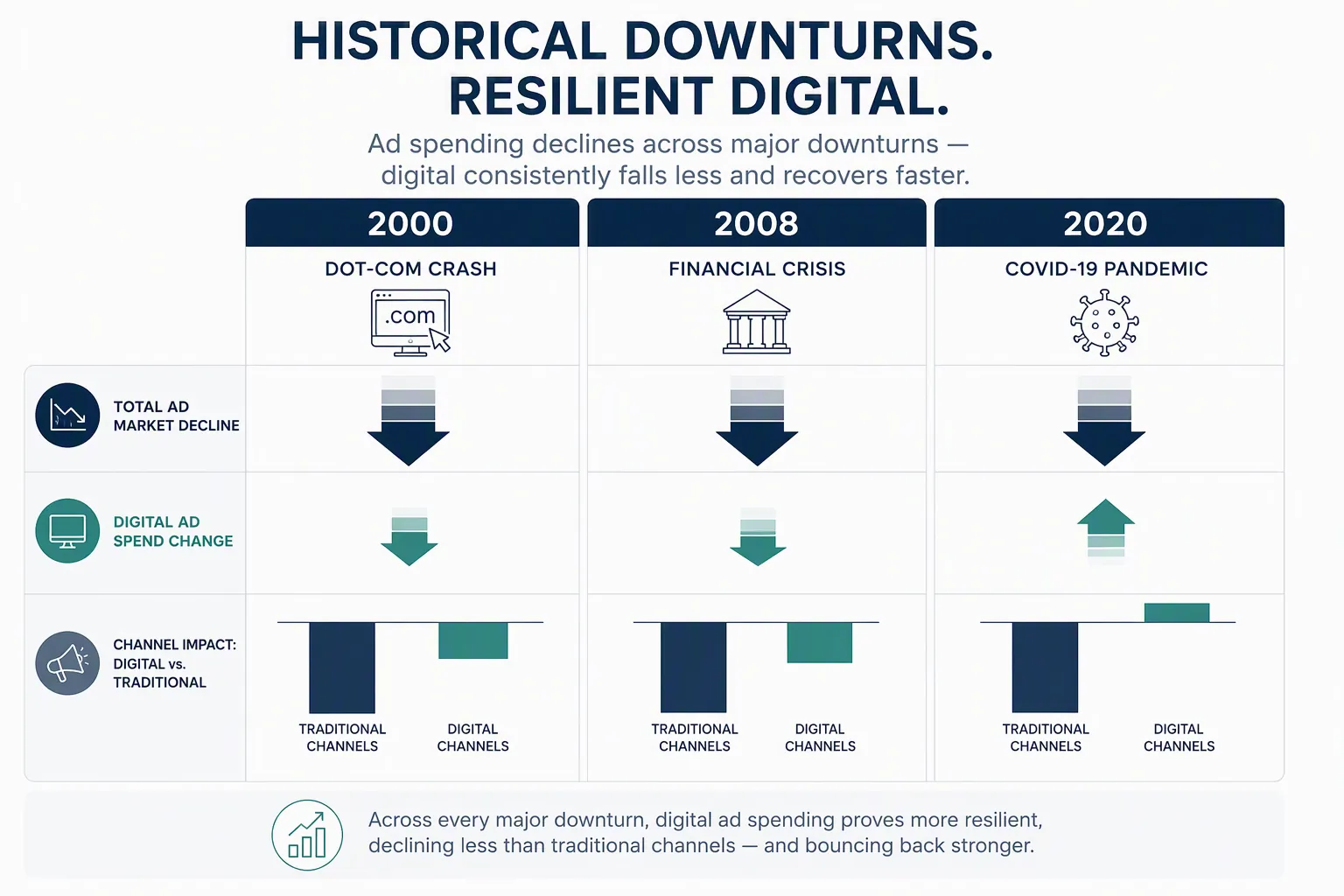
The useful recession benchmark is not that advertising disappears. It is that total ad markets tend to fall hard enough to reach every serious budget meeting, while digital either falls less, recovers faster, or both. Across the 2000 dot-com crash, the 2008 financial crisis, and the 2020 COVID shock, Brainlabs summarizes total ad-market declines in the roughly 10% to 15% range, with digital recovering faster than other channels.[2]
| Downturn | What happened to total ad demand | What mattered for digital buyers |
|---|---|---|
| 2000 dot-com crash | Total advertising declined in the roughly 10% to 15% range in the historical summary. | Digital was still small, but a large class of dot-com advertisers disappeared, which made the shock concentrated among the very companies most likely to buy emerging online media. |
| 2008 financial crisis | The US ad market fell 13% in one cited breakdown. | Digital declined only 2%, while print fell 27% and radio fell 22%, making the channel mix shift more important than the headline ad recession. |
| 2020 COVID shock | Total advertising again fell in the roughly 10% to 15% range in the historical summary. | Digital advertising grew 8% in the cited Brainlabs summary, reflecting a faster recovery and a sharp shift toward measurable, flexible channels. |
The 2008 comparison is still the cleanest reminder that “ad budgets are down” and “all channels are equally bad” are not the same statement. Nova Studio cites a 13% drop in the total US ad market, against a 2% decline for digital, a 27% fall for print, and a 22% fall for radio.[3] Wharton’s financial-crisis coverage made the same directional point at the time: digital advertising was being helped by the crisis because advertisers needed measurable, adjustable media rather than long-lead commitments.[4]
That does not mean digital budgets are protected. In 2000, the issue was not simply a macro ad pullback; many of the advertisers buying online media were the same dot-com companies losing access to capital. When the advertiser base is directly tied to the speculative asset being repriced, “cheap inventory” can show up at the same time entire categories stop bidding.
The COVID pattern cuts the other way but still needs care. A fast digital rebound did happen, and Brainlabs cites 8% digital growth in 2020 despite a broader ad-market decline.[2] But that was not a universal performance-marketing holiday. Some categories saw demand move online; others were supply constrained, closed, or preserving cash. The average channel outcome did not pay the invoices for every advertiser inside the average.
Lower CPMs Only Help If Conversion Demand Survives
There is a reasonable pro-digital case in a downturn. Auction media reprices faster than fixed commitments. Spend can be trimmed by campaign, geography, audience, query class, or SKU. If weaker advertisers leave the auction, surviving accounts can buy reach and clicks more cheaply. Brainlabs also notes that digital CPMs are up roughly 100% since 2019, which leaves room for compression if demand pulls back.[2]
The catch is that CPM is only the media-input price. A CFO does not care that impressions became cheaper if conversion rate falls, average order value weakens, sales cycles lengthen, or payback windows move outside the company’s cash tolerance. The buyer’s job in that moment is not to defend platform spend as a category. It is to show which campaigns still clear the current hurdle rate after the demand shock.
Older “advertise through the recession” evidence is useful here, but only when it is kept in its lane. The often-cited McGraw-Hill study tracked 600 companies from 1980 to 1985 and found that companies maintaining advertising during the 1981 recession saw 256% higher sales growth after recovery than those that cut, according to Brainlabs’ summary.[2] That is a striking result, but it comes from a 1980s industrial-company context, not from modern six- and seven-figure monthly Meta accounts with blended CAC targets and weekly liquidity checks.
The IPA evidence is closer to brand behavior but still not a direct performance-budget rule. Brainlabs cites an IPA 2008 study finding that brands going dark, defined there as no TV spend for six months, saw brand use decrease 24% and brand image decrease 28%.[2] That is a warning against indiscriminate cuts. It is not proof that every marginal prospecting ad set should survive a cash-preservation order.
What 2026 Adds: The Platforms Are Inside the Stress
The 2026 AI correction is not just another advertiser-demand shock layered onto otherwise neutral pipes. The companies that own the largest digital ad auctions are also among the companies defending the AI capex cycle. That matters because Meta, Google, and Amazon are not merely selling inventory into the downturn. They are managing investor expectations, revenue growth, product packaging, automation defaults, and monetization pressure while public markets question whether AI spending can earn back its cost.
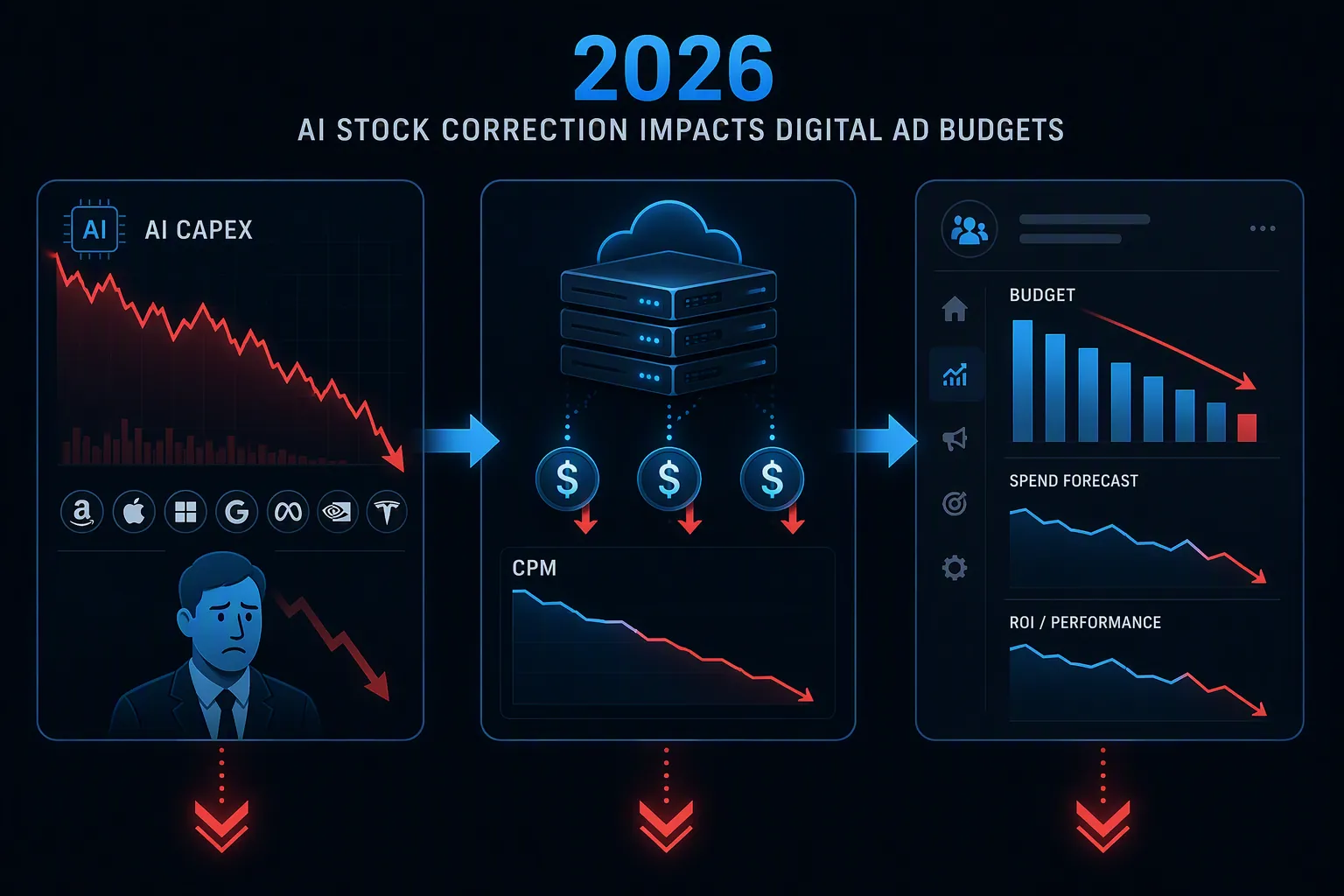
Alphabet’s negative free cash flow is the most important operating signal in the current set of facts because it connects the market selloff to the business model behind Google Ads and YouTube. Fortune reported that Alphabet’s free cash flow turned negative in Q2 2026 for the first time since the company’s 2004 IPO, in the same context as the $724 billion projected Mag 7 capex figure and the single-day $797 billion market-cap loss.[1] That does not prove Google will cut auction prices. It does show why the ad business is no longer separable from the AI investment debate.
This is the structural difference from 2008. During the financial crisis, digital ad platforms could be the lower-friction alternative to print, radio, and long-lead media. In 2026, the same platforms may still be the efficient alternative, but they are also under pressure to keep growth credible while investors question the capital intensity of the AI buildout. That can show up in subtle ways before it shows up in an earnings-call admission: more aggressive automation defaults, new campaign packaging, changes in recommendation surfaces, stronger nudges into broad targeting, or monetization changes that affect how buyers experience the auction.
None of that requires assuming platform panic. It only requires accepting that auction prices are not formed in a vacuum. If advertiser demand softens, CPMs can compress. If platform owners need to defend revenue while capex is under attack, they may also change the way inventory, bidding, and automation are presented to advertisers. Those two forces can pull in different directions: cheaper impressions in some auctions, higher pressure to adopt products that preserve platform yield in others.
The AI-Finance Loop Is Why the Risk Is Hard to Isolate
The market is not just reacting to AI enthusiasm cooling. It is reacting to the cost structure behind the enthusiasm. Oliver Wyman’s 2026 scenario analysis treats an AI bubble burst as a plausible financial-market shock, not just a technology-sector mood swing.[5] Forbes separately framed the large AI companies’ cost exposure as a potential meltdown risk in May 2026.[6]
The circularity of the AI spending chain makes that pressure harder for advertisers to dismiss. Ed Zitron’s June 2026 analysis reported OpenAI spending $17.2 billion on Microsoft Azure while posting a $20.9 billion loss on $13.04 billion in revenue, and described capital flows involving CoreWeave, Microsoft, and OpenAI.[7] The point for a media buyer is narrower than any grand verdict on AI economics: when infrastructure spend, cloud revenue, equity value, and AI product expectations are tied together, a repricing of one part can move quickly into the operating assumptions of the rest.
That is why the 2026 correction can reach ad budgets through more than one route. Company-side finance teams may cut acquisition budgets because valuation multiples fell, fundraising became harder, or board tolerance changed. Platform-side teams may face their own pressure to prove that AI capex supports revenue, which can affect auction design and product emphasis. The buyer sits between both pressures: fewer internal dollars approved, but potentially softer media prices in parts of the auction.
What to Watch in Q3 Budgets
The first signal is usually not a dramatic platform-wide CPM collapse. It is a change in budget governance. Monthly pacing becomes weekly pacing. Payback windows get shortened. Brand or upper-funnel tests lose oxygen first unless they are tied to a near-term revenue case. Campaigns that were acceptable at a blended target are re-sorted by marginal contribution.
- If CPMs fall while conversion rate and order value hold, surviving advertisers may get a real buying window.
- If CPMs fall because high-intent demand is weakening, cheaper inventory may not improve CAC or MER.
- If platform recommendations become more aggressive, treat automation changes as monetization events as well as optimization features.
- If finance shortens payback tolerance, historical recession averages matter less than current cash conversion.
This is also where channel-level history helps but cannot make the decision. Digital’s relative resilience in 2008 and its fast 2020 recovery argue against cutting working campaigns just because equity markets are ugly. The dot-com precedent argues against assuming that digital demand is automatically safe when the stressed asset class and the advertiser base overlap. In 2026, AI-native software companies, cloud-exposed vendors, and venture-backed growth companies may not behave like consumer staples with decades of media history.
Correction or Recession Is the Budget Fork
If the AI selloff remains a correction, the most likely paid-media effect is sharper budget scrutiny with pockets of CPM softness. In that version, the accounts with clean unit economics, short enough payback, and room to keep testing may find better prices than they had in the 2024–2025 inflationary CPM environment. They will still have to prove it faster and with less patience from finance.
If the correction becomes a full recession, the historical range becomes more relevant: total ad-market declines around 10% to 15% are a reasonable benchmark, not a forecast.[2] Digital may again fall less than traditional media or recover faster, but that does not prevent budget cuts inside companies preserving cash. Cheaper inventory is only useful to advertisers allowed to keep buying it.
The cleanest operating stance is conditional. Do not treat lower CPMs as a gift until conversion economics confirm it. Do not treat stock-market stress as an automatic reason to go dark if campaigns still clear the current cash hurdle. And do not treat Meta, Google, and Amazon as neutral auction utilities in this cycle; their AI capex pressure is now part of the media environment buyers have to monitor.
For Q3 2026, the useful evidence will come less from macro certainty than from dated campaign records: CPM movement, spend approvals, auction volatility, and platform product changes. Signal & Convert’s Benchmarks and Tracker records are the right places to keep checking whether the correction is showing up as a temporary pricing window, a deeper demand break, or a platform monetization shift.
References
- Big Tech earnings slam into a market in revolt over AI spending, Fortune, July 26, 2026
- Slashing your ad budget in a downturn? That might be your most expensive decision yet., Brainlabs
- The History Of Advertising In A Recession, Nova Studio
- Digital Advertising Gets a Boost from the Financial Crisis, Wharton
- How An AI Bubble Burst Could Shake Global Financial Markets, Oliver Wyman, January 2026
- AI Giants Face A Potential Cost Meltdown, Forbes, May 27, 2026
- The AI Industry Is Losing, Ed Zitron, June 30, 2026
Built on this evidence
No Bidding tactic or Creative record currently cites this case file. Compare it against other results in Benchmarks.
Related benchmark reading
Report a corroborating or contradicting result
Seeing something different in your own account? Feed the data-integrity loop instead of leaving an open comment.