
Why SanDisk's Stock Drop Won't Ease AI Ad Storage Costs
The 30% SanDisk stock crash might look like relief for AI ad infrastructure costs, but it's profit-taking on an overheated stock—not a supply signal. This article explains why storage costs remain structurally elevated and what advertisers should watch instead.
- Platform
- Google Ads
- Campaign type
- Performance Max
- Spend range
- Large budget
- Timeframe
- June 0 – July 2026
- NAND price increase
- 0-75% QoQ
- Verdict
- loss
- Industry vertical
- Digital Advertising
- Last reviewed
- 0-07-29
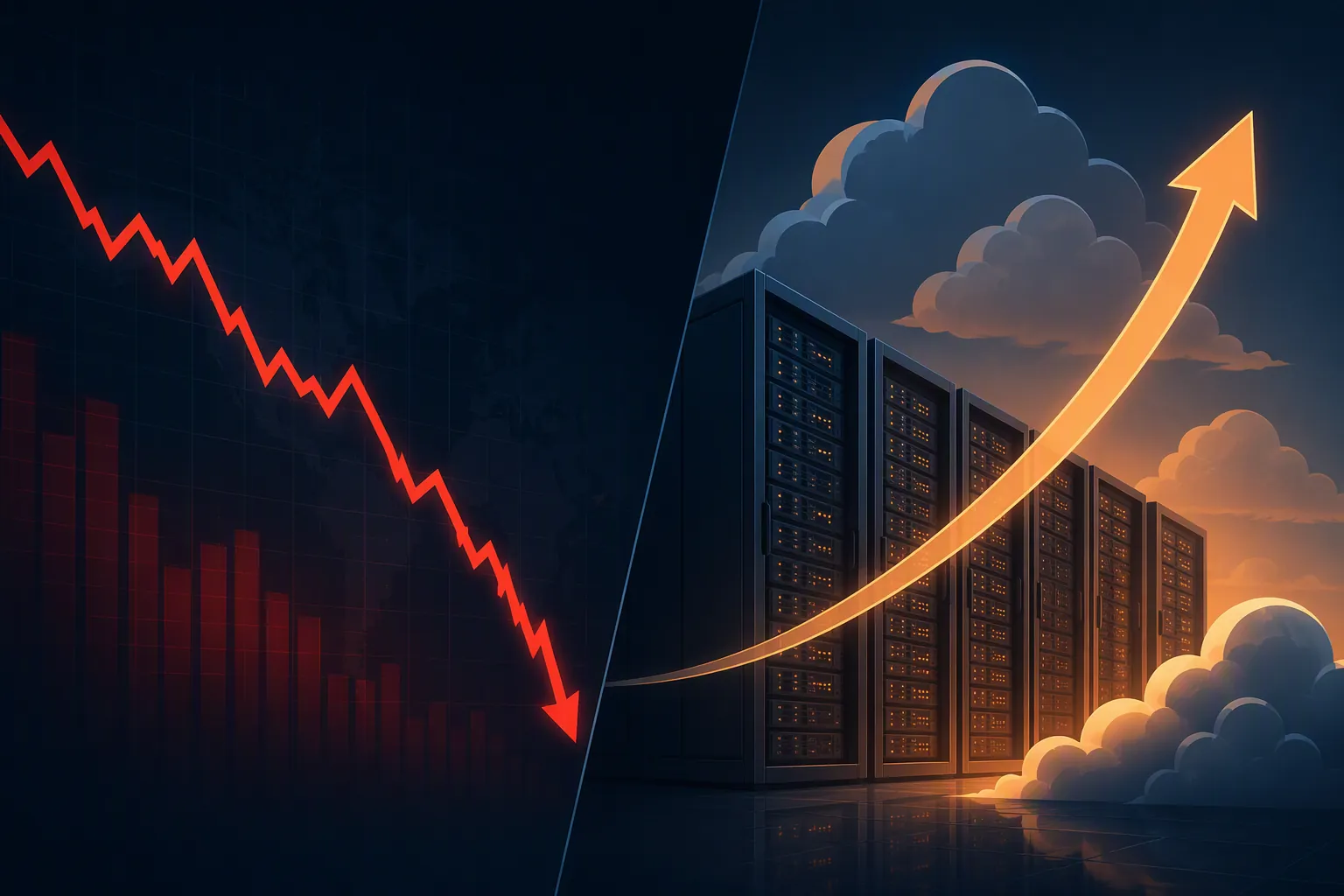
The short answer is no: the SanDisk stock drop is not a reliable signal that AI data storage costs for advertisers are about to ease. A falling SNDK chart may look like cost relief if the headline is read too quickly, but the physical storage market is still moving the other way.
The distinction matters for anyone building Q3 2026 media forecasts around Performance Max, Advantage+, AI Max, or other automated campaign systems. Finance may see SanDisk down roughly 30% from its June 22 high and ask whether the AI infrastructure pressure is finally breaking. The better answer is that the stock sold off after an enormous run, while NAND and enterprise SSD pricing remained tight.
The Stock Move Was Not a Storage-Relief Signal
SanDisk’s June 26 selloff was a market event before it was a storage-market event. TIKR attributed the roughly 10% one-day decline to a crash in South Korean chip stocks, including a 12% fall in SK Hynix and a 10% drop in the KOSPI, along with profit-taking after a steep AI-memory rally rather than a deterioration in NAND demand [1].
The July 13 move tells the same story. SanDisk fell about 13% on a broader risk-off rotation out of high-flying AI semiconductor names and into safer sectors, with oil-price spikes and U.S.-Iran geopolitical tension cited as drivers; the analysis did not identify a collapse in NAND demand as the reason for the drop [2].
That does not make the stock action meaningless. Equity markets can change capex expectations if a selloff lasts long enough, and suppliers can become more cautious if customers start delaying commitments. But a sharp trading-day correction is not the same thing as cheaper flash media showing up in data-center invoices.
The scale of the prior rally is the part that gets lost in the “crash” framing. Forbes reported SanDisk was still up more than 574% year to date even after the pullback from its June 22 all-time high of $2,354 [3]. For a media planner, that says less about storage getting cheaper and more about an overheated AI-memory trade giving back some altitude.
The Storage Market Is Still Tightening
If the question is whether campaign forecasts should assume lower AI infrastructure costs, the useful evidence is not the equity chart. It is NAND contract pricing, enterprise SSD availability, cloud storage notices, and supplier commitments. Those indicators still point upward.
TrendForce reported that NAND Flash contract prices surged 70% to 75% quarter over quarter in Q2 2026, after already rising 55% to 60% quarter over quarter in Q1 2026 [4]. That is the opposite of a relief signal. It means buyers were not merely paying a little more for storage; they were repricing into a tighter supply environment across consecutive quarters.
The enterprise SSD market shows the same pressure in a form that is closer to what cloud and AI infrastructure teams actually buy. TrendForce said enterprise SSD market revenue reached a record $18.46 billion in Q1 2026, up 86.1% quarter over quarter [4]. Revenue growth by itself does not prove unit scarcity, but paired with contract-price increases it is a strong warning against assuming storage-cost relief.
| Signal | What It Measures | What It Means for Ad-Cost Forecasting |
|---|---|---|
| SanDisk stock down roughly 30% from its June 22 high | Equity-market repricing after a very large AI-memory rally | Weak signal for advertiser costs unless it changes supplier behavior or capex plans |
| NAND contract prices up 70% to 75% QoQ in Q2 2026 | Actual buyer-supplier pricing for flash memory | Strong signal that storage inputs remain expensive |
| Enterprise SSD revenue at a record $18.46 billion in Q1 2026 | Data-center SSD spending at the infrastructure layer | Useful signal that enterprise storage demand is still absorbing supply |
| Cloud storage price increases already appearing | Provider pass-through into customer-facing cloud services | Closer signal for platforms that run AI ad systems on cloud infrastructure |
The most dramatic SSD data comes from VDURA’s Flash Volatility Index, cited by Forbes: 30TB TLC enterprise SSD pricing rose from $3,062 in Q2 2025 to $17,500 in Q1 2026, a 472% increase [5]. The same source said an all-flash 25PB deployment rose from $9.69 million to $48.17 million, a 397% increase driven primarily by flash media costs [5].
That data deserves a caveat. VDURA has a commercial interest in highlighting flash-cost pain because it sells storage architecture alternatives, so the numbers should not be treated as a neutral industry-wide average. Still, even with that caveat, the example is useful because it shows how quickly all-flash economics can change when enterprise SSD pricing moves against buyers.
The Chain From NAND to Ad Platforms Is Real, but Not Mechanical
Advertisers do not buy NAND wafers. They buy outcomes from platforms that run massive software systems: auction infrastructure, model-serving systems, creative-generation and assembly pipelines, audience stores, conversion logs, experimentation systems, and reporting databases. Storage is only one input inside that machinery, but it is not imaginary.
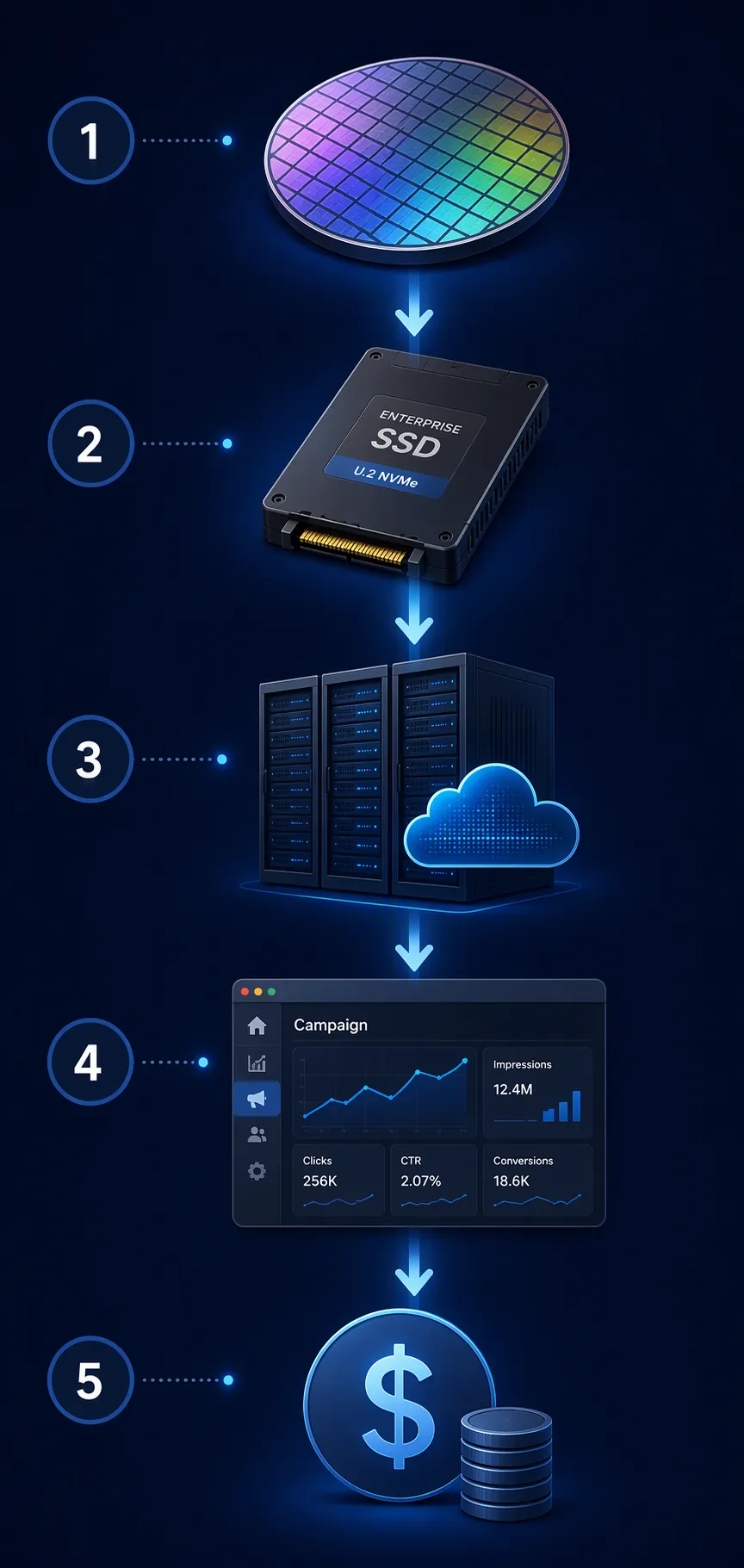
The practical chain looks like this: NAND tightness raises enterprise SSD pricing; enterprise SSD pricing raises the cost of data-center and cloud storage; cloud providers pass some of that cost through by tier, region, contract, or usage pattern; AI ad platforms absorb some infrastructure inflation and may pass some of it into advertiser-facing economics over time. Every link is plausible. The final link is the least directly measured.
No public source in the research set measures how much of Performance Max, Advantage+, or AI Max pricing is attributable to NAND, SSDs, or cloud storage. There is also no measured formula that turns NAND contract prices into CPCs, CPMs, campaign fees, or auction floors. Treating SanDisk’s stock decline as a direct forecast input would be false precision.
The safer interpretation is narrower: storage-cost pressure remains a credible contributor to AI ad infrastructure inflation. That is enough to matter for forecasts, especially when automated campaign products depend on more model inference, more asset processing, more event retention, and more near-real-time decisioning than older manual campaign workflows.
This is where the companion infrastructure signal matters. The earlier piece on Advantest and adtech infrastructure costs covers the chip-testing and broader AI hardware bottleneck. SanDisk is the NAND-specific version of the same planning problem: infrastructure inflation usually becomes visible upstream before it shows up as a clean line item in a media invoice.
Cloud Pass-Through Is Already Closer to the Advertiser
Cloud pricing is a more useful bridge than SanDisk’s market cap because it sits closer to the services AI ad platforms actually consume. Infinet reported that AWS and Azure block-storage tiers saw price increases in Q1 2026, and also noted cloud price changes from Google and Amazon effective May 1, 2026, including increases to Google Cloud CDN Interconnect, Direct Peering, and Carrier Peering list prices [6].
Those increases do not land evenly. A platform with long-term committed cloud contracts may feel the change differently from a smaller adtech vendor using more variable infrastructure. A self-serve advertiser may never see a storage surcharge by name. The cost can be absorbed, blended into product margins, reflected in minimums, expressed through optimization constraints, or delayed until broader pricing reviews.
That is exactly why the stock headline is such a poor operating signal. A media buyer does not need to know whether SNDK was oversold on July 13. They need to know whether the platform’s infrastructure input costs are easing enough to change the forecast. Cloud notices and enterprise SSD pricing sit much closer to that answer.
Pricing Floors Reduce the Chance of Fast Relief
The contract structure also argues against quick relief. Motley Fool reported that SanDisk had locked in $42 billion of multi-year customer agreements with pricing floors around $0.29 per GB, based on Bernstein estimates, and had pre-sold more than a third of fiscal 2027 chip production [7]. That kind of commitment does not behave like a commodity quote that can fall cleanly into next month’s media plan.
The same report cited Bernstein’s estimate that even in a worst-case memory-price collapse, SanDisk’s fiscal 2030 EPS would still be $214 with 60% of volumes under contract [7]. That is an equity analyst’s framing, not an advertiser-cost model, but the operational implication is plain enough: a meaningful share of supply is already tied to agreements that can keep pricing elevated even if sentiment cools.
Management commentary points in the same direction. TIKR reported that SanDisk management said NAND undersupply would extend beyond 2026 and that customers were already seeking 2027 supply commitments [1]. Micron also told investors the memory chip market would remain supply-constrained beyond 2027, according to Motley Fool [7].
That does not mean every storage-related cost will rise in a straight line. Buyers can redesign workloads, move colder data to cheaper tiers, negotiate committed-use discounts, or delay all-flash deployments. Large platforms have more options than a small agency or a mid-market brand. But those mitigations are not the same as market-wide cost relief.
What Advertisers Should Watch Instead
For campaign forecasting, the useful watchlist is boring and invoice-adjacent. It will not move with the drama of a one-day semiconductor selloff, but it is more likely to protect a Q3 2026 forecast from looking naive in Q1 2027.
- NAND contract prices: sustained quarter-over-quarter increases matter more than SanDisk’s daily share-price moves.
- Enterprise SSD availability: long lead times or premium pricing for high-capacity drives signal pressure at the data-center layer.
- Cloud storage and networking notices: tier-specific changes from AWS, Azure, Google Cloud, and other providers sit closer to platform operating costs.
- Platform infrastructure language: comments about AI serving cost, storage efficiency, logging, retrieval, and model-deployment expense are more relevant than stock-chart reversals.
- Contract timing: if cloud or adtech vendors renew infrastructure agreements during a high-cost storage window, advertiser-facing economics may adjust later rather than immediately.
The timing still argues for caution. Industry outlooks cited by Oscoo point to 2027 as the earliest window for meaningful SSD price relief, not the second half of 2026 [8]. “Earliest” is doing real work there. It is not a guarantee that ad platforms will see lower storage costs in early 2027, and it certainly is not evidence that a July 2026 stock pullback should lower campaign budgets today.
So the planning answer is restrained: do not raise AI campaign spend forecasts because SanDisk sold off, and do not promise finance that automated campaign infrastructure is about to get cheaper. Through at least early 2027, treat the SanDisk drop as equity-market noise unless it is accompanied by falling NAND contract prices, looser enterprise SSD availability, fewer cloud pass-through notices, or explicit platform commentary that infrastructure costs are easing.
References
- SanDisk Stock Fell 10% in a Day. Management Says the NAND Cycle Is Different, TIKR
- SanDisk Fell 13% Monday. Here’s Where SNDK Stock Could Head in 2026, TIKR
- SanDisk Stock Up Over 574%: Where It’s Heading In 2026, Forbes
- NAND Flash Contract Prices Projected to Surge 70–75% QoQ in 2Q26 as Enterprise SSD Demand Remains Strong, TrendForce, June 11, 2026
- SSD Storage Capacity Prices Are Over 20 Times HDD Storage Capacity Prices, Forbes, April 16, 2026
- SSD Prices & Supply in 2026: What Data Centers Need to Know About Tariffs, Infinet
- SanDisk: Even After a 580% Rise in 2026, It’s Still a Buy, The Motley Fool, July 19, 2026
- When Will SSD Prices Go Down? Q3/Q4 2026 Outlook, Oscoo
Built on this evidence
No Bidding tactic or Creative record currently cites this case file. Compare it against other results in Benchmarks.
Related benchmark reading
Report a corroborating or contradicting result
Seeing something different in your own account? Feed the data-integrity loop instead of leaving an open comment.