
Microsoft's Paid Search Deceleration Isn't a Stock Story
Microsoft's paid-search revenue growth has slowed sharply while CPCs surge, raising questions about the platform's long-term viability for media buyers. This analysis examines whether the deceleration signals a structural monetization gap between AI engagement and paid-search inventory, and advises Q4 2026 budget allocation decisions.
- Platform
- Microsoft Advertising
- Campaign type
- Search
- Spend range
- Multiple tiers
- Timeframe
- Q2 2026
- CPC
- 19% YoY increase
- Verdict
- mixed
- Last reviewed
- 2026-07-29
The Q4 budget question is not whether Microsoft can tell a cleaner AI story on earnings day. It is whether a paid-search manager can put another point or two of spend into Microsoft Advertising and still get enough qualified clicks without paying for inventory that is quietly getting tighter.
That is a different question from the one dominating the market narrative around Microsoft’s stock rebound prospects, AI advertising outlook, and paid search. Microsoft can be down roughly 18% to 20% over a twelve-month window, analysts can still cluster around optimistic price targets, and none of that tells a media buyer whether Bing search has enough auction depth for Q4 scaling.[1][2]
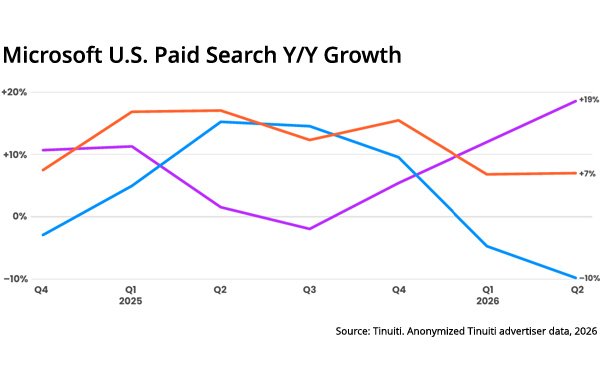
The more useful signal is coming from the auction. Tinuiti’s Q2 2026 benchmark, as covered by MediaPost, found Microsoft Advertising CPCs up 19% year over year while Microsoft paid-search spend among its clients rose 7%; Google CPCs, by comparison, increased 1%.[3] Tinuiti is one agency’s client mix, not the whole market. Still, those are buying-behavior numbers, and they are closer to the budget meeting than a price target.
The auction is saying something the AI story is not
A 19% CPC increase with only 7% spend growth is not a clean health signal. If advertisers are spending a little more but paying materially more per click, the implied click volume is under pressure. Since paid search impressions, click-through rate, CPC, and spend all move together, that pattern points toward fewer affordable opportunities to buy, not a broad expansion of search inventory.
The math does not require a complicated model. If a buyer spent $100 last year at an average $1 CPC, that buyer bought 100 clicks. If spend rises 7% to $107 while CPC rises 19% to $1.19, the buyer buys about 90 clicks. That example is hypothetical, but it illustrates the pressure in the benchmark: spend can rise while volume falls.
The cause is not proven by the public data. It could be supply pressure, stronger bidding from existing advertisers, a mix shift into more expensive query categories, changes in match behavior, or some combination. What the data does not show is an obvious flood of cheap incremental Microsoft search inventory arriving from AI surfaces.
That matters because Microsoft’s reported search advertising growth has also slowed. SERoundtable’s analysis of Microsoft earnings releases shows search and news advertising revenue growth moving from 21% in Q4 FY24, the quarter ending June 2024, to 16% in Q1 FY26, the quarter ending September 2025, and then to 10% in Q2 FY26, the quarter ending December 2025.[4]
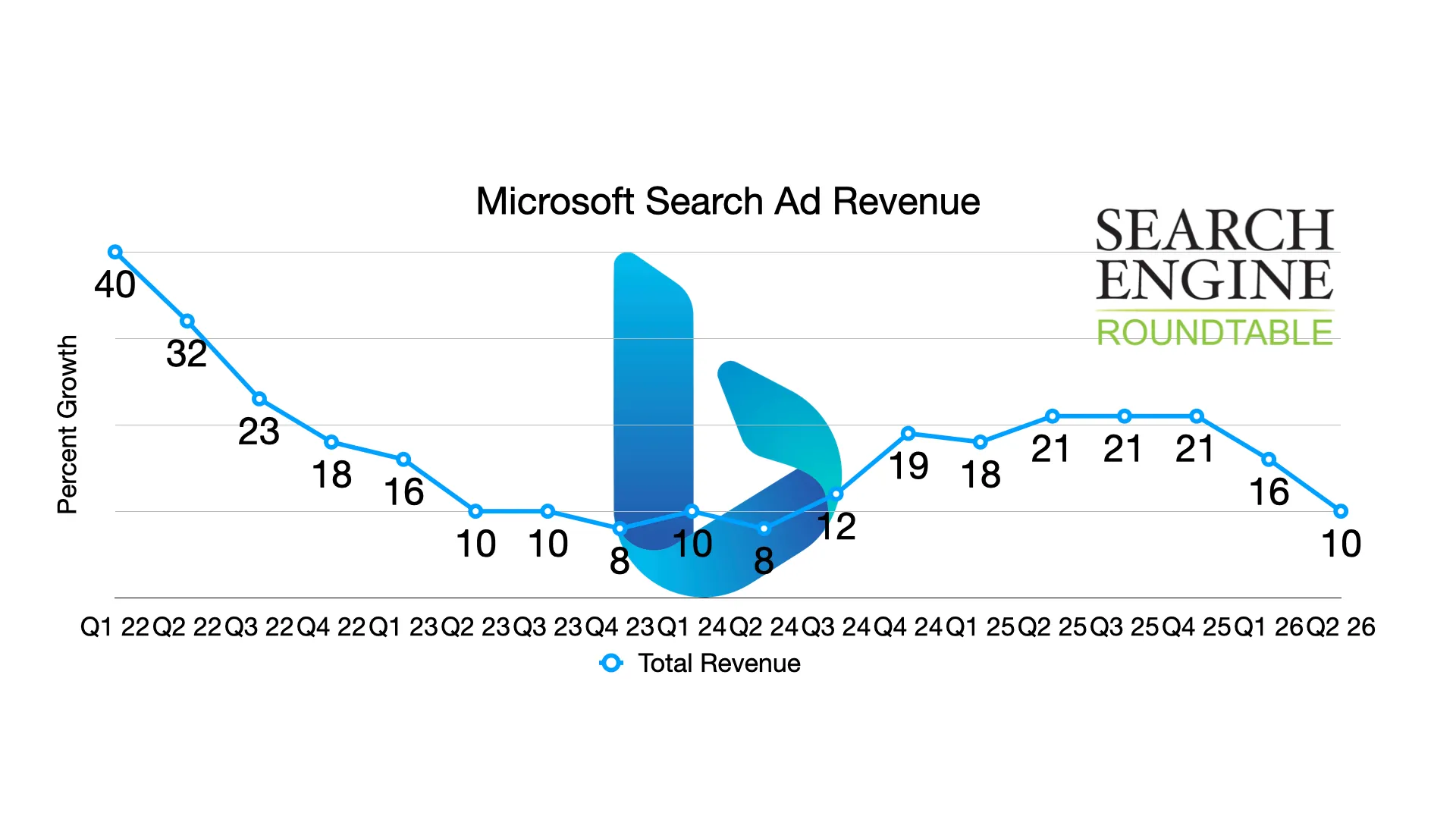
Revenue deceleration by itself could be normal maturation. A platform can grow quickly off a smaller base and then slow as comps get harder. But paired with the Tinuiti benchmark, the story becomes less comfortable: buyer-side CPCs are rising sharply, spend is only modestly higher, and platform-level growth is slowing. That is the combination a search operator watches before telling finance that the next marginal dollar should move out of Google.
Microsoft still matters, but it is not a scale substitute
None of this makes Microsoft Advertising irrelevant. Its full-year advertising revenue reached $14.6 billion in FY2025, up 21%, which SearchLab describes as the strongest growth in five years.[5] The platform also remains useful in the account-level sense: less crowded auctions, older searchers in some categories, and CPCs that can still come in below Google’s.
The broader market explains why the platform is worth defending but not romanticizing. DigitalApplied projects global PPC spend at $306 billion in 2026, up 11% year over year, and estimates Microsoft Advertising at roughly 6% share; it also reports that 36% of U.S. advertisers actively use Microsoft Ads versus 80% using Google.[6] That is the shape many paid-search accounts already reflect: Microsoft is a meaningful incremental channel, not the default engine of demand capture.
| Signal | What it supports | What it does not prove |
|---|---|---|
| Microsoft CPC up 19% YoY; spend up 7% YoY in Tinuiti Q2 2026 | Auction pressure and likely click-volume pressure within Tinuiti’s client base | The exact cause of the pressure across the entire Microsoft ecosystem |
| Search ad revenue growth slowing from 21% to 16% to 10% | Platform-level monetization is decelerating across the reported periods | That Microsoft search demand is permanently impaired |
| Microsoft Advertising around 6% of global PPC share | The platform remains material but secondary for most advertisers | That every account should hold the same allocation |
For accounts already allocating 5% to 15% of paid-search budget to Microsoft, the practical question is not whether to abandon the platform. It is whether a Q4 plan should assume more available volume than the auction has recently shown. In most mature accounts, the safer default is to preserve the efficient Microsoft core, not to underwrite an AI-driven inventory expansion before it is separately visible in reporting.
Copilot engagement is real; paid-search inventory is the missing bridge
Microsoft’s AI usage numbers are not trivial. SearchLab cites 320 million monthly active Copilot users and more than 13 billion chats, while TIKR cites more than 20 million paid Microsoft 365 Copilot seats from Microsoft’s FY Q3 2026 earnings context.[5][7] Those figures make the advertising question sharper, not weaker.

Engagement is not the same as monetizable paid-search inventory. A Copilot user asking a multi-step work question may be valuable to Microsoft’s software business, but that session does not automatically become a search ad impression with familiar intent, query matching, auction density, conversion tracking, and budget controls. The ad product has to create a buyable unit before it can help a paid-search allocation.
That is the structural gap. Microsoft can have large AI surfaces and still fail, at least near term, to turn those surfaces into enough measurable performance inventory to offset slowing search revenue growth. The public numbers support the existence of AI engagement; they do not yet support the claim that AI engagement is replacing or expanding paid-search demand capture at the level a Q4 budget needs.
AI Max is an answer, not proof
Microsoft is not ignoring the problem. In 2026, it announced AI Max and new ad tools for what Search Engine Land described as the agentic web era, including products meant to extend campaign reach and adapt ads across newer AI-driven experiences.[8] That is exactly where the platform should be investing if search behavior is spreading beyond the classic results page.
But a product announcement should not be booked as inventory until the account can measure it. For Q4 planning, the test is whether these surfaces produce distinct volume, distinct cost, and distinct conversion quality. If they are blended into existing campaign types without clean segmentation, the buyer may see spend movement without knowing whether Bing search is holding up or Copilot-adjacent placements are carrying the increment.
That distinction matters for optimization. Classic Bing search campaigns can be judged against query intent, search-term quality, CPC, impression share, conversion rate, and marginal CPA or ROAS. New AI surfaces need their own readout because they may behave more like assisted discovery than demand capture. Treating those environments as interchangeable makes the budget look more diversified while making the measurement less useful.
What would change the Q4 read
A healthier Microsoft paid-search outlook would not require a perfect earnings print. It would require evidence that the revenue deceleration is stabilizing and that buyers can access more impression volume without simply paying higher CPCs for fewer clicks.
- Search advertising revenue growth stabilizes or reaccelerates in a way that is not explained only by easier comparisons.
- Advertisers see impression and click volume expand at acceptable marginal CPA or ROAS, not just higher CPCs.
- Copilot or agentic-web placements become separately measurable enough to compare against Bing search, Google search, and Performance Max-style inventory.
- Reports distinguish adoption of AI ad products from performance lift attributable to those products.
- Auction benchmarks from more than one buyer set show Microsoft spend rising faster than CPC without conversion quality deteriorating.
Until those signals appear, the conservative read is not anti-Microsoft. It is a refusal to let enterprise AI engagement stand in for paid-search supply. The available data supports using Microsoft where it clears the account’s efficiency thresholds; it does not support assuming that Copilot has already created a new pool of search-like inventory.
The Q4 budget posture
For Q4 2026 planning, the default posture should be maintain or modestly reduce Microsoft paid-search allocation, depending on account-level marginal returns. Accounts still getting efficient nonbrand volume should keep it. Accounts where CPC inflation is eating click volume should not defend the same share just because Microsoft’s AI narrative is improving.
The operating split should be simple: keep Bing search campaigns and Copilot or AI-surface tests separate wherever reporting allows. Do not use AI-surface spend as a replacement line for proven search inventory until it shows its own conversion economics. If the platform forces blending, set stricter incrementality expectations and avoid interpreting blended gains as proof that search demand expanded.
Microsoft reports Q4 FY26 earnings today, July 29, 2026. If the new print shows a clear rebound in search advertising growth, the near-term read needs updating. The deeper test remains the same: whether Microsoft can turn AI engagement into separately measurable, monetizable demand capture rather than a larger audience story sitting next to a tighter search auction.
References
- Microsoft Stock Outlook 2026, Forbes
- Microsoft Stock Forecast, MarketBeat
- Microsoft Sees Paid Search Ad Media Buys Rise, MediaPost, July 16, 2026
- Microsoft Bing Ads Revenue Growth Slows To 10%, SERoundtable
- Microsoft Ads Statistics 2026, SearchLab
- PPC Statistics 2026: Paid Search Data Points, DigitalApplied
- Down 18% in the Last 12 Months, Can Microsoft (NASDAQ:MSFT) Stock Bounce Back in 2026?, TIKR
- Microsoft launches AI Max and new ad tools for the agentic web era, Search Engine Land
Built on this evidence
No Bidding tactic or Creative record currently cites this case file. Compare it against other results in Benchmarks.
Related benchmark reading
Report a corroborating or contradicting result
Seeing something different in your own account? Feed the data-integrity loop instead of leaving an open comment.