
Microsoft's AI Earnings Don't Justify Increasing Ad Spend
Microsoft's search ad revenue growth decelerated from 21% to an expected 8-9% across FY26, even as its AI revenue surged. This analysis separates the AI narrative from actual search auction performance, helping media buyers decide whether to increase Microsoft Ads budgets in H2 2026.
- Platform
- Microsoft Ads
- Campaign type
- Search
- Spend range
- Various
- Timeframe
- FY26 (Q1-Q3)
- Revenue Growth
- 10%
- Verdict
- mixed
- Industry vertical
- B2B
- Last reviewed
- 2026-07-29
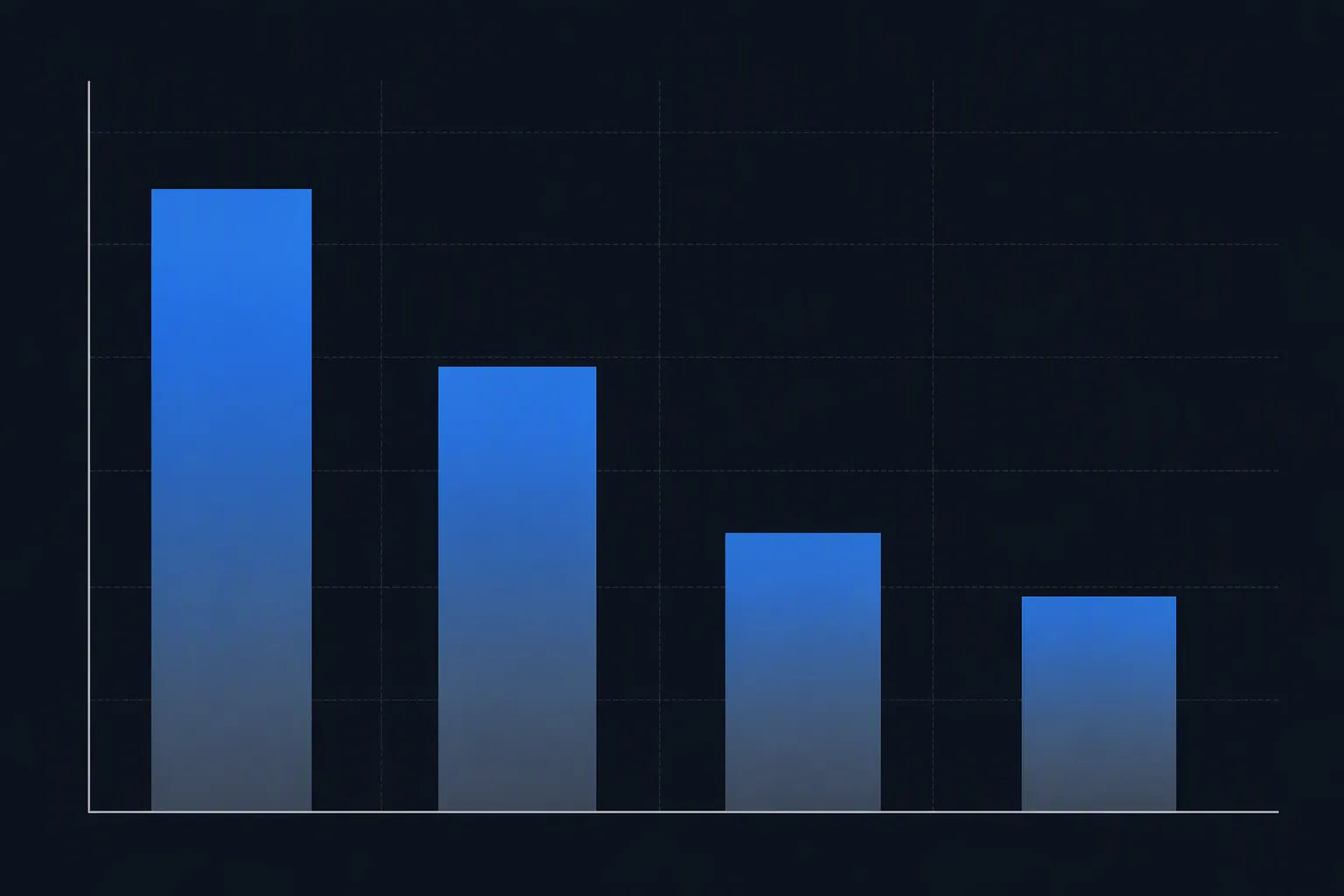
The uncomfortable part of the Microsoft earnings story is visible before getting anywhere near Copilot demos. Search and news advertising revenue excluding traffic acquisition costs moved from 21% year over year in Q1 FY26, to 16% in Q2, to 10% in Q3; for Q4 FY26, CFO Amy Hood guided to “high single digits” on the April 29 earnings call, which means roughly 8-9% if the guidance lands as expected.[1][2]
That Q4 number is not yet a reported result. Today is July 29, 2026, the date Microsoft is scheduled to report after market close, so any pre-release read on Q4 has to treat “high single digits” as guidance, not actuals. The read should be updated after the earnings release posts.
For a media buyer, that sequence matters more than the headline AI narrative. A decelerating search ad growth line does not mean Microsoft Ads is weak in every account. It does mean Microsoft’s broader AI earnings strength is not, by itself, evidence that Microsoft search auctions have gained a new level of volume, pricing power, or conversion depth.
| Fiscal 2026 period | Microsoft search and news ads ex-TAC growth | How to use it in budget planning |
|---|---|---|
| Q1 FY26 | 21% YoY | Strong start, but not enough alone to justify a second-half budget shift |
| Q2 FY26 | 16% YoY | Still healthy, already slower |
| Q3 FY26 | 10% YoY | Closer to normal channel growth than an AI-driven acceleration |
| Q4 FY26 guidance | High single digits | Guidance as of April 29, 2026; update once actual Q4 results are reported |
The Earnings Data Says Slowdown, Not Acceleration
For H2 2026, the earnings data does not support increasing Microsoft Ads base spend simply because Microsoft’s AI business is growing.
Search ad revenue growth can decelerate while individual advertisers still find profitable pockets. Brand terms can remain efficient. Certain B2B segments can still clear cheaper CPCs than Google. Shopping and audience-layered search campaigns can still perform. None of that changes what the company-level line is showing: Microsoft search advertising did not pick up a second gear during the same fiscal year that Microsoft’s AI story became louder.
The Q3 figure is especially useful because it sits close to the period when the AI narrative was already well established. Microsoft’s April 2026 results highlighted cloud and AI strength, but search and news advertising ex-TAC grew 10% year over year, not 20% or 30%.[1][3] That is respectable growth. It is not a budget reallocation mandate.
The mistake is to read “Microsoft is winning in AI” and quietly translate it into “Microsoft Ads will have more qualified search demand next quarter.” Those are different claims. One belongs to enterprise cloud revenue, AI infrastructure, and productivity software adoption. The other has to show up in impression volume, auction density, click quality, conversion rates, and marginal CPA inside ad accounts.
The AI Revenue Story Is Mostly Somewhere Else
Microsoft is a massive company with an advertising business attached to it, not an advertising company with a cloud division attached. FY26 total revenue is estimated around $329 billion, while search and news advertising revenue is about $18.7 billion, putting ads below 6% of total revenue.[4] That scale mismatch is not a footnote. It is the reason earnings headlines can be true and still weak evidence for paid-search allocation.
The comparison with Google makes the same point from the other side. Google’s ad revenue is around $204 billion, while Microsoft’s ad business at about $18.7 billion is less than 10% of Google’s ad base.[4] Microsoft can grow, gain useful share, and remain a smaller, more selective channel for most search buyers.
The $37 billion AI annual run-rate number also needs to stay in its lane. Microsoft’s AI ARR is dominated by Azure AI services and Copilot subscriptions, with the company pointing to Azure AI growth and paid Copilot seats rather than advertising as the center of the AI revenue story.[3] That is a real business result. It just does not prove that the next Microsoft Ads dollar will find more qualified demand than it did last quarter.
This distinction is where a lot of budget decks get slippery. Azure AI adoption can justify Microsoft’s valuation narrative. Copilot paid seats can justify a productivity software narrative. Neither automatically justifies lifting Microsoft Ads campaign budgets if the account’s impression share is already high, search term quality is thin, or marginal conversions trail the blended target.

Bing’s 1 Billion MAU Claim Is Not the Same as Paid Search Reach
Bing reportedly reached 1 billion monthly active users in April 2026, while StatCounter still showed Bing at roughly 5% global search share.[5] Both numbers can exist at the same time because they are not measuring the same buyer-relevant thing.
Monthly active users can include people touching Bing through surfaces that do not behave like classic commercial search inventory. Copilot interactions, enterprise usage, API-mediated experiences, and casual browser defaults can all inflate the sense of reach without telling a paid-search lead how many incremental bottom-funnel queries are actually available to bid on.
For budgeting, the useful question is narrower: when campaigns raise bids or loosen constraints, does Microsoft produce additional qualified conversions at the account’s acceptable marginal CPA or ROAS? A billion-MAU headline does not answer that. Search impression share, lost IS by budget, lost IS by rank, search term quality, conversion lag, and incrementality tests get much closer.
AI Max and Copilot Ads Belong in the Test Budget
Microsoft Advertising Activate 2026 gave buyers several products worth watching: AI Max in open pilot, Performance Max transparency upgrades, and Offer Highlights. Microsoft said AI Max delivered 8% incremental conversions and Offer Highlights produced 3x ROAS in its own reported results, but the public claims did not provide enough detail on account mix, sample size, time window, or auction conditions to treat them as planning-grade benchmarks.[6]
That does not make the products unimportant. AI Max could reduce the work required to expand query coverage. Cleaner PMax reporting could make Microsoft’s automation easier to defend. Offer Highlights could help retailers when promotions are the actual conversion lever. The issue is not whether the tools should be tested; it is whether vendor lift claims should move base budget before an account has its own evidence.
A controlled Microsoft Ads test in H2 2026 should start from constraints, not enthusiasm. Keep the existing campaigns that already clear targets. Put AI Max or Copilot-linked inventory into a separate experiment where possible. Define the conversion set before launch. Watch search terms and assisted conversions. Compare marginal performance against the dollars that would otherwise go to Google, paid social, retail media, or retention.
- Treat AI Max as query-expansion testing, not proof that Microsoft has created more commercial demand.
- Use PMax transparency upgrades to inspect placement, asset, and search behavior before increasing caps.
- Evaluate Offer Highlights only where the account has real promotional depth and clean revenue tracking.
- Keep Copilot ad tests isolated enough that weak or strong results can be read without contaminating core search performance.
What a Sensible H2 2026 Allocation Looks Like
The practical answer is not to cut Microsoft Ads because growth decelerated. If the account already has profitable Microsoft volume, keep it in the plan. If Google CPCs are painful and Microsoft returns cleaner lead quality in a specific segment, keep pushing there. The earnings data argues against a broad, preemptive base-spend shift, not against disciplined Microsoft Ads buying.
A buyer defending Q3-Q4 budget should separate three buckets.
| Budget bucket | What belongs there | Decision rule |
|---|---|---|
| Base Microsoft Ads spend | Campaigns already meeting marginal CPA or ROAS targets | Maintain or scale only where incremental volume stays qualified |
| Optimization spend | Bid, match type, feed, audience, and PMax reporting improvements | Fund when the account shows lost opportunity with acceptable efficiency |
| AI test spend | AI Max, Copilot inventory, Offer Highlights, new automation pilots | Cap separately until account-level results survive normal auction conditions |
The third bucket is where Microsoft’s AI advertising story belongs for now. It deserves budget, but it deserves test-budget governance: fixed caps, defined success metrics, and a post-test decision about whether the spend graduates into the base plan.
The post-release Q4 actuals matter. If Microsoft reports a surprise acceleration in search and news ads ex-TAC after market close, that would change the evidence. If Q4 lands near the high-single-digit guidance, the FY26 pattern remains straightforward: Microsoft’s AI revenue story accelerated while search ad revenue growth slowed.
Until account-level performance says otherwise, keep Microsoft Ads where it already earns its place, test AI Max and Copilot ad surfaces under controlled budgets, and do not move base spend just because Microsoft’s broader AI earnings look strong.
References
- Microsoft Bing Ads Revenue Up 10% In Q3 2026, SE Roundtable, https://www.seroundtable.com/microsoft-bing-ads-revenue-q226-40838.html
- Microsoft earnings preview: record AI spending and a stock near a one-year low, GeekWire, https://www.geekwire.com/2026/microsoft-earnings-preview-record-ai-spending-and-a-stock-near-a-one-year-low/
- Microsoft Cloud and AI strength fuels third quarter results, Microsoft, April 29, 2026, https://news.microsoft.com/source/2026/04/29/microsoft-cloud-and-ai-strength-fuels-third-quarter-results/
- What Google, Microsoft Earnings Say About Search, Search Engine Journal, https://www.searchenginejournal.com/what-google-microsoft-earnings-say-about-search/573499/
- Microsoft Ads Statistics 2026, Searchlab, https://searchlab.nl/en/statistics/microsoft-ads-statistics-2026
- Microsoft Advertising Activate 2026: Key takeaways from the event, Microsoft Advertising Blog, June 2026, https://about.ads.microsoft.com/en/blog/post/june-2026/microsoft-advertising-activate-2026-key-takeaways-from-the-event
Built on this evidence
No Bidding tactic or Creative record currently cites this case file. Compare it against other results in Benchmarks.
Related benchmark reading
Report a corroborating or contradicting result
Seeing something different in your own account? Feed the data-integrity loop instead of leaving an open comment.