
Does Microsoft's AI Spending Actually Improve Ad ROI?
Microsoft is spending ~$190B on AI in 2026, but how much of that benefits advertisers on the ad platform? This article separates infrastructure spend from ad-platform improvements, explains why the 8% PMax conversion lift claim is directional at best, and argues that the transparency upgrades Microsoft is shipping alongside AI products represent a more reliable near-term improvement for campaign ROI.
- Platform
- Microsoft Ads
- Campaign type
- Performance Max
- Spend range
- Various
- Timeframe
- Sep 0 - Sep 2025
- Conversion lift
- 0%
- Verdict
- mixed
- Last reviewed
- 0-07-29
Microsoft’s AI spending story is large enough to distort the ad conversation around it. The company is guiding to roughly $190 billion of 2026 capital expenditure, up 61% from 2025, while its FY26 Q3 search advertising revenue excluding traffic acquisition costs grew 12% and its AI business run rate reached $37 billion, up 123% year over year.[1] Those are not the same signal. One describes the infrastructure Microsoft is building for Azure, Copilot, data centers, and model capacity. The other describes what advertisers can actually see in the search auction.
That distinction matters for advertisers trying to connect Microsoft’s AI spending to ROI. A bigger AI buildout may eventually improve bidding models, creative assembly, matching, and measurement. It does not, by itself, prove that a Microsoft Ads campaign will hit target CPA next month, or that Performance Max should receive budget taken from a cleaner, better-understood search setup.

The useful question is narrower: which parts of Microsoft’s AI investment are visible to advertisers now? On that test, the strongest near-term evidence is not the capex number. It is the platform reporting work Microsoft announced in May 2026: website URL reporting with conversions, clicks, and spend; landing page reporting; search term insights; and auction insights still to come.[2] Those features touch the places where advertisers make decisions.
The AI Budget Is Not an Ad ROI Benchmark
The ad platform is benefiting from Microsoft’s broader AI effort, but the financial evidence does not show that advertising is the main destination of the spend. In FY26 Q3, search and news advertising revenue excluding TAC grew 12%, while the AI business run rate grew 123% year over year to $37 billion.[1] That gap is not a failure of Microsoft Ads. It simply tells advertisers not to read the AI run-rate line as a search campaign performance line.
The margin picture pushes the same way. Microsoft Cloud gross margin fell from about 72% to about 64% as AI infrastructure costs increased, a sign that the buildout is expensive before it is advertiser-visible.[1][3] If the money were flowing straight into ad-market efficiency, the advertiser-facing proof would be easier to inspect: better query matching, better placement controls, cleaner attribution, stronger incrementality evidence, or more transparent automated bidding diagnostics. Instead, much of the story sits in cloud capacity.
That does not make the investment irrelevant. Search ads run on systems that depend on compute, data pipelines, and machine learning infrastructure. Over time, a larger AI base could improve the models behind automated campaigns. But that is a product-development possibility, not a media-buying benchmark. A buyer cannot put “$190 billion of AI capex” into a pacing note and treat it as a reason why a campaign missed or beat forecast.
The timing also matters. As of July 29, 2026, Microsoft had not yet reported FY26 Q4 results, with earnings scheduled after market close, and management had guided to high-single-digit search ad growth.[4] So the latest quarter cannot be used as settled evidence that the AI investment has changed search-ad momentum. For deeper context on the search growth trend, the companion analysis, Microsoft’s AI Earnings Don’t Justify Increasing Ad Spend, is the better place to separate earnings momentum from budget decisions.
What Advertisers Can Actually Inspect
The May 2026 transparency upgrades deserve more attention than the larger AI headline because they reduce the distance between platform automation and account-level judgment. Website URL reporting shows conversions, clicks, and spend by URL. Landing page reporting gives advertisers another view of where automated campaigns send traffic. Search term insights expose more of the query behavior feeding performance. Auction insights, once available, should help buyers understand competitive movement rather than guessing from blended campaign totals.[2]
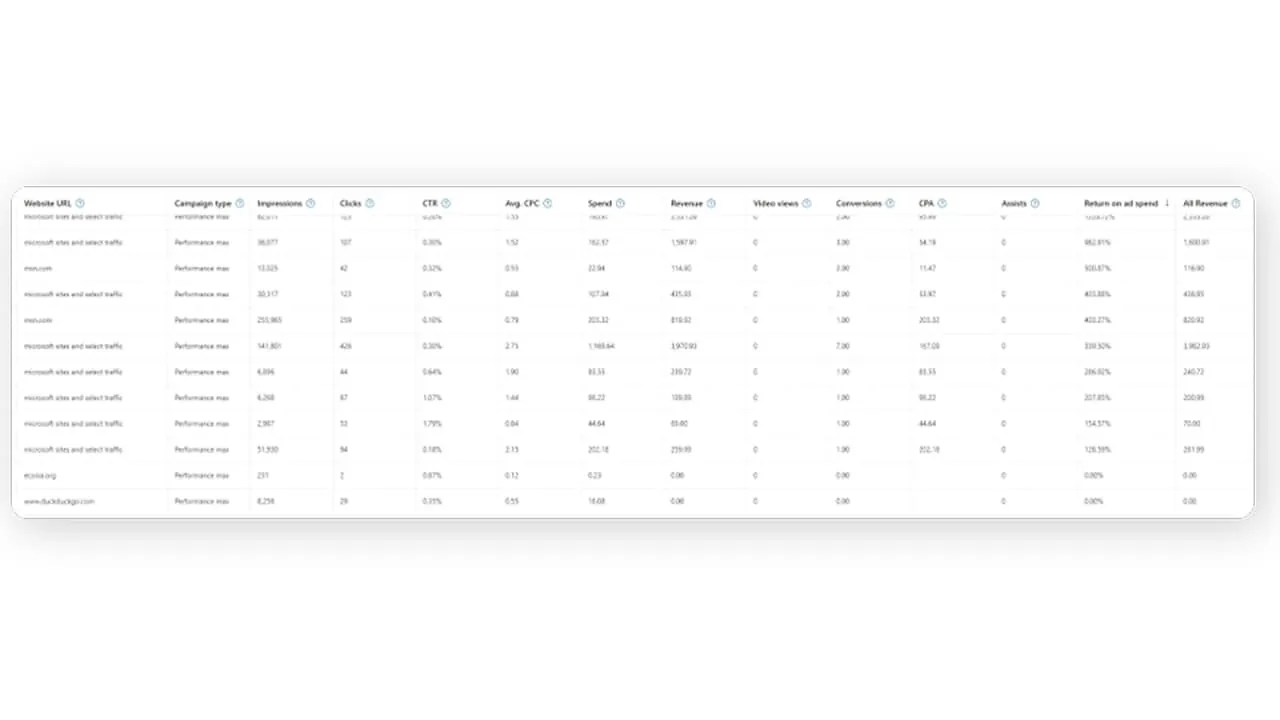
That is not glamorous, but it is where ROI work happens. If a Performance Max campaign spends across multiple URLs, URL-level reporting lets the buyer find whether budget is being pulled toward a page that converts, a page that assists, or a page that only absorbs traffic. If landing page reporting reveals that automation is repeatedly sending users into a weak path, the action is clear: fix the destination, exclude or restructure where possible, or stop treating the campaign’s aggregate CPA as a clean signal.
Search term insights are similarly practical. They do not turn an automated campaign into exact-match search, and they do not remove every blind spot. But they give the buyer a better chance to explain why performance moved. A finance team does not need a lecture on Microsoft’s model roadmap when spend rises and conversion value falls. It needs to know whether the account captured better demand, wandered into looser intent, or shifted into auctions where the advertiser has no margin.
| Advertiser-visible signal | Why it matters for ROI |
|---|---|
| Website URL reporting | Shows which URLs received spend, clicks, and conversions inside automated campaigns |
| Landing page reporting | Helps identify whether traffic is being routed to pages that can actually convert |
| Search term insights | Adds query-level context for diagnosing intent quality and wasted spend |
| Auction insights | Can help separate internal campaign issues from competitive pressure once available |
This is also where Microsoft has a chance to earn budget in accounts where Google is too expensive or too crowded. Microsoft Ads does not need to win every auction to be useful. It needs to make enough of its performance legible that an advertiser can defend the test, isolate waste, and understand whether automation is finding incremental demand or recycling low-quality volume. The product-change detail is covered more fully in How Microsoft’s AI Budget Squeeze Reshapes Advertiser Control.
The 8% PMax Lift Is Directional, Not Account-Safe
Microsoft says advertisers using Performance Max saw an 8% incremental conversion lift, based on Microsoft internal data from September 2024 through September 2025.[2] That is a useful directional claim. It is not a guarantee, and it is not the same thing as independently verified incrementality.
The limitations are ordinary but important. The data is internal. The time window includes seasonality. The result may be shaped by which accounts adopted Performance Max, how mature those accounts were, what conversion actions they optimized toward, and whether advertisers had enough budget flexibility for automation to learn. None of those caveats make the 8% figure meaningless. They make it unsuitable as a standalone reason to increase spend.
A practical reading is: Microsoft has evidence that PMax can add conversions across a broad internal dataset, and advertisers should test whether that shows up in their own accounts. The test still has to answer account-level questions. Are conversions incremental or shifted from other Microsoft campaigns? Does conversion quality hold? Does CPA volatility fit the budget owner’s tolerance? Do the new URL and search term reports explain performance well enough to keep scaling?
Agency case studies need the same handling. Results such as 1042% ROAS for Amsive, 300% ROAS for a B2B SaaS advertiser, or 562% year-over-year ecommerce growth are best-case managed examples, not platform-warranted benchmarks.[2] They can suggest what is possible under favorable conditions. They should not become the expected outcome in a media plan.
Why the Broader AI Narrative Still Creates Pressure
The market comparison with Meta is useful only if it stays in its lane. Meta’s ad revenue grew 24% in Q4 2025, helped by AI-driven targeting improvements, and its stock gained 87% over two years compared with Microsoft’s 7% over the referenced period.[5][6] That contrast suggests investors reward AI spending more clearly when it ties directly to ad performance. It does not prove Microsoft Ads is weak, and stock movement can age quickly. It does show why a generic AI investment story is not enough for advertisers who buy auctions, not narratives.
There is also trust friction around AI advertising more broadly. IAB reported that 82% of ad executives believe consumers feel positive about AI ads, while only 45% of consumers actually do, a 37-point gap that widened from 32 points in 2024.[7] That is not a Microsoft-specific performance metric. It is a reminder that the industry is prone to overestimating acceptance and underweighting the verification burden.
The financial narrative has its own concentration risk. Reporting cited 45% of Microsoft’s $627 billion remaining performance obligation as tied to OpenAI, and OpenAI lost Azure exclusivity in April 2026.[8][3][4] That matters because it shows how much of Microsoft’s AI story depends on enterprise infrastructure relationships that sit far away from an advertiser’s auction report. It is a risk to the AI narrative, not a direct Microsoft Ads KPI.
Regulatory pressure is another reason the reporting layer matters. If AI ad products face stronger separation or disclosure demands, the platforms with cleaner explanations will be easier for advertisers to defend. The transparency angle intersects with the issues covered in Which AI Ad Products Would the Sanders Bill Force Apart?, but the operational point is already visible: opaque automation creates both performance risk and explanation risk.
How to Use the Microsoft AI Signal in Budget Decisions
The defensible move is not to ignore Microsoft’s AI investment. It is to translate it into testable account questions. If the platform’s automation is improving, the evidence should surface in places advertisers can measure: stronger marginal conversions, better landing page distribution, less wasted query expansion, more stable conversion quality, or clearer auction context when performance shifts.
- Treat the $190 billion capex guidance as infrastructure context, not an ad-spend benchmark.
- Treat the 8% PMax conversion lift as a reason to test, not a forecast input.
- Use URL and landing page reporting to find where automated spend is actually going.
- Use search term insights to check whether performance changes come from better intent or broader reach.
- Increase budget only when account-level evidence holds after conversion quality, overlap, and volatility are reviewed.
Microsoft’s AI spending may matter a great deal over time. In Q3 2026, the advertiser-visible case is still narrower. The capex story does not justify raising spend on its own, and the 8% PMax claim is too broad to carry a budget shift by itself. The better reason to keep testing Microsoft Ads is whether the new transparency features expose enough actionable signal to improve account-level ROI.
References
- Microsoft FY26 Q3 earnings press release, Microsoft, 2026.
- Microsoft Advertising transparency post, Microsoft Advertising, May 2026.
- Microsoft cloud margin coverage, CNBC.
- Microsoft stock near one-year low despite earnings beats, GeekWire, July 27, 2026.
- Meta Q4 2025 ad revenue coverage, Reuters, January 29, 2026.
- Meta and Microsoft stock comparison coverage, Fortune, April 29, 2026.
- The AI Ad Gap Widens, IAB.
- Microsoft RPO and OpenAI concentration risk coverage, Reuters.
Built on this evidence
No Bidding tactic or Creative record currently cites this case file. Compare it against other results in Benchmarks.
Related benchmark reading
Report a corroborating or contradicting result
Seeing something different in your own account? Feed the data-integrity loop instead of leaving an open comment.