
How Microsoft's Scout Controversy Exposes the Gap in Platform Ad Claims
This article uses the Microsoft Scout AI assistant controversy to show media buyers how a three-layer contradiction between internal documents, public denial, and PR messaging reveals the trust gap in platform vendor claims — and provides a reusable audit framework for verifying ad platform communications.
- Platform
- Microsoft Advertising
- Campaign type
- Always-On Agent
- Spend range
- 0
- Timeframe
- June 2026
- Credibility
- Gap
- Verdict
- mixed
- Industry vertical
- Technology
- Last reviewed
- 2026-07-27
For media buyers, the useful version of the Satya Nadella Scout AI addiction controversy is not a broad argument about whether AI assistants are good or bad. It is a dated verification problem: an internal strategy document reportedly used dependency language, the CEO publicly rejected that framing two days later, and Microsoft then offered a cleaner product-purpose explanation. The ad implications start there, in the gap between the language used to plan a product and the language used to sell trust around it.
Before turning this into an ethics fable or a platform-bashing exercise, the evidence trail matters.
| Layer | What was reported or published | Why it matters to buyers |
|---|---|---|
| June 2 internal document report | 404 Media reported an internal Scout strategy document attributed to Omar Shahine, CVP of Scout, describing a three-phase plan from “addictive app to agentic platform,” with Phase 1 labeled “Make people addicted.” The report also said the document was “co-created turn-by-turn with AI” and that a human “verified every sentence.” [1] | This is the layer closest to operating intent, but the full document is paywalled, so most readers are working through quoted excerpts and corroborating secondary coverage. |
| June 4 CEO denial | 404 Media’s follow-up reported Satya Nadella saying, “I’m not sure what document this is… I’m looking for the guy who did this,” while noting that Shahine had publicly announced Scout on Microsoft’s own official blog. [2] | The denial does not just dispute wording; it raises an authorship and accountability question. |
| June 4 PR reframe | Microsoft’s spokesperson framed Scout as a product for helping people accomplish tasks more effectively, not for encouraging dependency. [2] | This is the layer most familiar to advertisers: a risk-sensitive external message that narrows the claim. |
| Official product positioning | Microsoft’s June 2 Scout announcement described the product as an “always-on personal agent.” [3] | That official framing is less inflammatory than “addicted,” but still points to a product designed for ongoing user presence and assistance. |
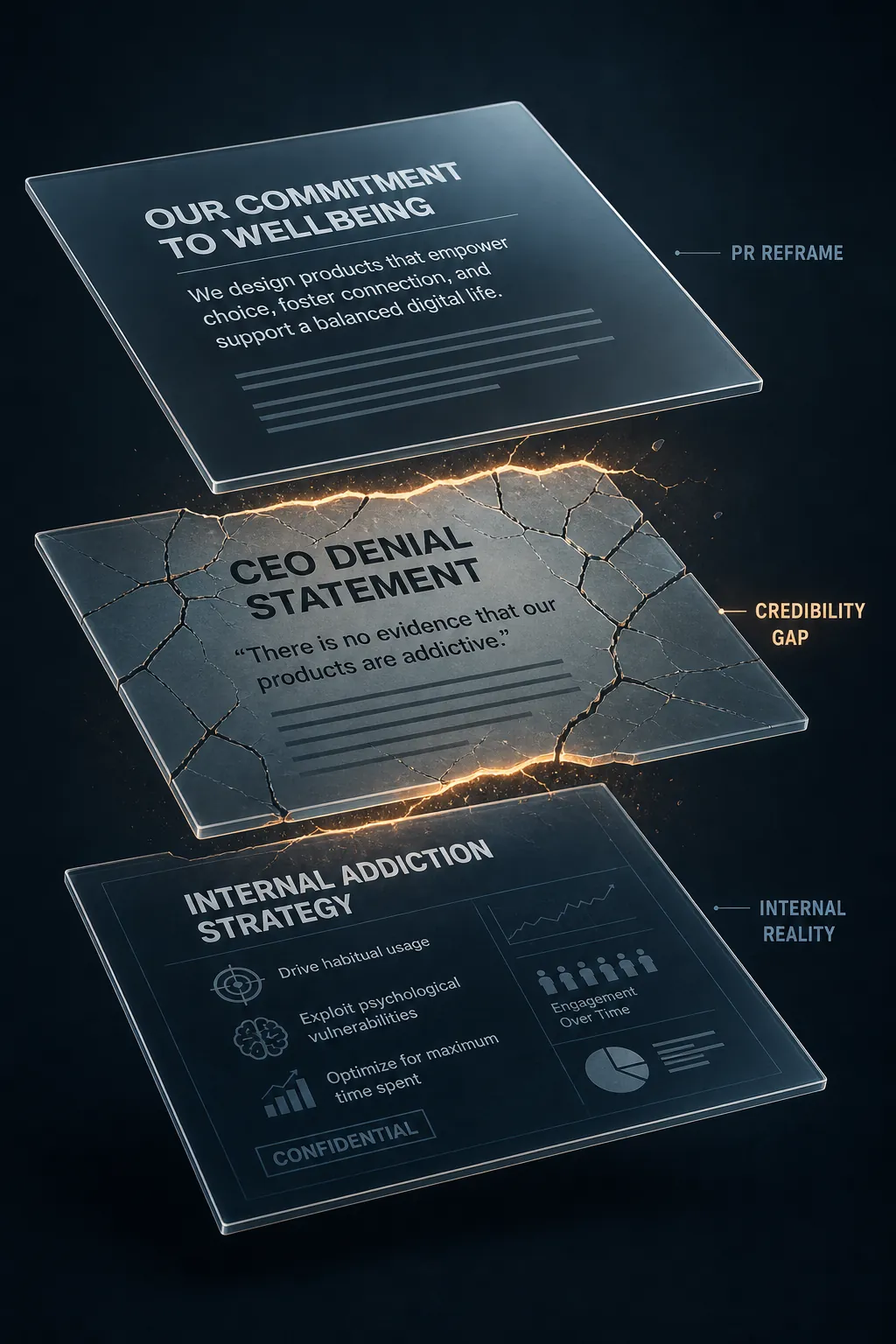
The contradiction is in the job each layer performs
The internal language reported by 404 Media is allocation-relevant because it describes an objective, not a feature. “Make people addicted” is not the same kind of sentence as “help people accomplish tasks.” One is a behavioral target. The other is a user-benefit frame. A buyer does not need to assume the internal wording represents the entire product strategy to see that the two sentences would lead to different risk assessments.
The authorship detail is not a side issue. 404 Media reported the internal document as associated with Omar Shahine, CVP of Scout, and then pointed out in the follow-up that Shahine was the person named on Microsoft’s official Scout announcement. That creates a harder problem than a stray junior-deck slide. If the reported author was also the public product sponsor, then the distance between “internal planning artifact” and “official product voice” is shorter than a normal PR cleanup would imply. [1][2][3]
Nadella’s response matters because it appears to separate executive leadership from the document’s wording. The line reported by 404 Media — “I’m not sure what document this is… I’m looking for the guy who did this” — reads less like a technical clarification than a disavowal of provenance. The problem for a buyer is not whether the quote creates a CEO “gotcha.” The problem is that the chain of responsibility becomes ambiguous at the exact point where buyers need to know whose language should be trusted. [2]
The spokesperson’s reframe performs a different function. It makes Scout legible as a productivity product: accomplish tasks more effectively, not encourage dependency. That may be a fairer description of what Microsoft wants the market to hear. It may also be a narrower description of what the product is intended to become. Public messaging often compresses internal trade-offs into the safest version of the story. The key is not to treat either layer as automatically pure. It is to ask which layer is carrying which incentive.
The AI co-author detail makes accountability messier, not lighter
The reported note that the document was “co-created turn-by-turn with AI” and that a human “verified every sentence” deserves a contained amount of attention. It should not become a philosophical detour about whether AI can author strategy. In a commercial audit, the practical question is simpler: if an AI-generated, human-verified strategy document says the quiet part plainly, who owns the sentence when the company later rejects the framing? [1]
The human verification line cuts against the easiest escape hatch. If the reported document itself said a human verified every sentence, then the uncomfortable wording cannot be treated merely as model hallucination without more evidence. It may still be an internal draft. It may still be poorly worded. It may not represent the final product direction. But “AI helped write it” does not erase the accountability question when the same document is described as human-verified.
That distinction matters for ad platform claims because AI systems are now used to generate recommendations, summarize performance, draft strategy, and automate budget movement. If vendors can distance themselves from AI-assisted internal language after the fact, buyers need a stronger standard for deciding when a product claim is actually endorsed, reviewed, and accountable.
Why this becomes an advertising issue before Scout has a public ad model
There is no public evidence in the available materials that Microsoft has announced a specific Scout advertising or monetization model. That boundary should stay intact. The more useful advertising implication is not “Scout will definitely sell ads this way.” It is that an always-on agent, if successful, becomes a new layer between users, tasks, recommendations, commerce, and measurement. Microsoft’s own product language points to an “always-on personal agent,” which is already enough to make media buyers ask how influence and attribution might work if the agent becomes a habitual interface. [3]
MediaPost made the bridge explicit in its June 8 analysis, arguing that “addiction or something similar could become the next ad metric” in an AI-agent commerce environment. That is an interpretation, not a confirmed Microsoft Advertising roadmap. It is still worth reading because it names the commercial direction that buyers should test for: if engagement depth, return frequency, task completion, or agent reliance becomes monetizable, the line between product success metric and ad metric can blur quickly. [4]
The risk is not only that a future agent product might create more ad inventory. It is that the platform could define the quality of that inventory through measures the buyer cannot independently observe. If the platform controls the assistant, the user path, the recommendation surface, the conversion reporting, and the performance narrative, then “lift” becomes a claim that needs external pressure before it becomes a basis for budget.
That is where the Scout controversy touches Microsoft Advertising’s broader market language. At Activate 2026, Microsoft Advertising positioned its platform around themes that included transparency and control. Those are the right words. The Scout document sequence is a reminder that the buyer’s job is to verify whether the product organization, executive messaging, and advertising organization use compatible definitions of those words when incentives get tighter. [5]
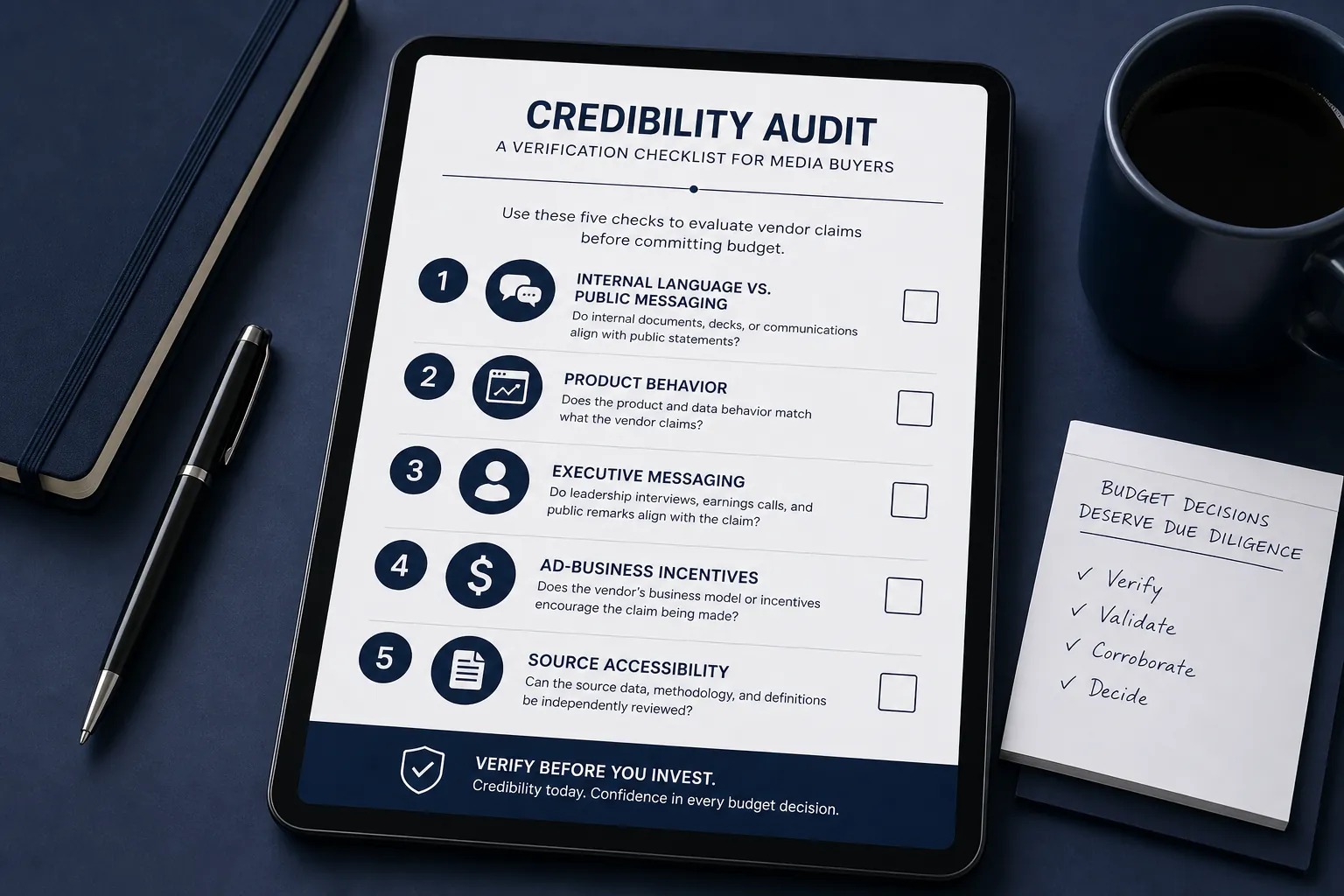
A buyer-side audit for platform credibility
The practical response is not to blacklist a vendor because one internal document used ugly language. It is to stop treating polished product claims as the highest-authority source. A media buyer can use the Scout sequence as a repeatable audit pattern whenever a platform launches an AI product, automation layer, default setting, or measurement framework.
| Audit checkpoint | What to ask before budget moves | What would raise the risk level |
|---|---|---|
| Internal language vs. public messaging | Does any internal, partner, or developer-facing language define success differently from the public product page? | The internal version optimizes for dependency, lock-in, time spent, default adoption, or budget capture while the public version emphasizes user benefit. |
| Product behavior | What behavior does the product actually increase or reduce once it is live? | The platform claims control, but defaults, prompts, or automation flows make opt-out, comparison, or independent measurement harder. |
| Executive accountability | Who is willing to own the claim when the wording becomes controversial? | A senior executive rejects the language while the named product sponsor, public announcement, or internal plan points back to the same team. |
| Ad-business incentive | If the product succeeds, where does the commercial upside appear? | The product increases surfaces, session depth, recommendation influence, or attribution dependence without explaining how advertisers can audit those effects. |
| Measurement independence | Can the buyer verify lift, incrementality, and conversion quality outside the platform’s own reporting? | The only proof of performance is vendor-reported lift, modeled attribution, or black-box optimization output. |
| Source accessibility | Can the underlying evidence be read directly, or is the buyer relying on excerpts from paywalled reports and secondary coverage? | The most important claim is real enough to affect risk but not accessible enough to settle every detail. |
The last checkpoint is uncomfortable but necessary here. The 404 Media document report is paywalled beyond the public headline and article excerpts, and The Information’s report on Nadella’s internal rebuke is also paywalled. The Information reported that Nadella rebuked the plan in a message to roughly 50 engineers, but most non-subscribers are again operating through paywalled access and secondary summaries. [1][6]
That does not make the controversy unusable. Multiple outlets cited the same core phrases from the 404 Media report, and Microsoft’s own Scout blog independently establishes Shahine’s public role in announcing the product. It does mean a careful buyer should separate three confidence levels: directly accessible Microsoft material, paywalled primary reporting, and secondary interpretation built on top of that reporting. The strongest claim is the existence of a credibility gap across those layers. The weaker claim would be any prediction about a specific Scout ad product.
How to use this before the next platform deck
In a vendor meeting, the Scout case should translate into sourceable questions, not speeches. If an AI product is described as helping users complete tasks, ask what internal success metrics define a successful user. If a platform says the buyer remains in control, ask which defaults changed, which controls are available at launch, and which are promised later. If an executive publicly distances the company from a phrase, ask who approved the product plan and whether the plan’s operating metrics changed after the controversy.
For measurement claims, the question is even plainer: what can be verified outside the platform’s own system? A buyer should not have to accept a full chain of platform-controlled inputs — audience selection, bidding, optimization, attribution, and reporting — and then call the output independent evidence. The same discipline applies beyond Microsoft; the Tracker piece “Neuromancer's Book vs Series Differences Are a Marketing Warning” extends that point into the broader problem of independent verification of platform-reported data.
The Scout sequence does not prove that Microsoft will monetize dependency, or that every AI assistant claim hides an addiction metric. It proves something narrower and more useful: when internal planning language, CEO denial, and PR reframing do not align, the buyer should treat future claims about lift, transparency, and control as claims to verify rather than assurances to trust.
References
- Microsoft Wants to Make People Addicted to Scout, Its New AI Assistant, Internal Documents Reveal, 404 Media, June 2, 2026
- Satya Nadella Not Sure Who Said Microsoft Wanted to Make Addictive AI, Is Looking for Guy Who Did This, 404 Media, June 4, 2026
- Introducing Microsoft Scout, your always-on personal agent, Microsoft 365 Blog, June 2, 2026
- Addiction Could Become Microsoft's Hidden Ad Metric, MediaPost, June 8, 2026
- Microsoft Advertising Activate 2026: Key takeaways from the event, Microsoft Advertising, May 19, 2026
- Exclusive: Nadella Rebukes Microsoft Executive’s Plan to Make Users Addicted to AI Agents, The Information
Built on this evidence
No Bidding tactic or Creative record currently cites this case file. Compare it against other results in Benchmarks.
Related benchmark reading
Report a corroborating or contradicting result
Seeing something different in your own account? Feed the data-integrity loop instead of leaving an open comment.