
How Waymo's Transparency Premium Applies to AI Ad Platforms
The Waymo-Uber valuation gap shows that markets reward transparency in AI operations — and the same dynamic is emerging in AI ad platforms. This article explains how that 'verification premium' can guide which platforms to trust with your ad budget.
- Platform
- Google Ads
- Campaign type
- Performance Max
- Spend range
- Variable
- Timeframe
- 2026
- ROAS
- 0
- Verdict
- mixed
- Last reviewed
- 2026-07-25
The market reaction to the Waymo-Uber split looked strange only if the question was whether AI is profitable today. Uber was the company with scale, operating income, a membership engine, and a buyback. Waymo was the expensive autonomous-driving business still sitting inside Alphabet's loss-making Other Bets segment. Yet when Waymo ended its Phoenix pilot with Uber on June 29, 2026, UBER fell 4%, a move described as roughly a $6 billion market-cap swing, while Alphabet remained comparatively stable around $320 despite ongoing Waymo losses.[1]
That is the useful part of the Waymo-Uber AI stock impact story for media buyers. It is not a stock tip. It is a live example of how investors appear to price AI systems when one side publishes operating evidence and the other side carries more uncertainty about how the same technology will affect its economics.

The gap is hard to ignore. Waymo's February 2026 private funding round implied a $126 billion valuation, about 700 times trailing revenue of roughly $180 million, according to TSG Invest's analysis. Uber, by contrast, was valued around $140 billion in the public market at about 11 times forward earnings, while Alphabet traded near a $1.9 trillion valuation at about 16 times earnings.[2]
Private valuations and public multiples are not the same instrument. Waymo is not a directly investable public stock, and secondary pricing could differ materially from a funding-round mark. Still, the comparison is useful because it shows what kind of AI story gets a premium: not a clean income statement, but a checkable operating record.
Why Waymo Gets the Benefit of the Doubt
Waymo's advantage is not that it has solved the financial problem. Alphabet's Other Bets segment lost $1.23 billion in Q1 2025, and Alphabet's cumulative investment in Waymo has been estimated at roughly $30 billion. Waymo also raised $16 billion in its February 2026 round, which underlines how much capital the model still needs before the economics are proven at broad scale.[3][4]
The reason the valuation still holds attention is that Waymo has been unusually specific about what the system is doing. The company reported more than 500,000 weekly paid rides in Q1 2026, up from 10,000 weekly rides in May 2023. It reported 14 million trips in 2025, more than 220 million fully autonomous miles, and a fleet of 2,500 vehicles scaling toward more than 3,500.[4]
It has also published a safety claim that its driverless service had 94% fewer serious-injury crashes across more than 220 million autonomous miles than human drivers on comparable roads.[5]
That safety claim needs a guardrail. Waymo's safety data is self-reported through Waymo's own safety materials, not an independent audit of every underlying incident. The useful point is not that every number should be accepted as final truth. The useful point is that the claims have names, dates, operating units, and denominators. A buyer can ask whether weekly rides are still growing, whether autonomous miles are accumulating without a safety deterioration, whether fleet additions translate into service density, and whether the accident comparison is built on a reasonable baseline.
That is a better evidentiary surface than a slide saying an AI model is improving mobility outcomes. It gives skeptics something to attack and supporters something to update.
Uber Is Not the Weak Side of the Story
The lazy version of this story is that Waymo represents the future and Uber represents the past. That is not what the numbers say. Uber reported $1.9 billion in Q1 2026 operating income, up 42% year over year. It also had more than 50 million Uber One members, with those members accounting for more than 50% of gross bookings, and it authorized a $3 billion buyback program.[6][7]
Those are not cosmetic facts. A profitable marketplace with a large membership base can absorb pressure, negotiate partnerships, subsidize transitions, and keep users inside its app even as vehicle supply changes. Uber's public-market multiple may look ordinary beside Waymo's private valuation, but ordinary is not the same as broken.
The issue is that autonomous exposure is harder to parse from the outside. If robotaxis lower driver costs, Uber could benefit as a demand aggregator, routing layer, or fleet partner. If robotaxis shift consumer attention toward vertically integrated operators, Uber could lose some of the control that makes the marketplace valuable. Both can be true in different cities, at different stages of deployment, with different commercial terms.
That ambiguity is what creates the black-box discount. Investors are not necessarily saying Uber cannot win. They are saying the risk is harder to isolate.
The Forecasts Help, but They Do Not Settle the Budget Question
Goldman Sachs Research projected in July 2025 that robotaxis could reach 8% of U.S. rideshare by 2030, representing $7 billion in autonomous-vehicle revenue and a 90% compound annual growth rate.[8]
That projection is useful context, not a verdict. It has timing risk, regulatory risk, local deployment risk, and the normal problem of any forecast that compresses many city-by-city outcomes into one national curve. Earnest Analytics credit-card data suggesting Waymo share gains against Uber is also directional rather than definitive, because a transaction sample does not necessarily represent the whole mobility market.
The more durable lesson is not whether robotaxis are 8% of rideshare by a specific year. It is that visible operating progress changes the burden of proof. Waymo can point to rides, miles, fleet counts, cities, and safety records. Uber can point to earnings, members, bookings, and capital returns. The market has to decide which uncertainty it is willing to underwrite.

The Same Discount Shows Up in AI Ad Platforms
Media buyers see the same pattern every time an AI ad product asks for more budget and less manual control. The platform may be genuinely better than the process it replaces. It may also hide the exact change that caused the lift, blend strong accounts with weak accounts, and publish an average result that no single advertiser can reproduce.
This is where the Waymo comparison becomes practical. Waymo does not eliminate uncertainty by publishing weekly rides or autonomous miles. It makes uncertainty reviewable. An ad platform does the same when it gives buyers a record that can be checked against a real account, a real spend band, a real time window, and a real metric definition.
A benchmark saying "advertisers saw 27% average improvement" may be true and still be weak evidence for a budget decision. The missing information matters: which advertisers, which verticals, what starting performance, what spend level, what attribution window, what exclusions, what campaign objective, and what happened after the model or default settings changed.
A named-account benchmark does not become sacred because it has a logo attached. A single case can be cherry-picked. But it gives a buyer a firmer place to start diligence. The account can be compared with similar budgets. The timeframe can be checked against product releases. The metric can be reconciled with the buyer's own measurement stack. The claim can be revisited after the platform changes bidding, targeting, creative generation, or reporting rules.
That is why a verification scorecard matters more as AI capex flows into ad products. The same pressure that funds model infrastructure also pushes platforms to automate more campaign decisions by default. A related tracker, How AI Capex Drives Digital Ad Spend — and What You Can Verify, follows that funding-to-product chain and separates independently confirmed claims from weaker platform assertions.
What Deserves a Higher Trust Multiple
A platform should earn more room in the budget when its evidence lets the operator answer basic questions without reverse-engineering a blended success story. The following fields are not paperwork. They are the difference between a claim that can be managed and a claim that has to be believed.
| Evidence Field | Why It Matters |
|---|---|
| Platform or product name | Shows exactly which AI system, placement, or campaign type produced the result. |
| Named account or clearly described cohort | Separates a real operating example from an anonymous average. |
| Spend range | Prevents a small-budget test from being treated like proof at enterprise scale. |
| Timeframe | Allows the result to be matched against seasonality, product releases, and platform policy changes. |
| Metric definition | Clarifies whether the claim measures revenue, ROAS, CPA, incrementality, conversion volume, or another outcome. |
| Verdict and limitation | States whether the test beat the control, where it failed, and what should not be generalized. |
| Last-reviewed date | Makes the benchmark stale or current instead of timeless by implication. |
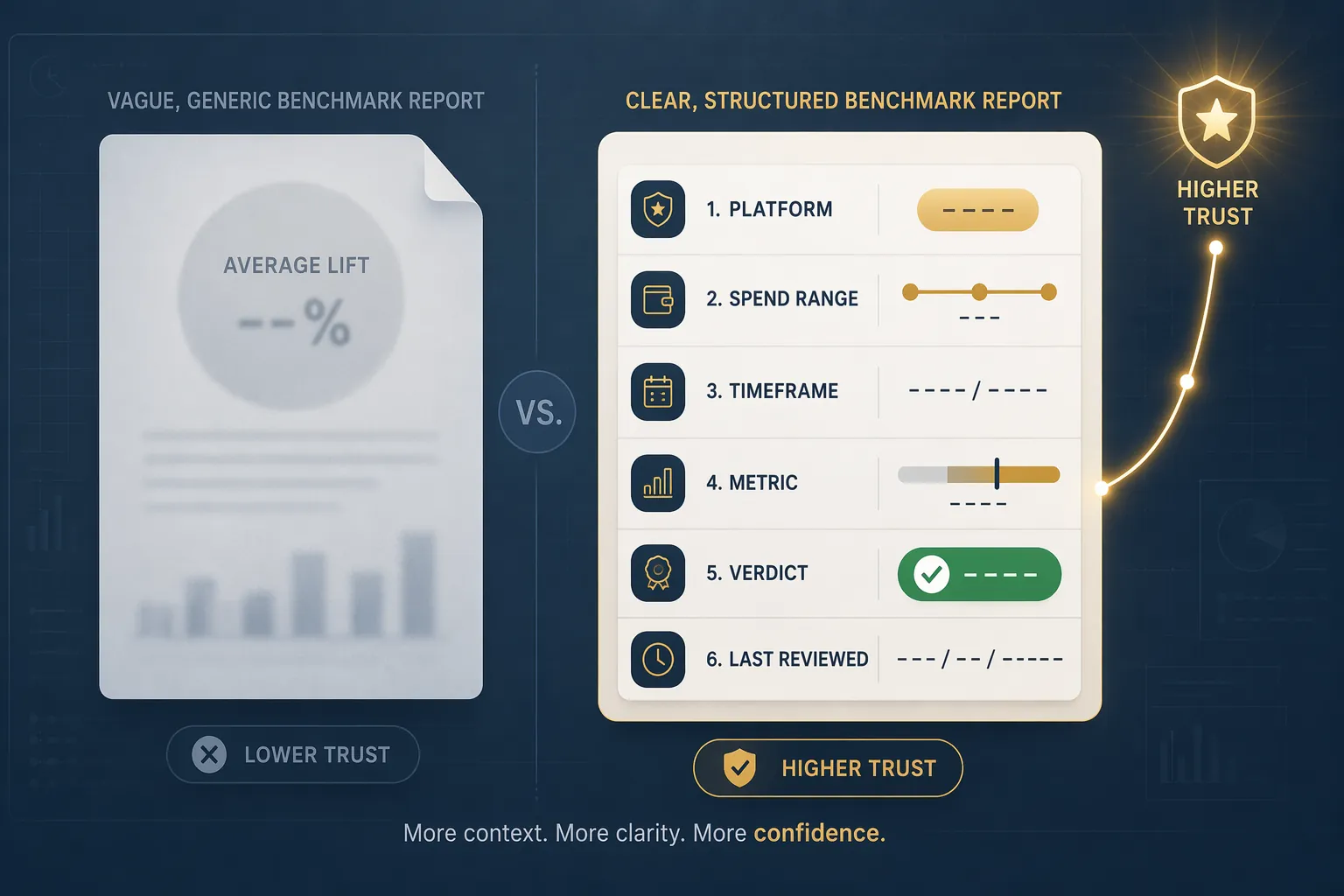
This standard does not require perfect transparency. Most AI ad platforms will not expose every model feature, auction interaction, or training update. Even Waymo's published operating record has limits: its valuation is private, its safety claims are company-reported, and its losses remain material. The right standard is not full auditability before any spend moves. It is enough named, dated, operational evidence to decide what risk the budget is taking.
That changes how platform claims should be weighted. A vendor disclosure with named customers, spend ranges, dates, metrics, and an explicit limitation deserves more attention than a polished aggregate lift claim. An independently measured result deserves more attention than either. A case that can be refreshed after a product default changes deserves more attention than a benchmark that lives forever in a sales deck.
How to Apply the Verification Premium in Budget Allocation
The practical move is to score evidence before scoring enthusiasm. When an AI campaign product asks for incremental budget, put its proof into three buckets.
- High-weight evidence: named account, dated test window, spend range, metric definition, comparison method, current status, and stated limitation.
- Medium-weight evidence: credible cohort result with clear vertical, budget range, timeframe, and metric, but no named advertiser.
- Low-weight evidence: aggregated average lift, broad adoption stat, or platform-wide claim with no account-level context.
Adoption should not be confused with effectiveness. If many advertisers enable an AI feature, that may show distribution power, default settings, or lack of alternatives. It does not show incrementality. Attitude should not be confused with behavior either. A survey saying marketers expect more automation is not the same as audited spend shifting into profitable AI campaigns.
Correlation also needs to stay in its lane. If performance improved after an AI bidding product launched, the platform still needs to account for budget changes, creative refreshes, audience mix, seasonality, promotional intensity, and attribution-window changes. A useful benchmark does not make all of those problems disappear. It names enough of them that the buyer can decide whether the result travels.
That discipline matters most when defaults change. If a platform quietly expands targeting, shifts match types, bundles inventory, or changes reporting, yesterday's benchmark may no longer describe today's product. A last-reviewed date is not a clerical detail. It tells the person approving spend whether the evidence belongs to the current system or to an older version that marketing still prefers to quote.
Waymo's valuation premium does not prove that every transparent AI company will win. Uber's profitability does not prove that exposure to a disruptive AI system is harmless. The signal is narrower and more useful: when an AI system asks the market for trust, checkable operating evidence reduces the discount. Media buyers should apply the same rule before handing over budget.
References
- Reuters coverage of Uber, Waymo and Alphabet market reaction, Reuters.
- Waymo Valuation Analysis, TSG Invest, February 2026.
- Alphabet Announces First Quarter 2025 Results, Alphabet Investor Relations, 2025.
- Waymo blog updates on rides, trips, autonomous miles and fleet scaling, Waymo.
- Waymo Safety Report, Waymo.
- Uber Announces Results for First Quarter 2026, Uber Investor Relations, 2026.
- Uber One membership and buyback coverage, TechCrunch.
- Robotaxis: The next frontier for autonomous vehicles, Goldman Sachs Research, July 2025.
Built on this evidence
No Bidding tactic or Creative record currently cites this case file. Compare it against other results in Benchmarks.
Related benchmark reading
Report a corroborating or contradicting result
Seeing something different in your own account? Feed the data-integrity loop instead of leaving an open comment.