
What Microsoft's AI model swap means for advertisers
Microsoft's quiet shift from OpenAI to in-house MAI models in its advertising tools has been widely covered, but the practical effect on daily campaign operations is narrower than the headlines suggest. This article separates which features are affected, which remain unchanged, and what advertisers should monitor.
- Platform
- Microsoft Advertising
- Campaign type
- Multiple (Performance Max0 AI Max for Search)
- Spend range
- No campaign spend data
- Timeframe
- July 0
- Creative quality assessment
- No quantified result
- Verdict
- mixed
- Last reviewed
- 0-07-27
Bloomberg’s July 7 report made the model swap sound like a broad Microsoft break from OpenAI and Anthropic: tens of thousands of AI prompts per week in Excel and Outlook were being routed to Microsoft’s own MAI models instead of outside frontier models.[1] For advertisers, the practical question is narrower: which Microsoft Advertising surfaces are actually exposed, and which ones should not be pulled into the panic without evidence?
The short answer as of July 27, 2026: Bing Image Creator is the clearest affected area. Copilot-generated ad copy and creative assistance deserve closer review because model attribution is opaque. Core bidding, query matching, and audience targeting should be treated as separate machine-learning infrastructure unless Microsoft discloses otherwise or advertiser-side tests show a measurable change.
| Microsoft surface | What is publicly supported | Advertiser stance |
|---|---|---|
| Bing Image Creator | VentureBeat reported that Bing Image Creator now runs end-to-end on MAI-Image-2.5.[2] | Review image fidelity, product-like visuals, text rendering, diagrams, and brand-control fit before using outputs in campaigns. |
| Copilot inside Microsoft Advertising | Microsoft has announced Copilot-powered advertising features, but has not publicly mapped each ad-platform Copilot function to GPT, Claude, or MAI models.[3] | Monitor generated copy quality and diagnosis output. Do not assume a performance decline without your own before/after evidence. |
| AI Max, Performance Max, and asset generation | Microsoft has announced AI-generated creative and brand controls, but model attribution for these ad tools remains undisclosed.[3] | Keep normal asset-review discipline. Treat generated text and images as approval-risk surfaces, not as proven bidding-risk signals. |
| Bidding, query matching, audience targeting | The cited MAI routing reports do not say Microsoft Advertising’s core auction, matching, or audience systems changed. | Do not treat the MAI swap as evidence that bidding or targeting degraded. Watch normal performance diagnostics. |
| Excel and Outlook prompt routing | Bloomberg’s original report concerned Microsoft 365 prompt routing, including Excel and Outlook, not Microsoft Advertising auctions.[1] | Useful context for Microsoft’s AI strategy; weak evidence for immediate ad-account action. |
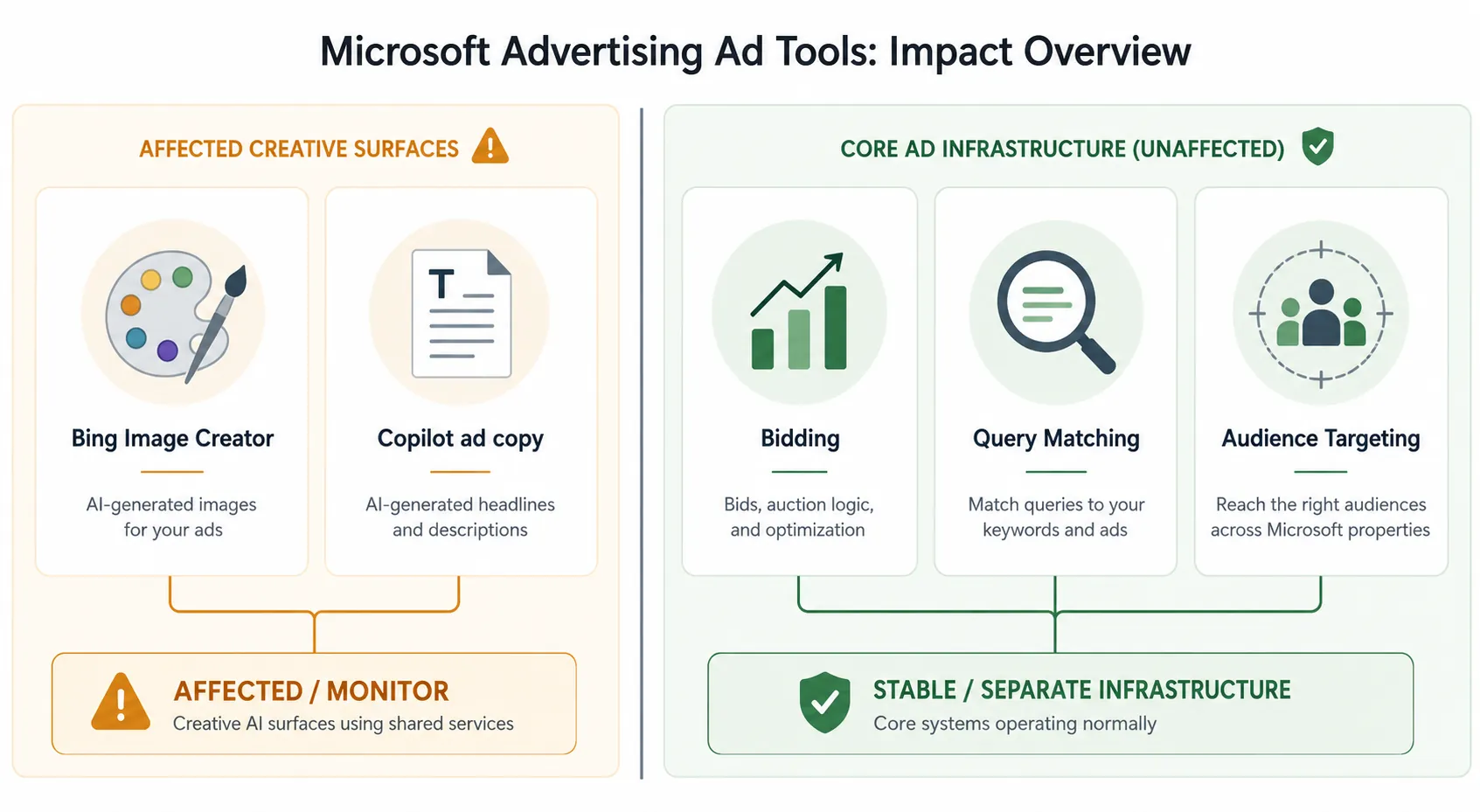
The headline is real; the ad-platform read-through is smaller
The Bloomberg story matters because it confirms a real routing change: Microsoft is no longer treating OpenAI and Anthropic as the automatic destination for every high-volume AI prompt inside its own products. But Excel and Outlook prompt routing does not automatically describe Microsoft Advertising bidding logic, query expansion, shopping feed matching, audience modeling, or auction-time decisioning.
Those systems already rely on structured, product-specific machine learning. There is no evidence that a search auction becomes worse because a summarization prompt in another Microsoft product moved from one language model to another. That does not make the MAI shift irrelevant. It just puts the risk in the places where frontier-model quality actually touches the advertiser’s workbench: image generation, copy generation, creative recommendations, and Copilot-style explanation layers.
This distinction is also why the OpenAI-versus-Microsoft corporate framing can be distracting. A media buyer does not need to decide whether Microsoft’s AI strategy is elegant. The account-level question is whether a generated asset gets worse, whether a Copilot suggestion becomes less useful, or whether a client sees weaker creative and asks why the campaign manager approved it.
Bing Image Creator is the cleanest advertiser-impact case
The most concrete production detail came after the first wave of headlines. On July 23, VentureBeat reported that Microsoft’s MAI-Image-2.5 now powers Bing Image Creator end-to-end.[2] That is not a vague “Microsoft may use its own AI somewhere” claim. It names a creative tool advertisers may actually use when building or testing campaign visuals.
Image generation is a different risk category from bidding. Bad bidding usually shows up in spend, conversion rate, search-term quality, impression mix, or CPA movement. Bad image generation shows up before the campaign even spends: awkward product shapes, distorted packaging, unreadable embedded text, broken diagrams, off-brand compositions, or visuals that create a legal or client-approval problem.
PCMag’s June testing is the reason this deserves more than a shrug. Its review found MAI-Image-2.5 “still not quite as good as Gemini’s Nano Banana Pro,” with noticeably worse text rendering in comics and diagrams.[4] That is not the same as a controlled Microsoft Advertising creative-performance test. PCMag’s testing was consumer-facing, and Microsoft told PCMag that these models were built for enterprise tasks rather than general-purpose consumer use.[4] Still, the failure mode is the kind advertisers cannot ignore. Text inside images, diagrams, labels, comparison cards, stylized product callouts, and instructional visuals are exactly where creative review gets tedious.
For simple background imagery, mood-board exploration, or early concepting, MAI-Image-2.5 may be perfectly usable. The trouble starts when the image has to carry information. A generated lifestyle backdrop can be slightly soft and still pass. A fake product label, a misspelled feature callout, or a malformed chart cannot be waved through because the model was cheaper to run.
The practical review lens is therefore specific. Check whether the image can survive the same approvals as a designer-produced asset. If the asset includes text, inspect every character. If it resembles a real product, check shape, scale, packaging, disclaimers, and any implied claims. If it is a diagram, verify whether the visual logic is actually readable rather than merely polished. If brand controls are applied, confirm that the output follows them instead of approximating the brand’s color palette while missing the harder constraints.
Copilot is the gray zone
Copilot deserves almost as much attention as Bing Image Creator, but with less certainty. Microsoft Advertising’s 2026 announcements include AI Max for Search in open pilot, Copilot-Powered Root Cause Analysis, and AI-Generated Creative with Brand Controls.[3] Those are the kinds of features where language-model quality can change the day-to-day experience: headline suggestions, description variants, diagnostic explanations, asset recommendations, and campaign troubleshooting.
What Microsoft has not done publicly is attach a model label to each advertising function. A Copilot answer inside the ads interface may not use the same model as an image tool. A root-cause explanation may not use the same model as a headline generator. A creative personalization system may combine retrieval, rules, templates, ranking models, and generative models in ways that are not visible to the buyer.
That opacity matters because generated ad copy is more exposed to frontier-model differences than auction infrastructure is. A model that is slightly weaker at nuance may still summarize a spreadsheet acceptably, but produce flatter headlines, miss a compliance constraint, overuse generic benefit language, or misunderstand the selling point in a landing page. The campaign might not fail because of one bad suggestion. The operator loses time because every suggestion needs more rewriting.
The right response is not to turn off every Copilot-assisted workflow on suspicion. It is to stop treating the copy as neutral platform output. If Copilot suggests headlines, compare them against prior accepted assets. If it explains a performance movement, verify the underlying metrics instead of accepting the narrative. If it proposes root causes, check whether it distinguishes budget limits, search-term drift, asset disapprovals, tracking changes, and auction competition rather than blending them into one confident paragraph.
There is also a missing-data point that should be called out directly: as of July 27, 2026, there are no public, independent advertiser-side before/after tests showing that Microsoft Advertising campaign performance improved or declined because of the MAI routing shift. No controlled media-buyer study has tied the model swap to CPA, ROAS, CTR, conversion volume, or search-term quality changes in live accounts. That absence does not prove safety. It means performance claims, either positive or negative, are ahead of the evidence.
The cost savings are Microsoft’s, not automatically the advertiser’s
The strongest business reason for the swap is cost and control. VentureBeat reported Microsoft’s internal claim that MAI-Image-2.5 cut GPU costs by 84% versus GPT-Image-2 in PowerPoint, and that MAI-Voice-2 produced an 89% GPU cost reduction and 50% error-rate reduction in Microsoft’s own evaluations.[2] VentureBeat also flagged the important caveat: these are Microsoft’s internal evaluations, not independent benchmarks.[2]
For advertisers, lower GPU cost is a platform-margin signal first. It may let Microsoft offer more AI features, absorb more usage, or reduce dependence on outside providers. It does not prove that generated images are better, that Copilot copy converts more often, or that any savings will show up in media costs.
There are good reasons Microsoft wants more self-sufficiency. AI infrastructure costs have already become part of the ad-platform economics story, which is why this site has tracked the broader AI infrastructure tax on ad costs. Dependency risk is also real; downstream tools can be exposed to model-provider incidents and outages, a pattern covered in the trackers on the OpenAI security breach and ChatGPT outage impact on AI ad tools. None of that turns a cost-saving model into a better advertising assistant by default.
Microsoft is building a portfolio, not flipping one master switch
The MAI shift is broader than one image model. At Build 2026, Microsoft unveiled a new set of MAI models, including MAI-Thinking-1, MAI-Code-1-Flash, MAI-Image-2.5, MAI-Transcribe-1.5, and MAI-Voice-2.[5] That list is useful mainly because it shows the direction of travel: Microsoft wants a larger in-house model portfolio for different tasks.
It does not follow that every Microsoft Advertising feature is now running on the same MAI model. Modern AI products are orchestration systems. One user action can involve a smaller task-tuned model, a retrieval layer, a ranking model, a policy filter, a template, and sometimes a frontier model for harder cases.
Microsoft’s own executives have described it that way. Mustafa Suleyman told VentureBeat the goal was “long term self-sufficiency,” while Satya Nadella said frontier models are still used “for frontier needs.”[2] That framing matters: this is a rolling routing change, not a clean cut-over where OpenAI disappears from every Microsoft product overnight.
The quality picture is also mixed, not simply “in-house equals worse.” Cybernews reported that independent benchmarks placed MAI-Thinking-1 well behind top-tier U.S. models and closer to DeepSeek V3.2 than to Anthropic’s Claude Sonnet 4.6.[6] But the same broad model leaderboard does not settle whether a smaller fine-tuned model can perform well on a narrow business task. Nadella’s counterargument is reasonable: if a model is tuned tightly enough for the job, it may be good enough, cheaper, faster, and easier to control.
That is why advertiser monitoring should be feature-specific. A weak general reasoning benchmark should make buyers cautious about Copilot explanations. It should not be used as proof that Microsoft’s audience matching suddenly got worse. A visible image-generation issue should tighten creative review. It should not trigger a budget migration unless account data shows a campaign-level problem.
What to monitor in Microsoft Advertising now
The monitoring work should sit where the public evidence points: generative creative surfaces first, Copilot assistance second, core delivery systems only through normal account diagnostics.
- For Bing Image Creator, add a stricter preflight review for text inside images, charts, diagrams, packaging, product-like visuals, hands, faces, logos, regulated claims, and brand-rule adherence.
- For Copilot-generated ad copy, compare new suggestions against previously approved headlines and descriptions. Watch for generic language, weaker offer specificity, compliance drift, and landing-page misunderstandings.
- For Copilot root-cause explanations, verify the metrics behind the explanation. A useful diagnosis should point to observable changes in budget, queries, assets, tracking, competition, or eligibility.
- For AI Max and Performance Max creative assets, keep manual approval standards high because Microsoft has not disclosed which model powers each generation or personalization step.
- For bidding, query matching, and audience targeting, keep watching normal performance indicators: search terms, impression share, CPC, conversion rate, CPA, ROAS, asset eligibility, and tracking health. Do not attribute movement to the MAI swap without account-level evidence.
If an account does show a sudden performance change, the investigation path should still start with the boring causes: tracking edits, budget caps, bid strategy learning, feed changes, disapprovals, seasonality, landing-page changes, consent or tag issues, search-term shifts, and auction pressure. The MAI swap belongs on the watchlist, not at the top of every postmortem.
As of July 27, 2026, Microsoft’s move toward in-house MAI models creates a real advertiser risk, but it is concentrated in generative creative and Copilot-style surfaces. Bing Image Creator has the clearest confirmed exposure. Copilot ad copy is worth closer review because attribution is undisclosed. There is not yet public evidence that Microsoft Advertising bidding, query matching, or audience targeting have degraded because of the model swap.
References
- Bloomberg report on Microsoft routing AI prompts from OpenAI and Anthropic to MAI models — Bloomberg, July 7, 2026
- Microsoft MAI-Image-2.5 production deployment report — VentureBeat, July 23, 2026
- Microsoft Advertising Activate 2026 announcements — Microsoft Advertising, 2026
- PCMag testing of Microsoft MAI-Image-2.5 — PCMag, June 2026
- Microsoft Build 2026 coverage of new MAI models — CNBC, June 2, 2026
- Cybernews report on MAI-Thinking-1 independent benchmarks — Cybernews, July 8, 2026
Built on this evidence
No Bidding tactic or Creative record currently cites this case file. Compare it against other results in Benchmarks.
Related benchmark reading
Report a corroborating or contradicting result
Seeing something different in your own account? Feed the data-integrity loop instead of leaving an open comment.