
AI data center spending is structurally raising ad costs
Rising CPCs and CPMs on Google and Meta aren't just auction inflation—they reflect a structural pass-through of ~$760B in hyperscaler AI infrastructure investment. This article explains the cost chain from data center electricity to ad pricing and what it means for 2027 budgets.
- Platform
- Google0 Meta
- Change category
- bidding
- Change type
- policy shift
- Impact level
- high
If your 2026 paid media plan still treats higher CPCs and CPMs as auction weather, the spreadsheet is probably underpricing the problem. Advertisers have been seeing cost increases in the 10–40% range across Google and Meta during 2025–2026, and the clean explanation is usually the least useful one: more competition, worse creative fatigue, seasonal volatility. Those factors still exist. But AI-driven data center energy consumption is now large enough that it belongs in the same budget conversation as auction demand.
The dashboard symptoms are already visible. Google Search CPC rose 12% year over year to a $2.96 cross-industry average in Q1 2026, the steepest annual increase since 2021.[1] Meta’s reported ad costs rose 14% while impressions increased only 6%, and separate March 2026 benchmark analysis showed Meta CPM spikes of 15–40% in that month alone.[2][3] On the infrastructure side, hyperscaler AI capex is now being discussed at roughly $760 billion for 2026 across Google, Meta, Amazon, and Microsoft, with Alphabet increasing its capex forecast again in July 2026 and Meta’s 2026 AI capex range topping out at $135 billion.[4][5]
That does not prove that a specific $2.96 Google CPC contains a measurable AI surcharge. Public platform reporting does not expose that receipt. The better conclusion is narrower and more useful: the cost base underneath ad delivery is changing, and the two companies most important to performance media are funding AI infrastructure inside businesses where advertising remains the primary revenue engine.

The invoice is showing up before the line item
A campaign manager can pull CPC, CPM, CPA, ROAS, impression share, frequency, learning status, auction overlap, and a dozen other diagnostic views. None of those views separate working media from platform infrastructure recovery. That is the practical problem. Finance asks why paid social needs more money to deliver the same acquisition volume. The platform report gives you a blended cost movement and a few auction explanations.
The gap matters because AI spending is not a side project sitting outside the ad business. Google and Meta are building and operating the compute layer that now touches ranking, recommendations, creative generation, measurement, targeting, moderation, search responses, and ad products. Some of that automation may improve campaign outcomes. Some of it may reduce manual work. But when the platform’s own operating environment becomes more expensive, advertisers do not need a visible surcharge for the cost to affect clearing prices.
This is where sloppy certainty does damage. The public evidence supports a structural pressure argument, not a clean account-level pass-through calculation. There are multiple intermediate steps between a new AI data center and a higher CPM in Ads Manager: capex guidance, depreciation, energy procurement, cloud and model-serving costs, product allocation, auction reserve behavior, ranking changes, advertiser demand, and reporting opacity. Anyone claiming to isolate the exact AI-infrastructure cents inside a single click is selling a precision the platforms themselves do not publish.
| Signal | What it shows | What it does not show |
|---|---|---|
| Google Search CPC up 12% YoY to $2.96 in Q1 2026 | Advertisers are paying more per click in a broad benchmark | The exact share attributable to AI infrastructure |
| Meta ad costs up 14% with impressions up 6% | Cost growth outpaced delivery growth | A platform-disclosed AI surcharge |
| Roughly $760B in 2026 hyperscaler AI capex | The infrastructure cost base is expanding sharply | How each dollar is allocated into ad pricing |
| Electricity and grid-cost pressure tied to data centers | The operating environment for compute is becoming more expensive | Uniform impact across every region or advertiser |
The cost chain is not mysterious. The attribution is.
The chain runs in a direction media buyers can recognize even if they cannot audit every link: hyperscaler AI capex increases, data center electricity demand rises, power and grid costs move upward, platform operating expenses absorb more compute and energy cost, and ad pricing becomes one of the places that can recover that burden.
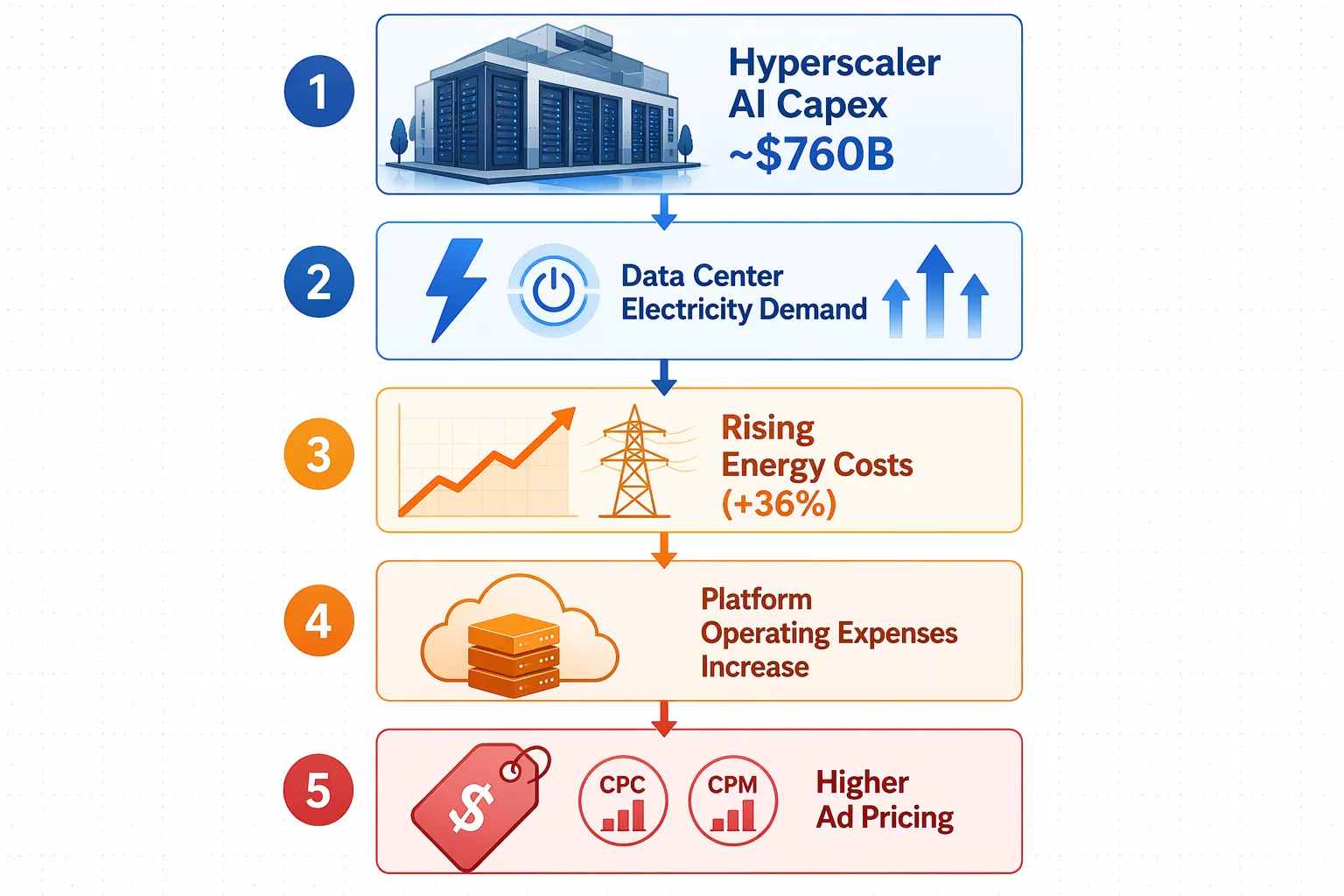
Start with demand. The International Energy Agency projects data center electricity demand doubling from about 470 TWh in 2025 to about 945 TWh by 2030, with AI workloads rising from about 29% to about 46% of that total.[6] That is not a small efficiency tweak inside an existing server footprint. It is a major expansion of compute demand in a power market that was not built around unlimited AI inference and training growth.
Then look at electricity pricing. U.S. residential electricity prices rose from 12.76 cents per kWh in 2020 to 17.44 cents per kWh, a 36% increase, and EIA projections cited by CNBC put them at 19.01 cents per kWh by September 2027.[7] Goldman Sachs separately projected electricity prices would rise an additional 6% through 2027, with data centers making up 40% of demand growth.[8] Residential rates are not the same thing as hyperscaler power contracts, but they are a useful signal that the grid cost environment is not moving in advertisers’ favor.
Regional markets make the pressure easier to see. In PJM, data center demand has been linked to $23 billion in customer price increases through at least 2028.[9] That figure is not a Google-or-Meta ad-cost bill, and it is not borne only by hyperscalers. It is still a concrete example of the same load problem: AI and data center growth can raise the cost of electricity capacity before any advertiser sees a new column in a platform export.
For a narrower dated case on that grid mechanism, the PJM benchmark analysis at PJM's data center crisis is making your AI ads more expensive is the better place to follow the regional capacity shortfall and its connection to AI ad economics. The broader point here is not that every advertiser lives inside PJM. It is that the infrastructure buildout has moved from abstract capex into real energy-market constraints.
Why this is different from normal auction inflation
Auction inflation usually gives buyers a familiar set of levers: adjust bids, segment campaigns, refresh creative, shift budget, narrow waste, broaden when volume is constrained, and wait for demand to cool. Those tactics still matter. They just do not fully answer a cost increase that is being pushed by the platform’s own infrastructure economics.
A seasonal CPM spike can fade after a retail window. A competitor entering the auction can be diagnosed in overlap and impression-share movement. Creative fatigue usually shows up in CTR, frequency, conversion rate, and learning instability. A platform-level cost floor is harder to see because it can move through reserve prices, delivery thresholds, ranking systems, inventory allocation, model-serving economics, and margin management without being labeled as such.
That is why the Meta cost signal is uncomfortable. A 14% increase in ad costs against only 6% more impressions does not automatically prove AI cost pass-through, but it does mean delivery volume alone cannot explain the bill.[2] The March CPM spike adds another visible symptom, especially because performance deterioration can be caused by both buyer-side conditions and platform-side changes.[3] Calling all of this “competition” is too convenient. It turns a structural question into a media-buying scold.
Google’s Search CPC movement deserves the same treatment. A 12% year-over-year CPC increase in Q1 2026 is a real planning input, not a vibe.[1] Search is still auction-driven, and industry mix matters. But when that increase lands in the same window as repeated capex forecast increases and accelerating AI infrastructure commitments, it should not be modeled as if the cost base underneath the auction is unchanged.
The platform reporting problem is the budget problem
The Current has argued that 10-figure data center bills ultimately leave advertisers exposed because the major ad platforms do not show what portion of spend funds working media versus infrastructure, automation, or other platform costs.[10] That is the operational issue. Advertisers are asked to trust optimization systems while losing visibility into the cost base those systems require.
The lack of visibility does not mean the cost is fake. It means the buyer cannot reconcile it. In most paid media reviews, the person defending spend has to explain three different things at once: whether the campaign got worse, whether the market got more expensive, and whether the platform’s own economics changed. Platform dashboards are built to discuss the first two. They are poor tools for the third.
This is also where adoption and effectiveness need to stay separate. Google and Meta can deploy more AI into ad products while advertisers simultaneously see higher costs. Automation can improve some accounts and still raise the cost floor across the system. A buyer can like Advantage+, Performance Max, broad match automation, generated creative, or model-assisted delivery and still ask whether the compute bill is being recovered through ad prices.
The cleanest version of the concern is not “AI makes ads worse.” It is that AI infrastructure changes the economics of operating the ad platforms, and the platforms do not provide enough pricing transparency for advertisers to separate performance gains from cost-base repricing.
Why 2027 planning should not assume a reset
The case for treating higher CPCs and CPMs as sticky is not that every month will rise in a straight line. It is that the major forward-looking inputs point toward persistence rather than relief.
Alphabet’s CFO signaled another significant capex increase into 2027 after Google increased its capex forecast again in July 2026.[4] Meta’s 2026 AI capex range, reported with a top end of $135 billion, puts the same pressure in the other major performance-media platform.[5] The IEA demand outlook runs through 2030, not a single holiday quarter.[6] Goldman’s electricity-price forecast also points through 2027, not just a short-term weather event.[8]
That time horizon matters in budget meetings. If a DTC brand saw a 20% paid social CPM increase in 2026, the comfortable forecast is to assume some normalization after creative refreshes, account restructuring, and seasonality roll off. The more responsible forecast is to separate tactical recoverable waste from structural price pressure. Some waste can be bought back through better media buying. A higher platform cost floor usually cannot.
A practical 2027 model should therefore avoid one blended inflation assumption. Treat auction volatility, creative performance, conversion-rate movement, and platform cost pressure as separate lines even if the final platform invoice collapses them back into one CPC or CPM. The point is not to invent a fake AI surcharge. The point is to stop forcing every increase into the tactical bucket simply because the dashboard does not label the structural one.
A cleaner way to classify next year’s increases
- If CPCs or CPMs rise while conversion rate, CTR, and frequency remain stable, do not automatically assign the increase to creative or landing-page deterioration.
- If costs rise across multiple campaigns, objectives, and audiences at the same time, treat platform-level pricing pressure as a live explanation, not an afterthought.
- If platform capex guidance, electricity forecasts, and data center demand keep moving upward, keep a structural inflation assumption in the 2027 plan.
- If a regional energy market materially improves or platform reporting starts separating infrastructure recovery from media delivery, revise the assumption rather than defending it out of habit.
The guardrails matter, but they do not erase the pressure
There are three caveats worth keeping close to the model. First, regional electricity variation is real. PJM is not ERCOT, and neither is a clean proxy for every market where Google or Meta operates. National averages can hide local congestion, power-contract differences, and different regulatory outcomes.
Second, platform pledges can change the optics without removing the economic question. Google and Meta have joined pledges to cover data center energy costs, but CNBC’s reporting also shows the debate over ratepayer protection and the sustainability of those commitments as AI demand expands.[7] A pledge may reduce direct public burden in a specific context. It does not tell an advertiser how the platform will recover higher infrastructure and operating expenses across its own products.
Third, benchmark methodology is not uniform. Google Ads and Meta Ads benchmarks draw from different data sets, time windows, account mixes, and industry distributions. A cross-industry CPC average is not your account. A March CPM spike is not a full-year forecast. These benchmarks are useful because they show broad direction, not because they replace your own cohort-level reporting.
None of those caveats makes the structural read go away. They only prevent the lazy version of it. The claim that public data proves a precise account-level AI pass-through is too strong. The claim that advertisers should plan as if infrastructure costs are irrelevant is weaker.
What to assume until the evidence changes
For 2027 planning, higher Google and Meta CPCs and CPMs should be treated as structurally sticky unless three things materially change: platform reporting becomes more transparent about cost allocation, energy-cost pressure eases in a way that affects data center economics, or hyperscaler capex guidance comes down. As of Q3 2026, the public signals are moving the other way.
That does not excuse bad media buying. It does not make every CPA miss inevitable. It does mean the buyer defending next quarter’s budget should not accept “CPCs are a tactical problem” as the whole diagnosis. Some of the increase is still in the account. Some of it is in the auction. A growing share appears to be in the infrastructure layer the platforms need to run the AI systems now sitting underneath the auction.
The useful classification is simple: this is not just market noise, and it is not yet an auditable surcharge. It is a dated structural cost pressure affecting 2027 paid media forecasts, whether or not the dashboard ever names it.
References
- Google Ads Benchmarks 2026: CPC, CTR, CVR by Industry, Digital Applied
- Why Meta Ads Are More Expensive in 2026, Coinis
- Why Meta Ads Performance Dropped in March 2026, Digital Applied
- Google increases capex forecast again after cloud-driven quarterly beat, Reuters
- Meta beats earnings as 2026 AI capex tops out at $135 billion, QZ
- Energy demand from AI, IEA
- Who pays for AI's electricity? Data centers spark debate over rising power costs, CNBC
- Electricity prices will keep rising on AI data center demand: Goldman, CNBC
- Data centers have already hiked electricity prices on the public by $23 billion, Fortune
- 10-figure bills for data centers ultimately leave advertisers on the hook, The Current
Primary source: https://www.cnbc.com/2026/07/23/who-pays-for-ais-electricity-data-centers-spark-debate-over-rising-power-costs.html