What Google Gemini Spark and Pro Tiers Deliver for Advertisers
This article examines whether Google's Gemini Ultra subscription ($100/month) justifies its cost over Pro ($19.99/month) for advertisers, showing that Spark's current features don't connect to Google Ads and that Ultra's real value is in productivity workflows, not campaign automation.
- Platform
- Google Ads
- Campaign type
- Performance Max
- Spend range
- $0
- Timeframe
- 0-day test
- CTR
- 0% uplift
- Verdict
- mixed result
- Industry vertical
- ecommerce
- Last reviewed
- 0-07-25
The advertiser version of the Gemini tier question is simple: if Ultra unlocks Spark, does that mean Gemini can now work a Google Ads account? As of Q3 2026, no. Ultra unlocks Gemini Spark and higher usage capacity, but Spark’s current Tasks, Skills, and Schedules are built around Workspace apps, not Google Ads campaign management. The Gemini features that actually touch advertising workflows already live inside Google Ads products such as Performance Max and AI Max for Search, and they do not require an Ultra subscription.
| Tier | Monthly price as of Q3 2026 | What it mainly unlocks | Advertiser-relevant read |
|---|---|---|---|
| Free | $0 | Basic Gemini access with lower usage limits | Useful for light drafting and quick trials, not a serious team workflow. |
| Plus | $9.99 | Higher access than Free, below Pro | A consumer-productivity tier; not the natural stopping point for most paid search teams. |
| Pro | $19.99 | Gemini productivity access with stronger limits than Plus | The default paid tier for advertisers who want Gemini for briefs, reporting drafts, analysis prep, and creative ideation. |
| Ultra | $100 | Gemini Spark access, 5x usage capacity, YouTube Premium, and the highest tier of Gemini access | Defensible for heavy users, but not because Spark manages campaigns. Ultra dropped from $200 to $100 after I/O 2026.[1] |
Spark Is a Workspace Assistant, Not a Google Ads Operator
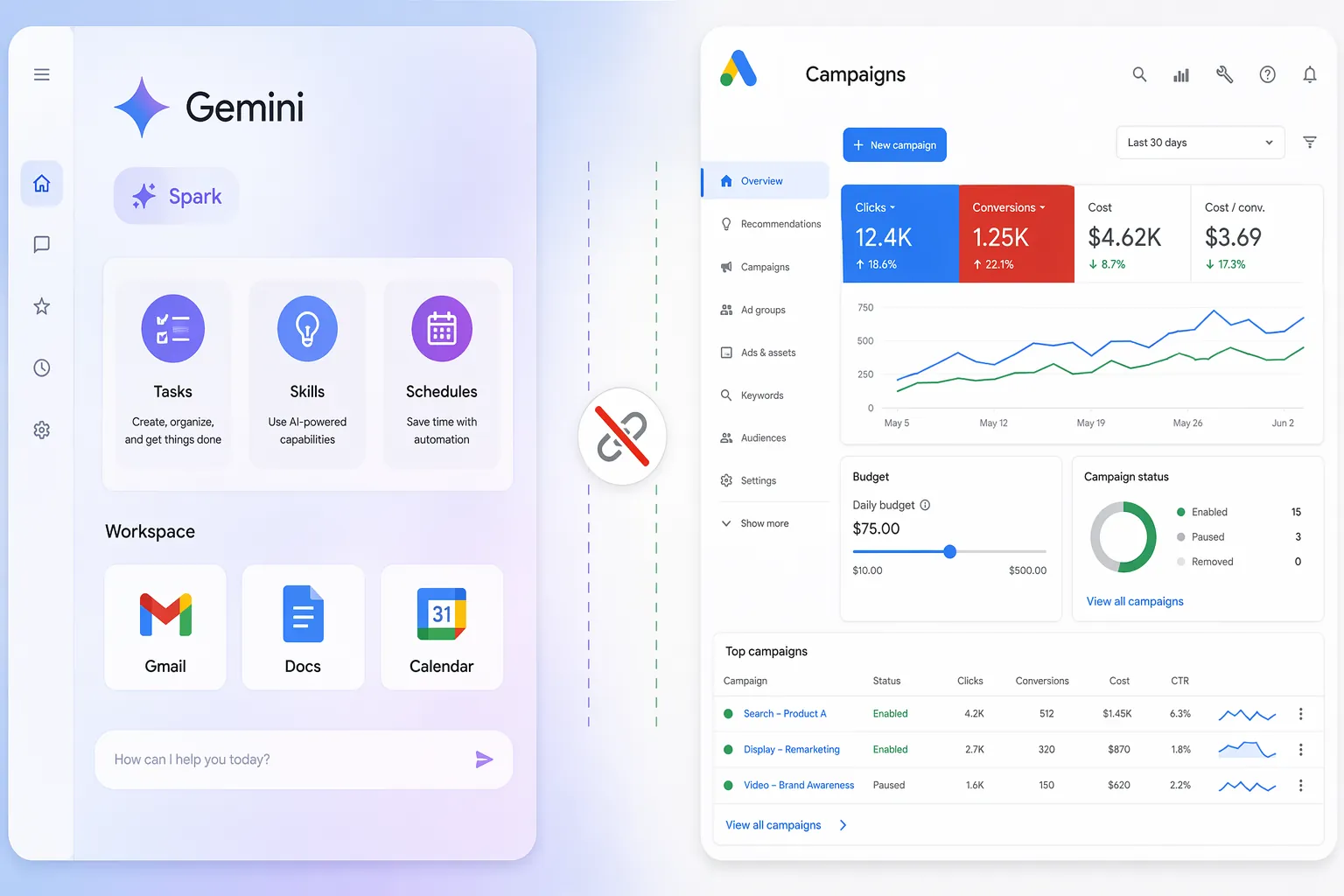
Spark is the Ultra feature that creates the most confusion because its label sounds like the thing advertisers have been waiting for: an assistant that can take a business instruction and turn it into operational work. The actual product boundary is narrower. Google’s support material describes Spark through Tasks, Skills, and Schedules, with connections into Gmail, Docs, Calendar, and Keep.[2]
That matters because those are productivity surfaces, not the campaign system of record. A Spark task can help organize work around a launch. A Spark schedule can support recurring reminders or prep. A Spark skill can package repeatable Workspace actions. None of the cited Spark material confirms access to the Google Ads API, campaign budgets, bidding controls, asset groups, search themes, audience settings, conversion goals, or experiments.[2]
The absence is not a small implementation detail. If a growth lead buys Ultra expecting Spark to pause a weak campaign, rewrite assets in an asset group, shift budget, or launch a Google Ads experiment, the missing connection has to be replaced by a human operator or by platform-native automation. That replacement work is where the real cost shows up.
- Spark can support Workspace-heavy workflows: launch checklists, email summaries, meeting prep, reporting drafts, calendar-based reminders, and reusable research routines.
- Spark is not confirmed to manage Google Ads campaigns: no supported campaign editing, budget control, bidding changes, asset publication, or experiment creation appears in the cited Spark documentation.[2]
- Ultra raises capacity and unlocks Spark, but capacity is not the same thing as campaign authority.
Where Gemini Already Matters for Advertisers
The cleaner way to evaluate Gemini features for advertisers is to separate off-platform productivity from in-platform advertising tools. Gemini’s advertiser-facing power is not hypothetical; Google began bringing Gemini models into Performance Max for asset generation in February 2024.[3] That is a Google Ads feature, not an Ultra entitlement.
For a deeper breakdown of the actual PMax surface area, the practical place to look is a Performance Max AI features guide for marketers. That is where the feature touches ad assets, asset groups, and campaign construction inside the Ads interface. Ultra does not need to be in the procurement line for that work to exist.

AI Max for Search belongs in the same bucket: advertiser-facing AI inside Google Ads, not a consumer Gemini subscription feature. If the question is whether model improvements can affect paid search workflows, the answer is yes. If the question is whether Ultra is required for that effect, the answer is no. The distinction is easier to see when comparing AI Max for Search versus Performance Max, because both live closer to campaign execution than Spark does.
Google’s broader ML changes across ads products have been moving in that direction for several years: less of the value comes from a separate chatbot tab, and more of it appears as assisted asset creation, campaign recommendations, matching, bidding, and format expansion. For teams tracking the bigger product arc, a Google, Meta, and HubSpot ML platform changelog is more useful than treating Ultra as the center of the ads roadmap.
The DeSight Studio Test Is Useful, With a Ceiling
The most concrete outside evidence for Gemini’s performance-marketing potential comes from DeSight Studio’s 30-day e-commerce split test using $55,000 in spend. The agency reported that Gemini 3.5 Flash produced a 21.4% CTR uplift and a 14.3% ROAS increase in Google Ads, while average order value fell by 5.3%.[4]
The CTR and ROAS numbers are the easy part to like. The lower AOV is the part worth slowing down for. If AI-generated copy increases engagement but pulls in more price-sensitive buyers, the account may look better at the ad interaction layer while changing customer quality. That does not make the test negative; it makes it a test that needs margin, cohort, and repeat-purchase follow-up before anyone turns it into a rule.
The same case also reported quality degradation beyond roughly 500 daily variants, which is a useful warning against treating variant volume as its own strategy.[4] For teams building an AI ad copy A/B testing workflow, that means the important control is not only whether Gemini writes faster. It is whether the test design can detect when faster output starts producing weaker traffic or less valuable orders.
Keep the case in its proper lane. It is a single-agency, e-commerce, 30-day benchmark, not a universal paid media average.[4] It supports the claim that Gemini-generated ad work can matter. It does not support the claim that Ultra or Spark is required to get that effect.
What Ultra Can Still Be Worth
Ultra is not pointless for advertisers. It is just easy to put it in the wrong budget category. The strongest case for Ultra is a heavy Gemini user who is already bottlenecked by usage limits, lives in Google Workspace, and will actually use Spark to reduce coordination work around campaigns.
| Workflow | What Ultra may improve | What it still does not replace |
|---|---|---|
| Competitive research prep | Higher-capacity Gemini usage and repeatable Spark routines can help collect notes, summarize pages, and prepare briefs. | Human judgment on positioning, claims, landing-page relevance, and test priority. |
| Weekly reporting | Workspace-connected drafts can help turn Docs, Gmail threads, and calendar context into a first-pass narrative. | Pulling authoritative performance data from Google Ads unless the team separately exports or connects the data. |
| Launch coordination | Schedules and Tasks can help keep reviews, approvals, and reminders moving. | Actual campaign creation, budget edits, bidding changes, and asset publication inside Google Ads. |
| Executive updates | Gemini can help turn messy campaign notes into cleaner summaries. | Accountability for why performance changed and what the team will change next. |
| YouTube-heavy personal or team use | YouTube Premium adds non-ads value to the subscription bundle. | Any direct Google Ads control. |
That is a real productivity argument. It is just not the same as a campaign automation argument. A small agency with several buyers can spend more time than expected cleaning up briefs, finding old client context in email, drafting report language, and coordinating approvals. If Spark removes enough of that drag for power users, Ultra can pay for itself as an operations layer.
The seat-count problem is where teams should be strict. One $100 subscription may be easy to approve. Five seats become a monthly assumption. If those seats were justified as “AI campaign management,” someone will eventually ask why budgets, assets, bidding, and experiments still require the Google Ads interface or another automation stack.
The Privacy Caution Belongs Around Custom Agent Plans
Privacy risk is not the main reason Spark should be separated from Google Ads. The product boundary is enough. Privacy becomes more important when teams try to build the missing connection themselves: exporting campaign data, sending it through Gemini-style workflows, and wiring recommendations back into ad operations.
For EU advertisers, the warning label is not theoretical. The supplied materials report that 76% of surveyed DPOs classify standard Gemini API integrations as high-risk for GDPR compliance.[5] That figure does not mean every Gemini workflow is noncompliant, and it does not produce a compliance plan by itself. It does mean custom agent ideas should slow down before account data, customer lists, query data, or conversion details start moving through loosely governed systems.
When privacy control is the constraint, self-hosted n8n or Make-style workflows may be part of the evaluation. Even then, the operational question stays the same: what data enters the workflow, who can review the output, and what system is allowed to change the campaign?
Pro Is the Default Advertiser Tier
For most advertisers, Pro is the cleaner default. It gives paid Gemini productivity without pricing every user as a power user and without pretending Spark is a Google Ads control plane. Use Pro for research, brief drafting, ad-copy exploration, reporting language, landing-page analysis, and internal planning. Use Google Ads-native AI features for campaign work.
Ultra is defensible when the buyer can name the non-campaign work it will absorb: heavy Gemini volume, Spark routines inside Workspace, recurring schedules, reporting prep, and YouTube Premium value. It is also more defensible for one or two operators than as a default seat for everyone touching paid media.
Do not buy Ultra because someone said Gemini can improve ads. Gemini already appears inside Google Ads products without Ultra.[3] Buy Ultra only when the extra capacity and Spark productivity workflows are valuable on their own. If the feature cannot touch budgets, assets, bidding, or campaign settings inside Google Ads, it should not be budgeted as campaign automation.
References
- Google I/O 2026 AI subscription tier announcements, Google Blog, May 2026
- Use Gemini Spark, Google Support
- Gemini models are coming to Performance Max, Google Ads & Commerce, February 2024
- Gemini 3 Flash Performance Marketing: Worth the Hype?, DeSight Studio
- DPO survey on Gemini API GDPR risk, supplied research materials
Built on this evidence
No Bidding tactic or Creative record currently cites this case file. Compare it against other results in Benchmarks.
Related benchmark reading
Report a corroborating or contradicting result
Seeing something different in your own account? Feed the data-integrity loop instead of leaving an open comment.