
How ChatGPT Outages Affect AI Ad Tools
A dated log of ChatGPT/OpenAI outages from late 2024 through Q2 2026, showing duration, root cause, and documented impact on AI ad tools that depend on OpenAI's API. Use it to check whether your toolchain was affected in each incident and how often these disruptions occur.
- Platform
- OpenAI
- Change category
- creative
- Change type
- incident
- Impact level
- High
Last checked: July 25, 2026, UTC. This tracker is built for the moment a campaign calendar is still live, the creative queue is not done, and someone needs to know whether the problem is their AI ad tool, OpenAI, or the connection between the two.
The impact of ChatGPT outages on AI ad tools depends on which OpenAI component failed. A ChatGPT interface outage can block teams using ChatGPT directly for hooks, variants, prompts, and QA. An OpenAI API outage can also hit downstream tools that use OpenAI models inside their own products. For Jasper, AdCreative.ai, Anyword, and Copy.ai, the available evidence supports treating API-level incidents as exposure events, not as confirmed vendor outages unless the vendor publishes its own incident record.
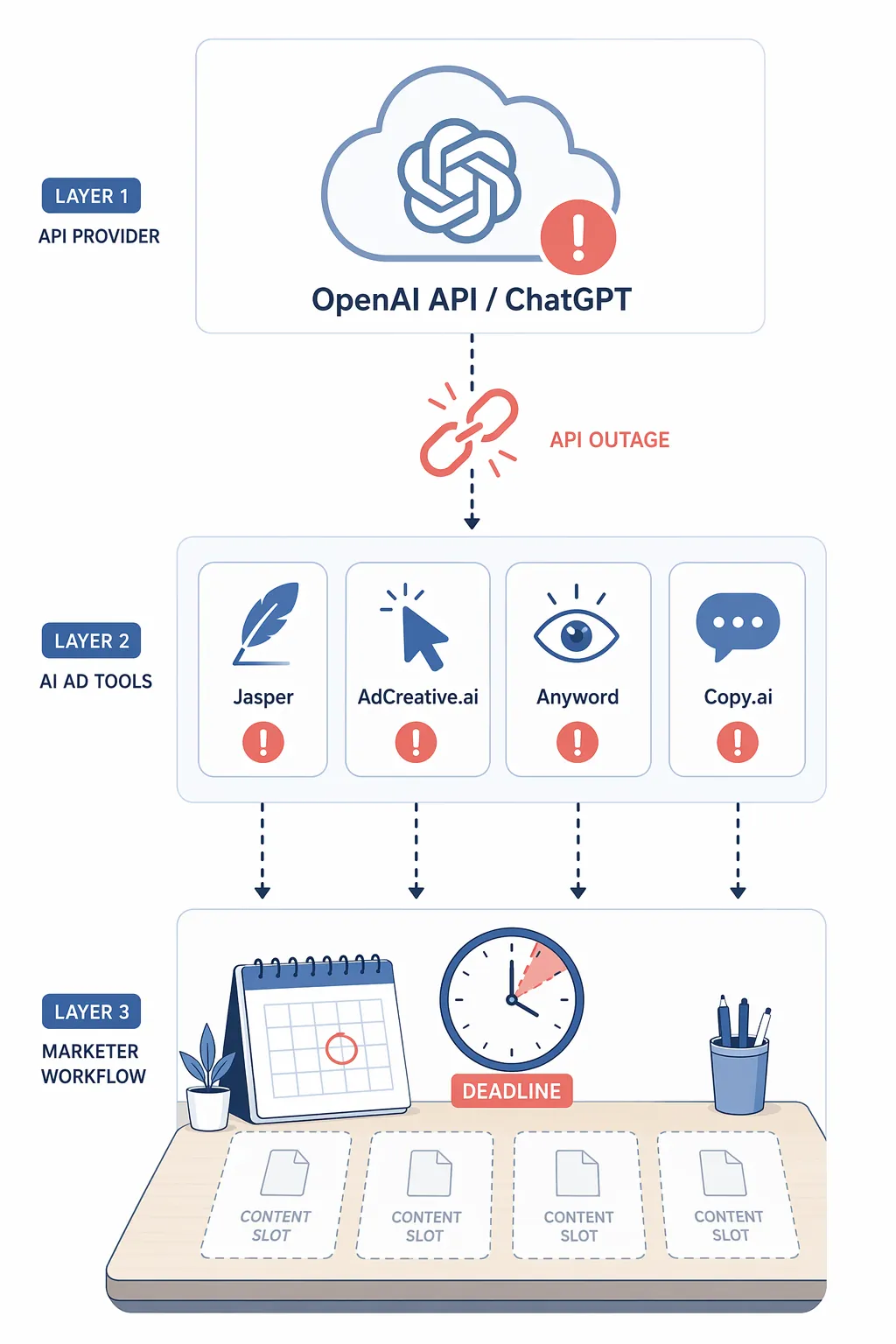
OpenAI and ChatGPT outage log for AI ad-tool exposure
The useful distinction in this log is confirmed OpenAI service degradation versus inferred downstream ad-tool disruption. Confirmed means the cited source identifies an OpenAI or AI-platform incident. Inferred means the affected workflow depends on OpenAI API availability, but the named ad-tool vendor did not publish a matching post-mortem in the materials reviewed.
| Date | Duration / report signal | Affected service | Root cause where available | AI ad-tool impact |
|---|---|---|---|---|
| Dec. 26, 2024 | About 6 hours; 50,000+ Downdetector reports | ChatGPT / OpenAI service disruption | Azure power issue | Confirmed OpenAI disruption. Direct ChatGPT creative work was exposed. Downstream AI ad-tool impact should be treated as inferred unless a vendor incident record confirms it. |
| Feb. 5-6, 2025 | About 23 hours | Gemini, not ChatGPT | Not specified in the provided source summary | Comparator only. Relevant to AI-ad operations because teams often use more than one model-backed tool, but it is not evidence of OpenAI or ChatGPT failure. |
| June 10-11, 2025 | About 34 hours from first reports to full resolution; about 44,500 Downdetector reports | ChatGPT, OpenAI API, and Sora | Orchestration-layer failure; Data Studios reports API error rates of about 25% | Highest-confidence exposure event for OpenAI-dependent AI ad tools. Jasper, AdCreative.ai, Anyword, and Copy.ai disruption is inferred from API dependency, not from named vendor post-mortems. |
| Dec. 2, 2025 | About 67,500 Downdetector reports; duration not specified in the provided source summary | ChatGPT / OpenAI service disruption | Not specified in the provided source summary | Large user-signal event. Treat direct ChatGPT workflows as exposed; treat named AI ad-tool disruption as unconfirmed unless the incident overlapped API degradation. |
| Feb. 3-4, 2026 | 55,000 Downdetector reports | ChatGPT / OpenAI service disruption | Configuration change | Confirmed OpenAI disruption. Ad-tool impact depends on whether the affected path included API-backed generation, not merely the ChatGPT web interface. |
| Q1 2026 broader AI-platform pattern | 51 high-signal disruption days across ChatGPT, Claude, Gemini, and Copilot; 39 of the 51 were Claude | Multiple AI platforms | Varies by platform and incident | Useful for frequency context, not a ChatGPT-only count. It supports tracking AI-tool infrastructure risk, but it should not be read as 51 ChatGPT disruption days. |
| Apr.-Jul. 2026 status window | APIs 99.93% uptime; ChatGPT 99.67%; Codex 99.98%; ChatGPT Ads Platform listed as 2 components with no published uptime percentage | OpenAI APIs, ChatGPT, Codex, ChatGPT Ads Platform | Status-page component reporting | Useful current check, but this window excludes the June 2025 outage. The missing Ads Platform percentage is a transparency gap for advertisers. |
That table is deliberately conservative. It does not say “Jasper was down” or “Copy.ai failed” for every OpenAI incident. It says the toolchain was exposed when the failure reached the OpenAI API, and it leaves room for product-level caching, fallback models, degraded features, or vendor-side mitigation. That is the difference between a useful incident record and a panic spreadsheet.
The June 2025 outage is the cleanest stress test
The June 10-11, 2025 incident deserves more weight than the usual “ChatGPT is slow” entry because it crossed the boundary that matters to ad teams. It affected ChatGPT, the OpenAI API, and Sora at the same time, with Data Studios attributing the incident to an orchestration-layer failure and reporting roughly 25% API error rates during the event.[1]
For a paid media team, that is the difference between one blocked browser tab and a production layer failing underneath several tools. A junior buyer drafting 40 Meta hooks in ChatGPT is clearly blocked by a ChatGPT outage. A copy lead using an AI ad platform that calls OpenAI models can also be blocked, but the evidence chain is different: the API failed, the tool depends on the API, and the affected feature likely degraded. Without a vendor post-mortem, that remains an inferred downstream impact.
The duration also has to be read carefully. Data Studios logs the June 2025 event at about 34 hours from first reports to full resolution.[1] Forbes’ real-time coverage described OpenAI applying a fix during a partial outage and reported degraded performance over a shorter roughly 12-hour frame.[4] Those two accounts are not interchangeable. One is closer to a full incident lifecycle; the other is closer to a partial-outage reporting window.
That distinction matters when someone asks why the team lost a launch afternoon even though a status page later says the issue was mitigated. “Fix applied,” “service recovering,” “degraded performance,” and “fully resolved” are different operational states. If generation still times out, the ad set still waits.
Why API incidents travel farther than chat-only incidents
A ChatGPT chat-only incident mostly affects teams that are using ChatGPT directly. That still matters: many ad teams use it as a fast drafting surface for angles, landing-page variants, competitor summaries, and internal QA. But it does not automatically prove that every AI ad tool failed at the same time.
An API-level incident is different. If a tool’s generation feature calls OpenAI models, the outage can show up as slow copy generation, missing variants, failed image prompts, broken prompt templates, empty previews, or background jobs that never finish. Catchpoint’s dependency-mapping guidance frames this as an architecture problem: teams need visibility into the external AI services sitting behind internal workflows, not just the SaaS brand name on the invoice.[5]
- Confirmed exposure: OpenAI reports API degradation or a sourced incident identifies API errors.
- Inferred downstream risk: an AI ad tool uses OpenAI APIs, but the vendor has not published its own matching incident report.
- Unproven vendor outage: a named tool is assumed to be down only because ChatGPT was down.
- Operationally resolved: the feature the ad team needs is generating usable output again, not merely that a provider has posted a mitigation note.
That is the line to keep with Jasper, AdCreative.ai, Anyword, and Copy.ai. The available material supports dependency risk when OpenAI’s API is degraded. It does not support a clean incident-by-incident claim that each named vendor had confirmed downtime during each OpenAI event.
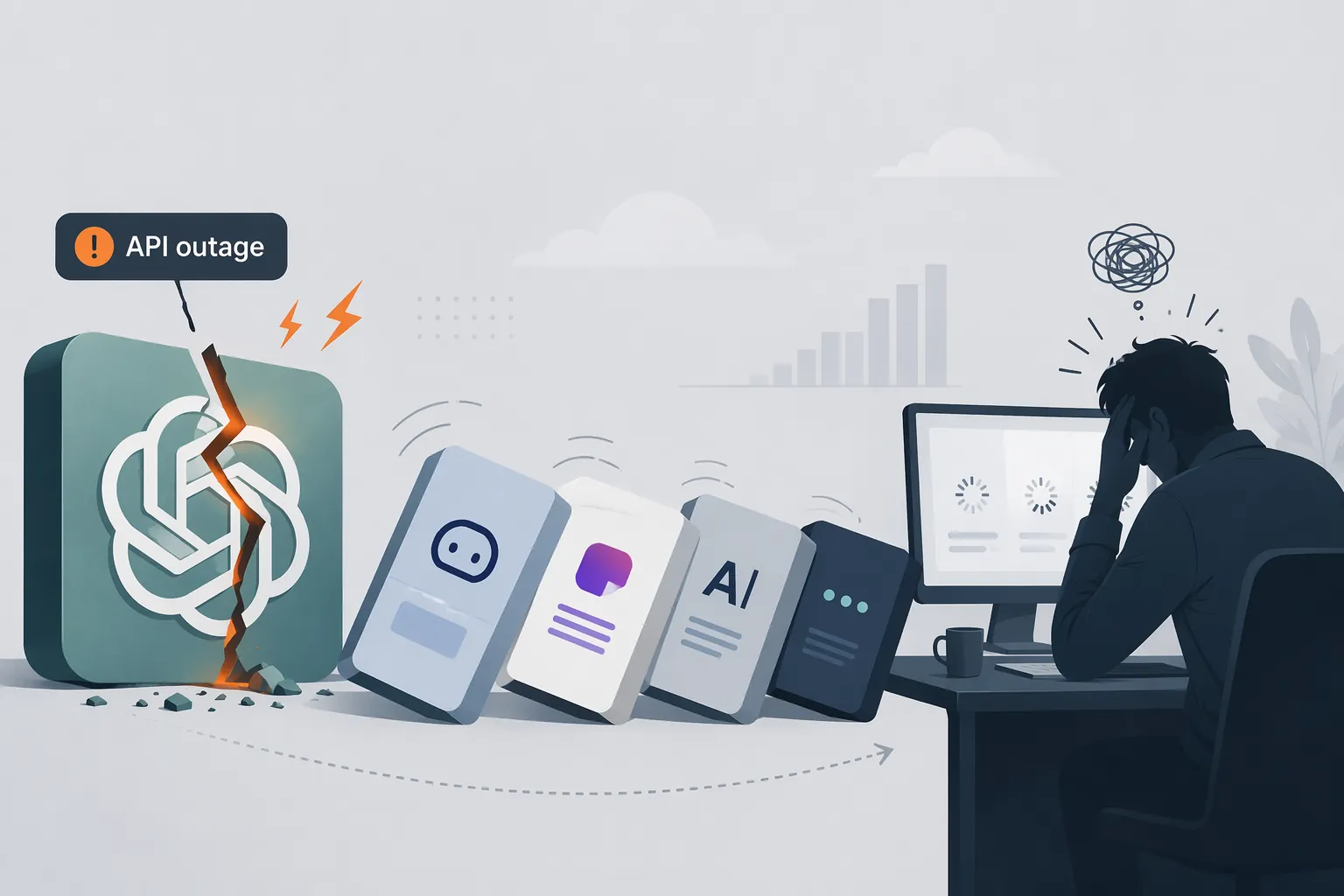
Frequency looks smaller when narrowed to ChatGPT, but not small enough to ignore
Ookla’s Downdetector analysis is useful because it stops this from being a memory contest. Across ChatGPT, Claude, Gemini, and Copilot, high-signal AI disruption days rose from 6 in Q1 2025 to 51 in Q1 2026.[2] That is the broader operating environment for teams building campaign workflows around generative AI.
It also needs the caveat in the same breath: 39 of those 51 Q1 2026 disruption days were attributed to Claude, so the number is not a ChatGPT-only outage count.[2] The right reading is not “ChatGPT was down 51 days.” The right reading is that AI platforms have become normal production dependencies, and disruption tracking has to be platform-specific.
The user behavior around these outages is also predictable. BuiltIn’s reporting, citing Dev Nag of QueryPal and Ookla observations, described how workers moved from casual frustration to visible workflow interruption when ChatGPT became unavailable.[6] That tracks with what happens inside ad operations: the dependency becomes obvious only when a deliverable is already due.
Current OpenAI uptime numbers are reassuring only inside their window
As of the July 25, 2026 check, OpenAI’s status page showed APIs at 99.93% uptime, ChatGPT at 99.67%, and Codex at 99.98% for the Apr.-Jul. 2026 window.[3] Those are useful numbers for a current vendor review. They are not a complete answer to whether AI ad-tool operations have been stable since late 2024, because that window excludes the major June 2025 incident.
The same status page listed the ChatGPT Ads Platform as two components but did not publish an uptime percentage for those components at the time checked.[3] For advertisers, that is not a scandal by itself. It is simply a field to keep watching. If ad inventory, creative generation, campaign setup, or reporting starts depending on those components, buyers will need the same status-page discipline they already use for Meta, Google, Shopify, and the rest of the stack.
What to record when the next incident starts
The cleanup gets easier when the incident record is built while the outage is happening, not three days later from Slack fragments. The fields below are enough to separate a local tool bug from an upstream AI-platform failure.
| Field | Why it matters |
|---|---|
| Incident start time | Separates pre-existing campaign problems from provider-side degradation. |
| Affected OpenAI component | ChatGPT, API, Sora, Ads Platform, and Codex do not carry the same downstream risk. |
| Observed ad-tool symptom | A spinner, timeout, missing variant, failed export, or bad response can point to different failure paths. |
| Vendor confirmation | A vendor status page or support ticket turns inferred exposure into confirmed impact. |
| OpenAI resolution language | Mitigated, monitoring, degraded, and resolved mean different things during campaign work. |
| Campaign consequence | Record whether launch, QA, copy approval, creative testing, or reporting was delayed. |
InformationWeek’s continuity framing is relevant here because the failure mode is not only technical. If an AI vendor becomes a single point of failure, continuity planning has to include the model provider underneath the application layer.[7] For ad teams, that means the dependency map should name OpenAI API exposure next to the tool name, not hide it under a generic “AI copy platform” label.
The practical response is not to abandon AI ad tools. They are still useful when a launch calendar needs twenty headline directions before lunch. The response is to keep a dated dependency record, mark each incident as confirmed or inferred, watch which OpenAI components are covered by published uptime data, and re-check toolchain exposure whenever OpenAI has an API-level incident.
References
- ChatGPT’s 34-Hour Outage (10–11 June 2025): Timeline, Technical Breakdown, and Business Impact — Data Studios
- AI Platform Reliability: Downdetector Data from Millions of User Reports — Ookla
- OpenAI Status — OpenAI
- ChatGPT Outage: OpenAI’s Fix Applied As Degraded Performance Affects Chatbot — Forbes
- When AI tools fail: How to map your AI dependencies for proactive visibility — Catchpoint
- What the ChatGPT Outage Reveals About How Workers Use It — Built In
- Your AI vendor is now a single point of failure — InformationWeek
Primary source: https://status.openai.com