
How Microsoft's AI Budget Squeeze Reshapes Advertiser Control
Microsoft is spending $120B+ on AI infrastructure, driving rapid ad product changes. This article breaks down which updates genuinely improve advertiser outcomes and which serve Microsoft's need to close the AI revenue gap, with dated sources and vendor-reported claims labeled accordingly.
- Platform
- Microsoft Advertising
- Change category
- targeting
- Change type
- default-on change
- Impact level
- significant
The easiest way to misread Microsoft Ads in 2026 is to treat every AI launch as either a gift to advertisers or a desperate monetization grab. The platform is doing both more useful and more self-interested things at the same time.
The budget pressure is not subtle. Microsoft’s FY2026 AI capital spending is reported at more than $120 billion, inside a wider hyperscaler AI spending wave approaching $700 billion.[1] Forbes, citing Sequoia’s David Cahn, framed the market problem as an estimated roughly $600 billion annual gap between AI infrastructure spending and actual AI revenue.[2] That estimate is not a campaign-level cause-and-effect formula. It does not mean a specific Microsoft Ads default exists because a data center invoice came due. But it is the right pressure system to keep in mind when a platform suddenly finds more surfaces, more automation, and more reasons to route spend through AI-mediated products.
For advertisers, the practical question is narrower than the market narrative: does Microsoft’s AI push give buyers more usable evidence, or does it mainly move more campaign decisions into machinery that is harder to audit? The answer depends on which 2026 change is in front of you.

The 2026 Change Register Advertisers Actually Need
A single product announcement does not explain the impact of Microsoft’s AI ad spending on advertisers. The pattern matters more: Microsoft is simultaneously exposing more reporting fields than Google does in comparable automated products and nudging more campaign work into AI-assisted matching, creative, bidding, and conversational inventory.
| 2026 change | What changed for advertisers | Control read |
|---|---|---|
| Performance Max transparency upgrades | Microsoft added search term reporting, publisher-level conversion metrics, and landing page URLs for PMax reporting in May 2026.[3] | Meaningful visibility gain, especially compared with Google-style PMax opacity. |
| AI Max open pilot | Microsoft positioned AI Max around expanded query matching, real-time creative personalization, and transparent asset and keyword reporting.[4] | Promising, but still a test surface; Microsoft’s reported lift should not be treated as a benchmark. |
| Autogenerated RSA assets | Autogenerated assets for responsive search ads were enabled by default in January 2026, with Microsoft reporting a 5% CTR lift.[5] | Convenient, but the default-on setting shifts creative control unless accounts are audited. |
| Automated bidding strategy consolidation | Microsoft consolidated automated bidding strategy options in March 2026.[6] | Operationally simpler, but fewer bidding levers can make troubleshooting less precise. |
| Copilot ad expansion | Microsoft continued expanding Copilot ad triggering and appearance, using earlier first-party performance claims from 2025.[7][8] | High-potential inventory, not yet independently verified at 2026 auction scale. |
| Brand Agents and Shopify in Copilot | Microsoft reported 2x conversion lift for Brand Agents and about 90% impression share growth for Shopify merchants in Copilot.[9] | Useful signal of Microsoft’s preferred demand path; too early and too vendor-reported to use as a planning constant. |
| Audience Generation | Microsoft promoted natural-language audience creation as part of its broader Activate 2026 AI ad stack.[4] | A workflow improvement if reviewed tightly; a risk if audience logic becomes invisible shorthand. |
| Negative keywords for PMax | Microsoft added negative keywords for PMax in March 2026.[6] | Direct advertiser control gain and one of the cleanest improvements in the set. |
That register is uneven by design. Some updates give buyers better evidence. Some reduce friction by reducing choice. Some are mostly Microsoft saying, in effect, that future demand will happen inside conversational and agentic surfaces. The mistake is to average them into one generic “AI ads” judgment.
Where Microsoft Deserves Credit: Reporting You Can Use
Microsoft’s strongest advertiser-positive move is not a performance claim. It is the reporting layer around Performance Max. In May 2026, Microsoft said advertisers would get search term reporting, publisher-level conversion metrics, and landing page URLs for PMax campaigns.[3] Those are not decorative fields. They are the places an operator goes when spend shifts and the account needs an explanation better than “the model found demand.”
Search term visibility changes the remediation path. If a PMax campaign begins converting on low-intent queries, the buyer can see the query pattern instead of inferring it from conversion quality, sales feedback, or landing page drift. That does not automatically make the campaign profitable. It does make the waste legible sooner.
Landing page URL reporting matters for the same reason. Automated campaigns often decide where traffic should land, and that routing can look efficient in aggregate while hurting specific product lines, lead forms, or margin tiers. When URLs are visible, a buyer can separate a matching problem from a page selection problem. Without that field, too much troubleshooting turns into guesswork.
Publisher-level conversion metrics are even more important for accounts exposed to mixed inventory. Bad traffic rarely announces itself as “bad traffic” in the top-line dashboard. It shows up as a placement, partner, or publisher pattern that looks acceptable until conversion quality is checked against source. Microsoft’s May 2026 PMax reporting upgrade gives advertisers a better chance to find those patterns inside the platform rather than after the CRM team complains.[3]
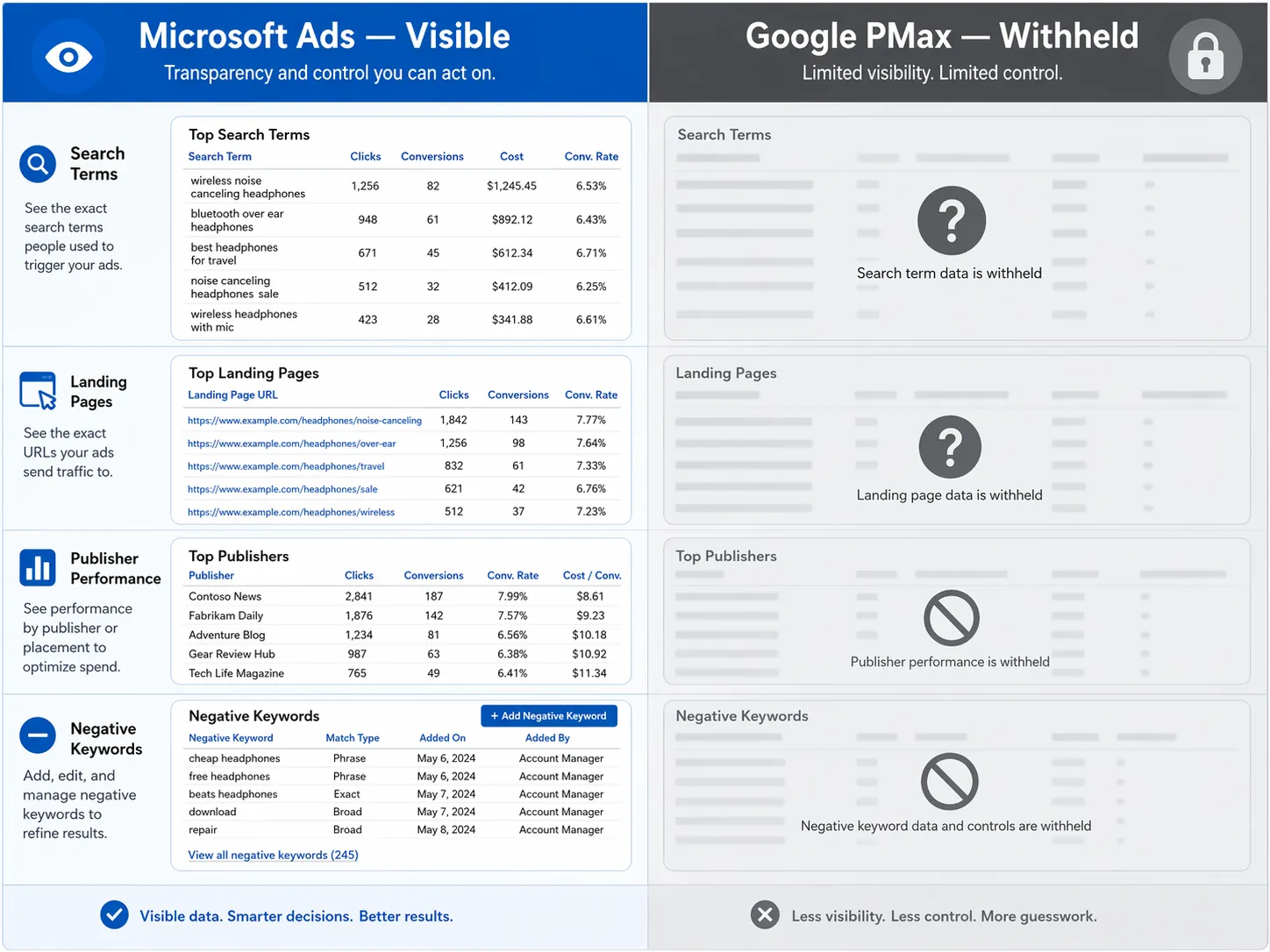
The competitive comparison with Google is unavoidable because the pain point is not theoretical. Google Performance Max has trained buyers to live with important blind spots, then explain opaque campaign movement to clients and executives who still expect channel-level accountability. Microsoft’s PMax transparency is not perfect control, but it is materially better control surface area than the version many advertisers have been forced to normalize elsewhere.
Negative keywords for PMax belong in the same bucket. Microsoft announced them in March 2026 as part of its product updates.[6] A negative keyword is not glamorous AI infrastructure. It is a basic safety valve. When a buyer can exclude known-bad intent, the campaign becomes easier to govern, especially in accounts where brand ambiguity, competitor terms, hiring queries, support searches, or research-only language can absorb budget while looking plausible to an automated system.
This is the part of Microsoft’s current positioning that should not be brushed off as merely catching up. In automated campaigns, visibility is not a nice-to-have report. It determines whether the buyer can make a responsible budget decision after performance moves. A channel with slightly less scale but better diagnostic evidence can deserve more serious testing than a larger channel that asks advertisers to accept the model’s answer without showing enough of its work.
AI Max Looks Better Because It Starts With More Disclosure
AI Max is where Microsoft’s transparency argument becomes more interesting, because the product is not just a reporting patch on an existing automated campaign type. Microsoft described AI Max at Activate 2026 as an open pilot using expanded query matching, real-time creative personalization, and transparent asset and keyword reporting.[4] PPC News Feed’s recap also framed it as an opt-in pilot rather than a forced migration path.[10]
That opt-in status matters. When an AI feature is optional, an advertiser can stage a test, isolate budget, set account-specific guardrails, and compare the output against existing search campaigns. When the same logic becomes a default migration or a hidden expansion layer, the buyer spends the first month trying to identify what changed.
Microsoft has reported an 8% incremental conversion lift for AI Max based on internal data from September 2024 through September 2025.[4] That is a useful vendor signal, not an independent benchmark. The time window predates many 2026 auction and product changes, and the result does not tell an individual advertiser whether the lift came from better matching, more permissive query expansion, creative variation, budget reallocation, or selection effects among early adopters.
The reporting promise is what makes AI Max worth testing anyway. Transparent asset and keyword reporting gives the buyer something to inspect after the model expands reach. If the new conversions come from acceptable queries, suitable landing pages, and creative combinations that do not distort the offer, the test has evidence behind it. If the conversion count rises while lead quality drops, the same reporting layer should make the failure easier to diagnose.
The Control Loss Starts With Defaults
The more uncomfortable side of Microsoft’s 2026 ad product motion is not that automation exists. Paid search has been automated for years. The issue is where Microsoft chooses defaults, and how much cleanup work advertisers inherit when the default is wrong for the account.
Autogenerated RSA assets are the cleanest example. In January 2026, Microsoft said autogenerated assets for responsive search ads were enabled by default, with sensitive verticals able to opt out, and cited a 5% CTR lift from Microsoft data.[5] The number may be directionally useful. It still measures Microsoft’s reported click-through-rate improvement, not necessarily conversion quality, compliance fit, brand safety, or margin-adjusted performance.
Default-on creative generation changes the workflow. The buyer is no longer only writing and testing assets; they are also policing machine-suggested language that may be close enough to sound acceptable and loose enough to create risk. In regulated, technical, luxury, B2B, medical, finance, or high-consideration categories, that review burden is not a minor inconvenience. It is the difference between creative assistance and accidental message drift.
Automated bidding strategy consolidation creates a quieter version of the same problem. Microsoft’s March 2026 product updates included bidding strategy consolidation.[6] Consolidation can reduce setup confusion, especially for smaller advertisers. It can also remove intermediate levers that experienced buyers use when a campaign is almost working but needs a specific correction. Fewer choices are pleasant until the remaining choices are too blunt.
This is where infrastructure pressure becomes operationally relevant. A company carrying massive AI investment has a rational incentive to increase usage of AI-mediated inventory, creative, bidding, and measurement. That does not make each feature bad. It does mean advertisers should treat convenience defaults as commercial design, not neutral account hygiene.
Copilot Is Upside, Not Proof
Copilot ads are the most obvious place where Microsoft wants new demand to form. They are also the place where the performance claims need the largest label attached.
Microsoft reported that conversational AI ads produced 73% higher CTRs and 16% stronger conversion rates, with lower-funnel segments showing 69% stronger CTRs and 76% higher conversion rates.[7] Microsoft also reported a “quick back” metric that was 52% to 59% lower than traditional search ads.[7] Those figures come from Microsoft first-party data from February through May 2025, before AI Max and before the 2026 auction environment described in the current product cycle.[7]
That timing matters. Early Copilot inventory may have had different user behavior, advertiser density, auction pressure, and novelty effects than the inventory advertisers will buy through late 2026. A high CTR in a newer surface can be real and still fail to translate into durable account economics once more advertisers enter, formats change, or the query mix broadens.
Search Engine Land reported in June 2026 that Microsoft was changing how Copilot ads appear and trigger.[8] That reinforces the same point: this surface is still being shaped. Treat it as a test environment with potentially valuable intent signals, not as a proven replacement for search inventory with known auction behavior.
Brand Agents, Shopify, and Audience Generation Show Where Microsoft Wants Spend to Move
Brand Agents are worth watching less because of the headline lift and more because of the direction of travel. Microsoft reported 2x conversion lift for Brand Agents and about 90% impression share growth for Shopify merchants in Copilot.[9] Both claims are Microsoft-reported, early-stage, and potentially shaped by which brands and merchants were included. They are not portable planning assumptions for a random ecommerce, lead gen, or B2B account.
The strategic signal is clearer than the benchmark. Microsoft wants brands to build more interactive presences inside its AI surfaces, and it wants commerce feeds, product data, and conversational discovery to meet inside the same environment. If that works, advertisers may eventually buy not only search clicks but guided consideration moments where the user is asking, comparing, refining, and being routed toward a brand response.
Audience Generation sits in a similar category. Natural-language audience building can save time and make sophisticated targeting more accessible.[4] It can also compress strategic thinking into a short instruction that nobody reviews closely enough. The useful version has a human checking whether the generated audience actually matches the business case, exclusion logic, and sales reality. The lazy version turns “find people like our best customers” into an expensive black box with nicer wording.
How to Allocate Through Q3 and Q4 2026
For the rest of 2026, Microsoft Ads deserves a more serious place in budget conversations when visibility itself improves decision quality. If a category depends on query hygiene, publisher review, landing page routing, or negative keyword control, Microsoft’s PMax reporting upgrades and PMax negatives are not small conveniences. They can change how fast a buyer can identify waste and defend spend.
That does not justify accepting every AI performance claim at face value. Microsoft’s reported lifts for AI Max, Copilot, autogenerated RSAs, Brand Agents, and Shopify-related Copilot exposure are vendor-reported signals. They are useful enough to justify controlled tests. They are not strong enough to rewrite budget allocation without account-level proof.
- Favor Microsoft where transparency lowers risk: search term reporting, landing page URLs, publisher-level conversion metrics, asset reporting, keyword reporting, and PMax negative keywords.
- Test AI Max as an opt-in expansion layer, with separate budget and quality checks, rather than assuming Microsoft’s reported 8% lift will transfer to the account.
- Audit autogenerated RSA settings before scale, especially in accounts where claims, compliance language, pricing, or brand tone cannot drift.
- Treat Copilot inventory as high-potential but unverified at current auction scale; judge it by downstream quality, not CTR alone.
- Watch whether today’s opt-in AI products stay opt-in as Microsoft continues looking for revenue against its AI infrastructure buildout.
Microsoft’s advantage is real where the platform shows its work. The risk is real where the platform makes more decisions by default and asks the advertiser to discover the consequences afterward. Budget should follow the first pattern cautiously, and interrogate the second one before it scales.
References
- Tech AI spending approaches $700 billion in 2026, cash taking big hit, CNBC, February 2026.
- AI Spending Is Surging Faster Than Revenue And Markets Are Repricing, Forbes, June 2026.
- Providing more transparency for your Performance Max campaigns, Microsoft Advertising blog, May 2026.
- Microsoft Advertising Activate 2026: Key Takeaways, Microsoft Advertising blog, June 2026.
- January 2026 product updates, Microsoft Advertising blog, January 2026.
- Negative keywords for PMax and other product news for March 2026, Microsoft Advertising blog, March 2026.
- 73% higher CTRs: Why advertisers need to pay attention to conversational AI, Microsoft Advertising blog, August 2025.
- Microsoft is about to change how Copilot ads appear and trigger, Search Engine Land, June 2026.
- Win across all three eras of the web, Microsoft Advertising blog, April 2026.
- Microsoft Activate 2026 Recap, PPC News Feed, May 2026.
Primary source: https://about.ads.microsoft.com/blog/providing-more-transparency-for-your-performance-max-campaigns