
What the 42% Drop Means for Bloom Energy AI Stock
Bloom Energy's record Q2 revenue and massive deal flow are undeniable, but a 42% stock drawdown, regulatory hurdles, and a short-seller attack demand scrutiny. This article weighs the fundamental momentum against the execution risks so you can decide if the AI infrastructure stock deserves a place in your portfolio.
- Platform
- Bloom Energy
- Campaign type
- AI Infrastructure
- Spend range
- $0B–$4.2B
- Timeframe
- Q0 2026
- Stock price change
- -42%
- Verdict
- loss
- Industry vertical
- AI Infrastructure
- Last reviewed
- 0-07-29
Bloom Energy’s AI infrastructure data center stock has already had the kind of move that makes clean narratives unusable. The stock reached $351.28 in June 2026 after a 717% one-year rally, then fell to roughly $186 by late July, a drawdown of about 42%.[1] In the same stretch, the company reported the strongest quarter in its history: Q2 2026 revenue of $1.065 billion, up 166% year over year and 27.7% above estimates.[2]
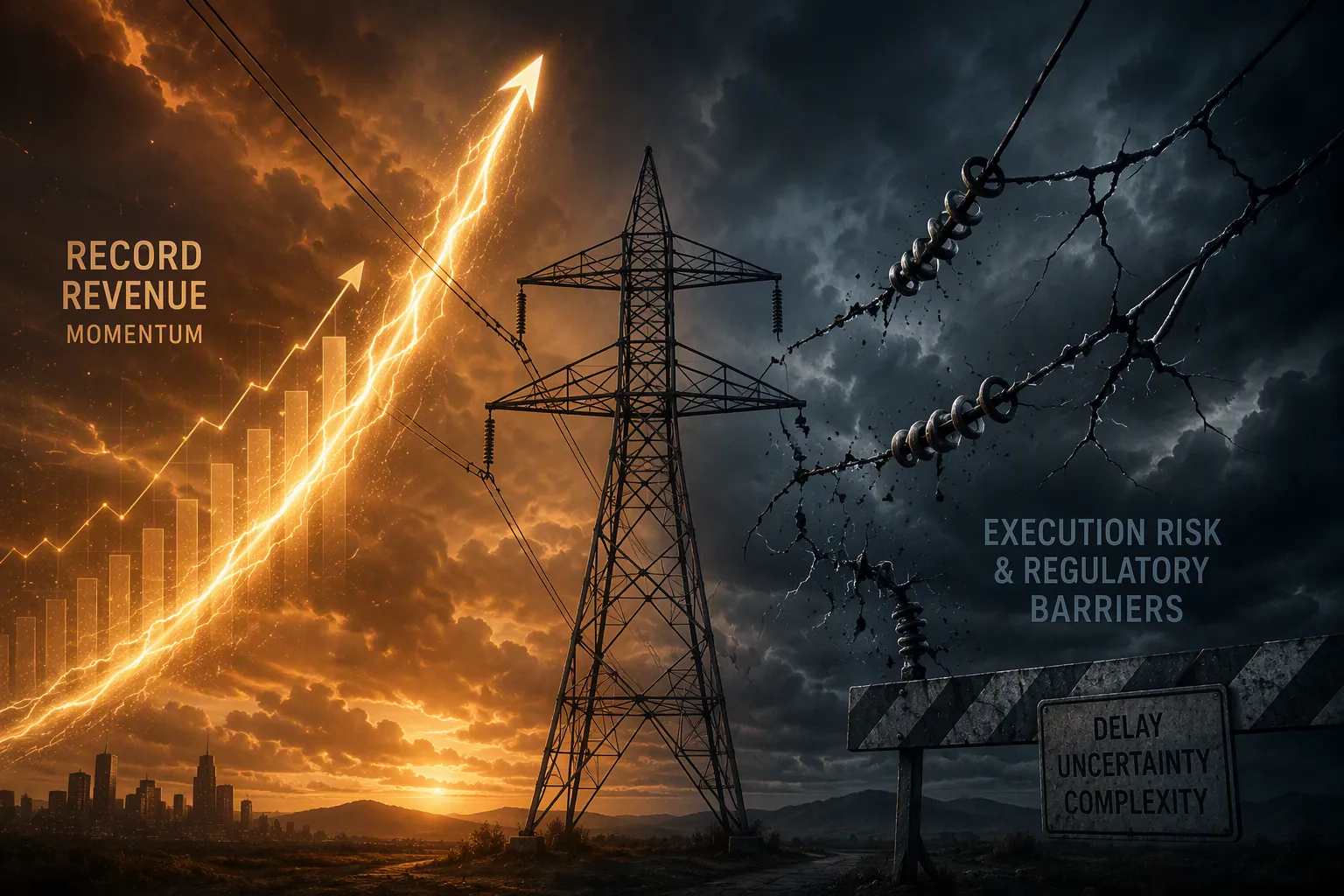
That is the uncomfortable setup. The business is accelerating, the stock is deflating, and neither fact cancels the other. Bloom also raised full-year 2026 revenue guidance to $3.9 billion to $4.2 billion, while the market is still being asked to digest a $25 billion Brookfield financing framework, a price-to-earnings ratio near 188, and analyst targets that run from $39 to $350.[3][4][5] The issue is no longer whether the AI power story exists. It does. The issue is how much uncompleted execution the current valuation still asks investors to finance.
The Quarter Was Not the Problem
There is no need to pretend Bloom’s recent numbers are weak. A company does not grow Q2 revenue 166% year over year by accident, and a $1.065 billion quarter changes how the market has to talk about capacity, demand, and customer urgency.[2] For a business tied to AI data center power, that matters because the bottleneck is not abstract interest in AI. It is the physical availability of power where data centers want to operate.
Bloom’s pitch fits that bottleneck neatly. Its solid-oxide fuel cells are presented as high-efficiency onsite power systems that can be deployed faster than many grid interconnection timelines. The cited deployment profile includes 54% efficiency and a 1–2 year deployment window, compared with multi-year grid queues.[6] That does not make Bloom immune to execution risk, but it explains why hyperscale demand would move toward a company that can put megawatts near the load instead of waiting for transmission, utility upgrades, and local power politics to clear.
The production story also has real scale behind it. Bloom has deployed 1.5 gigawatts globally, is targeting 2 gigawatts of annual production by December 2026, and says its Fremont facility can expand to 5 gigawatts.[6] Those are not small pilot-project figures. They are the kind of numbers that make investors willing to treat the company as more than a fuel-cell niche player.
The stock drop, then, is not a market discovery that Bloom has no business. It is a repricing of how much certainty investors are willing to assign to revenue conversion, permitting, supply chains, and financing structures before those steps are finished.
Deal Flow Is Not All the Same Kind of Evidence
The cleanest way to lose discipline around Bloom is to put every headline into one bucket called “demand.” Oracle demand, AEP offtake, Wyoming power plans, production targets, and Brookfield financing are all relevant. They are not equivalent.
| Item | What It Supports | What It Does Not Prove |
|---|---|---|
| Q2 2026 revenue of $1.065B | Bloom is converting some demand into reported revenue | That all announced AI infrastructure demand will convert at the same pace |
| FY2026 revenue guidance of $3.9B–$4.2B | Management sees higher near-term revenue than before | That multi-year project execution is already de-risked |
| $25B Brookfield framework | Financing capacity for power projects has expanded | That Bloom has received $25B of committed equipment purchase orders |
| Oracle, AEP, and Wyoming demand | Large customers and projects are moving toward onsite power | That all permitting, gas supply, interconnection, and construction risks are solved |
The Brookfield number deserves the most care because it is the easiest one to misuse. The announced expansion increases Brookfield’s framework to finance power projects. It is financing capacity, not the same thing as a $25 billion committed Bloom equipment order.[4] That distinction is not pedantic. A financing framework can help projects move, lower friction, and make the commercial pipeline more credible. But revenue still depends on customers, sites, permits, procurement, construction schedules, fuel supply, and final project economics.

This is where the stock’s previous enthusiasm becomes a burden. BofA analysts warned that the market was “assuming 5-yr perfection” around Bloom.[4] That phrase matters because it describes a valuation problem more precise than “AI bubble.” The market was not just pricing demand. It was pricing demand plus smooth deployment plus available supply plus regulatory clearance plus margin delivery plus financing conversion over a long horizon.
For an operator, this is the difference between a signed media platform partnership and actual profitable spend. A platform can announce access, inventory, or optimization. The budget only performs when the supply path works, the measurement holds, and the hidden constraints do not eat the lift. Bloom’s infrastructure version is larger and more capital-intensive, but the verification habit is the same: separate announced capacity from executable capacity.
The Bull Case Has Specific Customers Behind It
The stronger version of the Bloom bull case is not “AI needs power.” Everyone in the chain already knows that. The stronger version is that Bloom appears early to a narrow, painful part of the market: data center operators that cannot wait years for enough grid capacity and are willing to consider onsite generation.
Reported demand includes Oracle at 2.8 gigawatts, an AEP agreement valued at $2.65 billion with a 20-year offtake structure, and a Wyoming project of 900 megawatts.[6] Those figures are meaningful because they move Bloom out of the category of companies merely attaching themselves to AI language. They show large counterparties considering Bloom-style power as part of real infrastructure planning.
They also make the risk harder, not easier, to ignore. Small deployments can disappoint quietly. Gigawatt-scale infrastructure runs into utility coordination, fuel delivery, state regulators, local communities, construction sequencing, and supplier qualification. The bigger the claim, the more the stock depends on boring milestones.
That is why the Q2 result should raise the standard of scrutiny rather than lower it. Bloom has earned attention. It has not earned a pass on the unfinished parts of the story.
Project Jupiter Shows Where the Narrative Can Jam
Project Jupiter is the kind of case that makes the Bloom debate concrete. Oracle’s planned $165 billion campus was expected to include 2.45 gigawatts of Bloom fuel cells, but New Mexico regulators rejected the associated natural gas pipeline for a second time, and no hearing date had been scheduled as of mid-July 2026.[7]
That does not prove the project fails. It does prove that “onsite power” is not a regulatory escape hatch. Fuel cells still need fuel. Fuel supply still needs infrastructure. Infrastructure still needs approval. When the pipeline is blocked, the deployment clock changes, and the valuation model has to decide whether the delay is temporary friction or a sign that timelines have been too generously assumed.
This is also where AI data center investing starts to overlap with the less glamorous operating constraints already visible across the sector. Community pushback, local permitting, water, noise, transmission, and gas infrastructure can all turn a demand story into a queue. The same dynamic is showing up in discussions of noise complaints as a data center bottleneck, where the technical need is real but the site-level permission is not automatic.
New York’s one-year statewide data center moratorium adds a broader signal. It is not the same fact pattern as Project Jupiter, and it should not be treated as proof that every Bloom customer will be delayed. But it does show that data center growth is moving from an engineering problem into a state-policy problem.[8] For AI infrastructure stocks, that matters because regulatory calendars do not adjust themselves to revenue guidance.
The Scandium Dispute Is Still Open
The Hunterbrook Capital short report created a different kind of uncertainty. On July 7, 2026, the report questioned Bloom’s scandium supply dependence and triggered a 5.7% single-day stock drop.[9] Bloom’s COO responded by claiming 25 gigawatts of scandium production capacity from industrial tailings.[9]
Those two statements should not be forced into a fake resolution. Hunterbrook has not, based on the record cited here, proven that Bloom cannot secure supply. Bloom’s rebuttal also does not close the file by itself. A management response is evidence, but it is not the same as independently verified supply-chain certainty at the scale investors are now being asked to underwrite.
The practical question is not whether short sellers are virtuous or management is credible. It is whether a key material input can support the production growth implied by the AI data center story. If the answer is yes, Bloom can keep converting first-mover demand. If the answer is delayed, constrained, or margin-damaging, the financial model changes even if customer demand remains strong.
A 42% Drop Does Not Automatically Create a Cheap Stock
A fall from $351.28 to roughly $186 is large enough to change the conversation.[1] It removes some of the pure momentum premium. It does not, by itself, create margin of safety. At a price-to-earnings ratio around 188, Bloom still trades like a company that must turn a large share of its visible opportunity into profitable execution without many serious interruptions.[5]
That matters because the unresolved items are not decorative risk factors. They sit directly in the conversion path from AI infrastructure excitement to revenue and earnings.
- Financing risk: the Brookfield framework can support projects, but it is not the same as booked equipment revenue.
- Regulatory risk: Project Jupiter’s pipeline rejection shows that power deployment still depends on approvals outside Bloom’s direct control.
- Supply-chain risk: the scandium dispute remains contested rather than settled.
- Policy risk: New York’s moratorium indicates that data center expansion can become a statewide political issue, not just a site-selection issue.
- Valuation risk: a high multiple leaves less room for delays, cost overruns, or slower conversion.
The bearish mistake would be to look at those risks and dismiss Bloom as just another AI label. The bullish mistake would be to treat the Q2 revenue print and Brookfield headline as if they have already settled execution probability. The stock now sits between those errors.
Analysts Are Mapping Uncertainty, Not Solving It
The analyst spread is useful less as a forecast than as a measure of how unstable fair value has become. MarketBeat’s consensus shows 25 analysts on Bloom: 13 Hold, 10 Buy, 1 Strong Buy, and 1 Sell. The average price target is $254, but the range runs from $39 to $350.[5]
That is an extraordinary gap. A $39 target and a $350 target are not minor disagreements about next quarter’s margin. They imply different beliefs about how much of Bloom’s AI infrastructure pipeline converts, how quickly regulatory problems clear, how defensible the supply chain is, and what multiple the market should pay for growth once the first-mover excitement cools.
For investors who follow AI infrastructure stocks, this resembles other cases where the market has to separate real demand from narrative overflow. The same discipline applies when evaluating names like CoreWeave or when tracing how AI stock crashes hit digital ad budgets. Big end-market demand can be true while the equity still prices too much certainty too early.
What the Drop Means Now
The 42% decline means Bloom is no longer being priced with quite the same freedom it had near the June peak. The market has started to distinguish between the AI power narrative and the operational path needed to monetize it. That is healthy. It is also incomplete.
Bloom’s bull case is real: record Q2 revenue, raised guidance, large customer demand, fast deployment claims, and financing support all belong in the file. The company has done enough to make lazy “AI bubble” dismissal look unserious. But the risk/reward still looks unfavorable at current levels because the remaining open questions are the kind that can interrupt timing, margins, and revenue recognition, not just investor mood.
Until the Brookfield framework produces clearer revenue conversion evidence, Project Jupiter gets a more concrete regulatory path, and the scandium supply dispute is resolved with more than claim-counterclaim, Bloom remains a first-mover priced for a level of execution certainty it has not yet fully demonstrated. The story is stronger than the skeptics want it to be. The valuation still asks for too much trust.
References
- Bloom Energy Stock Price History, StockAnalysis.com
- Bloom Energy Q2 Earnings Report, Benzinga
- Bloom Energy Q2 2026 Earnings Report, StockStory
- Bloom Energy Brookfield Framework Coverage, 24/7 Wall St.
- Bloom Energy Analyst Ratings and Price Targets, MarketBeat
- Bloom Energy Production and Deployment Data, enkiai.com
- Oracle’s Project Jupiter faces second gas pipeline rejection, Data Center Dynamics
- New York State Data Center Moratorium Coverage, New York State
- Bloom Energy Hunterbrook Short Report Coverage, Investing.com
Built on this evidence
No Bidding tactic or Creative record currently cites this case file. Compare it against other results in Benchmarks.
Related benchmark reading
Report a corroborating or contradicting result
Seeing something different in your own account? Feed the data-integrity loop instead of leaving an open comment.