
What the Mercor Breach Means for Your AI Ad Campaigns
The Mercor-LiteLLM supply chain breach shows how a single compromised open-source dependency can cascade into credential harvesting, data exfiltration, and even Meta pausing contracts. This article breaks down what the incident means for media buyers relying on AI ad vendors and what specific risks to watch for.
- Platform
- Meta Ads
- Campaign type
- Supply Chain Attack
- Spend range
- High
- Timeframe
- 0
- Data Exposed
- 0TB
- Verdict
- loss
- Last reviewed
- 0-07-25
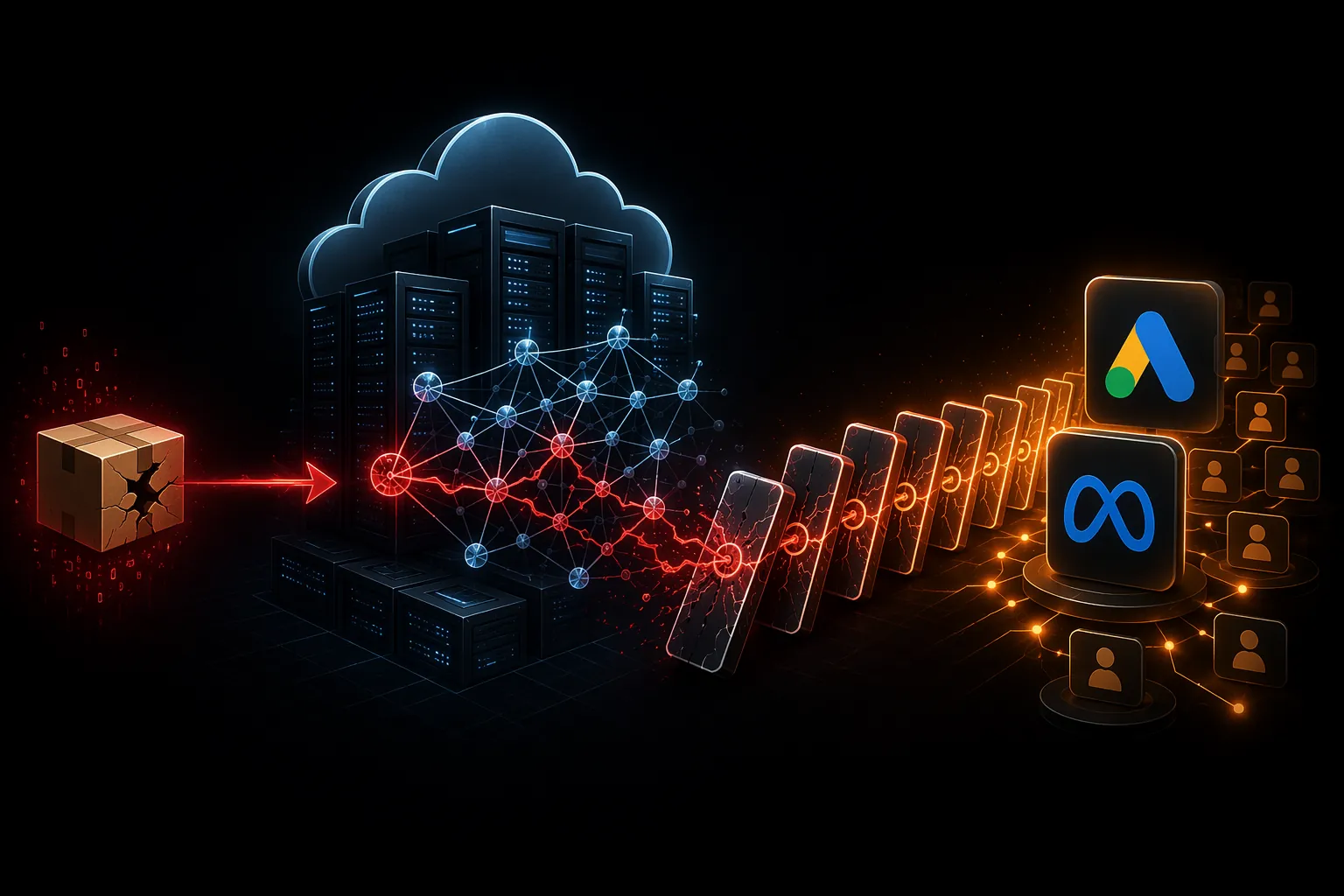
Meta’s decision to indefinitely pause all Mercor contracts after the breach is the part media buyers should notice first. Not the largest file size. Not the most dramatic extortion language. The practical signal is simpler: an AI vendor security incident was serious enough that a major ad platform stopped work with the vendor, at least for an open-ended period, according to WIRED reporting based on two named sources. That makes the Mercor incident one of the clearest 2026 examples of an AI startup breach moving from vendor-risk paperwork into campaign-continuity risk. [1]
For anyone running paid media through AI-assisted workflows, that distinction matters. A vendor breach does not have to mean the ad account itself was hacked to become a campaign problem. It can mean a platform pauses a data relationship. It can mean an optimization vendor loses access while an investigation is underway. It can mean an account lead has to explain why a tool connected to creative testing, audience modeling, reporting, or bidding had credentials exposed somewhere upstream.
The platform pause is the campaign signal
The Mercor breach is easy to misread as an AI-labor-market story or a Silicon Valley data leak. It is both of those things. But for media teams, the more useful reading starts with Meta’s reaction: WIRED reported an indefinite pause on Mercor contracts after the breach, connecting the incident to a platform relationship rather than leaving it in the abstract category of “vendor had a security issue.” [1]
That does not prove that Meta ad accounts were compromised. The available reporting does not establish that attackers took over campaigns, changed budgets, altered audiences, or accessed advertiser accounts through Mercor. The point is narrower and more operational: a breach at an AI vendor can be enough to interrupt platform work, even before public evidence shows downstream advertiser damage.
That is the kind of risk that rarely shows up in a pitch deck. Most vendor evaluations ask whether a tool can connect to Meta, Google, TikTok, a data warehouse, or a creative library. Fewer ask what happens if the vendor’s own dependency chain is compromised and the platform decides the safest move is to stop working with them while the facts are sorted out.
How a poisoned dependency reaches the media stack
The breach chain matters because it did not begin with someone guessing a media buyer’s password. It began upstream, in a software dependency. Strike Graph’s analysis described the Mercor incident as part of a TeamPCP/Trivy attack chain involving poisoned LiteLLM packages distributed through PyPI. LiteLLM’s reach makes that a serious blast-radius problem: Wiz Research estimated LiteLLM was present in 36% of all cloud environments, and Strike Graph reported more than 240 million Docker pulls. [2]
The malicious packages were reportedly live for only a short window, between 40 minutes and 3 hours, but the package had 3.4 million daily downloads. In an environment where builds, containers, and dependency updates are automated, “only a few hours” is not reassuring by itself. A vulnerable package does not need to sit there for weeks if enough systems are configured to pull it quickly. [2]
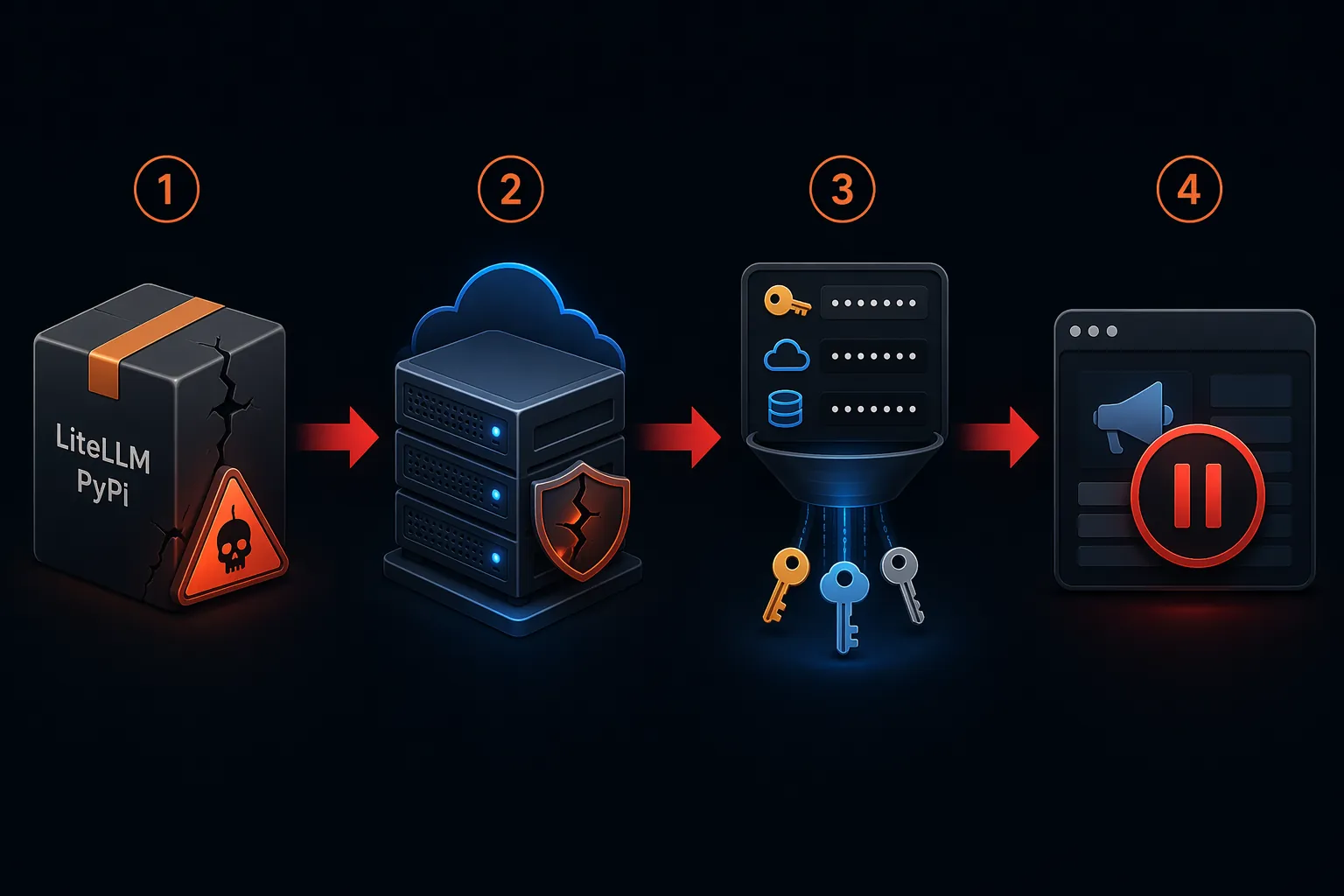
That is the part worth translating into ad operations. Many AI ad vendors are not isolated products sitting beside the campaign stack. They sit between systems: pulling spend and conversion data, generating creative variants, reading product feeds, mapping audiences, scoring leads, producing reports, or pushing recommendations back into platforms. If their infrastructure pulls a compromised dependency, the exposure path can run through the vendor before anyone in the ad account sees an alert.
| Breach-chain step | What it means for media teams |
|---|---|
| Poisoned dependency enters the vendor environment | A tool can be affected through its software supply chain, not only through its own login system. |
| Vendor infrastructure is compromised | Systems that process campaign, customer, creative, or performance data may become exposed. |
| Credentials are harvested | API keys, cloud credentials, and database passwords can become the bridge from vendor risk to account or data risk. |
| Platform relationship is paused or reviewed | Even without confirmed ad-account takeover, a vendor can lose platform access or contract continuity. |
Credential harvesting is where this becomes an ad-account concern
Trend Micro’s analysis of the attack emphasized credential harvesting: API keys, cloud credentials, and database passwords. Those are not abstract secrets in a media environment. They are often the connective tissue between an AI tool and the systems that hold campaign performance data, audience inputs, creative assets, product catalogs, conversion events, and budget instructions. [3]
A stolen API key is not always equivalent to full campaign control. Scope matters. Some keys are read-only. Some are limited to reporting. Some touch a warehouse but not an ad platform. Some can write changes back into campaign structures. The problem is that many commercial workflows blur those boundaries because convenience sells: connect the ad account, connect the CRM, connect the warehouse, connect the creative folder, and let the model optimize across all of it.
That convenience layer is where media buyers need better questions. If a vendor can read Meta campaign performance, export Google Ads search-term data, ingest CRM audiences, or push creative tests, then its credentials have campaign value. If those credentials are stored in a vendor environment affected by a supply-chain compromise, the risk is not just “their system had malware.” The risk is that the attacker may have gained access to the keys that make the vendor useful.
The available Mercor reporting does not show confirmed advertiser campaign takeovers. It does support a more cautious conclusion: the same kind of credential harvesting documented in the attack is exactly the category of failure that can turn an AI vendor breach into an ad-platform exposure problem. [3]
The exposed data was not just embarrassing; some of it could reveal how a vendor thinks
Fortune reported that Mercor confirmed it had been the victim of a major cybersecurity breach. Reporting on the Lapsus$ extortion group’s claims described roughly 4TB of exposed data, including 939GB of source code, a 211GB user database, and about 3TB of video interview recordings. TechCrunch also reported on the breach and the pressure surrounding the $10B-valued startup after the incident. [4][5]
The video and user-database exposure is serious on its own, especially for the people whose data may be inside those systems. For ad teams evaluating AI vendors, the source-code component deserves separate attention. Source code can show how a company builds, routes, scores, stores, or secures data. In an ad-tech context, that could include the logic behind audience modeling, creative-ranking systems, performance predictions, prompt orchestration, or data-matching workflows.
That does not mean Mercor’s exposed code contained advertising optimization logic. The public material summarized in the research does not establish that. The useful implication is about vendor categories: when an AI vendor works on campaign-adjacent tasks, source-code exposure can leak more than application mechanics. It can expose the assumptions and processing logic that clients treat as proprietary advantage.
Where campaign assets actually sit in the risk chain
Most media teams do not hand an AI vendor “the campaign” as one neat object. They hand over fragments that become powerful when combined: platform access, conversion labels, CRM segments, product margins, creative winners and losers, landing-page data, customer lists, call transcripts, feed attributes, and reporting exports. A breach does not need to touch every fragment to create a disclosure problem.
The highest-risk assets are not always the most obvious ones. A final campaign report is sensitive, but a live API key with write permissions is more dangerous. A creative folder matters, but a database mapping high-value customer segments to ad-platform audiences may matter more. A dashboard screenshot is inconvenient; an integration token that can keep pulling fresh data is a continuing exposure.
- Read access to ad-platform performance data can expose spend, conversion volume, CPA, ROAS, creative results, and market priorities.
- Write access can create direct operational risk if a tool can change budgets, pause assets, adjust campaign structures, or publish recommendations automatically.
- CRM and audience integrations can expose customer lists, lead quality signals, suppression groups, and lifecycle-stage data.
- Creative-generation workflows can expose unreleased offers, claims, product launches, brand positioning, and competitor-response plans.
- Warehouse or cloud credentials can turn a narrow marketing-tool breach into a broader company-data incident.
This is why “we use AI only for reporting” is not a complete answer. Reporting tools often have the broadest read access because they need to normalize data across channels. Creative tools may have access to brand assets and landing-page plans. Optimization tools may have the most dangerous write permissions. The label on the vendor matters less than the permissions it holds.
The short package window is not the comfort it sounds like
A common instinct after a poisoned-package incident is to look for duration. If the malicious version was available for only a short time, the incident sounds contained. In manual software environments, that might be more comforting. In modern AI infrastructure, automated pulls change the math.
Strike Graph’s summary is the uncomfortable combination: a malicious package window measured in minutes or hours, alongside 3.4 million daily downloads and a dependency with broad cloud-environment presence. That is exactly the sort of exposure pattern that makes supply-chain incidents hard for buyers to evaluate from the outside. The vendor can truthfully say the window was short while still needing to prove which systems pulled the affected package and what secrets were accessible at the time. [2]
For a media buyer, the follow-up question is not “was this package popular?” It is “did any system that stores or can reach my credentials, campaign data, audiences, or exports pull the compromised version?” That is a narrower question, and it is the one a vendor should be able to answer with dates, systems, scopes, and remediation steps.
Compliance badges do not answer the integration questions
Security questionnaires tend to converge on certifications because buyers need a fast screen. SOC 2 and ISO 27001 can still be useful signals. They are not useless. But they do not answer the most important campaign-specific questions by themselves: which keys are stored, how they are scoped, whether write permissions are necessary, how dependencies are monitored, and what happens to platform access during an incident.
The 2026 Delve controversy made that gap harder to ignore. Strike Graph cited DeepDelver whistleblower analysis claiming that 99.8% of 494 leaked SOC 2 reports contained identical boilerplate text, including pre-written auditor conclusions before clients had submitted company descriptions. That figure should be treated as whistleblower analysis, not as an independently settled measurement of the entire compliance market. Still, it is a useful reminder that a badge can become a substitute for asking whether the actual integration is safe. [2]
The weak evaluation pattern is familiar: procurement asks for the report, the vendor sends the report, the launch date is close, and the permissions request gets approved because everyone wants the test live. Then, months later, no one remembers whether the vendor got read-only access, admin access, warehouse access, or a service account that outlived the campaign.
What to ask before an AI ad vendor gets keys
The useful vendor review now has to be more specific than “are you secure?” It should follow the access path. Start with what the vendor needs to do, then force every requested permission to justify itself against that job.
- Ask whether platform access is read-only or write-enabled, and which actions the vendor can perform inside each ad platform.
- Ask where API keys, OAuth tokens, cloud credentials, and database passwords are stored, encrypted, rotated, and logged.
- Ask which open-source dependencies touch systems that can access client data or credentials, and how compromised packages are detected.
- Ask whether the vendor can isolate one client’s credentials and data from another client’s environment during an incident.
- Ask what happens to active campaigns if the vendor loses a platform contract, API permission, or partner status during a security review.
- Ask for the incident-notification trigger: when clients are told, who tells them, and whether notification waits for full forensic certainty.
The last question is not a formality. In a campaign environment, timing changes the damage. A media buyer who learns about a credential issue quickly can rotate keys, revoke app permissions, pause automation, preserve manual control, and warn stakeholders before a platform notice or public article creates the first internal alert.
The standard should also change by use case. A vendor that generates static copy drafts before upload should not need the same access as a vendor that reads live conversion data and pushes budget recommendations. A reporting connector should not retain write permissions because it was easier during setup. A creative-testing tool should not keep access to customer lists after the test ends.
This is bigger than one startup, but not every number says the same thing
The broader incident data supports caution, though it should be read carefully. IBM’s 2025 Cost of a Data Breach reporting found that 13% of organizations reported breaches of AI models or applications, and that 97% of those organizations lacked proper AI access controls. IBM also reported that 60% of AI-related incidents led to compromised data. Those figures speak to access-control weakness and data compromise across AI environments; they do not prove that ad campaigns usually get disrupted after an AI breach. [6]
The advertising-specific signal is sharper but still broad. IAB research found that more than 70% of marketers had already encountered an AI-related incident in advertising, and 40% had paused or pulled ads as a result. That is about AI-related advertising incidents generally, not specifically open-source supply-chain breaches. It still matters because pausing or pulling ads is the operational consequence media teams recognize immediately. [7]
Together, those numbers make the Mercor-LiteLLM breach harder to dismiss as a strange one-off. They do not justify treating every AI vendor as compromised. They do justify treating AI access controls, dependency exposure, and platform-continuity plans as part of campaign risk instead of leaving them buried in legal review.
The practical standard after Mercor
Media buyers do not need to abandon AI ad vendors because one breach exposed a fragile supply chain. They do need to stop treating “connect the API” as a neutral launch step. Every integration creates a chain of custody: who has the keys, what those keys can touch, where they are stored, which dependencies can reach them, and what happens if a platform pauses the vendor relationship.
The Mercor incident is useful because it connects the whole chain in public view: a compromised open-source dependency, credential-harvesting behavior, large-scale data exposure, and an indefinite pause by Meta. The strongest conclusion is not that every campaign using AI is unsafe. It is that vendor supply-chain security now belongs in the same operational conversation as budget caps, account permissions, conversion tracking, and launch readiness.
A vendor that wants campaign access should be able to explain its dependency controls, credential scope, incident notification process, and platform-continuity plan in plain language. If it cannot, the risk is not theoretical. It is sitting in the same place as the next launch date.
References
- Meta Pauses Work With Mercor After Data Breach Puts AI Industry Secrets at Risk, WIRED
- The Mercor breach exposed Silicon Valley's fragile AI supply chain, Strike Graph
- AI Domino Effect: How One App Breach Toppled Giants, Trend Micro
- Mercor, a $10 billion AI startup, confirms it was the victim of a major cybersecurity breach, Fortune
- After data breach, $10B-valued startup Mercor is having a month, TechCrunch
- IBM Report: 13% of Organizations Reported Breaches of AI Models or Applications, 97% of Which Reported Lacking Proper AI Access Controls, IBM Newsroom, July 30, 2025
- AI Adoption Is Surging in Advertising, But Is the Industry Prepared for Responsible AI?, IAB
Built on this evidence
No Bidding tactic or Creative record currently cites this case file. Compare it against other results in Benchmarks.
Related benchmark reading
Report a corroborating or contradicting result
Seeing something different in your own account? Feed the data-integrity loop instead of leaving an open comment.