What Cannabis Rescheduling Means for Your Paid Ad Campaigns
A platform-by-platform reality check as of July 2026: Google, Meta, TikTok, and X have not changed their cannabis ad policies despite federal rescheduling. Media buyers need to know where the gap between regulation and platform rules actually stands.
- Platform
- Google Ads
- Campaign type
- Search
- Spend range
- Canada pilot
- Timeframe
- 0-07-25
- CTR
- 0
- Verdict
- loss
- Industry vertical
- cannabis
- Last reviewed
- 0-07-25
As of July 25, 2026, the cannabis rescheduling impact on paid advertising is operationally simple and commercially awkward: the federal legal headline has not translated into new campaign eligibility on Google, Meta, TikTok, or X for U.S. cannabis advertisers. If a founder asks whether Schedule III means the brand can now push THC products through major paid platforms, the budget answer is still no.
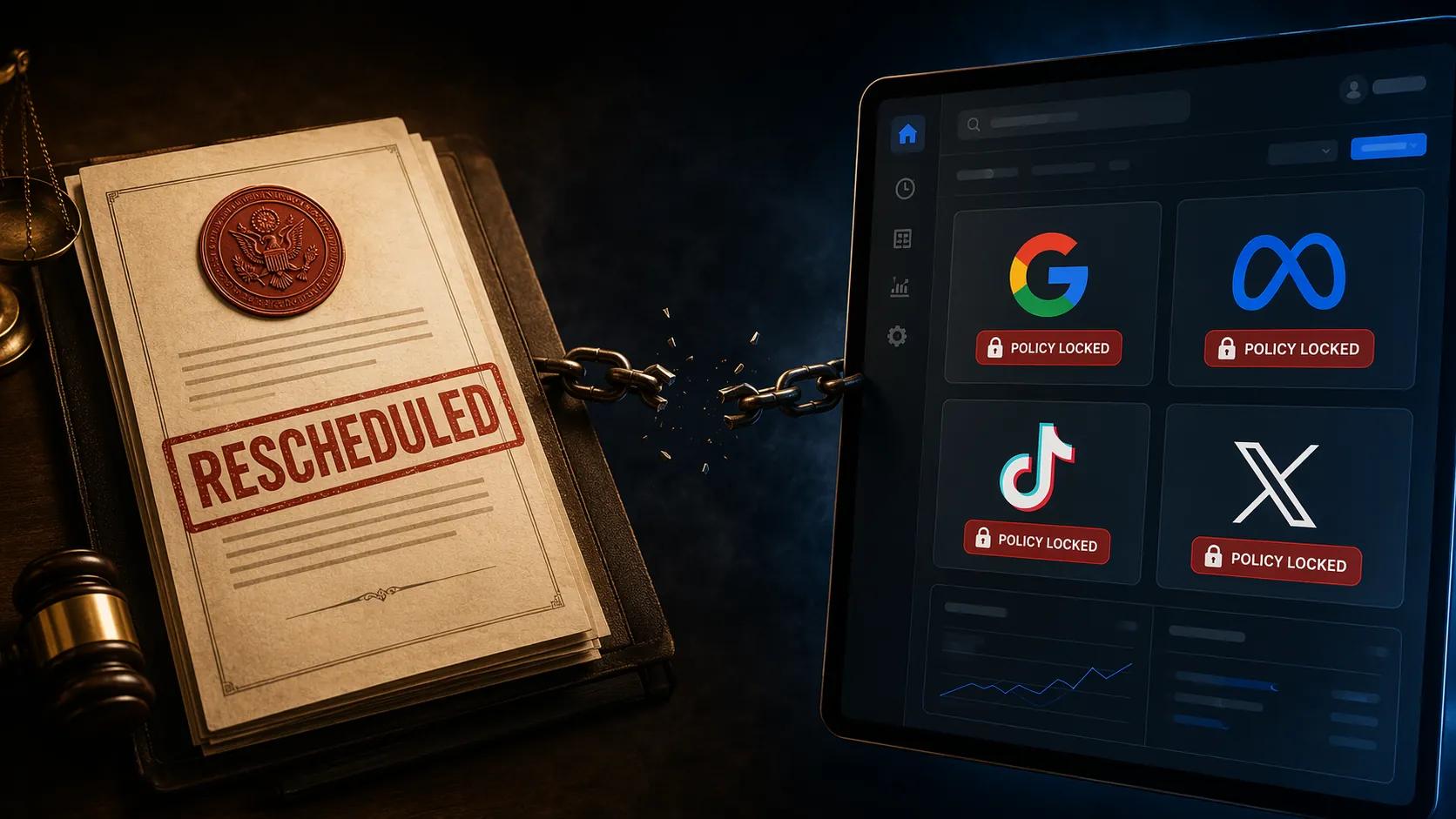
| Platform | Current cannabis ad status | Exception that actually exists | What still cannot run | Source checked |
|---|---|---|---|---|
| Google Ads | U.S. cannabis ads remain prohibited. | Canada-only Search pilot extended through Dec. 31, 2026, for licensed or authorized advertisers. | U.S. cannabis campaigns; Shopping; Display; YouTube; Performance Max as a cannabis workaround. | Google Ads Policy Help Jan. 2026 update [1] |
| Meta: Facebook and Instagram | THC products remain prohibited. | Non-ingestible hemp-derived CBD topicals may run only under certification conditions. | THC; ingestible CBD; smokeable cannabis; recreational cannabis product promotion. | Meta Business Help Center [2] |
| TikTok | Ingestible and smokeable cannabis ads remain prohibited. | Non-ingestible hemp topicals may be allowed with pre-approval from a TikTok sales representative. | THC; ingestible cannabis or CBD; smokeable cannabis; unapproved hemp campaigns. | TikTok Ads Policy [3] |
| X | Closest of the four to open cannabis inventory, but still bounded by strict rules. | Cannabis advertising program first announced in 2023, with 21+ targeting and other controls. | Direct THC product sales, health claims, targeting minors, and campaigns outside policy limits. | NisonCo and TechCrunch reporting [4][5] |
That table is the part that matters for a media plan. Rescheduling may change the legal posture for some cannabis-related activity, but ad accounts do not approve campaigns from Federal Register summaries. They approve, reject, or restrict campaigns against platform policy text, category classifiers, landing-page reviews, certification workflows, and human or automated enforcement.
The costly mistake is treating a legal update as if it has already edited the platform rules. A lawyer may be right that a claim is less exposed after rescheduling. That does not help much when the ad review screen still sees cannabis, THC, ingestible CBD, smokeable products, or an uncertified advertiser and sends the campaign back.
Google: the Canada pilot is real, but it is not a U.S. opening
Google is the platform most likely to be misread right now because it does have a concrete cannabis-related opening. The issue is scope. Google’s January 2026 policy update extended its Canada cannabis Search ads pilot through Dec. 31, 2026, and limits participation to advertisers with the relevant Health Canada licensing or provincial retailer authorization [1].
That does not mean U.S. cannabis ads are newly eligible. It also does not mean a Canadian cannabis advertiser can treat the entire Google stack as available inventory. The pilot is Search-only. It does not open Shopping, Display, YouTube, or a broad Performance Max path for cannabis campaigns [1].
For planning purposes, that makes Google Canada a limited exception, not a signal that U.S. rescheduling has unlocked the channel. If the campaign is a U.S. THC retailer, a multistate operator promoting adult-use products, or a brand trying to route demand through Shopping or YouTube, the policy answer is still functionally closed.
There is also no reliable public performance benchmark to budget from. The research base supports the existence and limits of the pilot, not a defensible CPC, CTR, or conversion-rate model. Any performance numbers circulating from participants should be treated as anecdotal unless the advertiser can verify them directly.
Meta: narrow topical CBD access, not THC access
Meta’s posture is less complicated to summarize because the important line has not moved. Facebook and Instagram still prohibit THC products and ingestible CBD. The available path is narrow: non-ingestible hemp-derived CBD topicals may be allowed under LegitScript certification conditions [2].
That distinction matters in actual account work. A topical hemp balm with the right certification sits in a different review lane from gummies, beverages, flower, vapes, dispensary menus, or THC product pages. Creative wording alone does not turn an ineligible product into an eligible one if the landing page, checkout flow, or brand catalog points back to prohibited cannabis products.
Rescheduling does not erase Meta’s category rules. A buyer can test compliant hemp-topical campaigns if the advertiser satisfies the certification path. They should not forecast Facebook or Instagram as newly available THC acquisition channels in Q3 2026.
TikTok: pre-approval is not a general cannabis lane
TikTok’s cannabis rules land in a similar place with slightly different mechanics. Ingestible and smokeable cannabis ads remain prohibited, while non-ingestible hemp topicals may be permitted only with pre-approval from a TikTok sales representative [3].
That sales-rep condition should not be glossed over. It means the campaign is not simply a self-serve upload with cleaner copy. The advertiser needs the right product category, the right approval path, and a campaign that stays within the platform’s allowed scope. For many cannabis brands, especially those selling THC or ingestible products, that still leaves TikTok outside the paid media plan.
X: closest to open inventory, still not a clean substitute
X is the one platform in this group that deserves a separate note because it has allowed cannabis advertising under a dedicated program. The program was announced in February 2023, making X the closest thing among the four major platforms to open cannabis ad inventory [5].
The constraints still matter. The available reporting describes rules around 21+ targeting, limits on direct THC-product sales, and restrictions on health claims [4][5]. Those are not small details for a cannabis advertiser; they affect creative, audience setup, landing-page design, offer structure, and whether the campaign can be judged on direct-response terms at all.
The other reason to keep a hand on the brake is verification. The current scope and participation levels of X’s cannabis program could not be strongly verified from 2026-dated public sources beyond the available industry summary. That does not make the program imaginary. It does mean a buyer should confirm eligibility, current policy text, representative guidance, and available placements before moving meaningful budget.
Why rescheduling did not rewrite the ad policies
The missing link is compulsion. Vicente LLP’s analysis makes the practical point: private platform moderation decisions are not the same thing as government speech restrictions, and rescheduling cannabis to Schedule III does not force Google, Meta, TikTok, or X to change their ad content policies [6].
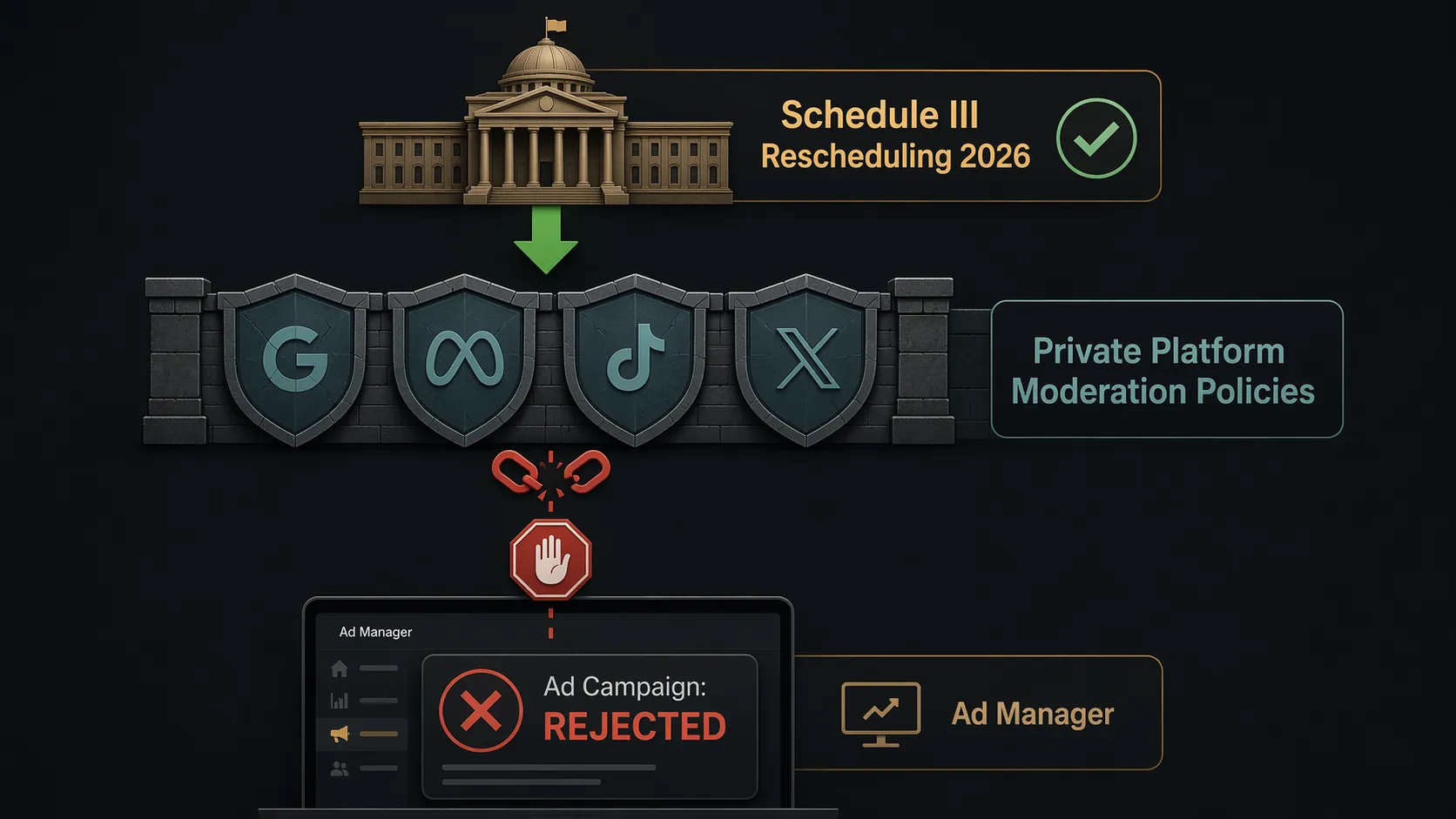
That is the real answer to the question media buyers keep getting. A federal classification change can affect tax treatment, research pathways, medical channels, enforcement priorities, or investment narratives. It does not automatically update a platform’s prohibited-products list, certification requirements, restricted verticals, automated classifiers, or reviewer training.
The April 2026 Final Order also did not make every cannabis product Schedule III. The relevant distinction is narrower: FDA-approved cannabis drugs and state medical-licensed cannabis moved to Schedule III, while recreational cannabis remains Schedule I [6]. For ad eligibility, that distinction only matters if the platform has written a policy path that recognizes it. As of this check, the major-platform policies have not turned that legal distinction into broad U.S. cannabis ad access.
The DEA timeline is still moving, but that is not a media-buying permission slip
The regulatory process is not finished in a way that should be mistaken for platform certainty. The DEA hearing on the proposed rescheduling ran from June 29 through July 15, 2026, and post-hearing briefs are due August 17, 2026 [7]. As of July 25, 2026, the ALJ’s recommended decision and the Administrator’s final order have not been issued [6][7].
Even when that process advances, the buying question remains separate: has the platform policy page changed, and has enforcement changed with it? A regulatory calendar can tell a compliance team what to watch. It cannot tell an agency to load Q3 spend into a channel whose written rules still reject the campaign type.
How to budget Q3 2026 without pretending the rules changed
For Q3 2026 planning, the conservative read is the usable read. Do not build a paid media forecast around the assumption that cannabis rescheduling will soon unlock Google, Meta, TikTok, or X at scale. The current platform rules are the constraint, not the industry headline.
- Treat Google’s Canada Search pilot as a Canada-only, Search-only exception for properly licensed or authorized advertisers.
- Treat Meta and TikTok as limited hemp-topical paths, not THC or ingestible cannabis acquisition channels.
- Treat X as a possible cannabis inventory source that still needs current eligibility confirmation, policy review, and direct platform guidance.
- Check the live platform policy text before launch, especially if copy, landing pages, product assortments, or checkout flows have changed.
- Watch for actual platform policy updates, not only DEA, DOJ, or industry news about rescheduling.
That is not the version a buyer can spend against on July 25, 2026. Budget against the ad policies that exist, not the policy changes the market wants to arrive.
References
- Google Ads Policy Help Jan 2026 update, Google Ads Policy Help, Jan. 2026, link
- Meta Business Help Center cannabis and CBD advertising policy, Meta Business Help Center, link
- TikTok Ads Policy, TikTok Ads Policy, link
- Cannabis Advertising on Twitter/X, NisonCo, link
- Twitter becomes first major social platform to allow cannabis ads in U.S., TechCrunch, Feb. 2023, link
- Cannabis Rescheduling Analysis, Vicente LLP, link
- DEA press release on cannabis rescheduling hearing, DEA.gov, June 25, 2026, link
Built on this evidence
No Bidding tactic or Creative record currently cites this case file. Compare it against other results in Benchmarks.
Related benchmark reading
Report a corroborating or contradicting result
Seeing something different in your own account? Feed the data-integrity loop instead of leaving an open comment.