
What Hochul's Straight Up Lying Accusation Means for AI Ad Verification
The Hochul-Blakeman AI ad controversy reveals that disclosure labels fail to restore trust — and the same verification gap applies to commercial AI ad creative. Media buyers learn why platform-reported AI ad metrics face the same trust collapse and how to adjust their verification process.
- Platform
- Meta
- Campaign type
- Advantage+
- Spend range
- General
- Timeframe
- 0
- ROAS
- 0%
- Verdict
- mixed
- Last reviewed
- 0-07-25
The synthetic version of Gov. Kathy Hochul did not ease viewers into the premise. In one AI-generated campaign video circulated by Nassau County Executive Bruce Blakeman, a fake Hochul appears to say, “Want some crack?”[1] Hochul’s response was just as blunt: she called the ads “straight up lying” and tried to stick Blakeman with a new name, “Bruce Fakeman.”[2]
That line made the fight easy to cover as political combat. But the more useful question for anyone buying media is colder: after a viewer has already reacted to a fake candidate, what exactly is a disclosure supposed to repair?
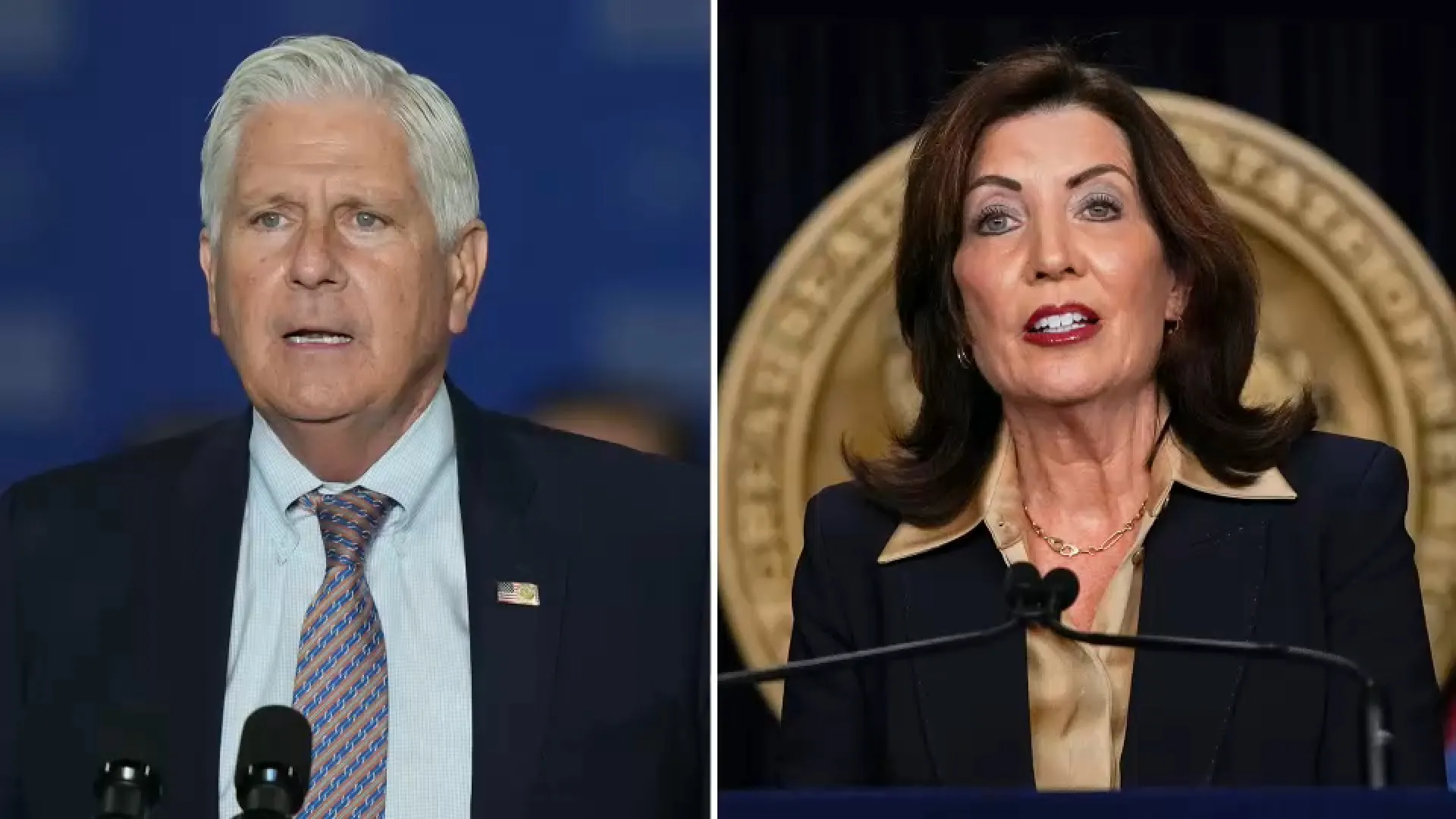
The Hochul-Blakeman fight matters because it shows the same verification problem that already sits inside AI-assisted commercial campaigns. A label can tell people, late and unevenly, that something synthetic happened. It does not prove the viewer understood it. It does not prove every version carried the same notice. It does not prove the platform detected anything independently. And it does not help the person downstream who has to reconcile the public claim against the underlying record.
The Disclosure Trail Was Already Uneven
Newsday’s audit is the part worth sitting with. The paper identified at least 17 AI-generated campaign videos posted by Blakeman between Jan. 1 and July 17, 2026, and found that disclosure compliance varied across the set.[1] Some videos carried disclaimers. Some did not. Newsday specifically noted a June 13 Knicks-themed video without a required disclaimer.[1]
That is the operational failure. The issue is not merely that a political campaign used AI to make an opponent look ridiculous. The issue is that the disclosure system depended on consistent execution by the actor benefiting from the creative. Once the audit finds uneven disclosure across at least 17 videos, the viewer no longer has a stable rule to rely on. Neither does a journalist, platform reviewer, compliance officer, or opponent trying to reconstruct what was live and when.
Columbia political scientist Yamil Velez gave Newsday the hinge that makes this more than a compliance footnote. Disclosure labels “don’t have much of an effect,” he said, because AI ads work through emotional reaction rather than factual belief.[1] That distinction matters. A viewer does not need to believe fake Hochul literally offered crack for the ad to land. The creative is doing its work earlier, in the flash of disgust, ridicule, familiarity, or fatigue.
If the label arrives at the end of the clip, in small type, in inconsistent form, or not at all, it is not functioning like verification. It is functioning like a receipt some viewers may never inspect.
Velez also told Newsday that “people are tired of AI slop,” and that fatigue may begin affecting campaigns; NYU’s Josh Tucker added that there is “no quintessential success story yet” of a candidate breaking through with AI.[1] Those are narrower claims than “AI political ads do not work.” They are better read as a warning about creative quality and trust ceiling. Synthetic content can still get attention. It can still earn coverage. It can still irritate the target. But attention is not the same as persuasion, and disclosure is not the same as credibility.
Viewers Do Not Process Labels Uniformly
ABC7’s July 22 voter segment added a useful reminder: audiences do not respond to AI labels as one clean block. Younger voters interviewed by the station described the ads as “misleading” and said they could “trick people,” while older voters in the segment were more accepting, with one saying people have “gotta go with the flow.”[2]
That is not a statistically representative read on New York voters, and it should not be treated like one. It is still useful because it captures the problem a campaign dashboard can hide. One audience segment may see the synthetic cue and downgrade the messenger. Another may treat the ad as normal political exaggeration. Another may never register the disclosure at all. A single “AI disclosed” field cannot tell you which of those happened.
Commercial creative has the same split. If an AI-generated beauty ad, SaaS demo, restaurant image, or founder video tests well in-platform, the reported aggregate may conceal different trust reactions by age, category, familiarity, and prior brand affinity. The audience that clicks is not always the audience that forgives. The audience that converts once is not always the audience that stays.
That is why the useful benchmark is not simply “did synthetic creative increase CTR?” It is closer to: did the lift survive when checked against sales quality, refund rate, repeat purchase, lead validity, post-purchase survey language, or brand trust movement? Signal & Convert’s AI creative trust-gap benchmark is the more relevant comparison than a clean in-platform engagement win, because the damage usually appears after the platform has already awarded itself the conversion.
The Platform Rules Still Lean on Self-Declaration
The obvious answer is to require labels. The less satisfying answer is that labels are only as strong as the detection, enforcement, and audit trail behind them.
Meta’s March 2026 AI disclosure rule, as summarized by AuditSocials, uses a three-strike enforcement path: ad rejection, then a 24-hour account hold, then possible account restriction or suspension.[3] The same analysis describes the system as relying on honor-system self-declaration rather than automated detection.[3] That matters more than the penalty ladder. A penalty that depends on the advertiser correctly flagging the asset starts with the same weak link as the political disclosure problem.
Google’s July 2026 policy update is different but points to the same weakness. Google says advertisers may show “AI Generated” labels on image and video creatives, and it notes that AI regulations in the European Union, India, and New York require disclosures for certain AI-generated or edited assets.[4] The operational distinction is important: Google permits the label presentation in that policy language; it does not turn every synthetic creative into a uniformly labeled, independently verified asset.
| Layer | What It Can Show | What It Still Does Not Prove |
|---|---|---|
| Creative disclosure | The advertiser or publisher says AI was used | That every version was labeled, that viewers noticed, or that the claim was independently detected |
| Platform enforcement | A rule exists and penalties may apply | That unlabeled AI assets are reliably caught before delivery |
| Reported performance | The platform attributes outcomes to the campaign or feature | That the lift is incremental, durable, or reconciled to business records |
| Independent verification | External data can confirm or challenge the claim | That the platform’s dashboard should be accepted without further checks |
This is where the political ad fight becomes a media-buying problem. A voter asks, “Can I verify what I just saw?” A buyer asks, “Can I verify what the platform says happened?” In both cases, the weak answer is: only if the actor closest to the benefit left enough evidence for someone else to check.
A ROAS Claim Is Not a Verification System
The commercial version of “just label it” is “just trust the dashboard.” Meta has marketed a 22% higher ROAS figure for Advantage+ creative features in 2026. That number should be treated as a platform-reported claim, not as an independent finding.

The reason is not that Meta, Google, TikTok, or any other platform is automatically wrong when it reports lift from AI-assisted creative. The reason is that the platform is measuring inside a system it controls: delivery, attribution windows, modeled conversions, creative selection, optimization signals, and the reporting surface. A reported ROAS improvement can be useful as a diagnostic input. It is not, by itself, proof that profit increased.
The Hochul case shows why the first label in the chain cannot close the file. “AI-generated” does not answer whether the audience understood the manipulation. “Advantage+ creative improved ROAS” does not answer whether the incrementality survived outside the ad account. Both claims need a second ledger.
For a buyer, that second ledger is usually not exotic. It is Shopify or another commerce backend. It is CRM stage quality. It is finance-recognized revenue. It is geographic or audience holdouts where available. It is a post-purchase survey that asks what the customer remembers, not just what the platform attributes. It is a refund and cancellation check after the campaign has already looked good in the dashboard.
The same discipline behind Signal & Convert’s transparency-premium benchmark applies here: the market value is not just in using AI, but in showing enough of the operating record that another party can trust the result without accepting a vendor’s preferred framing.
What Changes in the Verification Workflow
The practical adjustment is not to stop testing AI creative. It is to stop giving AI labels and platform lift claims more evidentiary weight than they deserve.
- Archive the creative as served, including disclosure placement, timing, caption text, landing page state, and major variant changes.
- Separate “AI disclosed” from “AI understood.” Use comments, surveys, complaint logs, and support tickets to catch trust reactions that CTR will not show.
- Reconcile platform ROAS against backend revenue, margin, refund, cancellation, and lead-quality data before calling the test a win.
- Hold out something real when budgets allow: geography, audience cells, time windows, or product groups that let the business compare exposed and less-exposed demand.
- Track performance by segment, especially when synthetic cues may land differently by age, category trust, or prior brand familiarity.
- Document who approved the AI asset, who verified the disclosure, and who signed off on the performance readout.
The last point sounds bureaucratic until something breaks. Then it is the difference between “the platform said it worked” and a usable record of what was shown, what was disclosed, what was sold, and what customers said afterward.
This is also where legal context should stay in its lane. New York’s AI disclosure environment matters because it shapes what campaigns and platforms must account for, and Google’s policy language now explicitly references jurisdictions including New York.[4] But the proposed New York ban has not passed, and the 2024 election law remains an incomplete test of how these rules perform under pressure. For advertisers, waiting for a clean legal answer is slower than fixing the audit trail now.
A buyer does not need to resolve the Hochul-Blakeman fight to learn from it. Treat the AI label as an unverified input. Treat the ROAS claim the same way. Then build the campaign record so someone who did not create the ad, sell the tool, or benefit from the attribution can still verify what happened.
References
- Blakeman is releasing generative AI campaign videos, embracing trend experts say has little effect, Newsday, July 22, 2026
- Bruce Blakeman faces backlash for AI political ads; Hochul calls it lying, ABC7 New York
- Meta AI Privacy Policy & Ad Targeting Changes 2026, AuditSocials
- AI-generated content disclosures, Google Ads Policy Help, July 2026
Built on this evidence
No Bidding tactic or Creative record currently cites this case file. Compare it against other results in Benchmarks.
Related benchmark reading
Report a corroborating or contradicting result
Seeing something different in your own account? Feed the data-integrity loop instead of leaving an open comment.