
What the Costco $14M Settlement Means for Email Subject Lines
The Costco $14M CEMA settlement confirms that false-urgency subject lines expose email campaigns to litigation risk. This article quantifies how replacing those lines with verifiable offers affects open rates, CPA, and conversion, so you can assess the real cost of compliance.
- Platform
- Campaign type
- Promotional email
- Spend range
- Undefined
- Timeframe
- 0-07
- Open rate
- 0%
- Verdict
- Mixed
- Industry vertical
- ecommerce
- Last reviewed
- 0-07-29
The uncomfortable part of the Costco email settlement is not that the subject lines looked exotic. They looked normal. “Today is the last day to access Member-Only Saving” and “Hot Buys available for 5 Days Only” are close cousins of the lines sitting in plenty of retail calendars right now. The Costco matter, Aaland v. Costco, moved toward a $14 million settlement in July 2026, and that makes the spreadsheet problem immediate: if a campaign team retires those urgency patterns, what happens to open rate, CPA, and conversion—and is the performance loss smaller than the legal downside?[1]
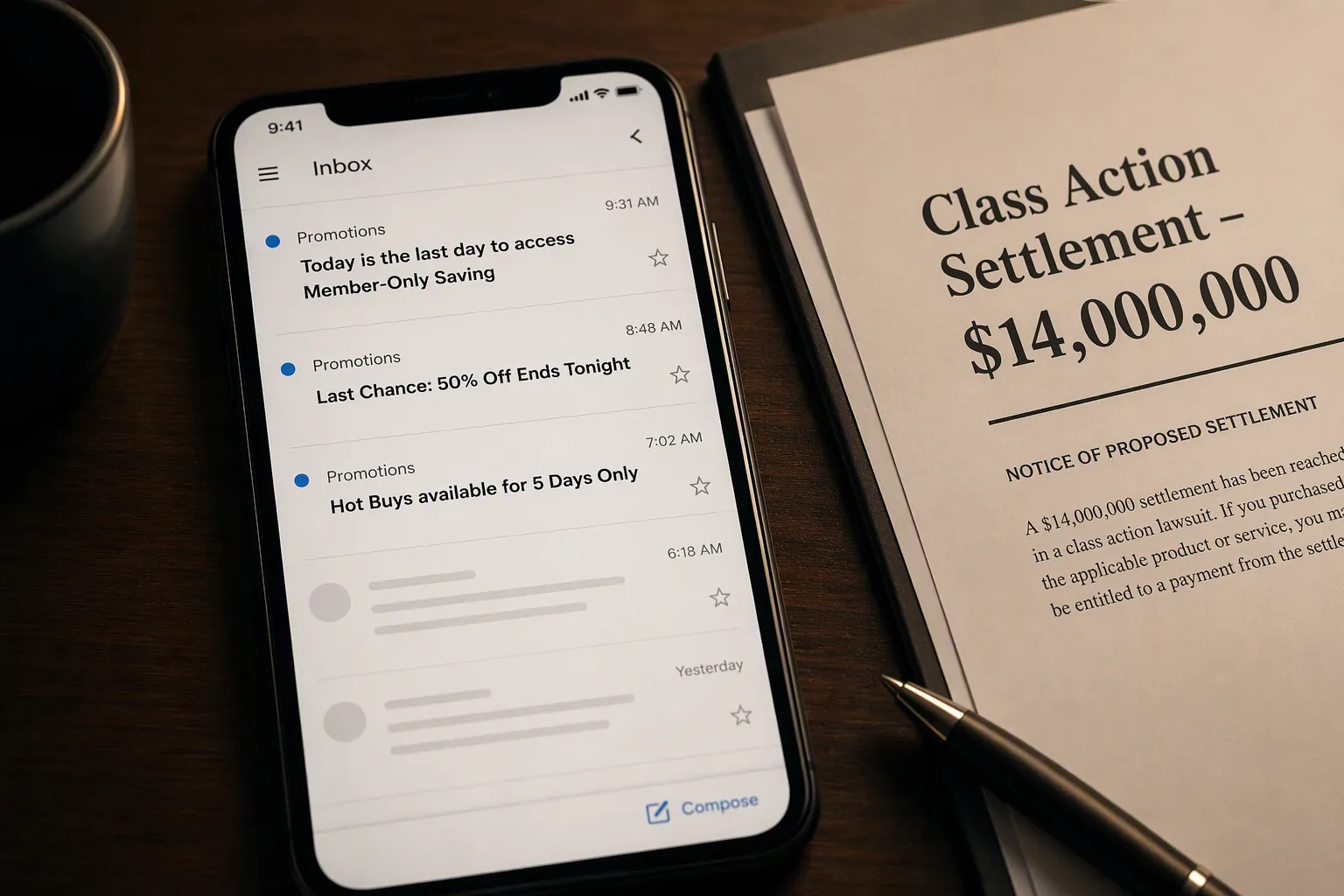
For brands asking how the Costco class action affects email advertising best practices, the answer is narrower than “stop using urgency.” Urgency is not banned. False factual urgency is the problem. If the sale really ends Sunday, say it ends Sunday. If access really closes tonight for that recipient group, the line can reflect that. The dangerous habit is treating scarcity as copy texture when nobody can prove the claim.
That distinction matters because marketers have good reasons to like urgency. Third-party aggregate benchmark data cited by Direction reports roughly a 22% open-rate lift from urgency language, while personalization benchmarks show about a 29% lift.[2] Those are not Signal & Convert campaign results, and they do not prove that any one brand will see the same effect. But they do explain why a growth team does not casually volunteer to remove “last chance” from a promotion that already has a revenue target attached.
Why Washington Changes The Math
Washington’s Commercial Electronic Mail Act is the reason this is not just another CAN-SPAM hygiene discussion. Under CEMA, unlawful commercial email can create statutory exposure measured per message. Before the 2026 amendment, sources analyzing the statute described a $500-per-email framework; after HB 2274, the post-amendment amount is $100 per violation, with potential trebling still part of the risk discussion.[3][4]
HB 2274 took effect on June 11, 2026, and added a knowledge standard: liability now turns on “actual knowledge or knowledge fairly implied on the basis of objective circumstances.” As of July 2026, that standard has not been fully tested in a final appellate ruling, so it should be treated as a meaningful change, not a safe harbor with settled edges.[4]
The other reason Washington deserves its own line item is preemption. Legal analyses of CEMA have emphasized that CAN-SPAM does not simply wipe away state claims based on falsity or deception. A campaign can be CAN-SPAM compliant in the ordinary operational sense—unsubscribe link, physical address, no forged routing information—and still create Washington exposure if the subject line contains a false factual claim.[3]
Brown v. Old Navy is the case marketers need to understand without pretending to be litigators. In April 2025, the Washington Supreme Court treated CEMA as reaching false factual statements in commercial email subject lines, while preserving room for puffery.[5] That means “Our best deals of the season” sits in a different bucket from “Sale ends tonight” when the sale does not actually end tonight. One is loose promotional opinion. The other is a checkable claim about time.
The Exposure Number Is Scary, But It Needs A Label
At the post-HB 2274 $100 level, one campaign sent to 500,000 Washington recipients creates a theoretical $50 million statutory damages figure before any serious argument about constitutionality, certification, settlement leverage, insurance, or collectability. That number is simple arithmetic, not a prediction of a collected judgment.
| Campaign fact | Planning implication |
|---|---|
| 500,000 Washington recipients | One subject-line decision can become a class-wide damages model. |
| $100 post-amendment statutory amount | The theoretical base exposure is $50 million before trebling arguments. |
| False factual urgency | The risk turns on whether the claim can be verified, not whether urgency feels common. |
| No final appellate test of the new knowledge standard as of July 2026 | Legal teams will price uncertainty into approval, even if defendants have arguments. |
The label matters because marketers should not build plans around cartoon damages. Class-wide aggregation of statutory damages can face due-process challenges, and a pleaded maximum is not the same as a check a defendant actually writes. The practical lesson is not “every bad subject line costs $50 million.” It is that the downside has moved out of the nuisance range for brands with meaningful Washington reach.
The litigation pattern also makes it harder to dismiss this as a one-brand problem. Commentators tracking Washington CEMA filings have described a wave of nearly 200 class actions, with recurring theories around sale duration, omitted conditions, and perpetual-sale messaging.[6] That does not prove every claim is strong. It does show that plaintiffs’ firms have a repeatable playbook, and repeatable playbooks are what turn a copy habit into a budget risk.
What Compliance Actually Costs The Campaign
The honest concern from a performance team is that subject-line compliance becomes a hidden tax on acquisition or retention revenue. If urgency language is worth a third-party benchmark lift of roughly 22% in opens, removing it sounds like a direct hit to the top of the email funnel.[2] But that is the wrong comparison if the replacement line keeps a concrete offer, a real deadline, and a reason to open.
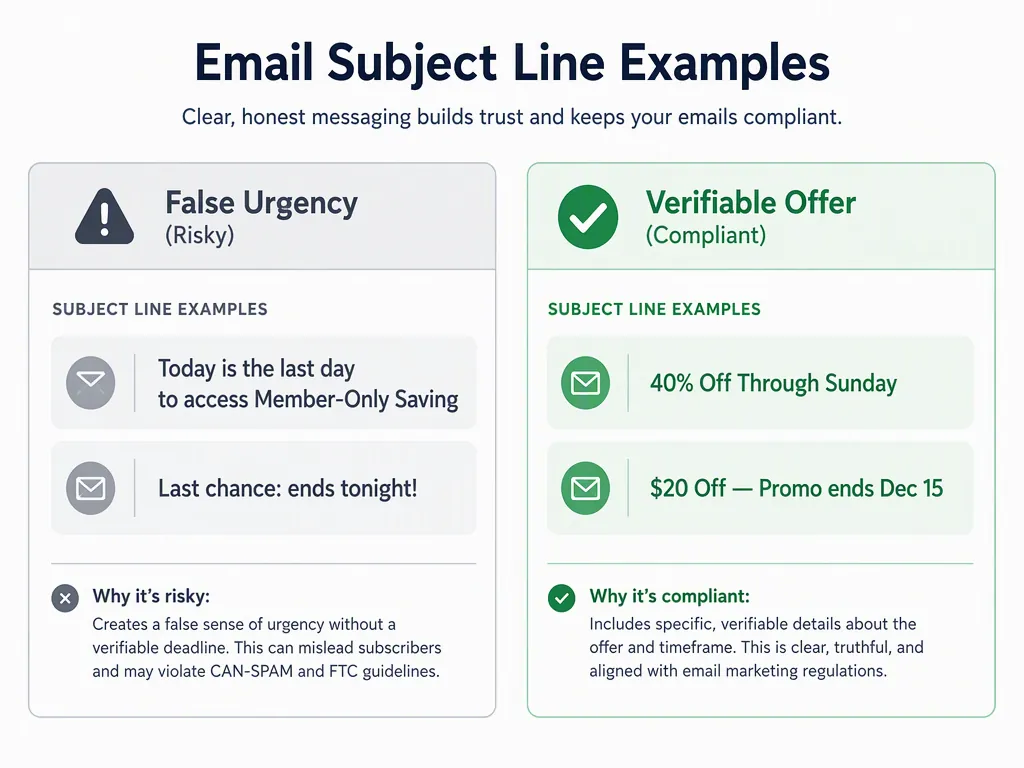
The choice is usually not between “Last chance: ends tonight” and “Newsletter issue 47.” It is between an unverifiable claim and a verifiable offer. “Today is the last day to access Member-Only Saving” can become “Member-Only Savings End July 31” if that date is true. “Hot Buys available for 5 Days Only” can become “Hot Buys Through Sunday” if the promotion is actually constrained to that window. The subject line still gives the subscriber a time-sensitive reason to open; it just stops inventing the fact pattern.
That rewrite logic changes how the performance loss should be modeled. If the old line’s lift came from urgency alone, some open-rate drop is plausible. If the lift came from relevance, discount clarity, brand affinity, and deadline clarity together, the drop should be smaller. The third-party personalization benchmark is useful here because it reminds us that subject-line performance is not a single lever; relevance can carry part of the load when fake scarcity is removed.[2]
For planning, do not model compliance as a total loss of urgency performance. Model it as a substitution: false urgency out, factual specificity in. The campaign may lose the extra push from an aggressive “last chance” frame, but it keeps the offer, the deadline, the audience cue, and the brand relationship. Those are the parts that can still move opens and conversions without asking legal to bless a claim no one can substantiate.
A Practical CPA Way To Think About The Trade
Use your own baseline, not a borrowed benchmark, for the actual decision. Start with the last comparable promotion and separate the email funnel into delivered volume, open rate, click rate, conversion rate, revenue per order, and margin. Then rerun the forecast with a lower open rate for the compliant subject line while keeping the offer mechanics constant. That gives the team a real CPA or revenue-per-send sensitivity range instead of a vague argument about “we need urgency.”
A hypothetical example shows the shape of the decision without pretending to be a real benchmark. Suppose a retailer expects a compliant subject line to reduce opens because it removes “last chance,” but the click-to-conversion rate stays similar because the offer is unchanged. The cost is the incremental orders lost from fewer opens. That number may sting inside the campaign P&L, but it is usually a bounded performance cost. The CEMA problem is not bounded the same way when the send includes a large Washington audience.
That is why the decision belongs in the same conversation as holdout testing and forecast risk, not in a compliance side channel. If the brand can prove that false urgency is generating a measurable lift, the next question is whether a verifiable deadline, clearer discount, or personalized category cue can recover enough of that lift. If the brand cannot prove the line is true, the legal risk is no longer an abstract objection from counsel. It is a campaign-level exposure multiplier.
Rewrite The Claim, Not The Whole Creative System
Most teams do not need a new email strategy by Monday. They need a stricter subject-line rule: every factual constraint in the line must match an auditable campaign condition. Time, quantity, eligibility, discount, and exclusivity should all be traceable to the offer setup.
- Replace “Last chance” with the actual end date when the promotion has one.
- Replace “Today only” with “Ends tonight” only if the offer truly expires tonight for that recipient.
- Replace “Members only” with the real eligibility group if nonmembers can also access the deal.
- Replace vague scarcity with a concrete discount, category, or benefit when inventory limits are not verified.
- Avoid rolling “final hours” language for promotions that routinely restart after midnight.
The cleanest replacements keep the psychological job of the original line. They still answer why the subscriber should open now. They just use facts the company can defend. “40% Off Through Sunday” is not timid copy. “$20 Off—Promo Ends Dec. 15” is not a legal memo. A specific deadline can still create urgency, and a specific discount often improves clarity.
| Risky pattern | Safer rewrite logic |
|---|---|
| “Today is the last day” | Use the actual expiration date or remove the time claim. |
| “Only 5 days left” | Use only if the offer calendar and send date make the count true. |
| “Exclusive member savings” | Use only if access is actually limited to members. |
| “Final hours for 40% off” | Use only if the discount will not continue, restart, or remain broadly available. |
| “Going fast” | Use only if inventory or availability data supports the scarcity claim. |
This is also where approval workflow should get less theatrical. Legal does not need to bless every adjective if marketing can show the offer record. The useful review packet is short: subject line, send date, audience, promotion terms, expiration time, eligibility, and whether the same offer will continue under another name. If those fields do not support the claim, the line changes.
Where The Hard Calls Remain
There are still gray areas. Puffery remains different from factual representation, but the boundary is not a creative playground. “Best deals of summer” may be promotional opinion. “Lowest prices of the year” sounds like a factual comparison unless the company can back it up. “Back by popular demand” may invite a different kind of substantiation question if there is no demand signal behind it.
The knowledge standard adds another unresolved layer. After June 11, 2026, plaintiffs must deal with the amended language, but “knowledge fairly implied on the basis of objective circumstances” can still be uncomfortable for a brand that repeatedly runs expiring-sale language while the same offer keeps returning. Until appellate courts define the standard more precisely, campaign records will matter because they show what the company knew, or should have known, when it sent the email.[4]
Audience geography matters too. A brand that can reliably exclude Washington residents faces a different calculation from a brand that sends nationally and cannot segment with confidence. But many retail and DTC teams do not have clean enough state-level suppression to treat Washington as someone else’s problem. If the list includes Washington recipients, the subject-line rule has to assume Washington exposure.
The Planning Decision
The Costco settlement does not mean every urgency subject line should disappear. It means unverifiable urgency should stop being treated as a harmless conversion trick. The campaign owner’s job is to preserve as much performance as possible with claims the company can prove: real end dates, real discounts, real eligibility, real inventory limits, and accurate personalization.
For a brand that cannot exclude Washington residents, retiring false urgency is the economically safer default. The likely conversion dip from moving to verifiable offer language is a campaign optimization problem. The statutory downside from one bad high-volume send is a balance-sheet problem.
References
- Aaland v. Costco settlement coverage, ClassAction.org / ClassActionU / New York Post / USA Today, July 2026.
- Urgency and personalization email benchmark coverage, Direction / Mailmend.
- Washington Commercial Electronic Mail Act analysis, Stoel Rives / Orrick.
- HB 2274 amendment analysis, Morgan Lewis, June 2026.
- Brown v. Old Navy Washington Supreme Court analysis, Fenwick, April 2025.
- Washington CEMA class action litigation wave analysis, Kelley Drye / Ecommerce Innovation Alliance.
Built on this evidence
No Bidding tactic or Creative record currently cites this case file. Compare it against other results in Benchmarks.
Related benchmark reading
Report a corroborating or contradicting result
Seeing something different in your own account? Feed the data-integrity loop instead of leaving an open comment.