
What the Costco Email Settlement Means for Your Ad Campaigns
Costco's $14M settlement over misleading promo email subject lines reveals a wave of state-level class actions that make false urgency a material financial risk for any email campaign — and CAN-SPAM compliance alone won't protect you.
- Platform
- Campaign type
- Promotional Email
- Spend range
- Not applicable
- Timeframe
- June 2021 - July 2026
- Statutory damages per email
- 500
- Verdict
- loss
- Industry vertical
- Retail
- Last reviewed
- 2026-07-29
The useful Costco email settlement lessons for email ad campaigns are not about whether a retailer should have sent fewer emails. They are about what happens when a subject line makes a timing claim that the offer calendar cannot prove. Costco’s proposed $14 million settlement in Aaland v. Costco was preliminarily approved on June 23, 2026, and the settlement class covers Washington residents who received Costco commercial emails between June 2021 and July 2026, not only people who bought something, opened the email, or clicked through.[1]
That distinction matters. The alleged problem was not a hidden sender, a broken unsubscribe link, or the kind of sloppy affiliate campaign everyone already knows to quarantine. The challenged emails allegedly used urgency language such as “Today is the last day to access Member-Only Savings” when the promotions were allegedly available beyond the stated deadline.[1] Costco denied wrongdoing, and a settlement is not an admission of liability. Still, the operational message is hard to miss: an email can clear the familiar federal CAN-SPAM checklist and still create state-law exposure if the subject line is allegedly false or misleading.[1][2]
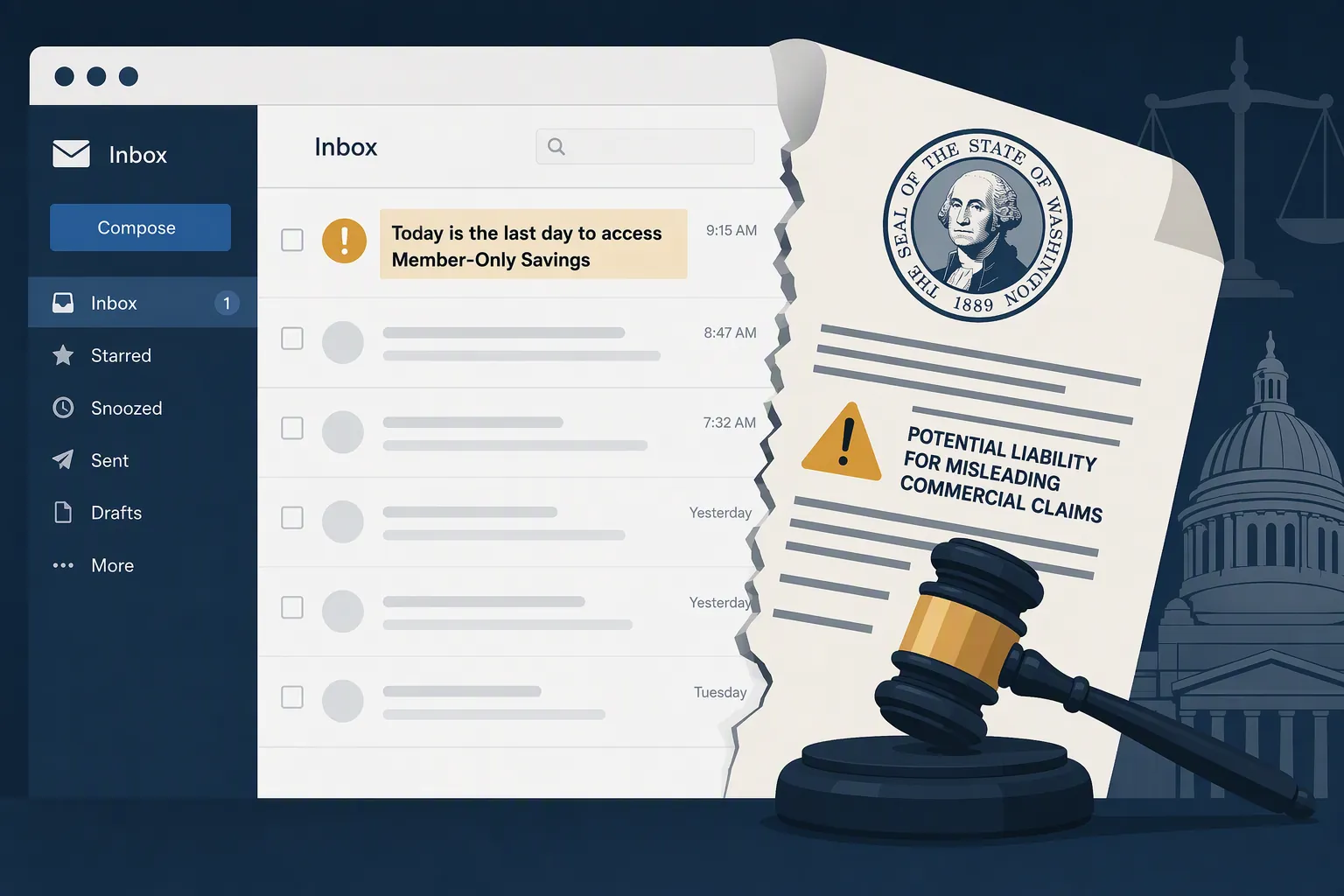
The claim lives in the subject line
For a campaign owner, the uncomfortable part is how ordinary the underlying behavior can look from inside the send calendar. A sale gets extended because inventory remains. A member offer rolls into a second window. A template built for a true deadline gets reused after merchandising changes the end date. A dynamic offer module refreshes, but the preheader and subject line do not. None of that feels like a scheme when the team is trying to get a campaign out before the paid media flight and store signage drift out of sync.
Washington’s Commercial Electronic Mail Act has made that habit expensive because the statute reaches false or misleading information in the subject line of a commercial email. In Brown v. Old Navy, decided by the Washington Supreme Court in April 2025, the court treated false or misleading subject-line information as actionable under CEMA; commentary on the decision has emphasized that industry practices such as rolling extensions, evergreen “ending soon” creative, or dynamically refreshed offers do not excuse an inaccurate subject line.[3]
That is the legal hinge the Costco settlement makes visible. The campaign question is no longer only, “Did we identify ourselves, include our address, and honor opt-outs?” It is also, “Can we prove that the deadline or scarcity claim in the subject line was true for the recipient at the time we sent it?”
Brown turned a familiar copy habit into a filing pattern
Costco is the visible case because the brand is familiar and the settlement number is large. The broader tracker item is the litigation wave after Brown. Law.com reported that more than 100 CEMA lawsuits were filed between April 2025 and April 2026, compared with only eight total in the prior 27 years.[4] That is the number that changes how a growth team should staff approvals. A dormant-looking state statute became a repeat class-action theory almost immediately after the state supreme court clarified how subject-line claims could be treated.
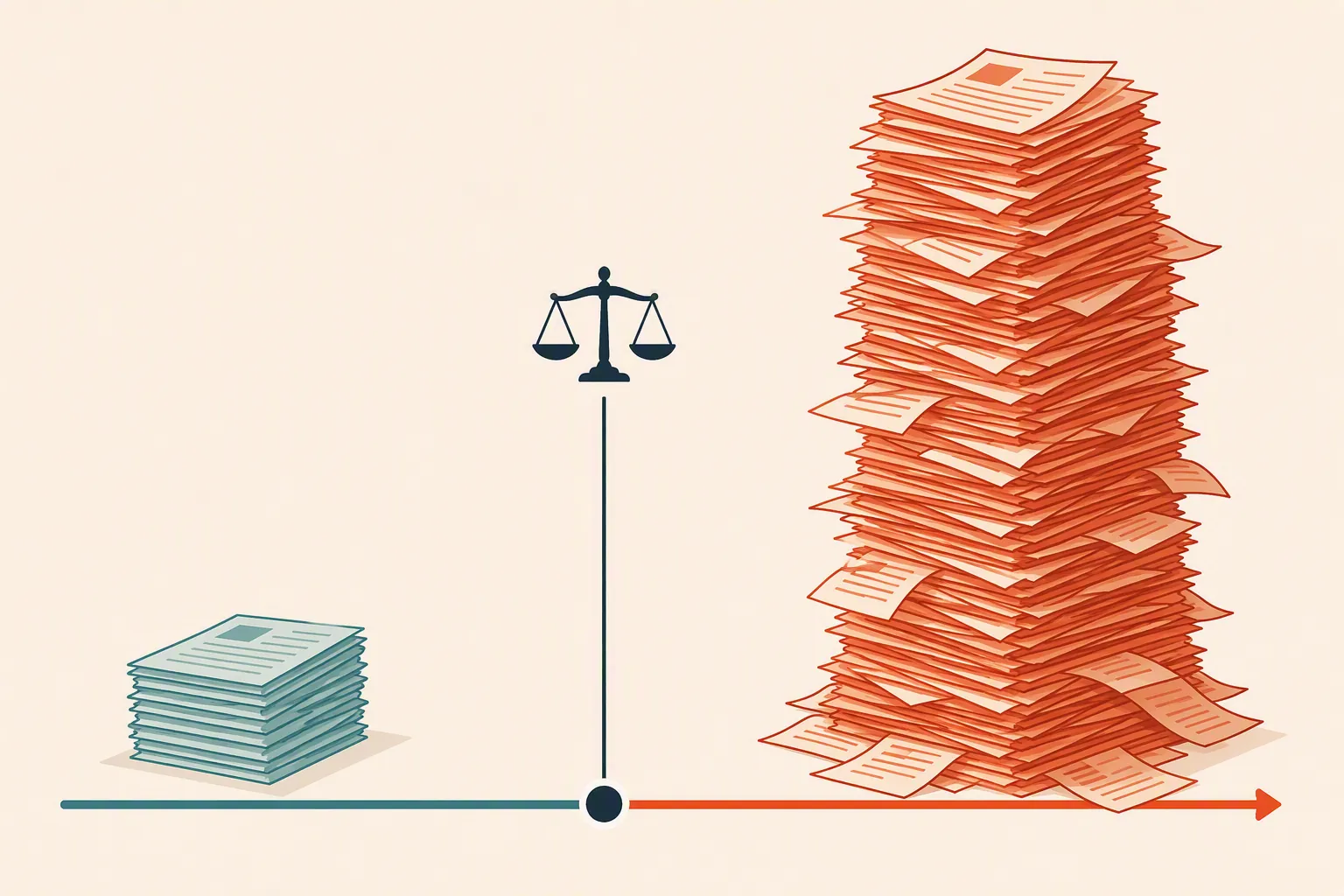
This is why the Costco matter belongs in a dated regulatory tracker, not in a generic “write honest emails” folder. The risk profile changed after a court decision. Plaintiffs then used the same basic theory across retail email programs. A team that had been approving urgency subject lines as normal promotional shorthand suddenly had to treat those lines as liability-bearing claims.
The Lyon Firm has separately described more than 60 retailers sued since Brown and has characterized potential class-wide liability at the pre-amendment $500-per-email level as reaching into the hundreds of millions.[7] That is a plaintiffs-side law firm description, not an independent measurement of success on the merits. It is still useful as a market signal: the theory has been packaged, repeated, and aimed at ordinary promotional email programs.
CAN-SPAM compliance is not the safe harbor people want it to be
The reflexive defense inside many companies will be, “Legal already approved our CAN-SPAM process.” That answer is too narrow. CAN-SPAM compliance addresses federal requirements such as sender identification, opt-out handling, and related disclosures. The Costco reporting says the exposure came from subject-line timing claims even though the emails were described as compliant with the FTC’s CAN-SPAM requirements.[1][2]
The preemption checkpoint is also moving against the easy defense. Federal courts considering Washington CEMA claims have rejected arguments that CAN-SPAM wipes out these state-law theories where the claim is based on alleged falsity or deception rather than mere technical formatting. Faegre Drinker’s January 2026 analysis of Ma v. Nike described a federal court upholding Washington’s CEMA against a CAN-SPAM preemption argument, and Inside Class Actions’ December 2025 review likewise framed the new wave of state anti-spam class actions around unresolved but active preemption fights.[5][6]
For approval workflows, that means the federal checklist is necessary but not sufficient. It should sit beside a state anti-spam review for subject-line truth, especially when the list includes Washington residents. Treating the two as the same review is how a campaign can be “compliant enough” right up until it is not.
The multiplication problem survives the statutory-damages cut
Washington reduced the statutory-damages pressure for new suits, but it did not make the math small. HB 2274, effective June 11, 2026, reduced CEMA statutory damages from $500 per email to $100 per email for lawsuits filed after that date.[1] Costco’s case was litigated under the earlier $500 tier, so the $14 million settlement should not be casually projected onto every new case. The post-amendment number is lower. It is not low.
Take a hypothetical Washington segment of 500,000 recipients. At $100 per email, one challenged send creates $50 million in theoretical statutory exposure before anyone argues about class certification, defenses, settlement discounting, insurance, or claims rates. If the same inaccurate urgency line appears in a resend, a triggered reminder, and a final-day version, the spreadsheet starts looking like a board packet instead of a campaign QA miss.
| Campaign variable | Why it now matters |
|---|---|
| Recipients, not purchasers | The Costco settlement class is based on Washington residents who received commercial emails, not on who bought or opened.[1] |
| Each send | CEMA damages are calculated per email, so duplicate urgency sends can multiply exposure. |
| Filing date | HB 2274 reduced damages for new suits after June 11, 2026, but older cases can involve the prior $500 tier.[1] |
| Subject-line wording | The legally sensitive claim may be the deadline or urgency statement, not the body copy. |
This is also where payout coverage can mislead marketers. A pro rata settlement fund does not mean each Costco class member receives $500. It means the case was valuable enough to fund a class settlement despite Costco denying wrongdoing and despite the absence of a final liability judgment. For operators, the relevant lesson is exposure sizing, not shopper windfall arithmetic.
The map is wider than Washington, but Washington is the immediate workflow problem
Washington deserves priority because Brown created a clear litigation path and because Costco shows how that path can reach a mainstream retailer. Other state anti-spam laws remain relevant, especially for national senders, but the evidentiary record here is not a clean state-by-state comparison. Inside Class Actions has described recent class actions under state anti-spam laws as a broader retail email-marketing trend, while the Washington cases provide the most concrete recent sequence from state supreme court ruling to repeated filings to major settlement posture.[6]
California often comes up in the same conversation because marketers are used to treating California as the high-friction compliance state. That instinct is directionally useful, but it can also lead to lazy benchmarking. Do not paste California penalty figures into a Washington risk memo unless counsel has validated the specific statute, cap, and claim theory. For this Costco tracker item, the supported operating change is narrower and more urgent: segment-aware state anti-spam review for subject-line truth, starting with Washington.
What has to change before the next send
The fix is not to ban urgency. Retail calendars depend on urgency, and accurate deadline messaging is still legitimate. The fix is to stop letting urgency live only in copy. A subject line that says “last day,” “ends tonight,” “final hours,” “today only,” or “member-only savings end soon” needs a source-of-truth record that survives the campaign.
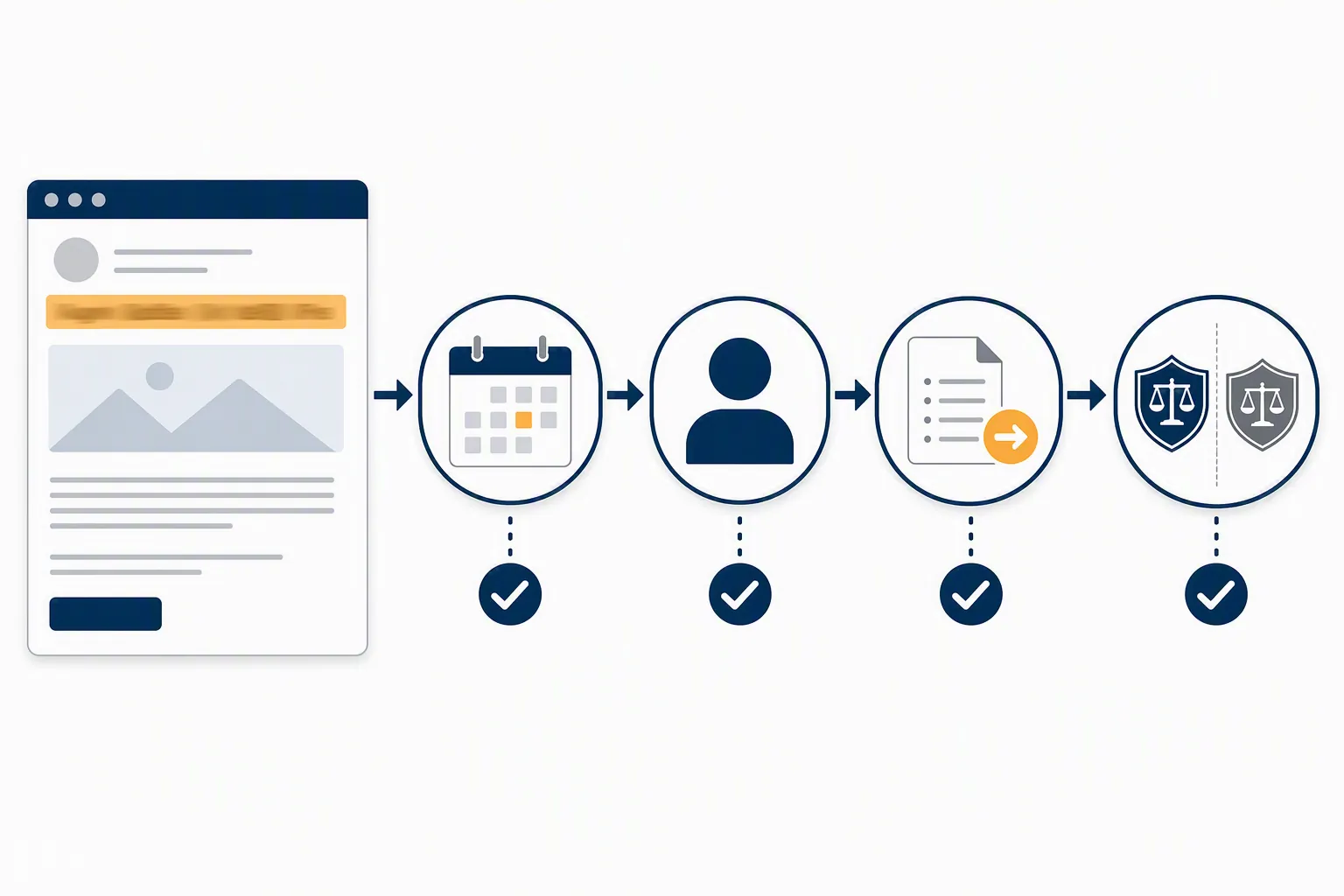
- Document the offer end time before approval. The record should say which offer the subject line references, when that offer ends, and which time zone governs the claim.
- Assign an owner for the deadline. Merchandising, CRM, and paid media can all influence timing, but one person needs authority to confirm whether the subject line remains true at send time.
- Create a rewrite or suppression rule for extensions. If a sale is extended, the campaign should either suppress the urgency version or replace it with copy that no longer claims a false deadline.
- Separate CAN-SPAM approval from state anti-spam review. The federal checklist should not be treated as the final answer for Washington recipients.
- Preserve the approval trail. If the send is later challenged, the team will need more than a screenshot of the final email; it will need the calendar, owner approval, segmentation logic, and any extension decision.
The most failure-prone moment is the extension. A campaign may be accurate when the first version is approved and inaccurate six hours later when a sale window changes. That is why the rewrite rule matters as much as the initial legal review. If the offer extends, the “last chance” subject line should not be allowed to coast through the resend plan just because the creative file already exists.
A practical approval note can be short: “Subject-line urgency verified against promo calendar as of send approval; Washington recipients included; if offer end time changes, suppress or rewrite urgency subject line before any additional send.” That one sentence will not solve every legal issue, but it forces the right conversation before the campaign owner becomes the person explaining why a routine email created statutory-damages math.
The new operating standard is simple enough to enforce: every urgency claim in an email subject line needs a documented offer end time, an accountable owner, a suppression or rewrite rule if the offer extends, and a review step that treats state anti-spam exposure separately from CAN-SPAM compliance.
References
- $14M Costco Settlement Resolves Class Action Lawsuit Over Promo Emails With Allegedly Misleading Subject Lines — ClassAction.org
- Costco's email marketing just turned into a $14 million problem — Quartz, July 27, 2026
- Washington Supreme Court says it's illegal to include any false or misleading information in the subject line of a commercial email — Clark Hill
- 'Sale Ends Today' and the Lawsuit Starts Tomorrow — Law.com, June 2026
- Federal Court Upholds Washington State's Commercial Electronic Mail Act against CAN-SPAM Preemption Argument — Faegre Drinker, January 2026
- Recent Class Actions Under State Anti-Spam Laws — Inside Class Actions, December 2025
- Fake Sale Lawsuits & CEMA Claims 2026 — The Lyon Firm
Built on this evidence
No Bidding tactic or Creative record currently cites this case file. Compare it against other results in Benchmarks.
Related benchmark reading
Report a corroborating or contradicting result
Seeing something different in your own account? Feed the data-integrity loop instead of leaving an open comment.