
How Nvidia's AI Chip Competition Drives Higher Ad Costs
Meta, Google, and Amazon have deployed custom AI chips that cut inference costs by up to 78%, yet average ad CPAs continue to rise. This article explains where the savings go and how chip competition changes the automation leverage media buyers face.
- Platform
- Meta
- Campaign type
- Social Ads
- Spend range
- Various
- Timeframe
- 0
- CPA
- 0
- Verdict
- mixed
- Last reviewed
- 0-07-29
The practical impact of Nvidia AI chip competition on ad platforms is not showing up as a clean discount for advertisers. It is showing up as cheaper infrastructure for the platforms, more room to run automated systems, and a wider gap between what the machine can do internally and what the buyer can see from the outside.
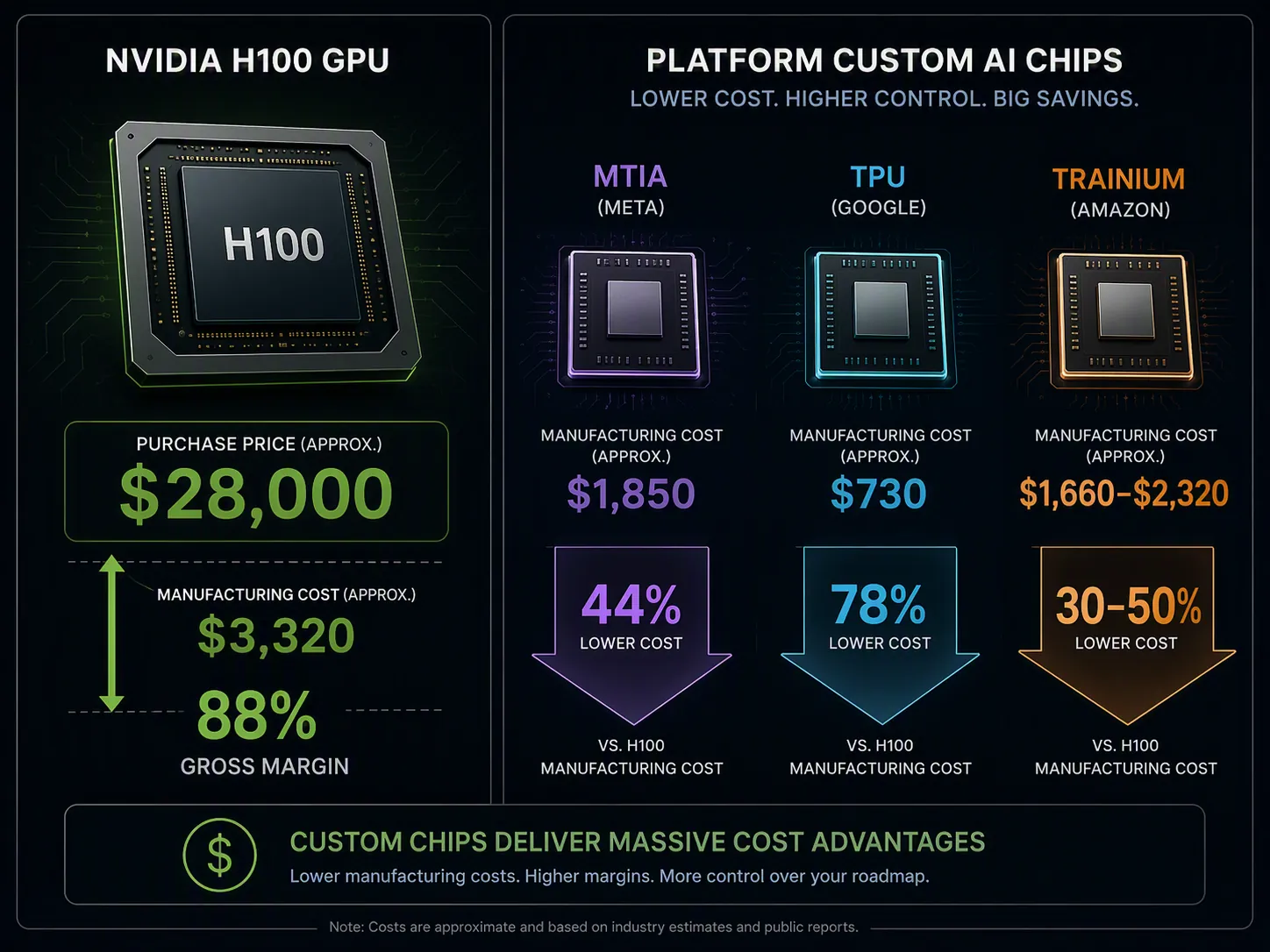
That distinction matters because the chip savings are real. Meta has reported a 44% total cost of ownership reduction versus GPUs for specific DHEN and HSTU ranking and recommendation models running on MTIA, its in-house AI accelerator.[1] Google has said Gemini serving unit costs fell 78% in 2025, helped by its TPU infrastructure.[2] Amazon’s Trainium3 has been described at roughly $1.80 per chip-hour versus about $4.80 for Nvidia H200 equivalents, a discount of more than 50% in that comparison.[3]
Advertisers, meanwhile, do not have a matching line item that says “inference got cheaper, your CPA went down.” The useful reading is narrower: custom silicon lowers the marginal cost of running more AI inside ad systems. It does not prove lower advertiser costs, and the available public evidence does not support a direct claim that MTIA, TPU, or Trainium caused any specific CPA movement. The operating pattern is still important: the cost curve bends inside the platform first, while the control surface often tightens for the buyer.
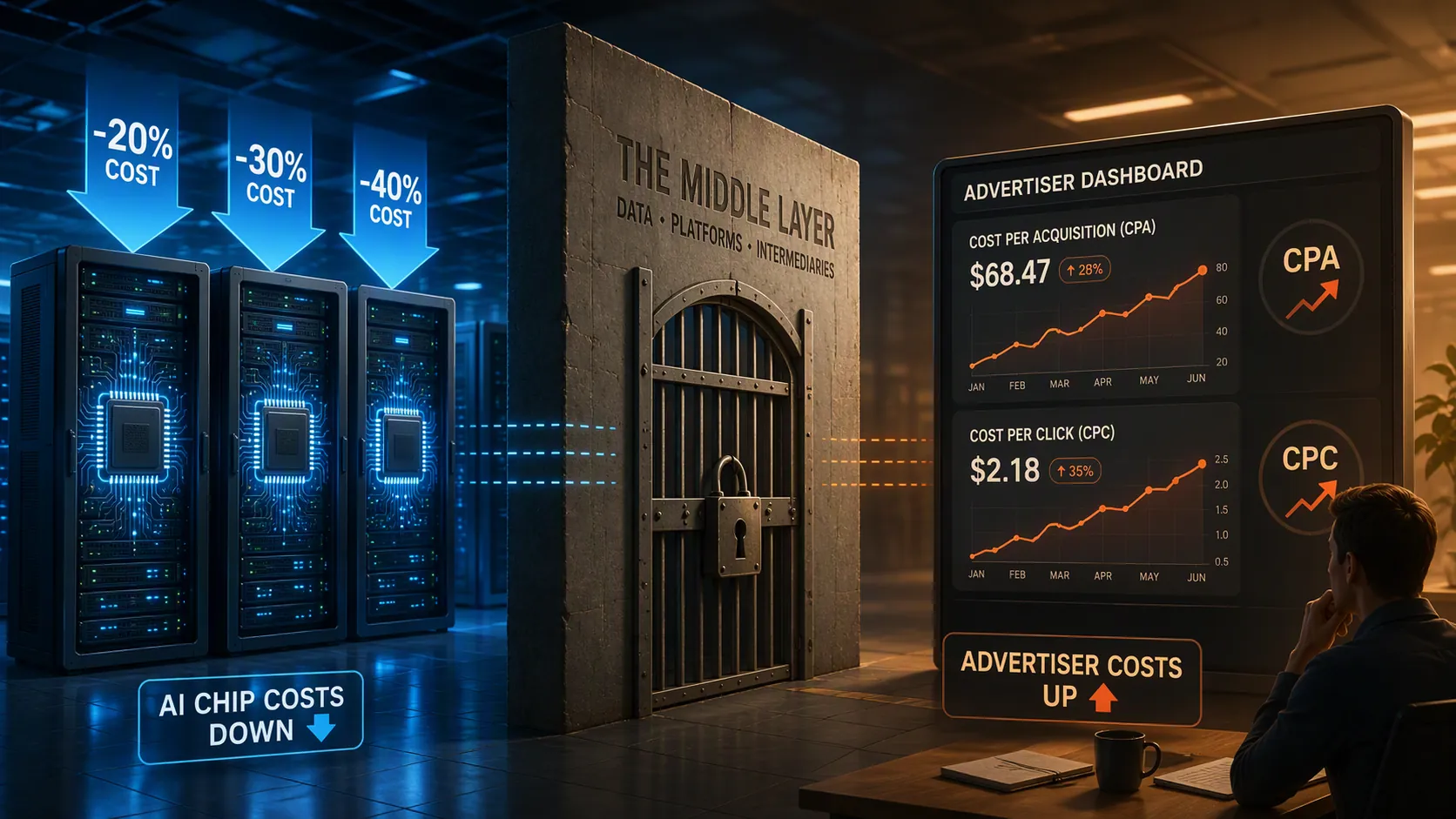
The Chip Savings Are Specific, Not Magical
The cleanest way to read the chip war is as a pressure valve. Nvidia’s economics gave the largest platforms a strong reason to stop renting all of their AI capacity from the same supplier. One analysis put the H100’s manufacturing cost at $3,320 and its selling price around $28,000, implying an 88% gross margin on that accelerator.[4] The same source estimated Nvidia’s data center revenue at $193.7 billion in FY2026 and its AI accelerator market share at roughly 80%, though market-share estimates vary depending on whether training, inference, or total accelerators are being measured.[4]
That margin structure explains the build-versus-buy incentive. It does not by itself explain advertiser pricing. Auction pressure, competition, conversion quality, measurement loss, creative fatigue, budget allocation, and platform policy all still matter. The chip layer is one input into the machine, not the whole machine.
| Platform | Custom AI chip signal | What the public number actually supports | Buyer interpretation |
|---|---|---|---|
| Meta | MTIA deployed for inference across organic content and ads; hundreds of thousands of chips in production | Meta reported 44% TCO reduction versus GPUs for specific DHEN and HSTU ranking and recommendation models | Watch ranking, recommendation, Advantage+ expansion, and creative automation defaults |
| TPU infrastructure supporting Gemini serving; 8th-generation TPU line splits inference and training chips | Google stated a 78% reduction in Gemini serving unit costs in 2025 | Watch Performance Max, AI Max, bidding automation, query expansion, and reporting granularity | |
| Amazon | Trainium positioned as a lower-cost alternative to Nvidia accelerators | Trainium3 was described at roughly $1.80 per chip-hour versus about $4.80 for H200 equivalents in one comparison | Watch retail media automation, Bedrock-connected ad products, creative tooling, and campaign consolidation |
Meta is the most directly relevant case for ad buyers because its chip disclosure connects to ranking and recommendation systems, not just generic AI enthusiasm. The company said MTIA is being used in production for inference across organic content and ads, and CNBC reported in March 2026 that Meta had hundreds of thousands of MTIA chips deployed in its data centers.[1][5] The 44% TCO figure, though, comes from Meta’s own ISCA’25 paper and applies to specific model families. It should not be stretched into “Meta’s whole ad stack is now 44% cheaper.”
Google’s public number is bigger, but it is also attached to a different workload. CEO Sundar Pichai said on an earnings call that Gemini serving unit costs fell 78% in 2025, and CNBC reported in April 2026 that Google’s 8th-generation TPU line separates inference-oriented TPU 8i from training-oriented TPU 8t.[2] That split matters for advertising because real-time ad serving is an inference problem as much as it is a model-training problem: every auction, prediction, bid adjustment, and creative decision has to run fast enough to be usable.
Amazon’s case sits slightly farther from the day-to-day paid media dashboard but belongs in the same analysis. Tech Insider reported that AWS’s Trainium business had a $20 billion-plus annual revenue run rate, that Trainium3 pricing was around $1.80 per chip-hour compared with roughly $4.80 for Nvidia H200 equivalents, and that Trainium powered more than 50% of Bedrock token throughput.[3] For advertisers, the point is not that Trainium automatically lowers Sponsored Products costs. The point is that Amazon can make AI-assisted retail media, creative, and commerce automation cheaper to run at cloud scale.
Where the Savings Go Before They Reach the Advertiser
Ad platforms do not sell inference at cost. They sell outcomes, access, audiences, conversion paths, and software-managed auctions. If the cost of running a ranking pass, a creative generation pass, or an automated bid adjustment drops, the first beneficiary is the platform’s ability to run more of those passes without blowing up its own infrastructure bill.
That extra capacity can go several places before it ever becomes buyer savings. It can support more frequent model scoring inside auctions. It can make broader campaign types economically practical at larger scale. It can power more default-on creative variation. It can fund agentic workflows that recommend, build, and alter campaigns. It can also make reporting less granular because the system is doing more of the decisioning internally and exposing fewer intermediate levers.
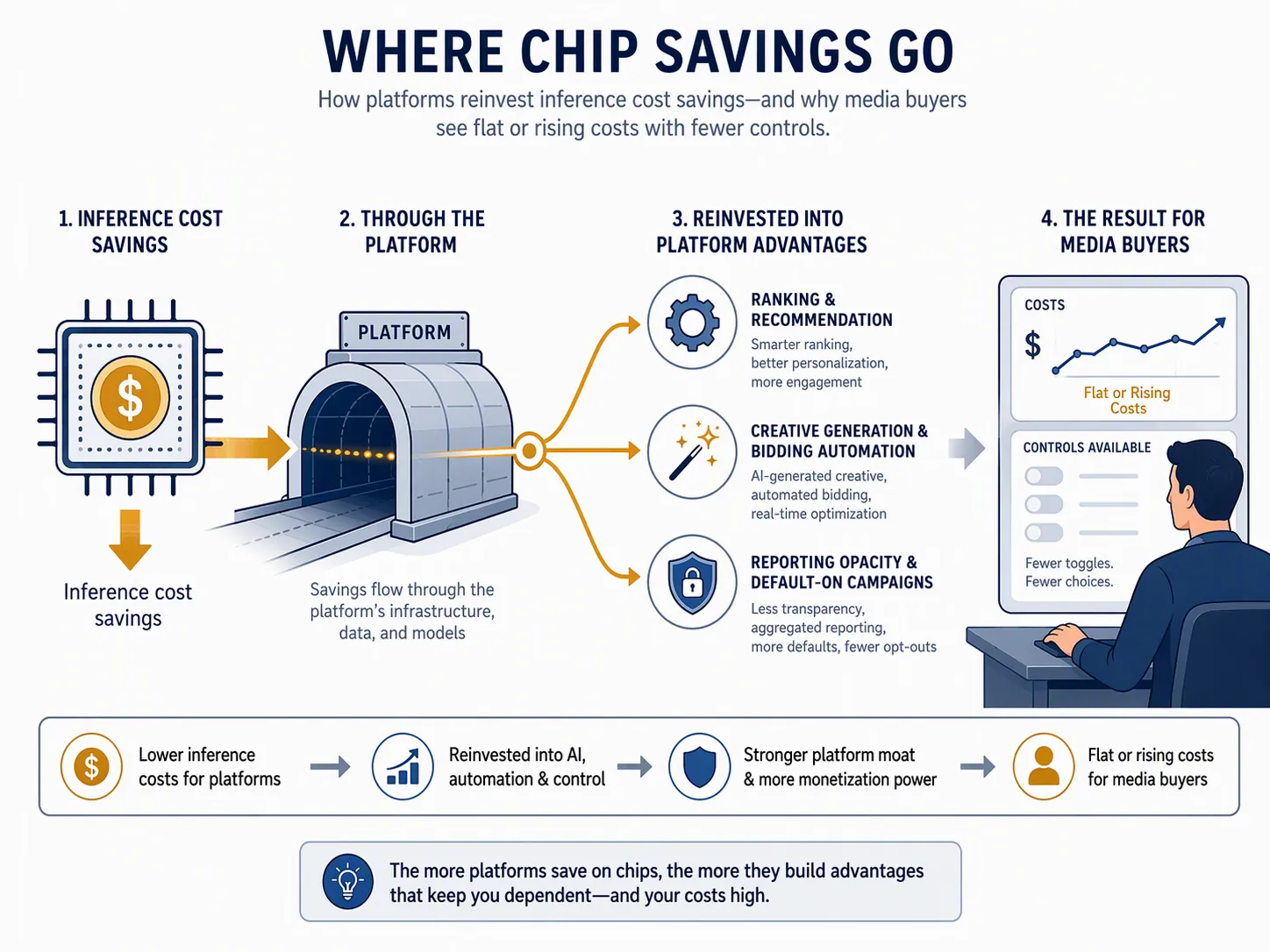
This is why platform claims about AI efficiency need to be separated from account-level efficiency. A platform can reduce the unit cost of serving a model and still ask the advertiser to accept broader targeting, fewer exclusions, less search-term visibility, more automated creative assembly, or campaign structures that are harder to isolate in testing. The platform’s compute efficiency improves its optionality. It does not automatically improve the buyer’s negotiating position.
The uncomfortable middle was described plainly by Omnicom CEO John Wren, who told Digiday that “the marketplace hasn’t seen what the cost of this AI is.”[6] He was talking about a real billing ambiguity: AI costs are being absorbed, bundled, or hidden inside broader service and media economics rather than presented as a transparent pass-through. Custom chips reduce some of that burden for the platforms, but they do not force a rebate mechanism.
The CPA Disconnect Is a Warning Signal, Not a Causal Proof
The tempting version of this argument is too neat: Nvidia chips were expensive, platforms built cheaper chips, and advertisers still paid more, so platforms pocketed the difference. The more defensible version is less satisfying and more useful. Public disclosures show platform-side AI serving and inference savings. Public advertiser benchmarks show rising or volatile acquisition costs in many accounts. No public platform disclosure connects those two lines with a clean causal bridge.
Third-party benchmark aggregators put average Meta Ads CPA at $38.19 in 2026, up 15% year over year. That figure should be handled carefully because third-party benchmark methodology may not match any one advertiser’s vertical, attribution window, conversion definition, or account structure. It is still directionally useful as a check against the idea that platform AI savings reliably turn into lower buyer costs.
Meta’s own Advantage+ performance claims belong in the same caution box. If a platform says an automated campaign type produces higher ROAS or lower CPA in aggregate, that is an adoption and product-performance claim under platform-defined conditions. It is not proof that infrastructure savings were passed through. It also does not tell a specific buyer whether their next dollar of budget will face more automation leverage, less reporting detail, or a cleaner incrementality read.
Why Nvidia Still Matters Even When the Platform Builds Around It
Nvidia is not disappearing from the ad platform stack. The relevant change is bargaining power. When Meta, Google, and Amazon can move more inference onto their own silicon, they reduce exposure to Nvidia’s pricing and supply constraints. That gives them more freedom to decide how much automation to run, where to run it, and which campaign surfaces to rebuild around it.
The broader market is moving in that direction. The Los Angeles Times reported JPMorgan estimates that custom silicon captured 37% of the AI chip market in 2024 and is projected to reach 45% by 2028.[7] Those estimates are not ad-platform forecasts, but they show the same structural movement: hyperscalers want more of the AI cost stack under their own control.
For a media buyer, the competitive framing should be blunt. Nvidia versus custom silicon is not mainly a question of which stock wins. It is a question of whether the ad platform can make automated decisioning cheap enough to become the default operating layer. Once that happens, the debate moves from chip cost to governance: what the buyer can exclude, inspect, test, and explain.
What to Track After a Custom-Chip Milestone
Chip announcements should go into the same operating log as campaign-type changes, reporting changes, and policy changes. Not because they predict next month’s CPA with precision, but because they reveal when the platform has lowered the cost of doing more automated work behind the screen.
- Record the date of each inference-focused chip deployment or serving-cost disclosure, including Meta MTIA production milestones, Google TPU inference launches, and Amazon Trainium adoption claims.
- Map those dates against your own CPA, ROAS, conversion rate, CPM, CPC, and budget-allocation records, using consistent attribution settings before drawing conclusions.
- Watch for automation defaults changing after infrastructure milestones: expanded Advantage+ eligibility, Performance Max or AI Max nudges, creative enhancement defaults, broader matching, and reduced manual exclusions.
- Screenshot and export reporting views before major platform migrations, especially search terms, placement data, creative-level results, audience breakdowns, and asset performance.
- Separate platform lift claims from your account evidence by documenting holdouts, pre/post periods, budget shifts, promo calendars, landing-page changes, and measurement-window changes.
The most useful question after a chip announcement is not “will CPAs fall?” It is “which decision will the platform try to automate next, and what evidence will I still be allowed to inspect?” A serving-cost reduction makes more auction-time scoring possible. An inference-optimized chip makes more real-time recommendations possible. A cheaper token pipeline makes creative generation and agentic account management cheaper to offer by default.
That is the monitoring rule. When a platform announces inference-optimized silicon or large-scale custom-chip deployment, expect the next pressure point to appear in automation defaults, reporting opacity, creative generation, bidding expansion, or campaign-type consolidation. Log the milestone against your own CPA and ROAS records before accepting a platform lift claim at face value.
References
- Meta MTIA: Scaling AI chips for billions of people, Meta AI
- Google launches training and inference TPUs in latest shot at Nvidia, CNBC, April 22, 2026
- Uber AWS Trainium3 Amazon AI chip deal 2026, Tech Insider
- Nvidia AI accelerator market share 2024-2026, Silicon Analysts
- Meta AI MTIA chip data center, CNBC, March 11, 2026
- Omnicom CEO: The marketplace hasn’t seen what the cost of this AI is, Digiday
- Nvidia faces its biggest threat yet as tech giants build their own AI chips, Los Angeles Times, May 6, 2026
Built on this evidence
No Bidding tactic or Creative record currently cites this case file. Compare it against other results in Benchmarks.
Related benchmark reading
Report a corroborating or contradicting result
Seeing something different in your own account? Feed the data-integrity loop instead of leaving an open comment.