
How NVIDIA's Ilya Sutskever Investment Changes Ad Tech Risk
NVIDIA's $5B bet on Ilya Sutskever's SSI lab breaks the circular financing pattern that ties most of its investments to chip purchases. This article explains why circular deals with ad tech partners like PubMatic and Criteo carry structural risk, while SSI poses no near-term threat to the platforms media buyers depend on.
- Platform
- Google Ads
- Campaign type
- Performance Max
- Spend range
- $0 billion
- Timeframe
- July 0
- ROAS
- 0x
- Verdict
- mixed
- Last reviewed
- 0-07-29
The practical answer is less dramatic than the headline looks: Safe Superintelligence is not the ad tech risk. The risk is the broader financing pattern around commercial AI companies that both receive NVIDIA money and depend on NVIDIA hardware to ship products. SSI sits outside that loop, which is exactly why the deal is useful.
On July 27, 2026, NVIDIA and SSI announced a new partnership and investment. NVIDIA’s official language described the investment as “substantial,” while Reuters and TechCrunch reported, citing Bloomberg, that the figure was $5 billion.[1][2] The same reports described SSI receiving access to NVIDIA’s Vera Rubin platform and a roughly 10x compute increase.[1][2]
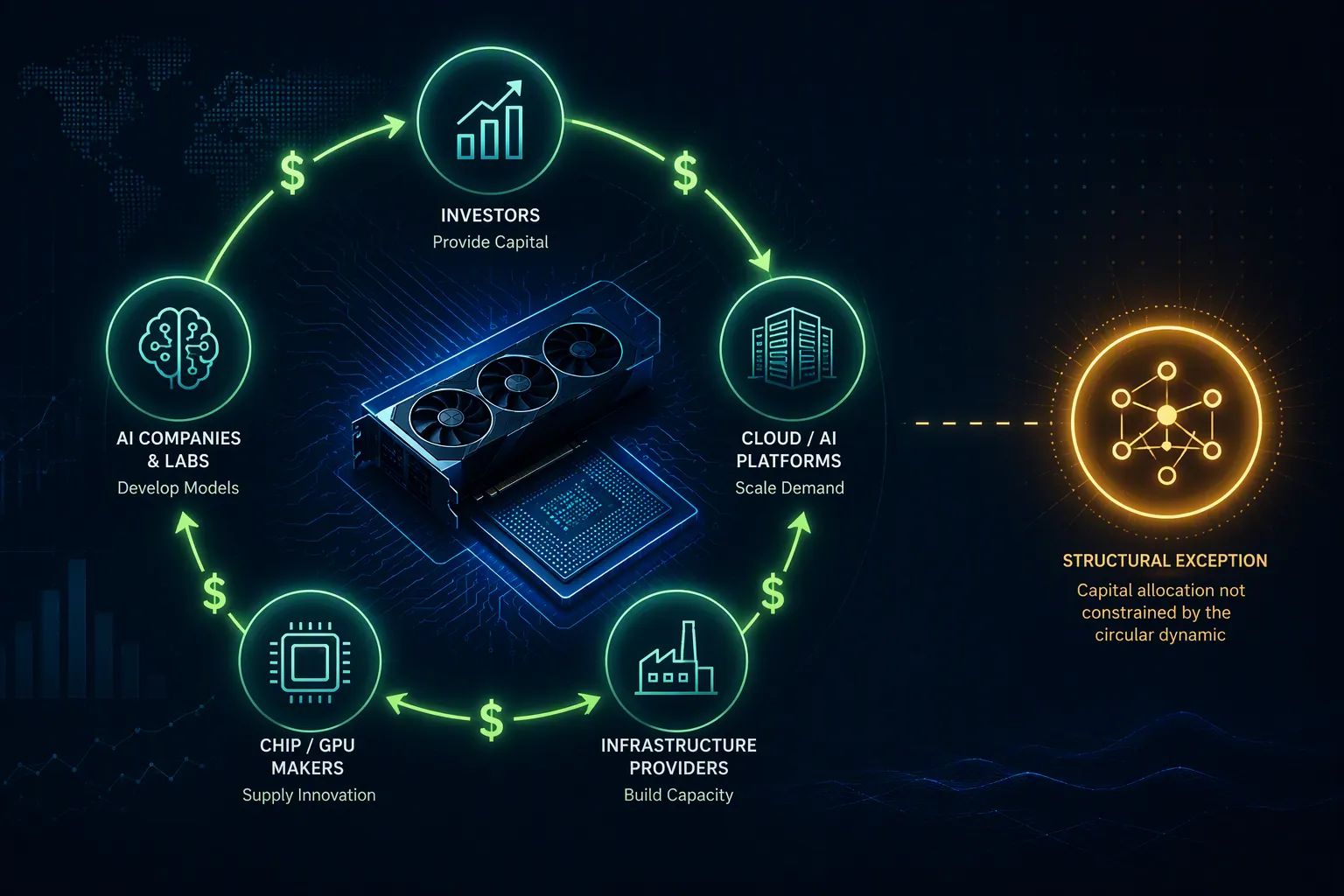
That looks strange if your day job is buying media through AI-shaped dashboards. NVIDIA is already close to platforms and infrastructure vendors that touch auctions, model training, measurement, and data-center capacity. Then it writes, reportedly, one of the year’s largest checks to a lab with no current ad product, no revenue engine, and no obvious path into campaign delivery. The important distinction is that SSI does not appear to complete the return leg that makes circular financing uncomfortable: NVIDIA invests, the recipient buys or reserves NVIDIA chips, the chip demand supports NVIDIA’s own growth story, and everyone in the middle treats the arrangement as strategic infrastructure.
The SSI Deal Is the Exception, Not the Pattern
NVIDIA’s 2026 investment pace is now large enough to matter operationally, not just financially. CNBC reported that NVIDIA had committed more than $40 billion to AI equity investments in 2026, including $30 billion to OpenAI, the reported $5 billion to SSI, $3.2 billion to Corning, $2.1 billion to IREN, $2 billion to CoreWeave, and $2 billion to Nebius.[3] The same coverage contrasted that with $17.5 billion in private AI investments in fiscal 2025, a useful baseline for how quickly the activity accelerated.[3]
Bloomberg’s visual mapping of NVIDIA’s interconnected AI deals, first published in January 2026 and updated in July, made the circularity critique easier to see: capital, chip orders, cloud capacity, and AI product roadmaps increasingly sit inside the same NVIDIA-centered graph.[4] CNBC’s July 27 coverage also noted Jim Cramer’s dot-com comparison, which is a warning signal rather than a verdict.[3] The point is not that every NVIDIA-backed company is fragile. The point is that media operators eventually inherit the plumbing consequences if capital commitments, GPU availability, and product roadmaps become too tightly coupled.
| Deal type | Why it matters to ad tech | Risk read for media buyers |
|---|---|---|
| Circular commercial compute deal | The investee depends on NVIDIA hardware or capacity to train, infer, measure, or deliver AI products. | Monitor pricing, product timelines, and whether promised AI features depend on scarce GPU allocation. |
| Ad tech infrastructure partnership | The NVIDIA layer sits close to decisioning, campaign optimization, or causal measurement. | Monitor whether platform performance claims become tied to hardware refresh cycles or vendor-controlled capacity. |
| SSI-style research investment | The lab has no current ad product, no revenue, and no disclosed chip-purchase obligation. | Do not treat it as a near-term campaign-delivery threat; watch Vera Rubin allocation only as an unconfirmed capacity signal. |
That table is the working filter. SSI belongs in the third row. PubMatic, Criteo, and Alembic belong much closer to the first two.
How Circular Financing Reaches the Campaign Layer
Circular financing is easy to dismiss as a market-structure story until it touches delivery. A media buyer does not care whether a GPU was financed through equity, debt, prepaid capacity, or a cloud partnership when the campaign is live. The buyer cares when the bidder slows down, the measurement model gets pushed to next quarter, the platform adds a fee, or the sales team suddenly starts describing a roadmap item as “early access.”
The mechanism is not mysterious. NVIDIA puts capital into companies that need NVIDIA compute. Those companies use or reserve NVIDIA hardware to build AI services. Their demand supports NVIDIA’s revenue narrative and, in some cases, helps the investee market its own AI capability. If AI demand softens or investors start marking down the loop, the first-order pain may show up in valuations. The second-order operational questions are the ones ad teams should care about: who gets allocation, who absorbs higher infrastructure cost, and which platform promises become dependent on the next hardware shipment.
None of the available sources show that an NVIDIA deal has already raised CPMs, delayed an ad product, or reduced campaign performance. That would be too strong. What the sources do show is a tighter connection between AI infrastructure financing and the ad tech layers that decide, train, and measure. For the cost pass-through path, the related benchmark piece on NVIDIA infrastructure costs and programmatic CPMs is the cleaner companion read. Here, the narrower claim is structural: a vendor’s dependence on NVIDIA compute deserves more attention when NVIDIA is also a capital provider or privileged infrastructure gatekeeper.
Where the NVIDIA Layer Already Touches Ad Tech
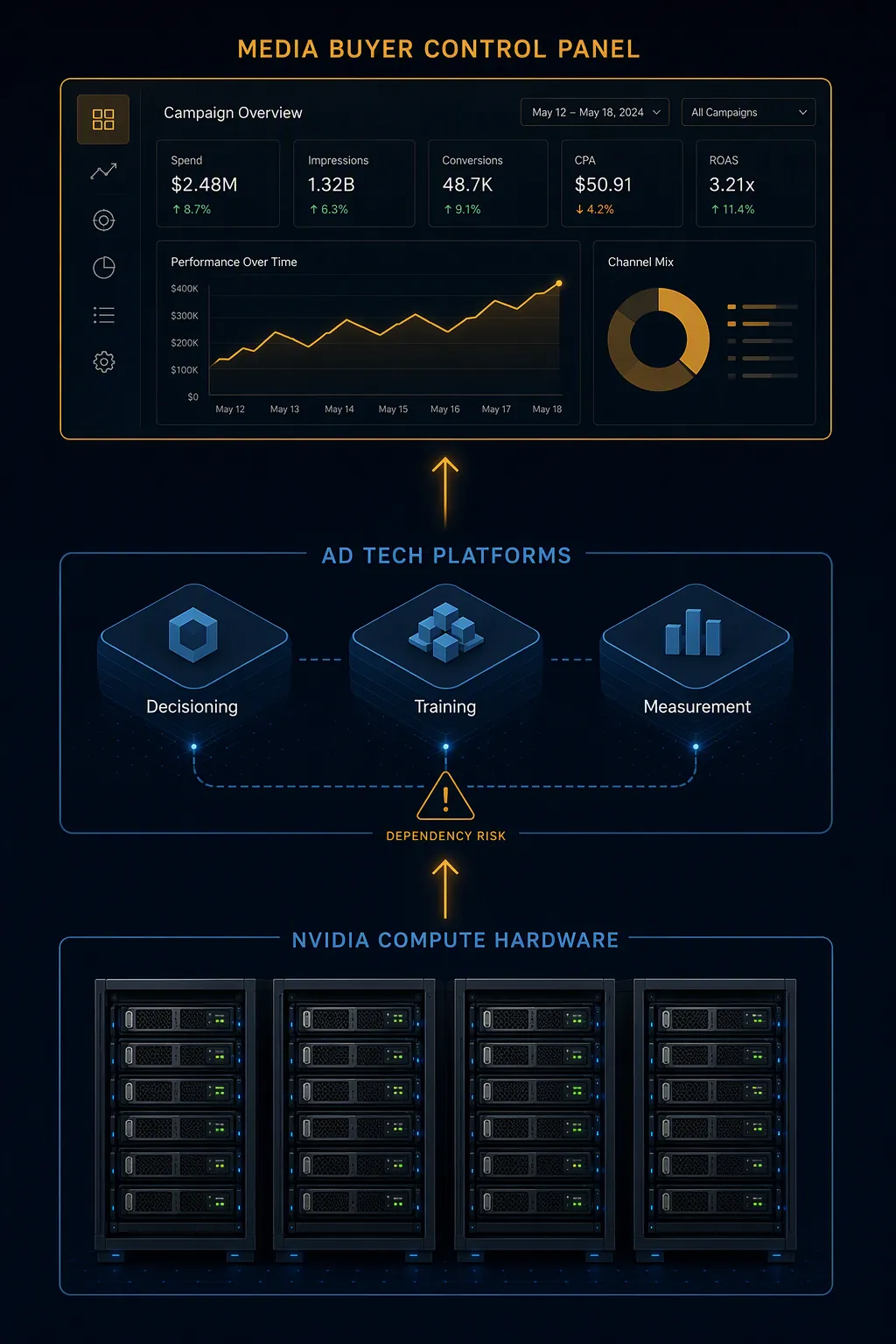
PubMatic is the cleanest example because the claim sits close to auction execution. PubMatic said its work with NVIDIA L40S GPUs delivered up to 5x faster ad decisioning.[5] That is not a vague “AI will improve marketing” promise. Decisioning speed affects how infrastructure handles bid requests, optimization logic, and latency-sensitive programmatic workflows. If a platform’s performance story starts to include specific NVIDIA hardware, then GPU availability and hardware economics become part of the platform’s delivery story, even if they never appear on an insertion order.
Criteo’s case sits one layer up, around model training and efficiency. NVIDIA said at Cannes Lions that Criteo achieved 2x training speedups and saved 17,000 GPU hours per year using NVIDIA technology.[6] Those numbers matter because they describe a platform benefit that can be operational, not decorative: faster training cycles can affect how quickly models incorporate new signals, refresh recommendations, or support new optimization features. But it is still an adoption-and-efficiency claim from the vendor ecosystem, not independent proof that advertisers will see a 2x campaign outcome improvement.
Alembic is different again. The company said on June 17, 2026, that it had secured NVIDIA Vera Rubin SuperPODs for Causal AI.[7] That puts the same next-generation platform family mentioned in the SSI reports into the measurement and causal-inference conversation. SiliconAngle described Vera Rubin as part of NVIDIA’s “agentic AI factory” infrastructure push in July 2026.[8] For advertisers, the relevant issue is not whether every causal model needs Vera Rubin. It is that measurement vendors are now competing for infrastructure that is also central to frontier AI labs, cloud providers, and large model companies.
Put those three examples together and the dependency layer becomes visible. PubMatic points to decisioning speed. Criteo points to training efficiency. Alembic points to causal measurement capacity. These are not peripheral marketing toys; they sit inside the workflow that determines which impression is bought, how a model is refreshed, and how incrementality is explained after the spend is gone.
Why SSI Does Not Create the Same Near-Term Ad Tech Exposure
SSI is structurally odd in a way that lowers near-term ad tech risk. Public company profiles describe Safe Superintelligence as a safety-focused AI lab founded by Ilya Sutskever, with a small team and a stated focus on building safe superintelligence rather than selling a current product.[9][10] The available materials describe no revenue product, no ad platform integration, and no chip-purchase obligation attached to the NVIDIA investment. That does not make the investment small. It makes the loop different.
A circular commercial deal often contains a return path: capital goes out, chip demand comes back. SSI, based on the available materials, looks more like capital plus privileged compute access into a research lab whose output is not currently monetized through campaign tools, ad exchanges, retail media networks, or measurement dashboards. If SSI eventually publishes ideas that influence safety methods, governance, or model behavior, that could matter broadly. There is no sourced basis, though, to say it will affect near-term ad buying workflows.
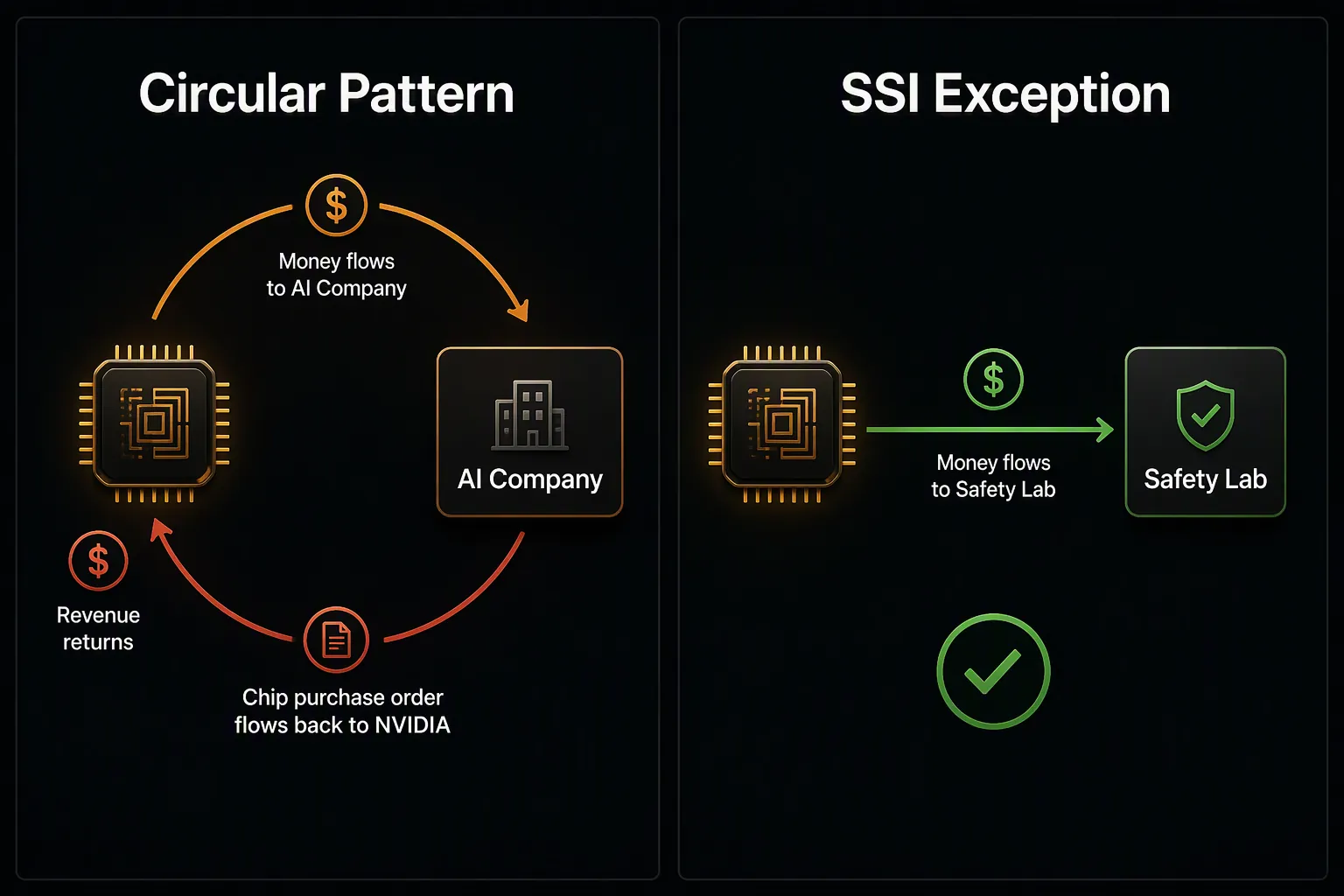
The only SSI-related item worth keeping on the ad tech monitoring list is Vera Rubin allocation, and even that should be labeled carefully. Reuters and TechCrunch reported that SSI would receive exclusive access to Vera Rubin GPUs and a roughly 10x compute increase.[1][2] Alembic separately said it had secured Vera Rubin SuperPODs for Causal AI.[7] It is reasonable to watch whether scarce next-generation capacity becomes a bottleneck across labs, measurement companies, and platform vendors. It is not reasonable, from the current evidence, to claim SSI is taking capacity away from ad tech customers or delaying any specific advertising product.
What Media Buyers Should Actually Monitor
The useful monitoring list is narrower than “anything NVIDIA funds.” A large NVIDIA check does not automatically create ad tech exposure. The higher-risk category is an investee or partner that meets two conditions at once: it depends materially on NVIDIA compute, and it participates in ad delivery, optimization, attribution, or measurement.
- Track platform claims tied to named NVIDIA hardware, especially when the claim concerns decisioning speed, model refresh, attribution, or causal measurement.
- Separate vendor efficiency metrics from advertiser outcome metrics; saved GPU hours and faster training do not automatically equal lower CPMs or better ROAS.
- Watch whether AI features move from standard product access into premium tiers, private betas, or capacity-limited packages.
- Ask whether a roadmap item depends on a specific GPU generation or reserved cloud capacity before treating the launch date as firm.
- Treat SSI as a compute-allocation signal, not as an ad tech platform risk, unless NVIDIA or SSI later discloses a commercial product path into advertising.
This is also where the NVIDIA-OpenAI financing story matters more directly than SSI. OpenAI has a consumer and enterprise product path, possible advertising implications, and a much larger reported financing structure. For that branch of the map, the tracker on NVIDIA-OpenAI data center financing and digital advertising is closer to the campaign-risk lane. SSI is important because it proves not every NVIDIA investment follows the same commercial loop.
The Practical Risk Read
There is no reason for a media buyer to panic because NVIDIA reportedly put $5 billion into Ilya Sutskever’s AI lab. SSI has no current ad product, no disclosed revenue model, no campaign delivery role, and no sourced chip-purchase obligation that would make it part of the circular demand pattern. Its access to Vera Rubin is worth watching only because the same infrastructure family is now showing up around advanced measurement and AI factory buildouts.
The real exposure sits with NVIDIA deals and partnerships where the investee both needs NVIDIA compute and sits close to the advertising stack. PubMatic’s L40S decisioning claim, Criteo’s training-efficiency claim, and Alembic’s Vera Rubin SuperPOD announcement are the kinds of signals that belong on a media buyer’s infrastructure watchlist. SSI is the exception that clarifies the rule: monitor circular commercial compute dependencies, not every impressive NVIDIA headline.
References
- NVIDIA SSI investment report — Reuters — July 27, 2026 — link
- NVIDIA invests in Ilya Sutskever’s Safe Superintelligence — TechCrunch — July 27, 2026 — link
- NVIDIA 2026 AI equity investment coverage — CNBC — May 9, 2026 and July 27, 2026 — link
- Visual guide to NVIDIA’s interconnected AI deals — Bloomberg — January 2026, updated July 2026 — link
- PubMatic NVIDIA L40S ad decisioning announcement — PubMatic — link
- Criteo training speedup and GPU-hour savings coverage — NVIDIA Blog — June 18, 2026 — link
- Alembic secures NVIDIA Vera Rubin SuperPODs for Causal AI — Alembic — June 17, 2026 — link
- NVIDIA Vera Rubin agentic AI factory coverage — SiliconAngle — July 21, 2026 — link
- Safe Superintelligence company profile — Wikipedia — link
- Safe Superintelligence profile — StartupHub.ai — link
Built on this evidence
No Bidding tactic or Creative record currently cites this case file. Compare it against other results in Benchmarks.
Related benchmark reading
Report a corroborating or contradicting result
Seeing something different in your own account? Feed the data-integrity loop instead of leaving an open comment.