
How Nvidia-OpenAI Data Center Financing Reshapes Digital Advertising
A dated tracker connecting Nvidia-OpenAI data center deals to the financial pressure driving OpenAI's ad monetization and the emerging pass-through mechanisms that affect media buyer budgets for H2 2026 and beyond.
- Platform
- OpenAI
- Change category
- bidding
- Effective date
- 0-07-27
- Change type
- opt-in feature
- Impact level
- High
As of July 27, 2026, Nvidia-OpenAI data center financing has moved from background infrastructure news into media planning. The reason is not that a large GPU commitment automatically creates a large ad business. It is that three tracks are now visibly connected: OpenAI’s compute cash burn, its accelerated ad monetization sequence, and the first cost pass-through structures showing up in agency and cloud-dependent marketing economics.
The caveats matter at the start. Nvidia’s September 2025 OpenAI partnership was framed as an intent-based commitment: Nvidia said it intended to invest up to $100 billion as OpenAI deployed at least 10 gigawatts of Nvidia systems, with the first gigawatt expected in the second half of 2026; that is not the same as a fully drawn, unconditional capital transfer on day one [1]. The reported $250 billion financing guarantee tied to OpenAI’s Ohio data center effort is also early-stage and may not close [2]. But buyers do not need either item to be fully settled before asking what the pressure does downstream. OpenAI’s reported $3.7 billion Q1 2026 cash burn, projected 2026 loss, and long-term computing commitments already create a monetization problem large enough to affect ad strategy [3]. Digiday’s July 27 reporting on agencies offering zero-fee structures in exchange for heavy use of principal media inventory is sourced anonymously and should be treated as emerging rather than universal, but it is already close enough to the insertion order to deserve attention [4].

Tracker: September 2025 to July 2026
The useful read is chronological. The infrastructure obligation appears first, then the ad product timeline, then the financing and pass-through mechanisms that turn the story into a budget issue.
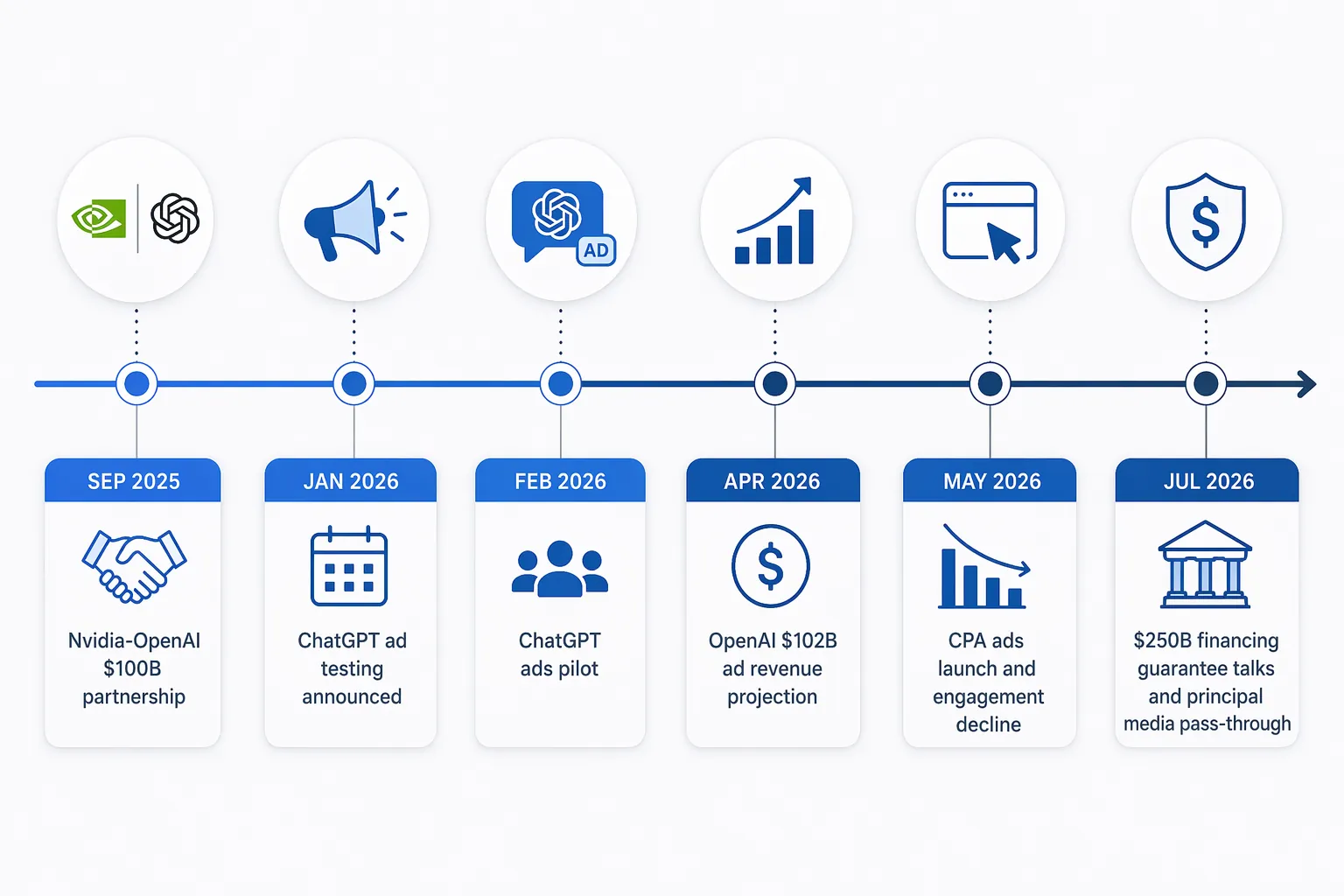
| Date | Source | What changed | Caveat | Advertising implication |
|---|---|---|---|---|
| Sept. 2025 | Nvidia Newsroom | Nvidia and OpenAI announced a partnership to deploy at least 10GW of Nvidia systems, with Nvidia intending to invest up to $100B and the first 1GW expected in H2 2026 [1]. | The commitment was intent-based and staged around deployment. | The compute base behind OpenAI’s future products became a financing story, not just a product capability story. |
| Q1 2026 | Digiday, citing OpenAI financial disclosures | OpenAI reportedly burned $3.7B in cash in Q1 2026, more than half of $5.7B in quarterly revenue, with a projected $14B loss for full-year 2026 and $665B in total computing spending commitments [3]. | Cash burn, loss, and commitments are not the same accounting measure, but all point in the same direction: heavy compute obligations. | A large ad revenue target becomes easier to understand as a financing response, not simply a channel experiment. |
| Jan. 2026 | OpenAI official blog and Digiday coverage | OpenAI published its advertising approach and hired Dave Dugan as part of its ad push [5][6]. | The public language emphasized caution around user experience rather than an immediate full ad rollout. | Buyers got the first formal signal that ChatGPT could become paid media inventory. |
| Feb. 2026 | Digiday | ChatGPT ads pilot activity began [7]. | Pilot activity does not prove scalable performance or auction depth. | Early-test access became worth watching, but not yet worth treating as a mature line item. |
| Apr. 2026 | Digiday summary of Axios/The Information reporting | OpenAI’s internal ad projections were reported at $2.5B in 2026 and $102B by 2030 [8]. | The 2030 number is contested and sits far above some outside chatbot ad market estimates. | The planning question shifted from whether ads would exist to how much ad load, pricing, and attribution pressure would be needed to chase that number. |
| May 2026 | Digiday | OpenAI turned on cost-per-action ads inside ChatGPT and built pixel infrastructure [9]. | CPA ads can reduce advertiser risk, but they require measurement plumbing and enough qualified intent to price efficiently. | ChatGPT started to look less like an awareness surface and more like a performance channel in construction. |
| Mar. 2 to May 11, 2026 | Digiday, citing Apptopia | Daily time spent in ChatGPT reportedly fell 18.3%, from 25.2 minutes to 20.6 minutes [3]. | Engagement data is a signal, not a complete inventory audit. | Any OpenAI ad model has to prove quality and frequency discipline; it cannot rely only on the size of the installed user base. |
| June 2026 | Columbus Dispatch coverage of The Information reporting | OpenAI’s Ohio data center talks were reported as a possible $500B campus effort [10]. | The talks were reported, not completed. | A geographically specific data center negotiation gave the compute financing story a concrete capital-project form. |
| July 26, 2026 | The Wall Street Journal | Nvidia was reported to be in talks with OpenAI over a $250B financing guarantee tied to the Ohio data center plan [2]. | The talks were early-stage and may not result in a closed guarantee. | If financing depends on future OpenAI cash generation, ads, subscriptions, API pricing, and enterprise contracts all become recovery channels to monitor. |
| July 27, 2026 | Digiday | Holding companies were reported to be offering zero-fee arrangements in exchange for advertisers routing more than 70% of spend through principal inventory, with AI costs absorbed inside that structure [4]. | The reporting relies on anonymous agency and CMO sources and does not establish market-wide adoption. | The pass-through issue is no longer theoretical: buyers need to ask where AI infrastructure costs are hidden in fee, media, and platform pricing. |
Why the OpenAI ad sequence matters more than the partnership headline
The $100 billion number gets the headline, but the ad buyer’s question is narrower: what kind of inventory has to be sold to support the economics around that infrastructure? OpenAI’s January-to-May sequence answers more than a generic “AI company enters ads” headline. It shows a move from public positioning, to hiring, to pilot, to internal revenue ambition, to CPA infrastructure.
January established intent. OpenAI’s own advertising post gave the company a way to talk about ads without immediately sounding like a display network, while the hiring signal showed that the work was becoming operational [5][6]. February then moved the issue into pilot territory [7]. At that point, the buyer’s best response was not to reallocate budget; it was to start asking which queries would be commercial, whether ads would be labeled clearly, how brand safety would be handled inside generated responses, and whether reporting would look more like search, affiliate, lead generation, or something else.
April made the pacing problem visible. The reported internal projection of $2.5 billion in ad revenue in 2026 and $102 billion by 2030 is not an established market forecast. It is a reported internal target, and it is contested [8]. That distinction matters because a target can still shape product decisions even if the market never validates it. If a platform is trying to close the gap between modest early ad revenue and a very large future number, the pressure usually appears in some mix of higher ad load, broader eligible query categories, more aggressive bidding products, richer measurement claims, and tighter integration with commerce outcomes.
May is the more important product moment for performance marketers. Cost-per-action ads and pixel infrastructure turn ChatGPT from a possible sponsored-answer environment into something that can be evaluated against CPA, conversion rate, assisted conversion, and incrementality debates [9]. That does not make it efficient. It only makes it buyable in the language a performance team recognizes.
The inventory story is not clean. Digiday, citing Apptopia, reported that daily time spent in ChatGPT fell 18.3% from March 2 to May 11, 2026, dropping from 25.2 minutes to 20.6 minutes [3]. That weakens the easy version of the pitch in which ChatGPT’s audience scale alone solves monetization. Lower time spent does not prove ad inventory will fail, especially if commercial intent is concentrated in fewer, higher-value sessions. But it does force buyers to separate reach from usable, measurable, conversion-oriented moments.
That is also where a separate performance record becomes useful. Signal & Convert’s ChatGPT ads performance failure tracker is the better place to inspect early click and response quality. This tracker’s job is different: it connects the product timeline to the infrastructure financing pressure behind it.
The revenue target collides with outside market ceilings
The outside market context keeps the OpenAI ad story from drifting into either hype or dismissal. eMarketer projected a total chatbot ad market ceiling of $5.41 billion, while the reported OpenAI 2030 ad target would require revenue per query to rise from $0.002 to $0.041, roughly a 20x increase [11]. Those are not equivalent forecast methods, and the comparison should not be treated as a proof that OpenAI cannot build a large ad business. It does show how much monetization intensity the reported target implies.
For a media buyer, the practical translation is simple enough: if OpenAI tries to monetize toward the upper end of that ambition, the platform will need more than polite sponsored suggestions. It will need commercial surfaces that can take real budget, support measurable outcomes, and justify price against search, retail media, social, affiliate, and lead-gen alternatives. That is a high bar for an interface where user trust is part of the product.
This is why CPA pricing is a meaningful development. A CPA product lets OpenAI avoid asking buyers to value raw impressions in an unfamiliar environment. It can say: pay when the user acts. But CPA does not remove platform risk; it relocates it. The buyer still has to ask who defines the action, whether the pixel captures the right conversion, how attribution windows are set, whether ChatGPT receives credit for demand that would have converted elsewhere, and how failed or low-quality actions are filtered.
The pass-through mechanism is already showing up in agency economics
The most immediate budget issue is not whether ChatGPT becomes a top-five ad platform in 2027. It is whether AI infrastructure costs begin appearing inside plans before buyers have a clean way to price them.
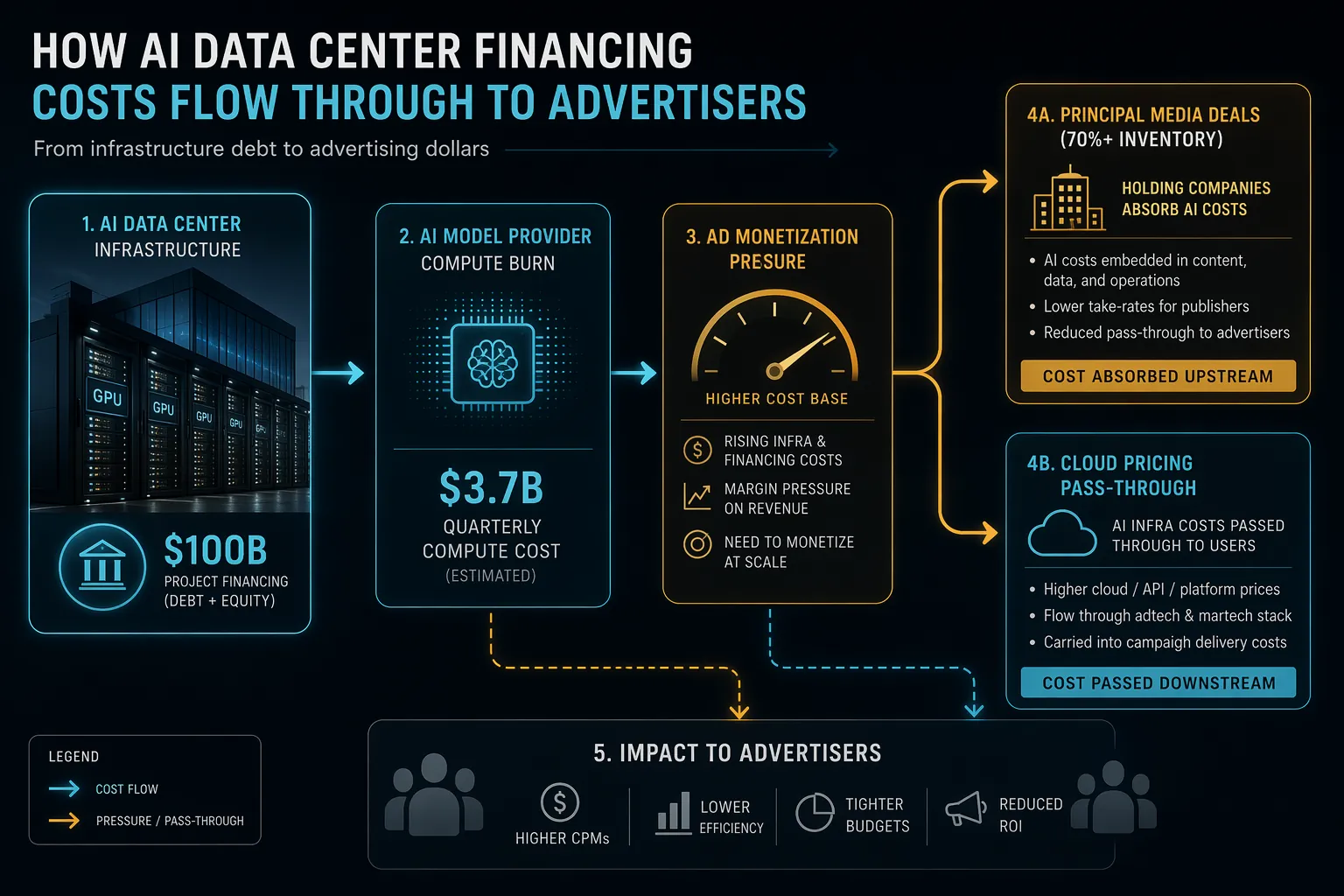
Digiday’s July 27 report is the clearest operational signal so far. It described holding companies offering zero-fee structures in exchange for advertisers putting more than 70% of spend through principal inventory, with the agency group absorbing AI-related costs inside the arrangement [4]. The sourcing is anonymous, and the report does not prove that this is now the default model. Still, a buyer does not need universal adoption to ask whether a proposed “efficiency” structure is being funded by inventory selection, margin, data access, or another cost line.
Principal media already changes the buyer’s control problem because the agency is not only advising on media; it may also be reselling or packaging inventory with its own economics. Add AI costs, and the trade becomes harder to inspect. A zero-fee proposal can look clean in the agency fee column while moving margin into media cost, inventory mix, technology bundling, or opaque optimization layers. The budget did not become free. It became harder to read.
The same Digiday report quoted IAB Europe’s chief economist describing agencies as operating like “futures markets” for AI costs, and noted that advertising still lacks a standard pricing model for AI tokens [4]. That is the line buyers should keep close during H2 negotiations. If there is no common unit price for the AI input, then “AI-enabled efficiency” can hide very different margin assumptions across agencies, platforms, and tools.
The negotiation questions should be specific. If an agency proposes absorbing AI production, planning, analytics, or optimization costs, the advertiser should ask what inventory commitment funds that absorption; whether the 70% principal threshold, or any similar threshold, is mandatory; which inventory is owned, pre-bought, guaranteed, or dynamically sourced; how savings are benchmarked against non-principal alternatives; and whether AI costs are being capitalized into media rates rather than disclosed as technology fees.
This is not a reason to reject principal media on sight. It is a reason to stop evaluating it only as a fee-reduction device. If the advertiser’s plan depends on reach, CPA, ROAS, or incrementality, the plan needs a comparable read across principal and non-principal supply. Otherwise, the AI cost is paid through reduced optionality, weaker auction transparency, or inventory that was selected because it financed the service model.
Cloud and infrastructure costs set the wider floor
OpenAI is the sharpest case because its ad ambitions are now visible, but the infrastructure pressure is broader. Goldman Sachs’ consensus estimate put hyperscaler capital expenditure at $527 billion for 2026, with a possible rise to $700 billion; Q3 2025 capex alone was estimated at $106 billion, up 75% year over year [12]. Those numbers do not forecast ad price increases by themselves. They do explain why cloud-heavy marketing tools, AI creative systems, analytics products, and media platforms have stronger incentives to recover compute costs somewhere.
The ad market is not shrinking around this pressure. IAB’s 2026 outlook projected 9.5% growth in U.S. ad spend, fueled by digital growth and agentic AI [13]. That growth matters because it gives platforms and service providers room to package AI features as value expansion rather than only as surcharge recovery. But growing spend does not make cost recovery disappear; it can make the recovery easier to bury inside larger plans.
For buyers already tracking energy and cloud pass-through, this Nvidia-OpenAI line should sit beside the data-center electricity ad cost tracker and the Alphabet negative free cash flow benchmark. The shared question is not whether infrastructure spending is impressive. It is where the recovery shows up: higher platform fees, stricter packaging, changed auction incentives, reduced service flexibility, or new ad products launched before performance proof is mature.
What to monitor in H2 2026 and 2027
The Nvidia-OpenAI pipeline does not justify a blanket budget shift into or away from ChatGPT ads. It does justify a standing line of questioning in every plan that touches AI media, AI production, AI analytics, or principal inventory.
- Watch OpenAI ad load, not only ad availability. A new CPA surface is only useful if commercial placements remain scarce enough to protect user trust and strong enough to generate qualified actions.
- Separate OpenAI’s reported internal revenue ambitions from external market estimates. The $102B 2030 figure should be treated as a pressure signal, not a planning baseline.
- Ask how CPA is defined. Buyers need action definitions, attribution windows, deduplication logic, refund or invalid-action policies, and visibility into assisted versus last-touch credit.
- Interrogate principal media “AI cost absorption.” If a zero-fee structure depends on routing most spend through principal inventory, the advertiser should model the media trade-off against independent inventory and transparent service fees.
- Model cloud and platform price pass-through. AI-heavy martech, creative automation, measurement, and media optimization tools may recover infrastructure costs through usage tiers, bundled features, minimum commitments, or reduced service flexibility.
- Keep the Ohio financing line live. The $250B guarantee talks are not closed, but if they advance, they will strengthen the link between OpenAI’s infrastructure obligations and the need for large-scale revenue channels.
For now, the planning readout is narrow: do not treat Nvidia-OpenAI data center financing as a separate enterprise-tech story. Treat it as a live ad-market variable until the next dated update.
References
- NVIDIA and OpenAI Announce Strategic Partnership to Deploy 10 Gigawatts of NVIDIA Systems, Nvidia Newsroom, Sept. 2025
- Nvidia in talks with OpenAI over $250 billion financing guarantee for Ohio data center, The Wall Street Journal, July 26, 2026
- OpenAI’s infrastructure cash burn and ChatGPT engagement trends, Digiday, May 2026
- Holding companies use principal media to absorb AI costs, Digiday, July 27, 2026
- Our approach to advertising, OpenAI, Jan. 2026
- OpenAI tests ChatGPT ads and hires Dave Dugan, Digiday, Jan. 2026
- ChatGPT ads pilot launches, Digiday, Feb. 2026
- OpenAI internal ad revenue projections reported by Axios and The Information, Digiday, Apr. 2026
- OpenAI turns on cost-per-action ads inside ChatGPT, Digiday, May 2026
- OpenAI data center talks in Ohio, The Columbus Dispatch, June 2026
- Chatbot advertising market forecast, eMarketer
- Hyperscaler capex consensus estimate, Goldman Sachs, Dec. 2025
- 2026 Outlook Study, IAB, 2026
Primary source: https://openai.com/blog/our-approach-to-advertising